
Achieving a pristine, resilient home lawn often begins with solving a frustrating botanical puzzle: identifying invaders before they choke out desirable turfgrass. Weeds are opportunistic plants that exploit gaps in turf density, soil compaction, nutrient deficiencies, and improper mowing heights. However, applying a blanket weed killer or pulling shoots indiscriminately rarely yields long-term success. Different plant families, life cycles, and metabolic pathways demand distinct management strategies. A single-season annual weed requires an entirely different timing and chemical approach than a deeply rooted perennial broadleaf or a creeping grass-like sedge.
(Reference: Pest, Disease and Weed Identification Weed Identification and Control – Penn State Extension)This comprehensive guide functions as an advanced lawn weed identification reference. It breaks down turf weeds by their fundamental botanical classifications, physiological structures, and seasonal emergence patterns. By mastering these diagnostic clues, you can diagnose turf problems at a glance, eliminate guesswork, and implement targeted control measures that protect your lawn’s ecosystem.
Explore our detailed breakdown on Weeds Identification Chart [Master Comparison Chart].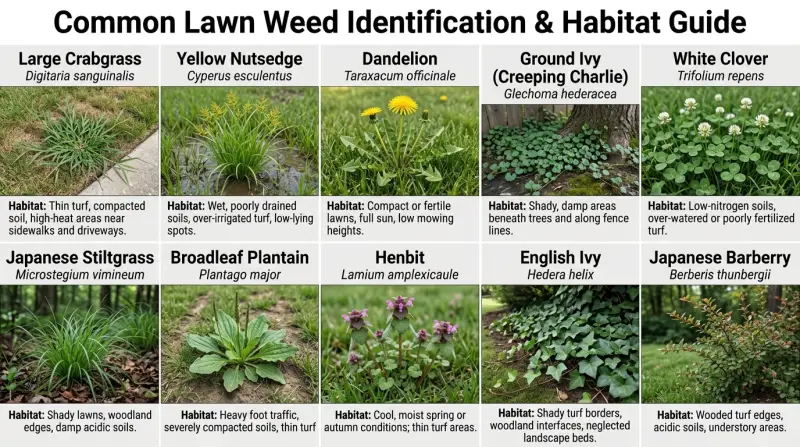
Lawn Weed Identification Chart
- Weeds are categorized into three primary functional groups: grassy weeds, grass-like weeds, and broadleaf weeds.
- Life cycles dictate control timing; summer annuals germinate in spring, whereas winter annuals germinate in late summer or fall.
- Stem cross-sections are vital diagnostics: sedges possess triangular stems, whereas grasses feature round or flattened hollow stems with visible nodes.
- Broadleaf weeds are generally easier to control selectively in turf than grassy weeds because their vascular bundles and leaf structures respond predictably to selective synthetic or natural herbicides.
- Cultural practices—such as maintaining proper mowing heights, ensuring adequate soil drainage, and overseeding thin patches—provide the most effective long-term defense against weed invasion.
To use an identification chart effectively, you must understand how turf professionals systematically break down plant morphology. When you encounter an unwanted plant in your yard, do not look merely at the color of the foliage. Instead, examine its stems, root systems, leaf veins, and reproductive structures. The following comprehensive reference details the most common lawn weeds encountered across North American home landscapes.
| Weed Common Name | Botanical Classification | Life Cycle | Key Identifying Features | Primary Habitat / Indicator |
|---|---|---|---|---|
| Large Crabgrass Digitaria sanguinalis | Grassy | Summer Annual | Coarse, hairy leaves; branching, sprawling stems that root at nodes; finger-like seedheads. | Thin turf, compacted soil, high-heat areas near sidewalks and driveways. |
| Yellow Nutsedge Cyperus esculentus | Grass-like (Sedge) | Perennial | V-shaped, shiny, yellowish-green leaves; solid, triangular stems; produces underground tubers (nutlets). | Wet, poorly drained soils, over-irrigated turf, low-lying spots. |
| Dandelion Taraxacum officinale | Broadleaf | Simple Perennial | Deeply notched basal rosette; bright yellow composite flower; thick, fleshy taproot; wind-borne seeds. | Compact or fertile lawns, full sun, low mowing heights. |
| Ground Ivy (Creeping Charlie) Glechoma hederacea | Broadleaf | Creeping Perennial | Square stems; scalloped, rounded leaves; funnel-shaped bluish-purple flowers; strong minty odor when crushed. | Shady, damp areas beneath trees and along fence lines. |
| White Clover Trifolium repens | Broadleaf | Perennial | Compound leaves with three leaflets often marked with a faint white chevron; white or pinkish pom-pom flower heads. | Low-nitrogen soils, over-watered or poorly fertilized turf. |
| Japanese Stiltgrass Microstegium vimineum | Grassy | Summer Annual | Pale green, flat, lance-shaped leaves with an off-center silvery midrib; weak-rooted and easily pulls up in clumps. | Shady lawns, woodland edges, damp acidic soils. |
| Broadleaf Plantain Plantago major | Broadleaf | Perennial | Oval, ribbed leaves in a low-growing rosette; long, rat-tail seed spikes; tough, fibrous root system. | Heavy foot traffic, severely compacted soils, thin turf. |
| Henbit Lamium amplexicaule | Broadleaf | Winter Annual | Square stems; opposite, rounded, scalloped leaves; upper leaves clasp the stem; small purple-pink tubular flowers. | Cool, moist spring or autumn conditions; thin turf areas. |
| English Ivy Hedera helix | Broadleaf | Woody Perennial | Dark green, leathery, lobed leaves on juvenile vines; aerial rootlets; greenish flowers followed by dark berries. | Shady turf borders, woodland interfaces, neglected landscape beds. |
| Japanese Barberry Berberis thunbergii | Woody Shrub Weed | Perennial Woody | Spiny stems, small spoon-shaped green or purple leaves, yellow flowers, and oblong red berries. | Wooded turf edges, acidic soils, understory areas. |
Reading this table requires looking beyond surface similarities. For instance, both crabgrass and Japanese stiltgrass are annual grasses that thrive in disturbed turf, yet crabgrass demands blazing sunlight and heat, whereas Japanese stiltgrass aggressively colonizes deep shade. Identifying these micro-environmental preferences transforms weed management from a guessing game into a targeted science.
Taxonomic Categories: Grassy vs. Grass-like vs. Broadleaf Weeds
All turf weeds fall into distinct botanical divisions. Knowing these divisions is mandatory because chemical selectivity—how a weed killer targets unwanted plants without harming Kentucky bluegrass, fescue, or bermudagrass—depends entirely on these groupings.
Grassy Weeds (Graminoids)
Grassy weeds belong to the Poaceae family. Structurally, they look very much like your lawn’s turfgrass, making them the most difficult to identify and control selectively in an established lawn. They possess:
- Hollow or pithy stems divided by distinct, swollen joints called nodes.
- Parallel leaf veins running lengthwise up the blade.
- Ligules and collars where the leaf blade meets the stem sheath (critical diagnostic features under magnification).
Common examples include crabgrass, goosegrass, foxtail, and annual bluegrass (Poa annua).
Grass-like Weeds (Sedges and Rushes)
Though they resemble grasses at a casual glance, grass-like weeds belong to entirely different plant families (Cyperaceae for sedges, Juncaceae for rushes). The easiest rule of thumb for field identification is remembering an old botanist’s rhyme: “Sedges have edges, rushes are round, and grasses have holes right up to the ground.”
- Sedges: Feature solid stems with a distinct three-sided (triangular) cross-section. If you roll the stem between your fingers, you will clearly feel three flat sides. Yellow nutsedge is the primary turf offender.
- Rushes: Possess round, unjointed stems filled with spongy pith rather than hollow chambers. They typically indicate persistent soil saturation.
Broadleaf Weeds (Dicotyledons)
Broadleaf weeds are the easiest to spot and manage in turf. They belong to the dicot class of flowering plants, meaning their seeds emerge with two seed leaves (cotyledons). Key characteristics include:
- Net-like or branching leaf veins that spread outward from a central midrib.
- Showy, distinct flowers with petals in multiples of four or five.
- Taproots or sprawling root networks that often spread via stolons (above-ground runners) or rhizomes (underground runners).
Because their vascular system and leaf surface area differ fundamentally from monocot turfgrasses, selective synthetic herbicides (such as 2,4-D, dicamba, and MCPP) can translocate through broadleaf foliage and kill them without harming grass blades.
Life Cycles: Timing Your Identification and Control
A weed’s life cycle dictates precisely when it germinates, grows, sets seed, and dies. Attempting to eradicate a winter annual in mid-summer or a perennial with a pre-emergent herbicide in autumn results in wasted effort and money.
| Life Cycle Type | Germination Window | Peak Growth Phase | Reproduction Method | Optimal Control Timing |
|---|---|---|---|---|
| Summer Annuals (e.g., Crabgrass, Spurge) | Early spring (soil temp 50°F–55°F) | Late spring & summer heat | Exclusively by seed | Early spring pre-emergent; early summer post-emergent when small. |
| Winter Annuals (e.g., Henbit, Chickweed) | Late summer / early autumn | Fall through winter / early spring bloom | Exclusively by seed | Late summer or mid-autumn post-emergent before flowering. |
| Biennials (e.g., Bull Thistle, Wild Carrot) | Spring or summer | Year 1: Rosette / Year 2: Flower & seed | Exclusively by seed | Rosette stage during Year 1 or early spring of Year 2. |
| Simple Perennials (e.g., Dandelion, Plantain) | Anytime from seed | Spring through autumn | Seed and crown regeneration | Fall (most effective) or spring during active translocation. |
| Creeping Perennials (e.g., Ground Ivy, Clover) | Spring or vegetative spread | Spring and autumn moisture peaks | Seed, stolons, rhizomes, or tubers | Mid-to-late autumn when plants pull nutrients down to roots. |
Annual Weeds
Annuals complete their entire life cycle from seed to flower, seed set, and death within a single 12-month period. They are split into summer and winter groups. Because they rely entirely on seed production for survival, stopping seed set or blocking germination with a pre-emergent herbicide is the most effective management strategy.
Biennial Weeds
Biennials take two years to complete their lifecycle. In the first year, they germinate and form a low-lying cluster of leaves called a basal rosette. In the second year, they bolt (send up a tall flowering stalk), produce seeds, and die. Control is easiest during the first-year rosette phase.
Perennial Weeds
Perennials live for more than two years, returning season after season from surviving crown tissue, taproots, rhizomes, or tubers. Simply chopping off the top growth of a dandelion or yellow nutsedge will not kill it; the remaining underground storage organ will quickly push up new shoots. Systemic herbicides or thorough manual excavation of the entire root structure are mandatory.
Detailed Diagnostic Profiles of Common Turf Invaders
To move beyond basic charts, examine the specific physical signatures and ecological behaviors of the most prevalent lawn weeds found across residential properties.
Crabgrass (Digitaria spp.)
Crabgrass is the quintessential summer annual grassy weed. Seed germination begins when soil temperatures reach 50°F to 55°F for several consecutive days—often coinciding with the blooming period of eastern redbud trees or forsythia. The leaves are light green, wide compared to typical turfgrass, and feature rough hairs on both surfaces. Growth starts upright, but as mowing and foot traffic occur, the stems sprawl outward along the ground, rooting at the nodes to form a dense, crab-like mat that smothers surrounding turf.
Yellow Nutsedge (Cyperus esculentus)
Often misidentified as “nutgrass,” yellow nutsedge is actually a perennial sedge. It thrives in soils that remain damp, compacted, or poorly drained. Its leaves are noticeably yellowish-green, stiffer than turfgrass, and feature a shiny, waxy texture with a prominent midrib folded into a V-shape. If you roll the stem between your thumb and forefinger, you will feel distinct sharp edges. Nutsedge grows much faster than surrounding grass during hot mid-summer weather, giving lawns an uneven, jagged appearance. Pulling it out manually often snaps the stem while leaving underground tubers (nutlets) attached to the root system, which instantly sprout new plants.
Ground Ivy / Creeping Charlie (Glechoma hederacea)
A member of the mint family, creeping Charlie is a low-growing perennial that forms dense, creeping carpets in shady, moist turf areas. It is easily identified by its square stems, opposite rounded leaves with scalloped or crenate edges, and funnel-shaped, purplish-blue flowers that bloom in spring. When crushed, the foliage releases a strong, pungent, mint-like aroma. It spreads aggressively via above-ground stolons that root at every leaf node, making manual hand-pulling tedious and prone to leaving fragments that regenerate.
White Clover (Trifolium repens)
White clover is a cool-season perennial legume easily recognized by its trifoliate leaves—each leaf composed of three rounded leaflets, frequently marked with a faint whitish watermark chevron. It produces globular, white or pinkish flower heads that attract honeybees. Clover is a nitrogen-fixing plant; it captures atmospheric nitrogen and converts it into usable soil nutrients. Consequently, clover infestations are classic indicators of low soil nitrogen levels or under-fertilized turf. Correcting soil fertility often causes desirable turfgrasses to outcompete clover naturally.
Emerging Invasive and Woodland Weeds (English Ivy, Japanese Barberry, and Callery Pear)
Modern turf management increasingly encounters aggressive invasive species spreading from woodland borders into home landscapes. English Ivy (Hedera helix) creeps along turf edges, blanketing the soil with leathery leaves and climbing trees via rootlets. Japanese Barberry (Berberis thunbergii) invades turf borders with thorny stems and dense thickets, thriving in acidic soils. Additionally, invasive ornamental escapes like Callery Pear (Pyrus calleryana) seedlings frequently sprout in unmanaged fence rows and lawn perimeters. Early identification and targeted mechanical or herbicidal removal prevent these woody invaders from displacing turfgrass entirely.
Environmental and Soil Indicators: What Weeds Tell You About Your Lawn
Weeds are not random nuisances; they are botanical indicator species. Every weed species has specific ecological tolerances and preferences. By reading the weed population in your yard, you can diagnose underlying soil and environmental disorders without expensive laboratory testing.
| If Your Lawn Features Abundant… | The Underlying Soil / Turf Condition Is Likely… | Corrective Cultural Action |
|---|---|---|
| Crabgrass & Goosegrass | Compacted soil, thin turfgrass canopy, mowing too short. | Core aerate compacted areas, raise mowing height to 3–3.5 inches, overseed thin patches. |
| Yellow Nutsedge & Moss | Poor drainage, excessive irrigation, chronic soil saturation, shade. | Improve subsurface drainage, reduce irrigation frequency, prune tree branches to increase sunlight. |
| White Clover & Black Medic | Low soil fertility (specifically nitrogen deficiency), low pH. | Apply a balanced turf fertilizer, test soil pH and apply agricultural lime if acidic. |
| Broadleaf Plantain & Knotweed | Severe soil compaction from heavy foot traffic or vehicle parking. | Relieve compaction with mechanical core aeration; redirect foot traffic paths. |
| Moss & Creeping Charlie | Excessive shade, acidic soil, chronically damp surface conditions. | Thin tree canopy for sun exposure, correct soil pH, improve surface airflow and drainage. |
Treating the weed without fixing the underlying soil condition is a temporary fix. For example, if you spray moss or knotweed with a post-emergent herbicide but fail to core-aerate the severely compacted soil beneath it, the weeds will inevitably return within a single growing season.
Step-by-Step Weed Identification Workflow
When you spot an unfamiliar weed in your lawn, follow this systematic diagnostic workflow to identify it accurately before selecting a control product.
- Examine the Leaf Structure: Look closely at the veins. Are they parallel (grassy or grass-like) or net-like (broadleaf)? If it has parallel veins, check whether the stem is round/hollow (grassy weed) or triangular (sedge).
- Check the Stem Shape: Run your fingers along the stem. Is it completely round? Does it have flat sides forming a triangle? Is it square (common in the mint family, such as henbit and creeping Charlie)?
- Inspect Growth Habit and Roots: Is the plant growing as a single upright shoot, forming a flat basal rosette against the soil, or creeping horizontally via runners (stolons) and rooting at the nodes? Dig up a small sample to check for taproots, bulbs, or tubers.
- Note Reproductive Structures: Look for flowers, seedheads, or burrs. Note the color, petal count, and arrangement of the flowers. Seedhead morphology (such as the finger-like branches of crabgrass or the rat-tail spikes of plantain) provides definitive confirmation.
- Cross-Reference with Seasonal Timing: Ask yourself when the weed appeared and grew most vigorously. A weed that blankets the lawn in March and dies by June is a winter annual; one that emerges in June and thrives in August heat is a summer annual.
Common Mistakes in Lawn Weed Identification and Control
Homeowners often struggle with weed control not because products lack efficacy, but because of foundational diagnostic and operational errors. Avoiding these common pitfalls saves time, money, and turf health.
- Confusing Grassy Weeds with Broadleaf Weeds: Applying a selective broadleaf herbicide (like 2,4-D) to a grassy weed like crabgrass or nimblewill will have zero effect on the weed while potentially stressing the lawn. Always verify weed class before mixing chemicals.
- Ignoring Soil Conditions: Treating symptoms rather than root causes ensures re-infestation. If compacted soil or low nitrogen caused the weed breakthrough, chemical applications alone provide only temporary relief.
- Incorrect Pre-Emergent Timing: Applying a pre-emergent herbicide for summer annuals in late spring is useless; the seeds have already germinated weeks prior. Timing must align with soil temperature benchmarks (e.g., 50°F–55°F) rather than calendar dates.
- Misidentifying Sedges as Grasses: Attempting to kill yellow nutsedge with standard grass killers or broadleaf herbicides fails because sedges require specialized active ingredients (such as halosulfuron or imazaquin) designed for sedge metabolism.
- Mowing Too Short: Scalping turfgrass weakens its root system and exposes the soil surface to sunlight, triggering dormant weed seeds to germinate. Maintain a mowing height of 3 to 4 inches for cool-season turfgrasses to shade out weed seedlings.
Frequently Asked Questions
The easiest way to determine a weed’s life cycle is to check its root system and persistence. Annual weeds possess relatively shallow, weak root systems and die completely at the end of their growing season, leaving dead debris behind. Perennials survive the winter underground via deep taproots, tubers, or creeping rhizomes, returning reliably from the same root crown every spring.
Not necessarily. Many weed-and-feed products contain synthetic broadleaf herbicides (like 2,4-D or dicamba) combined with nitrogen fertilizer. Applying these to sensitive turfgrass species—such as St. Augustinegrass, centipedegrass, or newly seeded lawns—can cause severe turf injury or chemical burn. Always read the product label to verify compatibility with your specific grass species.
If weeds return annually in the same location, it indicates a localized environmental stress factor. This is often caused by chronic soil compaction, poor drainage, excessive shade, low soil pH, or underground debris (like buried construction rubble). Correcting the underlying soil profile or reseeding with a more resilient turf variety resolves the chronic recurrence.
Pre-emergent herbicides create a chemical barrier in the top layer of soil that prevents germinating weed seeds from establishing roots and shoots; they must be applied before weed seeds sprout. Post-emergent herbicides are sprayed directly onto the foliage of actively growing, visible weeds, where the plant absorbs the chemical to disrupt its internal metabolic processes.
Natural and organic weed suppression relies heavily on dense turf canopy management. Maintain proper soil fertility, core-aerate compacted soils annually, irrigate deeply and infrequently to encourage deep turf roots, and mow at a high setting (3+ inches) to shade the soil surface. For existing weeds, hand-pulling when the soil is damp after a rain ensures you extract the entire root system.
Conclusion
Mastering lawn weed identification transforms weed management from an endless, frustrating chore into a systematic science. By looking beyond the surface foliage to examine leaf veins, stem cross-sections, root systems, and life cycles, you can accurately diagnose which invaders threaten your yard. Pairing this botanical knowledge with an understanding of what weeds reveal about soil compaction, moisture, and fertility empowers you to fix root causes rather than just treating symptoms. Implement proper cultural practices—such as proper mowing heights, strategic fertilization, and aeration—alongside targeted control windows, and you will build a thick, dense turfgrass canopy capable of naturally resisting future weed invasions.