
To the untrained observer, finding tiny specks, spheres, or globules on foliage, bark, soil, or indoor surfaces can provoke immediate concern or curiosity. Are they beneficial predator eggs, harmless plant-eaters, or destructive agricultural pests? Decoding these microscopic marvels requires moving beyond simple guesswork. Insect egg identification is an exercise in biological detective work, requiring careful observation of geometry, chorion sculpturing, spatial arrangement, and environmental placement.
Every insect species packages its developing progeny with specific protective adaptations. Some encase their eggs in frothy protective matrices like oothecae, while others sculpt microscopic ribs, geometric nets, or metallic sheens directly onto the outer shell membrane. Understanding these diagnostic variations allows researchers, gardeners, agriculturalists, and naturalists to anticipate hatching cycles, implement targeted management strategies, and appreciate the astonishing biodiversity hidden in plain sight. This guide explores the morphology, classification, diagnostic methodologies, and ecological significance of insect ova.
Explore our detailed breakdown on Rabbit Breed Identification Chart [Full Reference Chart].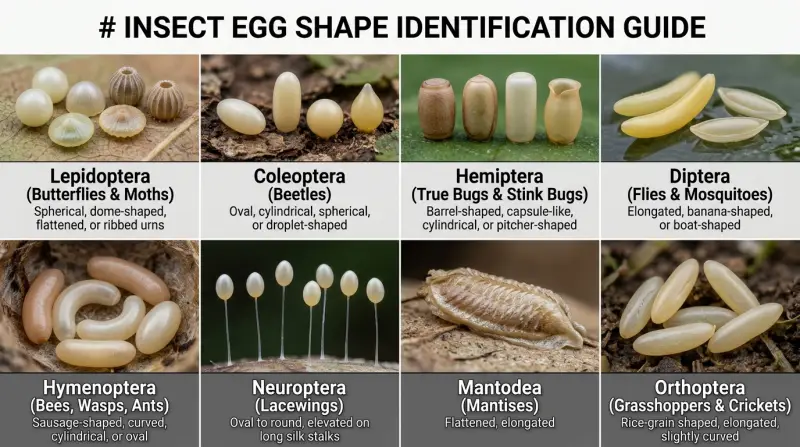
Insect Egg Identification Chart
- Insect egg morphology is highly specialized, varying by order, family, and species across geometric, textural, and depositional dimensions.
- Optical magnification (hand lenses or stereo microscopes) is essential for observing surface chorion details like ribs, reticulations, and micropyles.
- Deposition sites—such as underside leaves, vertical stems, standing water, or soil substrate—provide primary clues for taxonomic classification.
- Beneficial insect eggs, such as those of lady beetles and lacewings, exhibit distinct physical markers that separate them from agricultural pests.
- Environmental conditions, parasitism, and hatching status can alter egg appearance, requiring field observers to cross-reference multiple diagnostic variables.
To accurately classify an unknown insect ovum, observers must evaluate multiple physical traits simultaneously. The following comprehensive classification chart outlines the primary morphological markers, typical deposition habits, and representative families associated with major insect groups.
| Insect Group | Primary Shape & Geometry | Typical Color Palette | Surface Texture / Chorion | Deposition Site & Arrangement |
|---|---|---|---|---|
| Lepidoptera (Butterflies & Moths) | Spherical, dome-shaped, flattened, or ribbed urns | White, pale yellow, green, pink, brown | Ribbed, reticulated, pitted, or smooth | Single or clustered on leaf undersides, stems, or host vegetation |
| Coleoptera (Beetles) | Oval, cylindrical, spherical, or droplet-shaped | Pearlescent white, yellow, brownish, translucent | Smooth, slightly textured, or covered in fecal/soil secretions | Soil, crevices in bark, beneath leaves, or embedded in plant tissue |
| Hemiptera (True Bugs & Stink Bugs) | Barrel-shaped, capsule-like, cylindrical, or pitcher-shaped | Green, bronze, white, translucent with dark rings | Smooth, metallic sheen, or topped with a distinct hatch lid (operculum) | Upright clusters (rosettes) on leaf undersides |
| Diptera (Flies & Mosquitoes) | Elongated, banana-shaped, or boat-shaped | White, pale cream, dark brown/black (mosquito rafts) | Grooved, striated, or membranous | Floating rafts on standing water, decaying organic matter, or soil |
| Hymenoptera (Bees, Wasps, Ants) | Sausage-shaped, curved, cylindrical, or oval | Pearlescent white, translucent cream | Smooth, glossy, delicate chorion | Inside cells (hives/nests), plant galls, parasitized host bodies, or subterranean chambers |
| Neuroptera (Lacewings) | Oval to round, elevated on long silk stalks | Green, white, greyish | Smooth | Suspended singly or in groups on slender filaments attached to leaves |
| Mantodea (Mantises) | Flattened, elongated | Tan, brown, creamy white | Encased within a hardened foam ootheca | Glued to twigs, bark, stones, or man-made structures |
| Orthoptera (Grasshoppers & Crickets) | Rice-grain shaped, elongated, slightly curved | Yellowish, brown, grey | Leathery, tough chorion | Deposited underground in pods (pod clutches) or inserted into plant stems |
Reading this chart requires examining the specimen under appropriate lighting and magnification. While general shape separates broad taxonomic orders (such as distinguishing a beetle’s oval egg from a stink bug’s barrel-shaped capsule), surface ornamentation and deposition behavior provide the exact keys needed for refined identification.
Anatomy and Morphology of Insect Ova
An insect egg is a complex biological capsule designed to protect the developing embryo from desiccation, mechanical damage, and predators while permitting essential gas exchange. Understanding the internal structures and outer shell components explains why these micro-structures look and behave the way they do.
The Chorion and Its Sculpting
The outer shell of an insect egg, known as the chorion, is a hardened proteinaceous layer secreted by the follicular cells of the female’s ovaries during oogenesis. The chorion often features surface patterns—such as raised ridges (costae), mesh-like networks (reticulations), pits, or spines. These structures are not merely decorative; they serve structural functions by reinforcing the shell against external pressure and creating microscopic channels that facilitate respiration in humid or water-logged environments.
Micropyles and Respiration
Because insect embryos require oxygen, the chorion must remain permeable to gases without allowing the internal fluids to evaporate. Specialized structures called micropyles—tiny microscopic channels located at the apex or anterior pole of the egg—allow sperm to enter during fertilization and subsequently facilitate gas exchange. In many species, spongy respiratory structures known as the aeropyle system project above the surface of the chorion, functioning like biological snorkels when eggs are submerged in dew or rain.
Detailed Identification by Insect Order
Different taxonomic groups exhibit distinct reproductive strategies and egg architectures. Recognizing these patterns allows field naturalists to trace the identity of unseen parents.
Lepidoptera: Butterflies and Moths
Lepidopteran eggs display extraordinary diversity across families. Butterfly eggs are frequently laid singly and exhibit striking geometric perfection—some resembling miniature ribbed pumpkins, others carved urns or smooth spheres. Moth eggs are more commonly deposited in overlapping shingles, flat masses, or spherical clusters, often covered in protective scales brushed from the female’s abdomen during oviposition. Colors shift dynamically as the embryo develops; dark head capsules often become visible through the translucent chorion shortly before hatching.
Coleoptera: Beetles
Beetle eggs are generally less ornamented than those of butterflies, prioritizing functional efficiency. Ladybug (Coccinellidae) eggs are bright yellow-orange, football-shaped, and stood upright in tight clusters of ten to thirty on leaf surfaces. Leaf beetle eggs are often elongated and cemented to foliage or dropped into soil crevices. Because beetle larvae often face intense subterranean or exposed competition upon hatching, their chorions are frequently tough and resistant to microbial decay.
Hemiptera: True Bugs and Aphids
Hemipterans, particularly Pentatomidae (stink bugs), produce some of the most geometrically precise eggs in the insect world. Stink bug eggs are barrel-shaped or cylindrical, arranged in symmetrical hexagonal clusters resembling tiny military drums. Each egg features an upper cap called an operculum, which the emerging nymph pushes open like a trapdoor. Aphid eggs, by contrast, are tiny, oval, and shiny black, deposited on woody perennial stems in autumn to overwinter before hatching into asexual female fundatrices in spring.
Diptera: Flies and Mosquitoes
Dipteran reproductive strategies vary based on aquatic and terrestrial larval requirements. Mosquitoes lay elongated, bullet-shaped eggs either individually on damp mud or joined together side-by-side into floating rafts containing up to three hundred eggs that bob on the surface of stagnant water. House flies and blow flies deposit creamy-white, grain-like clusters in decaying organic matter, manure, or carrion, where high moisture levels prevent the soft chorion from drying out.
Hymenoptera: Wasps, Ants, and Sawflies
Hymenopteran eggs are rarely seen by casual observers because they are typically hidden inside secure micro-habitats. Parasitic wasps inject microscopic, translucent, sausage-shaped eggs directly into the bodies of host insects or plant galls. Social wasps and bees deposit smooth, pearlescent white eggs securely at the base of wax or paper brood cells. Sawfly eggs are inserted into living plant tissues using a saw-like ovipositor, causing the leaf tissue to swell into characteristic pocket galls.
Comparative Diagnostic Matrix: Beneficial vs. Pest Eggs
To help gardeners and agricultural managers quickly evaluate risks in the field, the following comparative matrix contrasts common beneficial predator eggs with destructive herbivorous pest eggs based on visual presentation and host context.
| Functional Category | Common Species / Group | Distinctive Visual Traits | Typical Placement Context |
|---|---|---|---|
| Beneficial | Green Lacewing (Chrysopidae) | Oval, pale green or white, elevated individually on 1cm silken stalks | Leaf blades and stems near aphid colonies |
| Beneficial | Lady Beetle (Coccinellidae) | Football-shaped, bright yellow-orange, standing vertically in tight groups | Leaf undersides in areas with heavy pest activity |
| Beneficial | Syrphid Fly (Hoverfly) | Elongated, torpedo-shaped, white with minute pebbled sculpturing | Exposed foliage directly among aphid or scale infestations |
| Pest | Brown Marmorated Stink Bug | Barrel-shaped, pale green/bronze, arranged in neat geometric hexagonal arrays | Undersides of primary crop leaves (tomatoes, peppers, beans) |
| Pest | Tomato Hornworm / Sphinx Moth | Spherical, smooth, pale translucent green or yellowish | Single deposits on lower or upper leaf surfaces of Solanaceae crops |
| Pest | Squash Bug (Anasa tristis) | Oval, bronze to reddish-brown, laid in angular V-shaped leaf vein angles | Ventral leaf surfaces of cucurbits (squash, pumpkins, melons) |
Environmental and Ecological Factors Influencing Appearance
An insect egg does not remain static from the moment it is laid to the moment it hatches. Natural environmental pressures and biological processes alter physical appearances, introducing variables that observers must account for.
As embryonic development progresses, consumption of yolk and formation of internal organs alter internal translucency. Many pale green or yellow eggs darken significantly hours before hatching as the sclerotized mouthparts and pigmented head capsules of the developing larva press against the inner membrane. , parasitoid wasps frequently target insect eggs, drilling through the chorion to deposit their own larvae. Parasitized eggs often turn jet black, metallic grey, or develop irregular circular exit holes when the adult parasitoid emerges instead of the host insect.
Weather conditions also leave physical marks. Heavy rainfall can batter unprotected egg masses, flattening delicate hairs or washing away protective frothy coatings. Extreme heat and UV exposure can bleach pigmentation, while fungal pathogens can encase neglected egg clutches in white, grey, or greenish mold filaments.
Step-by-Step Identification Field Methodology
When encountering unidentified insect eggs in a garden, forest, or indoor space, follow a systematic diagnostic protocol to narrow down possibilities without damaging the specimen.
- Secure Contextual Data: Note the exact substrate. Is the egg on the underside of a specific host plant leaf, embedded in bark crevices, floating on water, or resting on an indoor wooden baseboard? Plant host specificity often eliminates ninety percent of potential insect candidates.
- Analyze Spatial Arrangement: Observe whether the eggs are solitary, laid in linear rows, clustered in overlapping shingles, assembled in geometric rosettes, or encased in a foamy ootheca.
- Evaluate Geometry and Color: Use a 10x to 20x hand lens or pocket loupe to inspect shape (spherical, oval, barrel-shaped, cylindrical) and baseline coloration. Avoid touching the eggs directly with bare skin to prevent crushing fragile structures or exposing skin to potential irritants.
- Inspect Surface Texture: Look for chorionic ornamentation. Are there vertical ribs, microscopic netting, surface hairs, a distinct opercular cap, or a protective covering of scales or frass?
- Cross-Reference with Regional Guides: Match observed traits against agricultural extension databases, local entomological keys, or host-plant pest identification charts.
Common Mistakes and Identification Pitfalls
Even experienced naturalists occasionally misidentify biological materials found on vegetation or indoor surfaces. Avoiding common diagnostic errors ensures accurate classification.
- Confusing Insect Eggs with Fungal Structures: Slime molds (such as Fuligo septica), bird’s nest fungi, and plant rust pustules are frequently mistaken for insect egg masses. Fungal structures generally lack distinct individual cellular boundaries and uniform geometric spacing.
- Ignoring Plant Galls and Scales: Plant galls caused by mites or midges, as well as armored scale insects (which look like tiny waxy shells attached to twigs), are sometimes misidentified as clusters of insect eggs. Inspecting beneath the structure with magnification reveals whether it is a living insect body, a plant tissue growth, or a true ovum.
- Overlooking Spider Egg Sacs: Spiders are arachnids, not insects. Their egg sacs are typically enclosed in papery, silk-spun cocoons rather than being laid as individual naked ova or structured chorionic clusters. Finding a silk matrix usually points toward arachnids rather than insects.
Frequently Asked Questions
Beneficial insect eggs—such as those of lady beetles, syrphid flies, and lacewings—are often deposited in exposed, strategic locations near aphid colonies, and lacewing eggs are uniquely elevated on slender silk stalks. Pest eggs, such as those of stink bugs and moths, are frequently arranged in dense, uniform geometric clusters directly on primary crop foliage where emerging larvae can immediately begin feeding.
Color shifts occur as the embryonic insect develops inside the chorion. As internal organs form, yolk is consumed, and mouthparts or head capsules darken (sclerotize), the internal structures become visible through the translucent outer shell. A sudden shift to dark grey, black, or mottled patterns typically indicates that hatching is imminent.
Yes, but it requires care. If you must prune a leaf bearing beneficial or desirable insect eggs, cut around the egg mass leaving a buffer of leaf tissue, and place it gently on the underside of a healthy leaf on a nearby plant. Avoid touching or scraping the eggs directly off the surface, as this ruptures the delicate chorion and destroys the embryo.
Eggs that turn jet black or develop neat, circular exit holes have typically been parasitized by microscopic beneficial wasps (such as Trichogramma species). Instead of a pest larva hatching, a tiny parasitic wasp emerges from the egg, making it a natural biological control agent in the garden.
Many insect species—including numerous aphids, grasshoppers, and certain moths—overwinter in the egg stage through a process called diapause. Their bodies produce natural cryoprotectants (such as glycerol) that lower the freezing point of internal fluids, and the tough, impermeable chorion protects the embryo from ice crystal penetration and severe desiccation until spring warming triggers hatching.
Conclusion
Mastering insect egg identification transforms a mundane outdoor observation into an engaging exercise in ecological literacy. By analyzing the subtle architecture of the chorion, the geometry of deposition clusters, and the choice of host substrate, observers gain direct insight into the complex reproductive strategies of the insect world. Whether managing garden ecosystems, conducting field research, or simply exploring backyard biodiversity, a careful eye for microscopic detail reveals a fascinating hidden dimension of nature.