
The insect world is typically characterized by rapid development, fleeting adult stages, and high reproductive turnover. For the average housefly, mayfly, or worker bee, life is measured in days or weeks. However, a select group of insects has evolved extraordinary evolutionary strategies that allow them to defy these biological norms. Studying insects with the longest lifespan reveals fascinating survival adaptations, ranging from eusocial caste systems and underground dormancy to extreme metabolic regulation.
Understanding these long-lived species requires looking past the brief adult phase that most humans observe. In many cases, the secret to longevity lies in the juvenile nymph stage, a well-protected subterranean nest, or the royal responsibilities of a colony matriarch. This article explores the biological mechanisms, environmental factors, comparative metrics, and species-specific traits that enable certain insects to survive for decades while their relatives perish in a single season.
Explore our detailed breakdown on Quokka Lifespan Chart.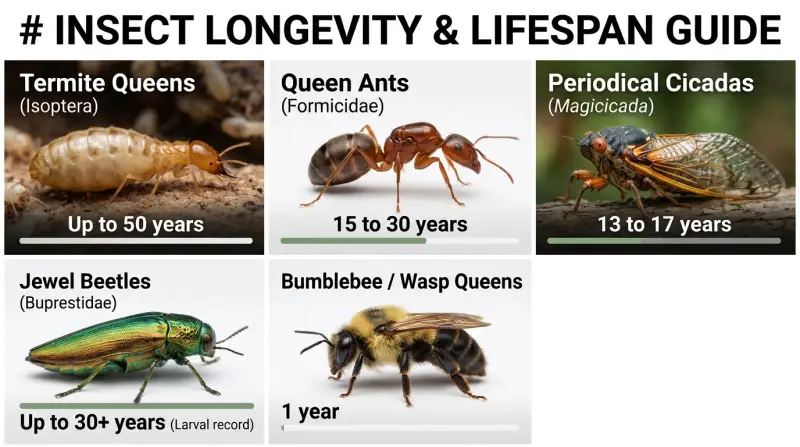
Insects With The Longest Lifespan
- Termite Queens Lead: Termite queens are the longest-living insects on Earth, with verified lifespans stretching up to 50 years inside protected royal chambers.
- Subterranean Nymphs: Periodical cicadas spend up to 17 years underground as nymphs, making their total developmental cycle one of the longest among insects.
- Ant Colony Longevity: Queen ants, such as the black garden ant (Lasius niger), can live up to 28 to 30 years by utilizing eusocial protection and high antioxidant levels.
- Metabolic Suppression: Long-lived insects often suppress metabolic rates, reduce oxidative stress, and rely on communal thermoregulation to extend survival.
- Distinction from Arachnids: While often grouped with insects in popular culture, long-lived arachnids like tarantulas (up to 30–36 years) are not insects, though their longevity strategies offer interesting biological parallels.
To fully grasp how certain insects achieve multi-decade lifespans, we must evaluate the specific orders, developmental strategies, and social structures that support extended survival. The following sections break down the primary contenders for the longest-living insects and examine the physiological trade-offs that make such longevity possible.
| Species / Group | Maximum Lifespan | Primary Lifespan Phase | Longevity Mechanism |
|---|---|---|---|
| Termite Queens (Isoptera) | Up to 50 years | Adult (Queen) | Protected royal chamber, eusocial care, low oxidative stress. |
| Queen Ants (Formicidae) | 15 to 30 years | Adult (Queen) | Colony defense, specialized diet, high telomerase activity. |
| Periodical Cicadas (Magicicada) | 13 to 17 years | Juvenile (Nymph) | Subterranean xylem feeding, predator satiation through synchronized emergence. |
| Jewel Beetles (Buprestidae) | Up to 30+ years (Larval record) | Juvenile (Larva / Wood-boring) | Dormancy inside dry timber, slow metabolic rate in nutrient-poor wood. |
| Bumblebee / Wasp Queens | 1 year | Adult (Overwintering Queen) | Diapause / hibernation during cold months. |
Note: The table above outlines maximum recorded lifespans across key insect groups. While wood-boring beetle larvae and cicada nymphs spend the vast majority of their lives hidden underground or inside timber, eusocial queens (termites and ants) maintain long adult lives as reproductive focal points of their colonies.
Termites: The Undisputed Monarchs of Longevity
When discussing insects with the longest lifespan, termites command the top position without question. While worker and soldier termites live for only a few months to a couple of years, the termite queen is a biological marvel. Macrotermes and other mound-building termite species produce queens that can live for 30 to 50 years.
The secret to a termite queen’s longevity lies in her environment and social structure. Protected deep within the core of a subterranean or mound nest, the queen is insulated from temperature fluctuations, UV radiation, and external predators. She is constantly tended, fed, and groomed by thousands of worker termites. , her body undergoes physogastry—an extreme abdominal distension dedicated entirely to egg production—yet her cellular repair mechanisms manage to outpace the cellular damage typically associated with high metabolic output.
Ant Queens: Decades at the Heart of the Colony
Ants provide another prime example of extreme insect longevity, though the lifespan disparity between castes is massive. While worker ants typically survive for 1 to 3 years depending on the species, ant queens can live for decades.
- Black Garden Ant (Lasius niger): Documented laboratory and field colonies have shown queens surviving for up to 28 or even 30 years.
- Leafcutter Ants (Atta spp.): Queens routinely live between 15 and 20 years, managing massive agricultural fungal gardens.
- Carpenter Ants (Camponotus spp.): Queens frequently exceed 10 to 15 years of age while establishing extensive wood-nesting networks.
Recent entomological research indicates that ant queens utilize specialized antioxidant pathways and high levels of DNA repair enzymes. Unlike solitary insects, a queen ant’s survival is heavily subsidized by the worker caste, which absorbs the external risks of foraging and defense.
Cicadas: The Long Game of Subterranean Nymphs
While adult periodical cicadas live for only 4 to 6 weeks above ground, their total life cycle is among the longest in the insect world. North American periodical cicadas of the genus Magicicada spend either 13 or 17 years entirely underground as developing nymphs.
During this subterranean phase, cicada nymphs feed slowly on xylem fluid drawn from plant roots. The evolutionary strategy here is not individual adult longevity, but rather developmental patience paired with predator satiation. By emerging all at once in numbers numbering in the trillions, they overwhelm local predators, ensuring that enough adults survive to reproduce before their brief aerial life concludes.
Wood-Boring Beetles: The Accidental Decades-Long Larvae
Some of the most astonishing records of insect longevity involve wood-boring beetle larvae (such as certain Buprestidae and Cerambycidae species). While their adult forms are relatively short-lived, larvae trapped inside dry, structural lumber or furniture have been documented emerging as fully formed beetles 10, 20, or even over 30 years after the wood was initially milled.
This prolonged lifespan is a result of environmental arrest. Larvae feeding on dry heartwood experience extreme nutritional scarcity, forcing them to enter a state of metabolic torpor. They grow at an imperceptible rate, stretching a normal 2-year developmental cycle across decades until moisture or structural changes trigger their final pupation.
Comparative Analysis of Insect Lifespans vs. Other Arthropods
To fully contextualize insect longevity, it is instructive to compare maximum lifespans across different arthropod classes. While insects dominate social structures and subterranean nymphal phases, arachnids and crustaceans exhibit radically different physiological pathways to achieving multi-decade survival.
| Taxonomic Group | Representative Species | Maximum Recorded Lifespan | Primary Longevity Driver |
|---|---|---|---|
| Insecta (Eusocial Queen) | Termite Queen (Macrotermes) | Up to 50 years | Eusocial nest protection, constant tending, cellular repair. |
| Arachnida (Tarantula) | Giant Blond Tarantula (Aphonopelma chalcodes) | 30 to 36+ years | Extremely slow metabolism, periodic molting, solitary burrowing. |
| Crustacea (Freshwater) | American Lobster (Homarus americanus) | 50 to 100+ years | Indeterminate growth, continuous telomerase expression. |
| Insecta (Subterranean Nymph) | Periodical Cicada (Magicicada) | 13 to 17 years (Total cycle) | Subterranean xylem dormancy and prime-number life cycles. |
| Insecta (Solitary Pest) | Common Housefly (Musca domestica) | 28 to 30 days | High reproductive turnover, short developmental window. |
Eusociality vs. Solitary Living: Why Social Insects Live Longer
A clear dividing line separates short-lived solitary insects from long-lived social insects. Solitary species—such as houseflies, butterflies, and mosquitoes—face constant environmental hazards, high predation rates, and rapid senescence. Their evolutionary strategy favors high reproductive output over individual repair.
In contrast, eusocial insects (termites, ants, and some bees and wasps) outsource risk. The workers and soldiers act as a biological buffer, absorbing environmental stress, disease, and predation so that the reproductive queen can remain safe inside a climate-controlled nest. This division of labor removes the selective pressure for rapid aging in queens, allowing natural selection to favor genes associated with robust somatic maintenance, high immunity, and efficient DNA repair.
Physiological Mechanisms of Insect Longevity
How do long-lived insects bypass the oxidative damage that typically destroys somatic cells? Entomology and molecular biology have uncovered several key physiological pillars:
- Oxidative Stress Reduction: Long-lived queens produce lower levels of reactive oxygen species (ROS) relative to their metabolic output, or maintain hyper-efficient antioxidant enzyme systems (such as superoxide dismutase and catalase).
- Telomerase Activity: Unlike short-lived somatic tissues that undergo rapid cellular senescence, queen ants and termites retain elevated telomerase activity, preserving chromosomal stability across decades of cell division.
- Vitellogenin Upregulation: Vitellogenin, traditionally a yolk protein precursor for egg production, doubles as a potent antioxidant in social insects, protecting both the queen’s tissues and her developing embryos from oxidative degradation.
Common Misconceptions Regarding Insect Lifespans
When researching insect longevity, several common points of confusion arise among hobbyists and students of entomology.
- Confusing Arachnids with Insects: Tarantulas and large spiders are frequently cited as living 20 to 30 years, but they are arachnids, not insects. True insects possess three distinct body segments and six legs.
- Confusing Larval Stage with Adult Life: A cicada lives 17 years, but almost all of that time is spent as an immature nymph. The adult insect lives for less than two months.
- Worker vs. Queen Lifespan: People often assume a species’ lifespan based on its queen, ignoring the fact that worker ants or termites usually die within months.
Frequently Asked Questions
Termite queens hold the record for the longest-living insect, with certain species capable of living up to 50 years. This longevity is achieved through constant care from worker castes, a protected subterranean environment, and highly efficient cellular repair mechanisms.
Yes, eusocial insect queens—specifically certain species of ants and termites—spend many years (sometimes decades) in their adult reproductive phase. However, most solitary adult insects complete their life cycles within a single season.
Queen ants live longer because they remain protected deep within the nest and do not engage in risky behaviors like foraging or defending the colony. Additionally, genetic adaptations in queens provide superior cellular maintenance, antioxidant protection, and DNA repair compared to worker ants.
No. While tarantulas can live between 10 and 36 years, they belong to the class Arachnida rather than Insecta. They are closely related to scorpions and ticks, possessing eight legs and two main body segments.
Periodical cicada nymphs survive long subterranean periods by attaching to tree roots and feeding slowly on nutrient-poor xylem fluid. Their extremely low metabolic rate during this underground phase allows them to develop over more than a decade before their synchronized surface emergence.
Conclusion
The study of insects with the longest lifespan challenges our traditional perceptions of aging, development, and survival. While the vast majority of the insect world exists on an accelerated timeline of weeks and months, subterranean nymphs, wood-boring larvae, and eusocial queens demonstrate that nature holds extreme outliers. By leveraging social protection, metabolic arrest, and specialized cellular repair, these remarkable organisms prove that longevity in the insect kingdom is not an accident, but the result of highly specialized evolutionary design.