
The shoreline of Lake Superior serves as one of North America’s premier natural museums. Sculpted by ancient continental rifting, repeated glacial scouring, and high-energy wave action, the beaches of Minnesota, Wisconsin, Michigan, and Ontario expose a staggering diversity of geological history. For rockhounds, beachcombers, and amateur geologists, scanning these gravel bars and cobble beaches is both a meditative pastime and an exciting treasure hunt.
(Reference: Lake Superior Rocks Identification)However, the sheer variety of stones found along the “Inland Sea” can quickly overwhelm beginners. A single handful of polished beach stones might contain ancient volcanic basalts, colorful sedimentary jaspers, metamorphic schists, and prized semi-precious gemstones. Without a systematic approach, identifying these rocks becomes a frustrating guessing game of random sorting rather than an exercise in geological science.
Explore our detailed breakdown on Seashell Identification Chart (Complete Data Matrix).This master guide provides a comprehensive framework for Lake Superior rock identification. By examining mineral formation processes, diagnostic physical properties, and distinct visual markers, you will gain the field knowledge necessary to accurately classify your shoreline finds, avoid common identification mistakes, and understand the deep geological narrative written into every stone.
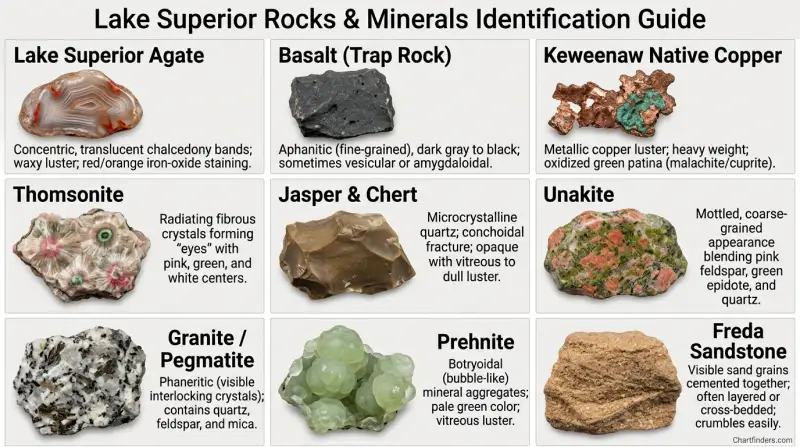
Lake Superior Rock Identification Chart
- Glacial and Volcanic Origins: Most Lake Superior rocks originated from the Keweenawan Rift system (about 1.1 billion years ago) and were subsequently transported, sorted, and deposited by Pleistocene glaciers.
- Agates Require Banding: A true Lake Superior agate must display concentric or parallel chalcedony banding formed in gas cavities within ancient basalt.
- Hardness is Diagnostic: Testing scratch resistance using Mohs scale principles (e.g., quartz scratches glass; calcite does not) rapidly narrows down mineral families.
- Vesicular Basalt is the Matrix: Many prized minerals—including agates, prehnite, datolite, and copper—form within the air bubbles (amygdules) of basaltic lava flows.
- Erosion Exposes Hidden Colors: Wave tumbling polishes rocks, breaking down soft matrix materials to reveal striking contrast in jaspers, unakite, and granite pegmatites.
- Safety and Ethics Matter: Always verify local land management regulations regarding rock collecting, especially within state/national parks and protected indigenous sites.
To successfully navigate the vast taxonomy of the Lake Superior basin, field-experienced rockhounds rely on structured reference frameworks. The following comprehensive master table details the primary rock and mineral types encountered along the lake, summarizing their diagnostic visual markers, hardness profiles, and geological origins.
| Rock / Mineral Type | Primary Identification Clues | Hardness (Mohs) | Common Colors | Geological Origin |
|---|---|---|---|---|
| Lake Superior Agate | Concentric, translucent chalcedony bands; waxy luster; red/orange iron-oxide staining. | 7 | Red, orange, brown, white, yellow | Precipitated from silica-rich groundwater inside basalt gas cavities. |
| Basalt (Trap Rock) | Aphanitic (fine-grained), dark gray to black; sometimes vesicular or amygdaloidal. | 5 – 6 | Dark gray, black, greenish-black | Extrusive volcanic lava flows from the Midcontinent Rift. |
| Keweenaw Native Copper | Metallic copper luster; heavy weight; oxidized green patina (malachite/cuprite). | 3 | Copper-red, turning green over time | Hydrothermal precipitation in fault zones and basalt flow tops. |
| Thomsonite | Radiating fibrous crystals forming “eyes” with pink, green, and white centers. | 4.5 – 5 | Pink, green, white, red | Secondary mineral filling vesicles in specific Keweenawan basalts. |
| Jasper & Chert | Microcrystalline quartz; conchoidal fracture; opaque with vitreous to dull luster. | 7 | Red, brown, green, black, banded | Chemical precipitation in ancient marine or iron-formation environments. |
| Unakite | Mottled, coarse-grained appearance blending pink feldspar, green epidote, and quartz. | 6 – 7 | Pink, pistachio green, clear/gray | Metasomatized granite formed through hydrothermal alteration. |
| Granite / Pegmatite | Phaneritic (visible interlocking crystals); contains quartz, feldspar, and mica. | 6 – 7 | Pink, white, gray, black speckled | Slow-cooling intrusive magma bodies exposed by deep erosion. |
| Prehnite | Botryoidal (bubble-like) mineral aggregates; pale green color; vitreous luster. | 6 – 6.5 | Pale green, yellowish-green, white | Low-grade metamorphic/hydrothermal environment in mafic rocks. |
| Freda Sandstone | Visible sand grains cemented together; often layered or cross-bedded; crumbles easily. | 6 – 7 (grains) | Brick red, reddish-brown | Late Precambrian sedimentary deposition in ancient river basins. |
The table above serves as your primary screening tool when examining a beach cobble. By systematically testing hardness, examining crystal structure under a hand lens, and noting color variations, you can quickly categorize most specimens before performing a more rigorous analysis.
Geological Background of the Lake Superior Basin
Understanding what you pick up off a Lake Superior beach requires going back 1.1 billion years to the formation of the Midcontinent Rift System (also known as the Keweenawan Rift). During this period, the North American continent began to tear apart, generating massive outpourings of basaltic lava. These volcanic flows filled a massive basin, trapping superheated water and gases that formed cavities known as vesicles.
Over millions of years, silica-rich hydrothermal fluids percolated through these cooling basalt layers, depositing microscopic quartz crystals that gradually built up layer by layer into what we now prize as the Lake Superior agate. Simultaneously, other mineralizing solutions deposited native copper, calcite, datolite, and prehnite within the same volcanic matrix.
Following the volcanic phase, vast inland seas deposited thick layers of sand, silt, and iron-rich sediments, which later lithified into sandstones, jaspers, and banded iron formations (BIFs). Then, during the Pleistocene epoch (the Ice Ages), massive continental glaciers advanced and retreated across the region. These immense sheets of ice acted as geological conveyor belts, ripping up bedrock, crushing softer materials, and depositing an eclectic mixture of rocks—ranging from local basalts to Canadian Shield granites—directly along modern-day shores.
Detailed Breakdown of Major Lake Superior Rock Types
To master rock identification in this region, you must move beyond general categories and examine the specific micro-features, mineral compositions, and structural behaviors of the most common rock and mineral families.
1. Lake Superior Agates (The Crown Jewel)
The Lake Superior agate is not merely a quartz rock; it is a geological masterwork. Formed exclusively in gas bubbles within ancient basaltic lava flows, these agates are defined by several non-negotiable diagnostic criteria:
- Concentric Banding: True agates display distinct, repeating bands of chalcedony that mirror the outer wall of the original cavity. If a stone lacks banding, it is generally classified as jasper, chalcedony, or quartz, not an agate.
- Iron-Oxide Coloration: The rich reds, deep oranges, and golden yellows characteristic of Superior agates come from trapped iron oxides (hematite and goethite) leached from the surrounding host rock during formation.
- Translucency: When held up to a strong flashlight or sunlight, the outer layers of a quality agate will transmit light, revealing inner fortification lines and ghost banding.
- Conchoidal Fracture: When broken, agates fracture along smooth, curved, shell-like surfaces typical of microcrystalline quartz.
2. Volcanic Matrix Rocks: Basalt and Amygdaloidal Basalt
Basalt is the dark, heavy, fine-grained volcanic rock that serves as the geological mother lode for many of Lake Superior’s most sought-after minerals. Unaltered basalt is nondescript—dark gray, greenish-black, and extremely dense. However, beachcombers prize amygdaloidal basalt. As gas bubbles expanded in the cooling lava, they created hollow voids (vesicles). Later, mineral-rich groundwater filled these voids with secondary minerals like quartz, calcite, chlorite, or copper. When the surrounding basalt weathers away, these filled nodules—called amygdules—are released onto the gravel bars.
3. Intrusive and Metamorphic Igneous Rocks: Granites, Pegmatites, and Unakite
Not all Lake Superior rocks are volcanic. The northern shores and glacial drift introduce an abundance of coarse-grained intrusive igneous rocks:
- Granite and Pegmatite: Featuring interlocking crystals of quartz, pink or white feldspar, and biotite mica, these rocks cooled slowly deep beneath the Earth’s crust. Pegmatites represent the final, water-rich stage of magma crystallization, often yielding oversized mineral crystals.
- Unakite: A striking, highly sought-after altered granite composed primarily of pink orthoclase feldspar, green epidote, and clear quartz. Its distinct pistachio-green and salmon-pink mottling makes it instantly recognizable on any gravel bar.
4. Sedimentary and Chemical Precipitates: Jasper, Chert, and Banded Iron Formation (BIF)
Chemical precipitation in ancient shallow seas produced massive formations of microcrystalline silica. Jasper is an opaque, impure variety of silica typically colored bright red, brown, or yellow by iron impurities. Banded Iron Formation (BIF)—frequently found on the Mesabi and Marquette iron ranges and washed down into the lake—features striking alternating layers of dark magnetite/hematite and red jasper or chert, telling a 2-billion-year-old story of Earth’s oxygenation.
Physical Testing Methods for Field Identification
When visual inspection alone fails, experienced rockhounds rely on simple physical tests to narrow down mineral identities. Carrying a small field kit containing a streak plate, a piece of window glass, a steel nail, and a small dropper bottle of diluted hydrochloric acid transforms guesswork into empirical science.
The Mohs Hardness Scale in Practice
Hardness measures a mineral’s resistance to scratching. Because quartz (Mohs 7) is abundant in the Lake Superior basin, many common beach rocks will scratch softer minerals. Field testing relies on these benchmarks:
- Fingernail: Hardness ~2.5 (scratches soft gypsum or talc, but rarely found loose on beaches).
- Copper Penny: Hardness ~3.5 (scratches calcite, but cannot scratch fluorite or quartz).
- Steel Pocket Knife or Masonry Nail: Hardness ~5.5 (easily scratches calcite, fluorite, and apatite; slides across quartz).
- Quartz Crystal or Agate: Hardness 7 (scratches window glass, feldspar, and steel; definitive test for quartz-based stones).
Luster and Fracture Analysis
Observe how light reflects off a freshly broken or tumbled surface. Minerals like native copper exhibit a metallic luster, while agates, quartz, and jasper show a waxy to vitreous (glassy) luster. Conversely, weathered shales and basalts often display a dull or earthy luster.
Examine the fracture pattern. Quartz and its varieties (agates, chert, jasper) exhibit a conchoidal fracture (smooth, curved ripples). Cleavage, by contrast, is the tendency of a mineral to break along flat, predictable planes defined by its internal atomic crystal lattice (seen clearly in micas and calcites).
Common Rock Identification Mistakes and Look-Alikes
Even seasoned rockhounds occasionally misidentify shoreline specimens due to clever natural mimicry. Being aware of common pitfalls prevents disappointment and deepens your field expertise.
1. “Wet Rock” Illusion
The single most common trap for beachcombers is the wet-rock phenomenon. A dull, weathered piece of basalt or ordinary granite looks stunningly vibrant, glossy, and colorful when submerged in water or slick with lake spray. Once the rock dries out in your collection bucket, the colors often fade dramatically. Tip: Carry a small spray bottle of water or brush your thumb across a dry stone to test its true, dry appearance before keeping it.
2. Glass vs. Quartz Agates
Because Lake Superior shipping lanes have centuries of maritime history, beaches near historic ports occasionally yield pieces of melted bottle glass or industrial slag that have been smoothed and tumbled by wave action into convincing “agates.”
How to tell them apart: Genuine agates feel noticeably heavier (higher specific gravity), feel colder to the touch than glass, and under a 10x hand lens, reveal microcrystalline growth structures rather than microscopic air bubbles trapped in man-made glass.
3. Confusing Basalt Amygdules with Fossils
Because Lake Superior geology is overwhelmingly Precambrian and volcanic, true invertebrate fossils (like trilobites or brachiopods) are virtually nonexistent in local beach gravels. Rounded cavities or mineral fillings in basalt are frequently mistaken for fossilized eggs, bones, or shells. Always remember: Lake Superior rocks pre-date complex animal life by hundreds of millions of years.
Frequently Asked Questions
While agates can be found along virtually any gravel or cobble beach across the entire basin, famous hotspots include McClain State Park and Gratiot River County Park in the Keweenaw Peninsula, Agate Beach in Two Harbors, Minnesota, and the gravel bars around Grand Marais. Beaches subjected to heavy wave action and active gravel shifting offer the highest turnover.
Look for three primary indicators: first, rotate the stone in bright sunlight to check for translucent chalcedony layers; second, use a 10x loupe to inspect for sharp, concentric fortification banding; third, check for the characteristic waxy luster and red/orange iron-oxide staining common to the region.
Yes. Regulations vary by jurisdiction. On most federal public lands (such as National Lakeshores like Pictured Rocks or Apostle Islands), commercial collecting is strictly prohibited, and recreational removal of natural objects is often restricted. However, many state-owned public beaches permit amateur rockhounding for personal collections under specific daily weight limits. Always check local land management rules before heading out.
The smoothness of beach cobbles is the result of thousands of hours of natural mechanical tumbling. Wave action drives millions of sand grains and pebbles against one another, continuously grinding away sharp corners, soft outer weathered rinds, and rough edges until only the toughest, most durable quartz and igneous cores remain.
Basalt is the most common heavy rock, but if you encounter a stone that feels remarkably heavy for its size and exhibits a dark metallic sheen or green oxidation, you may have found a piece of native copper or a heavy iron-rich Banded Iron Formation (BIF) fragment derived from the ancient mining districts of northern Michigan and Minnesota.
Conclusion
Mastering Lake Superior rock identification transforms an ordinary shoreline stroll into an engaging geological expedition. By combining fundamental principles of mineral hardness, volcanic origin, and structural diagnostic markers—such as the iconic concentric banding of genuine agates—you can read the deep history written into every pebble.
Remember that patience, observation, and respect for local regulations are the bedrock of responsible rockhounding. Whether you are hunting for translucent Keweenaw agates, pistachio-green unakite, or ancient iron-banded jaspers, every stone holds a fragment of a violent, beautiful past shaped 1.1 billion years ago and polished by the relentless tides of the greatest freshwater lake on Earth.