
Walking along a tidal shoreline and discovering a pristine seashell is one of the timeless joys of beachcombing. However, looking down at a handful of ribbed cockles, smooth olive shells, and spired snails quickly raises a challenging question: What species am I actually holding? Without a systematic approach, shells can begin to look alike, leading to frustration and misidentifications.
A structured seashell identification chart transforms a random collection of beach treasures into an organized understanding of marine biodiversity. By learning how to read the anatomical architecture of mollusks, beachcombers, educators, and marine biology enthusiasts can decode the secrets of the intertidal zone. This guide explores the foundational rules of shell classification, structural anatomy, regional variations, common look-alikes, and field-tested methods to help you accurately identify virtually any shell you encounter.
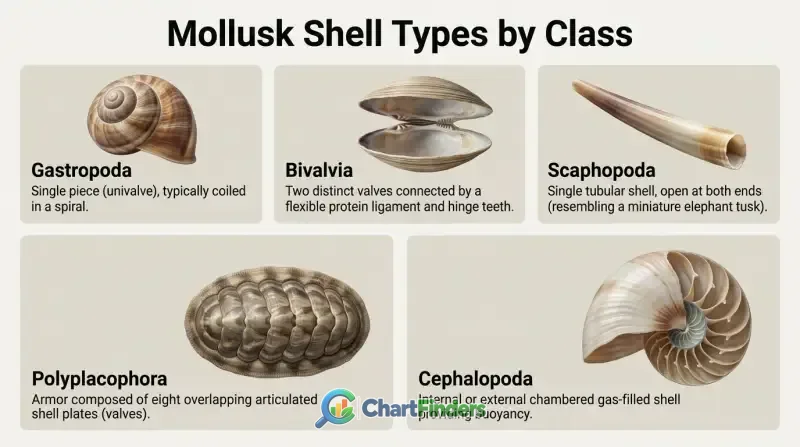
Seashell Identification Chart
- The Primary Split: All seashells belong to one of two major groups—Gastropods (single, univalve spiral shells) or Bivalves (paired shells joined by a hinge).
- Anatomy Dictates Identity: Aperture shapes, siphonal canals, hinge teeth, and growth lines are permanent biological features far more reliable for identification than surface color alone.
- Taxonomic Families: Grouping shells by families (such as Muricidae, Conidae, or Veneridae) speeds up identification by highlighting shared evolutionary traits.
- Environmental Factors: Wave action, diet, and water temperature cause natural variations within the same species, making morphological flexibility an important consideration.
- Modern Tools: Field guides, physical dichotomous keys, and AI-powered visual identification apps complement traditional chart-based analysis.
- Conservation Ethics: Responsible beachcombing requires verifying that a shell is uninhabited before collecting it, protecting fragile marine ecosystems.
To master seashell identification, you must first understand the broad taxonomic divisions that govern mollusk architecture. The phylum Mollusca contains several classes, but beachcombers primarily encounter two: Gastropoda and Bivalvia, along with minor representation from classes like Scaphopoda (tusk shells) and Polyplacophora (chitons).
The following comprehensive reference table outlines the core classes, defining traits, symmetry characteristics, and common examples encountered along temperate and tropical coastlines.
| Mollusk Class | Shell Structure | Symmetry | Key Diagnostic Features | Common Examples |
|---|---|---|---|---|
| Gastropoda | Single piece (univalve), typically coiled in a spiral. | Asymmetrical (coiled around a central axis or columella). | Aperture (opening), operculum (trapdoor), siphonal canal, whorls, spire. | Cones, Whelks, Cowries, Olive shells, Moon snails. |
| Bivalvia | Two distinct valves connected by a flexible protein ligament and hinge teeth. | Bilateral symmetry (left and right valves are mirror images). | Umbo (beak), hinge plate, pallial line, adductor muscle scars, ribs. | Clams, Cockles, Oysters, Mussels, Scallops. |
| Scaphopoda | Single tubular shell, open at both ends (resembling a miniature elephant tusk). | Radially symmetrical along a curved longitudinal axis. | Elongated, tapering tube; smooth or longitudinally ribbed exterior. | Tusk shells, Tooth shells. |
| Polyplacophora | Armor composed of eight overlapping articulated shell plates (valves). | Bilateral symmetry with serial repetition of plates. | Leathery girdle surrounding eight separate, interlocking calcareous plates. | Chitons (Coat-of-mail shells). |
| Cephalopoda | Internal or external chambered gas-filled shell providing buoyancy. | Bilateral symmetry, often planispiral (coiled in a single flat plane). | Internal septa dividing chambers, siphuncle tube, delicate exterior. | Nautilus, Paper argonauts (and internal squids/cuttlebone). |
Studying this structural breakdown allows you to sort any shoreline find within seconds. If a shell has a hinge, your search is instantly confined to Bivalvia. If it is a continuous spiral tube, it belongs among the Gastropoda.
Decoding Gastropod Anatomy: The Spiral Architecture
Gastropods represent the most diverse class of mollusks, encompassing over 80% of all living mollusk species. Identifying a snail shell requires looking closely at its vertical geometry and aperture design.
- The Spire and Whorls: The spire consists of all the whorls above the body whorl (the largest, final chamber where the animal lived). The pointed tip at the very top is the protoconch (the embryonic shell).
- The Columella: This is the central internal pillar around which the whorls coil. Peering inside the aperture often reveals whether the columella is smooth, folded, or toothed.
- The Aperture and Canal: The opening where the animal emerges. Carnivorous and scavenging gastropods (like whelks and conchs) feature an extended siphonal canal—a channel at the base of the aperture that houses the breathing siphon. Herbivorous grazers (like limpets and abalones) have wide, open apertures without canals.
- The Outer Lip: The margin of the aperture. In mature shells, this lip often thickens, flares, or develops internal teeth, signaling that the animal has reached full adult size.
Decoding Bivalve Anatomy: The Mirror-Image Framework
Bivalves lead a more sedentary lifestyle than snails, typically burrowing in sand, cementing to rocks, or swimming by clapping their valves together. Identifying them relies heavily on interior markings and exterior sculpture.
- The Umbo: Also called the beak, this is the oldest part of the shell, located near the hinge. The umbo typically points toward the anterior (front) end of the shell, helping establish left-versus-right valve orientation.
- Hinge Mechanics: Beneath the umbo lies the hinge plate, which may feature interlocking cardinal and lateral teeth. The pattern of these teeth is a primary taxonomic identifier used by malacologists.
- Muscle Scars and Pallial Line: When a bivalve dies and the soft tissue decays, it leaves distinct scars on the interior shell wall where the adductor muscles attached. The pallial line runs along the inner margin; an indentation in this line (the pallial sinus) indicates whether the clam has siphons that retract deep inside the shell.
Major Seashell Families and Their Diagnostic Signatures
Once you categorize a shell as a gastropod or bivalve, the next step in identification is narrowing it down to family. Recognizing family-level traits dramatically speeds up field identification.
1. Family Conidae (Cone Snails)
Cone shells are prized by collectors for their geometric patterns and sleek, inverted-cone silhouettes. They feature a narrow, elongated aperture and a low, flat spire. Caution: Live cone shells possess a venomous harpoon-like radular tooth capable of delivering a dangerous neurotoxic sting. Always observe live cones with extreme care.
2. Family Muricidae (Murexes and Rock Shells)
Muricids are predatory snails characterized by highly ornate, rugged exteriors. Their shells often feature prominent axial ribs, spines, frills, and a well-developed siphonal canal. Because they inhabit rocky, turbulent waters, their heavy ornamentation helps anchor them against wave action.
3. Family Cypraeidae (Cowries)
Cowries possess smooth, glossy, porcelain-like surfaces with vibrant, hidden patterns. Adult cowries have a long, narrow aperture flanked by “teeth” along both the inner and outer lips. The spire is completely covered in adult shells by continuous mantle growth, giving them their characteristic oval, dome shape.
4. Family Veneridae (Venus Clams)
As one of the largest families of bivalves, Venus clams are sturdy, rounded to triangular shells with distinct concentric growth rings and well-developed hinge teeth. They inhabit shallow marine sands and muds worldwide, ranging from small quarter-sized littleneck clams to massive quahogs.
5. Family Pectinidae (Scallops)
Scallops are instantly recognizable by their fan-shaped valves and distinct “ears” (auricles) flanking the umbo. Most scallops feature radial ribs radiating outward from the hinge. Unlike most bivalves, scallops can swim actively by snapping their valves open and shut to expel water.
Environmental and Geographic Variations in Shells
A frequent challenge in seashell identification is phenotypic plasticity—the ability of a single species to develop significantly different physical characteristics depending on its local environment. Relying solely on color or size charts can lead to misidentifications if environmental factors are ignored.
- Wave Energy and Shell Thickness: Populations of the same snail or clam species living in high-energy, wave-swept surf zones often grow thicker, heavier, and more robust shells to prevent crushing. Conversely, calm estuarine or deep-water populations of the exact same species may produce thin, delicate, lightweight shells.
- Dietary Pigmentation: Shell coloration is frequently influenced by diet. Marine snails that graze on specific red or green algae incorporate those pigments into their growing calcium carbonate matrix, resulting in brilliant color morphs within a single species.
- Geographic Clines: Water temperature gradients across latitude affect shell size and ornamentation. Many marine mollusks grow larger in colder northern waters due to slower metabolic rates and extended lifespans, while tropical counterparts often display more complex color polymorphism.
Step-by-Step Field Identification Process
When you discover an unknown shell on the beach, apply this structured 5-step identification workflow to systematically narrow down your options.
- Clean and Dry the Specimen: Gently rinse away sand, salt, and organic debris. Many subtle color patterns, fine striae, and microscopic growth lines only become visible once the shell is completely dry.
- Determine the Class: Check for a hinge (Bivalvia) or a continuous spiral coil (Gastropoda). If it is a rigid tube open at both ends, it is a Scaphopod.
- Examine Symmetry and Orientation: For gastropods, hold the shell with the aperture facing you and the spire pointing upward. If the opening is on your right, it is a right-handed (dextral) coil—the most common orientation. For bivalves, locate the umbo pointing toward the front and match the left or right valve.
- Measure and Inspect Sculpture: Note the exact dimensions. Examine the surface under a magnifying glass for spiral cords, radial ribs, nodes, spines, or punctations. Look inside the aperture or check the hinge teeth.
- Cross-Reference with Guides or AI: Compare your findings against regional field guides, taxonomic keys, or AI identification applications like Shellium to confirm the exact species name.
Common Identification Pitfalls and Look-Alikes
Even experienced beachcombers occasionally stumble over tricky identification hurdles. Being aware of common pitfalls prevents frustrating misclassifications.
- Worn and Rolled Specimens: Shells that have tumbled in the surf for months lose their outer pigmented layer (the periostracum) and surface sculpture, turning smooth and white. A heavily worn moon snail can easily be mistaken for an entirely different family.
- Juvenile vs. Adult Morphology: Young gastropods often look dramatically different from adults of the same species. A juvenile conch lacks the flaring, thickened outer lip of the adult, making it look like a standard whelk.
- Alien Species Introductions: Ballast water discharge and aquaculture have introduced non-native mollusks into new ecosystems. Finding an Asian clam (Corbicula fluminea) or a Veined Rapa Whelk outside its native range can confuse traditional regional checklists.
Frequently Asked Questions
The easiest test is checking for a hinge. If the shell consists of two separate matching pieces joined at a hinge point, it is a bivalve (such as a clam or scallop). If the shell is formed from a single continuous piece that coils in a spiral, it is a gastropod (such as a snail or whelk).
Many seashells have a microscopic outer protein layer called the periostracum, or porous calcium carbonate structures that trap air when dry. When water fills these microscopic pores, it alters how light reflects and refracts off the crystal layers, temporarily deepening and saturating the shell’s natural colors.
No. Color is one of the most variable traits within mollusk species. Factors such as diet, water temperature, sun exposure, and genetic variation cause individuals of the exact same species to display vastly different color morphs. Always prioritize structural morphology, such as aperture shape, hinge teeth, and rib patterns, over color.
Check the aperture of gastropods for an operculum (a hard or leathery trapdoor) closing off the opening, or check if the shell feels surprisingly heavy because of soft tissue inside. For bivalves, if the two halves remain tightly clamped shut when you try to pull them apart, a live animal is likely inside. Always return live mollusks gently to the water.
A pocket-sized regional field guide, a 10x jeweler’s loupe for examining fine growth lines and hinge teeth, a small metric ruler for precise measurements, and a reliable smartphone app for instant AI-assisted cross-referencing make an ideal field identification kit.
Conclusion
Mastering seashell identification turns a casual walk on the beach into an engaging exercise in marine biology. By systematically evaluating whether a specimen is a gastropod or bivalve, analyzing its structural anatomy, recognizing family-level traits, and accounting for environmental variations, you can decode the identity of almost any shell you encounter. Armed with a solid understanding of mollusk architecture and ethical collecting practices, you are ready to explore the shoreline with renewed confidence and insight.