
Deciding to bring a new feline companion into your home is an exciting milestone, but the decision takes on an entirely different dimension when you consider adopting a pair. The modern landscape of pet ownership increasingly highlights the benefits of feline socialization, leading many shelters and breeders to strongly advocate for adopting littermates or bonded pairs. Yet, multiplying your kitten count by two also multiplies your daily responsibilities, financial commitments, and spatial requirements.
Understanding the dual reality of multi-kitten adoption means looking past the undeniable cuteness of dual cuddle piles. It requires an objective look at behavioral development, long-term budgeting, veterinary realities, and household management. Whether you are wondering how two energetic youngsters will affect your existing pets, your sleep schedule, or your monthly expenses, this guide explores the complete spectrum of considerations to help you determine if your household is genuinely ready for a double dose of feline energy.
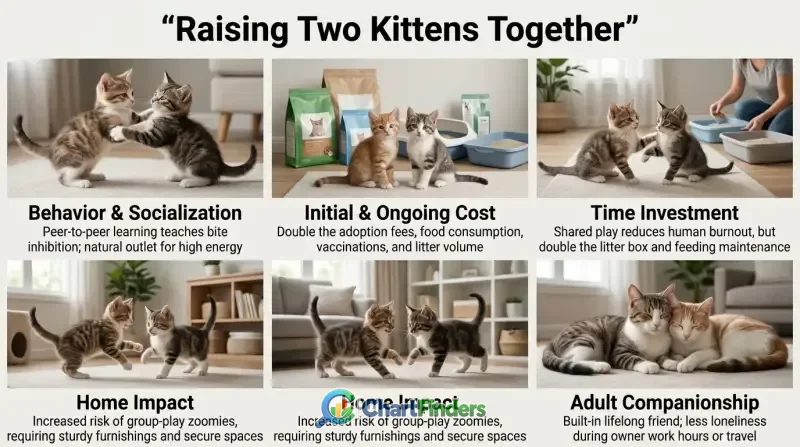
Pros And Cons Of Getting Two Kittens
- Socialization Synergy: Two kittens naturally teach each other bite inhibition and burn off boundless energy together, reducing destructive behavior directed at human hands or furniture.
- The Financial Multiplier: Veterinary bills, premium food, litter, and supplies double immediately, with routine annual care representing a significant recurring household budget item.
- Compatibility Trumps Age: Matching energy levels and temperaments is critical; pairing mismatched personalities can lead to chronic stress rather than harmonious companionship.
- Environmental Infrastructure: Successfully housing two kittens requires duplicating key resources—such as litter boxes, feeding stations, and vertical spaces—following the “n+1” rule to prevent territorial friction.
- Behavioral Independence: Cats raised in pairs are often less prone to separation anxiety and human-directed clinginess, developing more secure, balanced adult personalities.
When evaluating the pros and cons of getting two kittens, prospective owners must weigh immediate lifestyle adjustments against long-term behavioral and emotional outcomes. The following analysis breaks down the major advantages and disadvantages of welcoming a dual-kitten household.
| Evaluation Factor | The Two-Kitten Experience | The Single-Kitten Experience |
|---|---|---|
| Behavior & Socialization | Peer-to-peer learning teaches bite inhibition; natural outlet for high energy. | Relies entirely on humans for social cues; higher risk of “single kitten syndrome.” |
| Initial & Ongoing Cost | Double the adoption fees, food consumption, vaccinations, and litter volume. | Standard baseline costs for a single pet; easier entry point for tight budgets. |
| Time Investment | Shared play reduces human burnout, but double the litter box and feeding maintenance. | Requires intensive one-on-one human interaction to burn energy and prevent boredom. |
| Home Impact | Increased risk of group-play zoomies, requiring sturdy furnishings and secure spaces. | Concentrated energy focused on household items or human ankles if under-stimulated. |
| Adult Companionship | Built-in lifelong friend; less loneliness during owner work hours or travel. | May demand more attention from owners; can become lonely in empty homes. |
As illustrated in the comparison above, neither path is universally superior; rather, each presents a distinctly different set of responsibilities and rewards that align with specific human lifestyles and financial realities.
The Compelling Advantages of Adopting Two Kittens
There are robust behavioral, psychological, and physiological reasons why animal behaviorists and rescue organizations frequently encourage double adoptions. Felines are inherently social creatures, even if their solitary hunting heritage sometimes suggests otherwise.
Built-In Playmates and Energy Burners
Kittens possess an astonishing, seemingly inexhaustible supply of energy. During their first year of life, they undergo rapid neurological and physical development that demands intense physical output. Two kittens will chase, wrestle, stalk, and tumble with one another, providing an organic outlet for instincts that would otherwise be directed toward your furniture, curtains, or ankles.
This peer-to-peer play is not merely about burning calories; it is a critical educational tool. When one kitten bites too hard during play, the other will yelp and withdraw, instantly teaching the aggressor the boundaries of acceptable bite inhibition. Humans attempting to socialize a single kitten often struggle to replicate this precise, instant negative feedback loop, which frequently results in hand-biting behaviors that persist into adulthood.
Mitigating “Single Kitten Syndrome”
Veterinarians frequently use the term “single kitten syndrome” to describe cats raised in total isolation from feline peers during their critical socialization window (roughly 2 to 7 weeks of age, extending through 4 months). Cats raised entirely alone often display behavioral abnormalities as they mature, including excessive aggression, inappropriate biting, fear-based reactivity, and hyper-attachment to humans. Having a companion provides a constant mirror for emotional regulation, teaching a young cat how to navigate social boundaries, share spaces, and modulate arousal levels.
Emotional Resilience and Reduced Loneliness
Modern work schedules, social commitments, and travel mean that many pet owners leave their homes vacant for eight to ten hours a day. For a single kitten, this isolation can induce chronic boredom, anxiety, and stress-related vocalization. Two kittens keep each other company, cuddle during naps, groom one another, and maintain mental stimulation throughout the day. When you return home, you are greeted by two well-adjusted pets rather than a stressed, hyper-demanding animal starved for interaction.
The Real-World Disadvantages and Challenges
While the benefits are substantial, ignoring the drawbacks of a dual adoption is a recipe for household friction. Bringing two fast-growing animals into your living space introduces complex logistical and financial realities.
The Immediate Financial Multiplier
The most immediate and undeniable impact of two kittens is financial. Every expense associated with cat ownership is doubled. Consider the baseline requirements:
- Veterinary Care: Double the initial vaccination series, microchipping, parasite preventatives, and crucially, double the cost of spay or neuter surgeries.
- Consumables: Growing kittens eat prodigious amounts of high-quality food. As they transition from wet food to adult maintenance, your grocery bill will scale rapidly. Litter consumption also doubles, requiring larger and more frequent purchases of litter material.
- Supplies: While you can share certain items, you must invest in multiple litter boxes, distinct food and water stations, separate carriers for vet visits, and dual scratching posts.
Increased Household Wear and Tear
Two kittens moving at high speed across a living room do not act with calculated grace. While a single kitten can cause mischief, two kittens egg each other on, turning routine play into synchronized acrobatics. Curtains, blinds, decorative items, houseplants, and upholstered furniture face exponentially higher risks of damage. Securing your home against two curious, agile explorers requires considerably more vigilance than managing one.
Management of Inter-Cat Dynamics
A common misconception is that any two kittens placed together will automatically become lifelong cuddle partners. While littermates often bond closely, personality clashes can still occur. If one kitten is remarkably dominant and the other is timid, the shyer cat may experience chronic stress, leading to behavioral issues such as inappropriate elimination, hiding, or stress-induced cystitis. Owners must monitor dynamic shifts carefully and intervene if play crosses the line into bullying.
Financial Planning and Budgeting for Two Cats
Transparent financial planning is essential before committing to a multi-cat household. Many prospective owners calculate only the adoption fee, failing to account for the long-term cost of living, routine wellness care, and emergency medical contingencies.
Veterinary expenses represent the most volatile variable in pet ownership. While a young kitten is generally robust, accidents happen—ingestion of foreign objects, sudden viral upper respiratory infections, or soft-tissue injuries from overzealous play can result in unexpected veterinary bills. When you have two cats, the statistical likelihood of requiring veterinary intervention at some point doubles.
, preventive care costs must be multiplied across both animals. Annual wellness exams, rabies and FVRCP boosters, flea, tick, and heartworm preventatives, and dental cleanings add up significantly over a cat’s 15-to-20-year lifespan. Establishing a dedicated pet savings account or investing in comprehensive pet insurance from day one is vastly more manageable when started while the cats are young and pre-existing conditions do not yet exist.
| Expense Category | Estimated Annual Cost (One Cat) | Estimated Annual Cost (Two Cats) |
|---|---|---|
| Food & Treats | $250 – $450 | $500 – $900 |
| Litter & Waste Management | $150 – $250 | $300 – $500 |
| Routine Veterinary Care & Parasite Control | $200 – $400 | $400 – $800 |
| Toys, Grooming & Miscellaneous Supplies | $100 – $200 | $200 – $400 |
| Total Estimated Yearly Baseline | $700 – $1,300 | $1,400 – $2,600 |
Environmental Setup: The Multi-Cat Infrastructure
Cats are territorial creatures governed by resource security. To prevent behavioral conflicts, resource guarding, and stress-related elimination outside the litter box, your home must be properly structured to accommodate two animals harmoniously.
The Golden Rule of Litter Boxes
The universally accepted rule of thumb in feline behavior is the “n+1 rule” for litter boxes, where n represents the number of cats in the home. For two kittens, this means you should ideally provide three distinct litter boxes placed in separate, accessible locations—not clustered side-by-side in a single closet. Cats view side-by-side boxes as a single large elimination zone, which dominant cats can easily blockade.
Feeding Stations and Resource Spacing
In nature, solitary hunters do not share meals in cramped proximity. Forcing two kittens to eat side-by-side out of adjacent bowls can induce eating anxiety, leading one cat to gulp food rapidly while the other backs away. Separate feeding stations—placed in different corners of a room or even in separate rooms entirely—reduce tension and allow each kitten to consume their meals in peace.
Vertical Territory and Safe Havens
Conflict resolution in the feline world often relies on avoidance and elevation. Providing ample vertical territory—such as multi-tiered cat trees, wall-mounted perches, and clear shelves—allows one kitten to escape unwanted attention from the other. Additionally, quiet, enclosed hiding spots ensure that each animal has a private retreat when they wish to sleep undisturbed.
Step-by-Step Decision Framework: Is Your Home Ready?
To determine whether you should proceed with adopting two kittens, walk through this practical decision framework:
- Audit Your Monthly Budget: Calculate your current disposable income and determine if you can comfortably absorb an extra $50 to $100 per month in food, litter, and supplies, plus a $1,000 to $2,000 emergency veterinary buffer.
- Evaluate Your Living Space: Assess your square footage and layout. Do you have adequate room to space out multiple litter boxes, feeding stations, and resting areas without cluttering your living space?
- Assess Your Daily Schedule: Do you have the time required to perform twice-daily litter box scooping, interactive play sessions with both kittens, and ongoing training and socialization?
- Check Lease or Housing Restrictions: If you rent, verify your landlord’s pet policy and ensure there are no strict multi-pet limits or prohibitive additional security deposits.
- Consider Existing Pets: If you already share your home with senior cats, dogs, or small animals, evaluate how introducing two high-energy kittens will impact their quality of life and stress levels.
Common Mistakes to Avoid in Multi-Kitten Households
Even well-intentioned owners can stumble when managing two young cats. Avoiding these frequent pitfalls ensures a smoother integration process:
- Assuming All Play is Friendly: Failing to distinguish between healthy, reciprocal play (where roles reverse and body language remains loose) and aggressive bullying (where one cat constantly stalks, pins, and terrorizes the other).
- Skimping on Individual Human Time: Relying entirely on the cats keeping each other company and neglecting to build individual, trusting bonds between each kitten and human family members.
- Punishing Stress Behaviors: Reacting with anger or punishment if a stressed cat eliminates outside the box, which only increases anxiety and worsens the underlying behavioral problem.
- Failing to Provide Separate Attention: Feeding, petting, and playing with the kittens exclusively as a single unit rather than nurturing their individual identities and confidence.
Frequently Asked Questions
Littermates are often a fantastic choice because they are already familiar with each other’s scent and have established play dynamics. However, bonded pairs from different litters who have been carefully matched by a shelter or coordinator can be equally successful. Compatibility in energy level and temperament matters far more than shared genetics.
Yes, but the nature of the bond is different. A single kitten may be more clingy and dependent on you for all social and emotional stimulation. Two kittens often grow into exceptionally secure, confident adult cats who enjoy human affection on their own terms without developing severe separation anxiety or destructive clinginess.
Gently interrupt the interaction by redirecting the energetic kitten’s attention toward a wand toy or feathery teaser. Ensure both cats have plenty of vertical space to escape each other, and verify that all core resources (food, water, litter boxes) are fully duplicated so the bullied cat is never trapped or blockaded from necessities.
Logistically, buying food in bulk formats (such as larger bags of dry kibble or cases of canned wet food) can offer minor cost efficiencies. However, the total volume of food consumed will double as they grow. Never compromise on nutritional quality to save money; growing kittens require protein-rich, calorie-dense formulations designed specifically for feline growth.
Gender pairing is less critical than individual personality, especially when both kittens are spayed and neutered early. While male kittens sometimes exhibit slightly higher rough-and-tumble play styles, individual temperament, activity level, and proper socialization play the dominant roles in determining harmony.
Conclusion
Adopting two kittens is a deeply rewarding endeavor that enriches your home with vibrant energy, affectionate companionship, and endless entertainment. Yet, it is a commitment that demands careful preparation, robust budgeting, and thoughtful environmental management. By weighing the doubled financial and logistical responsibilities against the profound social and behavioral benefits, you can make an informed, confident decision. If your budget is secure, your home is prepared, and your heart is ready, welcoming a pair of feline companions offers a uniquely joyful path to multi-pet ownership.