
The transition from a two-cat household to a three-cat household represents a fundamental shift in domestic ecology. While two cats often settle into a predictable routine of mutual companionship or peaceful coexistence, adding a third feline introduces a complex social triangle. This shift can disrupt established territorial boundaries, alter household resource distribution, and amplify financial and time commitments.
For dedicated cat lovers, the thought of a third feline companion is immensely appealing. Yet, the realities of managing a multi-cat home go far beyond the initial charm of a crowded lap. This article explores the nuanced realities of living with a trio of cats, evaluating the financial, behavioral, and spatial impacts to help you determine if a three-cat household fits your lifestyle.
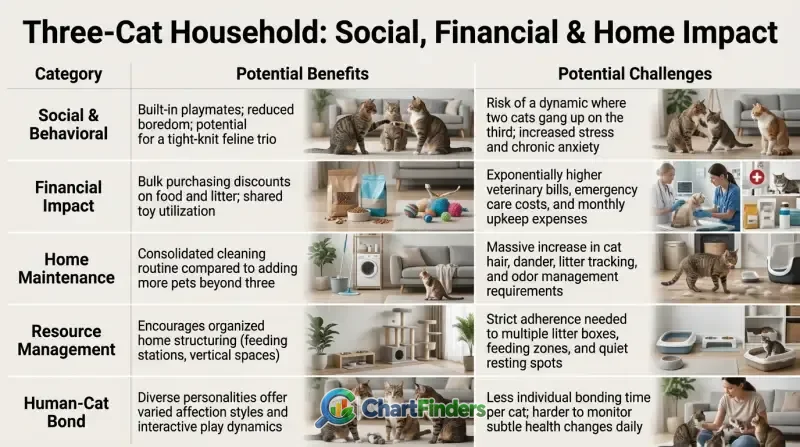
Pros And Cons Of Having Three Cats
- Social Triangle Dynamics: Three cats create a complex social web where subtle bullying, shifting alliances, and resource guarding are far more common than in single or two-cat homes.
- Substantially Increased Costs: Veterinary care, high-quality nutrition, and preventative treatments scale rapidly, turning routine care into a major financial commitment.
- The N+1 Litter Box Rule: Managing three cats requires a minimum of four properly distributed litter boxes across multiple zones to prevent behavioral elimination issues.
- Built-In Enrichment: Cats in a trio often keep each other stimulated, burning off excess energy through play-chasing and social interaction when humans are busy.
- Space and Architecture Requirements: Traditional homes need vertical territory, escape routes, and wide-clearance pathways to prevent bottlenecks and stress points among three distinct personalities.
| Category | The Pros (Advantages) | The Cons (Disadvantages) |
|---|---|---|
| Social & Behavioral | Built-in playmates; reduced boredom; potential for a tight-knit feline trio. | Risk of a dynamic where two cats gang up on the third; increased stress and chronic anxiety. |
| Financial Impact | Bulk purchasing discounts on food and litter; shared toy utilization. | Exponentially higher veterinary bills, emergency care costs, and monthly upkeep expenses. |
| Home Maintenance | Consolidated cleaning routine compared to adding more pets beyond three. | Massive increase in cat hair, dander, litter tracking, and odor management requirements. |
| Resource Management | Encourages organized home structuring (feeding stations, vertical spaces). | Strict adherence needed to multiple litter boxes, feeding zones, and quiet resting spots. |
| Human-Cat Bond | Diverse personalities offer varied affection styles and interactive play dynamics. | Less individual bonding time per cat; harder to monitor subtle health changes daily. |
Analyzing the balance between the advantages and disadvantages requires looking closely at how feline psychology intersects with human domestic routines. Let us examine the specific benefits and drawbacks in detail.
The Benefits of Having Three Cats
For the right household, owning three cats brings unique joys and behavioral advantages that cannot be replicated with a single cat or even a pair.
- Enhanced Feline Enrichment: Cats are naturally social predators that benefit from observation, play, and interaction. A trio often forms dynamic play groups, chasing each other through hallways, wrestling, and keeping their minds sharp through active engagement.
- Distributed Attention Needs: When you have only one or two cats, they may place intense demands on your time and attention. Three cats tend to distribute their social energy among themselves, often seeking each other out for naps, grooming, and companionship.
- Resilient Social Structures: In a well-balanced trio, if one cat is not in the mood to play, the other two can engage with each other. This prevents a high-energy cat from incessantly pestering a senior or lower-energy housemate.
- Diverse Personalities: Each cat brings a distinct character to the home. The combination of three personalities often creates a vibrant, entertaining household environment full of amusing interactions.
The Hidden and Direct Drawbacks
While the pros sound delightful, the cons of a three-cat household demand serious consideration before bringing home that third pet.
- The Feline Social Triangle: In a two-cat home, relationships are binary (they get along, tolerate, or fight). In a three-cat home, a mathematical triangle forms. It is common for two cats to form a bonded pair or alliance, inadvertently isolating, bullying, or stressing out the third cat.
- Escalating Veterinary Expenses: Routine checkups, annual vaccinations, parasite control, and emergency care multiply quickly. If two cats fall ill simultaneously or require specialized senior care, veterinary costs can strain household finances.
- Intense Resource Guarding and Stress: Cats are territorial animals. Three cats require strategic resource placement to prevent subtle resource guarding. If food bowls, water fountains, and litter boxes are grouped together, dominant cats can block access, causing chronic stress, UTIs, and inappropriate elimination in submissive cats.
- Environmental Wear and Tear: Three cats generate three times the dander, hair, and litter scatter. Scratching posts, furniture, carpets, and window perches will experience accelerated wear, requiring frequent replacement and intensive daily cleaning.
Understanding Feline Social Dynamics: The Triangle Effect
The single most important factor in determining whether a three-cat household will succeed is feline social dynamics. Unlike dogs, which are pack animals designed to fit into large hierarchical groups, domestic cats are solitary hunters that tolerate or bond with social groups based on resource availability and early socialization.
Why Three is a Turning Point
Transitioning from one cat to two often expands companionship, but moving to three cats changes the geometry of the home. Feline behaviorists frequently warn about the “triangle dynamic.” In this scenario:
- Cat A and Cat B bond closely, sharing resting spots and grooming each other.
- Cat C is left on the outside of this partnership.
- Cat C may face passive-aggression, blockades in hallways, or active chasing from the bonded pair.
Even if overt fighting does not occur, subtle psychological bullying—such as staring, blocking access to food or litter boxes, and displacing resting cats—causes chronic stress in the outsider cat. This stress often manifests in stealthy ways, such as over-grooming, hiding, or eliminating outside the litter box.
Assessing Your Existing Cats’ Temperaments
Before introducing a third cat, you must honestly evaluate the personalities of the cats currently in your home.
| Existing Cat Profile | Suitability for a Third Cat | Behavioral Outcome & Risk Level |
|---|---|---|
| Confident & Social (Welcomes strangers, high play drive) | High Suitability | Likely to welcome a new playmate, though may attempt to dominate the newcomer initially. Low risk if introductions are managed. |
| Insecure & Anxious (Startles easily, hides from guests) | Low Suitability | High Risk. A third cat will likely overwhelm them, causing increased hiding, behavioral regression, and stress-related medical issues. |
| Senior Cat (Calm, slowing down, joint stiffness) | Very Low Suitability | Extreme Risk. Energetic younger cats will pester seniors, leading to pain, distress, and a compromised quality of life in their golden years. |
| Closely Bonded Pair (Inseparable, constant mutual grooming) | Moderate to Low | Moderate Risk. A bonded pair already has a complete social circle. Inserting a third cat can upset their closed ecosystem and create friction. |
If your current cats are seniors or anxious souls, adding a third cat is rarely a good idea. Conversely, if you have a young, highly energetic cat that constantly demands attention, a compatible third cat can serve as an ideal play outlet.
The Financial Realities of Owning Three Cats
Financial planning for multi-cat households goes beyond estimating the cost of an extra bag of food. Expenses in pet ownership scale non-linearly due to emergency medical needs, preventative care, and specialized equipment.
Breaking Down the Ongoing Monthly Costs
When projecting the cost of three cats, budget for the following categories on a monthly and annual basis:
- Nutrition: Three adult cats consume a substantial amount of food. Premium wet and dry food diets can easily range from $100 to $250+ per month depending on dietary restrictions, prescription foods, and quality levels.
- Litter and Waste Management: High-quality litter, waste bags, and deodorizers add up quickly. Expect to use 40 to 60 pounds of litter monthly across multiple boxes.
- Preventative Healthcare: Flea, tick, and heartworm preventatives must be purchased for three distinct animals year-round. Annual veterinary wellness exams, dental cleanings, and bloodwork for aging cats multiply the baseline medical budget.
- Emergency Reserves: Veterinary emergencies rarely happen to one pet at a time. If an accident occurs or a chronic illness develops, having a robust emergency fund or pet insurance policy covering all three cats is essential.
Home Infrastructure: Setting Up a Three-Cat Environment
Space management is critical in a multi-cat home. You cannot simply squeeze more supplies into a small apartment; you must expand your home’s capacity vertically and strategically.
The Golden Rules of Multi-Cat Logistics
- The Litter Box Formula: The golden rule states you need N + 1 litter boxes, where N is the number of cats. For three cats, you need a minimum of four litter boxes distributed across different rooms and floors—never lined up side-by-side in a single utility room, which cats perceive as a single large box.
- Strategic Feeding Stations: Never feed three cats right next to each other. This forces them into close proximity while vulnerable. Separate feeding stations—or the use of microchip-activated bowls—prevent food stealing and resource anxiety.
- Vertical Territory Expansion: Floor space matters less than vertical space. Cat trees, wall-mounted shelves, and clear pathways across furniture allow cats to pass each other without forced confrontation, reducing hallway blockades and territorial tension.
- Multiple Escape Routes: Every room that cats frequent should have multiple exit points. A cat trapped in a dead-end room by another cat will experience severe anxiety.
Step-by-Step Decision Framework: Should You Get a Third Cat?
Before making a final commitment, walk through this practical decision framework to test your readiness for a three-cat household.
- Evaluate Space Capacity: Do you live in a spacious home or a compact apartment? Can you add vertical shelving and multiple distinct resting zones? If space is tight, stop here.
- Audit Your Current Household Budget: Calculate your current pet expenditures and multiply them by 1.5 to account for emergency padding. Can you comfortably absorb an unexpected $2,000 veterinary bill without financial distress?
- Assess Current Cat Personalities: Are your existing cats confident, social, and playful? Or are they older, easily stressed, or highly territorial? Ensure your current cats are thriving before adding another variable.
- Commit to the Introduction Process: Are you prepared to spend 2 to 4 weeks strictly managing a gradual scent-swapping and site-swap introduction process behind closed doors? Quick introductions almost always fail in multi-cat homes.
- Time and Energy Audit: Do you have the bandwidth for daily litter box maintenance across four stations, daily grooming, and individual interactive play sessions with three distinct animals?
Common Mistakes in Three-Cat Households
Many multi-cat owners run into preventable behavioral and management pitfalls. Avoiding these common mistakes can save your household from stress and behavioral fallout:
- Rushing the Introduction: Letting a new cat out of a carrier on day one to meet two resident cats creates immediate panic, spraying, and lifelong animosity. Always use a proper gradual quarantine and scent-exchange protocol.
- Grouping All Resources Together: Placing all food bowls in the kitchen and all litter boxes in the basement creates choke points where dominant cats can easily control resources. Spread resources across different zones.
- Ignoring Subtle Stress Signals: Owners often miss subtle signs of bullying, such as a cat waiting for permission to enter a room, refusing to use a litter box while watched, or over-grooming their belly. Address micro-tensions immediately before they escalate to spraying or severe aggression.
- Punishing Feline Conflict: Yelling at or physically punishing cats for fighting or hissing only increases their anxiety and associates the punishment with each other, worsening the underlying aggression.
Frequently Asked Questions
Yes, exponentially so. While moving from one cat to two is a linear increase in work, moving from two to three introduces complex social triangulation. Resource management, cleaning frequency, and monitoring for subtle health or behavioral issues become significantly more demanding.
You need a minimum of four litter boxes (following the N+1 rule). , these boxes must be placed in separate locations throughout the home, rather than clustered together in one room, to ensure subordinate cats can access them safely.
There is no single “perfect” combination, but behaviorists often note that female cats tend to be more territorial, while males can be more playful and adaptable. A balanced mix of personalities and energy levels matters far more than gender alone. Always prioritize matching activity levels and confidence over biological sex.
If bullying occurs, you must temporarily step back in the introduction process. Re-establish a safe room for the targeted cat with all necessary resources. Use baby gates with mesh screens to allow visual contact without physical access, and consult a certified feline behavior consultant if tension persists.
In most cases, no. Senior cats require peace, quiet, and predictable routines. Introducing a third cat—especially a kitten or young adult—typically causes severe stress, exacerbates arthritis pain through harassment, and compromises the health and well-being of older pets.
Conclusion
Having three cats can be an immensely rewarding experience for households equipped with the space, financial stability, and behavioral understanding required to manage a complex feline social group. The built-in companionship and vibrant energy of a trio bring boundless joy to dedicated cat owners. However, the decision should never be made lightly. By carefully evaluating your current cats’ personalities, budgeting for escalating veterinary and supply costs, and committing to proper resource distribution, you can create a harmonious, thriving multi-cat home where all three felines feel safe, secure, and loved.