
Accurately identifying a rabbit breed goes far beyond simply matching a coat color to a picture. Whether you are an agricultural judge, a 4-H exhibitor reviewing your fair entry documentation, a rescue worker evaluating an incoming surrender, or a dedicated breeder managing pedigree lines, visual recognition requires a structured methodology. Rabbits exhibit an extraordinary range of biological diversity, spanning from tiny 2-pound Netherland Dwarfs to massive 16-pound Flemish Giants. Across recognized registries, hundreds of distinct combinations of fur types, ear orientations, and skeletal structures exist, creating a complex classification puzzle.
This guide serves as an authoritative master reference for rabbit identification. It breaks down the core physiological markers used by breed authorities, analyzes the five official body types, contrasts fur structures and ear carriage mutations, and provides practical frameworks for distinguishing look-alike breeds. By moving past surface-level assumptions and analyzing structural conformation, you will learn to evaluate rabbits with professional precision.
Rabbit Breed Identification Chart
- Conformation Over Color: Skeletal structure, body type, and weight class are much more reliable identification markers than coat color or pattern alone.
- Five Recognized Body Types: Rabbit bodies are categorized into five distinct architectural styles: Compact, Commercial, Compact/Cylindrical, Full Arch, and Semi-Arch.
- Fur Variations Dictate Breed: Specialized coats—such as the upright velvet fur of Rex, the reflective sheen of Satin, or the dual-layer wool of Angoras—instantly narrow down breed options.
- Ear Carriage Divisions: Breeds are sharply split between erect (upright) ears and lop (hanging) ears, which are further subdivided by head mount and ear length.
- The Look-Alike Trap: Many distinct breeds share identical color markings (such as Californian, Himalayan, and broken-pattern varieties), requiring secondary traits for correct identification.
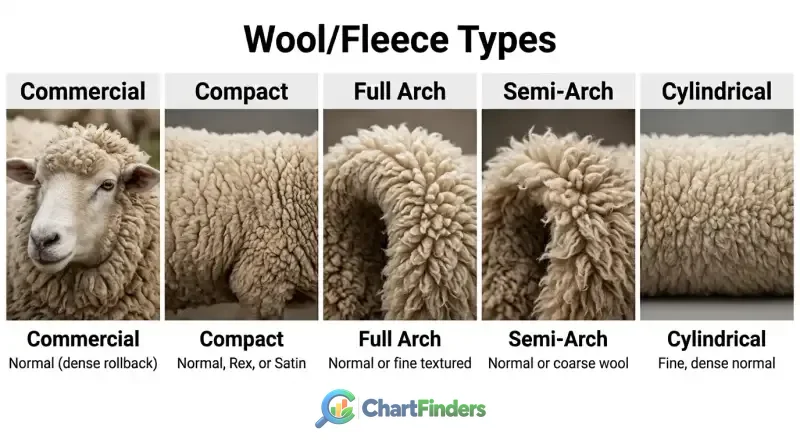
To establish a reliable baseline for identification, it is essential to compare the primary biometric categories recognized by major rabbit breeders’ associations. The following reference chart outlines the foundational classification vectors used to differentiate major breed groups.
| Body Type Class | Weight Range | Typical Ear Carriage | Primary Coat Structure | Representative Breeds |
|---|---|---|---|---|
| Commercial | 9.0 – 16.0+ lbs | Erect, heavy base | Normal (dense rollback) | New Zealand, Californian, Champagne d’Argent |
| Compact | 2.0 – 6.0 lbs | Erect, short | Normal, Rex, or Satin | Netherland Dwarf, Holland Lop, Mini Rex |
| Full Arch | 4.5 – 9.0 lbs | Erect, alert | Normal or fine textured | Belgian Hare, Checkered Giant, Tan |
| Semi-Arch | 6.0 – 16.0+ lbs | Erect, substantial | Normal or coarse wool | Flemish Giant, English Lop, Giant Chinchilla |
| Cylindrical | 3.0 – 4.5 lbs | Erect, fine | Fine, dense normal | Himalayan |
The table above illustrates the macro-categories of rabbit morphology. However, identification requires drilling down into specific physical markers. The following sections dissect each anatomical pillar of rabbit breed identification.
Decoding Rabbit Body Types (Conformation)
Body type is the most critical structural determinant in rabbit identification. Unlike dogs or cats, where breeds are often distinguished primarily by head shape or coat, rabbit breed standards are fundamentally anchored in skeletal conformation. Judges and identifiers look at how the animal carries its weight and the curvature of its spine.
1. Commercial Body Type
The commercial body style is built for meat and fur production, characterized by a long, deep, and wide body with a smooth, well-rounded topline. The back rises in a gradual curve from the nape of the neck to the hip, dropping sharply down over the hindquarters. Breeds with this body type—such as the New Zealand and the Californian—possess heavy bone density and muscular shoulders, loins, and hindquarters that feel solid and meaty when handled.
2. Compact Body Type
Compact breeds are smaller, shorter in body length, and closely coupled. They lack the elongated torso of commercial or arch types. Instead, they present a blocky, tight appearance with minimal daylight showing underneath the belly. The Netherland Dwarf and Mini Rex are classic examples of this architecture, where the head sits directly against the shoulders with almost no visible neck.
3. Full Arch (Mandolin) Body Type
Full arch breeds—often referred to as having a “mandolin” or “racing” shape—feature an exaggerated, sweeping curve of the spine when viewed from the side. The body line rises sharply behind the shoulders and arches continuously over the loin and hips down to the base of the tail. These breeds, such as the Belgian Hare and Checkered Giant, are typically high-strung, athletic, and carry themselves high off the tabletop, revealing significant daylight beneath their bodies.
4. Semi-Arch (Mandolin / Cat-like) Body Type
Often called the “gentle giants” of the rabbit world, semi-arch breeds possess a body that starts to arch behind the shoulders, but the arch is much more relaxed and elongated than a full arch breed. When stretched out, their body style resembles a crouching cat. The Flemish Giant and English Lop exemplify this category, combining massive bone structure with a powerful, slightly sloped topline.
5. Cylindrical Body Type
The cylindrical type is rare and currently represented almost exclusively by the Himalayan. These rabbits possess a long, tubular body that sits low and level. When viewed from the front or side, the width of the shoulders matches the width of the hips precisely, maintaining an even cylinder shape without taper.
Coat and Fur Structure Classifications
Fur texture provides an immediate identification shortcut. While the majority of rabbit breeds possess a standard “normal” coat, selective breeding has produced specialized mutations that alter hair shaft length, density, and angle.
- Normal Coat: Features guard hairs that protect a dense undercoat. When stroked from tail to head, the fur returns smoothly to its original position (rollback coat) or stands upright briefly (flyback coat).
- Rex Fur: A genetic mutation where both guard hairs and undercoat are drastically shortened to approximately 1/2 inch. The hairs stand perpendicular to the skin, creating an ultra-dense, plush, velvet-like texture that feels entirely different from normal fur.
- Satin Fur: A mutation that flattens the transparent outer hair shell (cortex), causing light to pass straight through rather than scattering. This gives the coat an intense, metallic sheen and a remarkably silky hand-feel.
- Wool / Angora Fur: Extremely fine, long, continuous-growth fibers produced by breeds such as the English Angora and French Angora. This fiber requires specialized management and creates a distinct fluffy appearance.
- Astrakan / Astrakhan-Type Fur: Present in specialized curly-coated breeds like the Astrakhan or Karakul-type experimental lines, featuring tight ringlets of fur.
Ear Carriage and Head Conformation
Ear structure is split into two primary camps: erect (upright) and lop (hanging). However, within these categories, subtle variations separate closely related breeds.
Erect ears vary from the long, heavily-furred ears of the English Spot to the tiny, wedge-shaped ears of the Netherland Dwarf. Lop ears, on the other hand, are caused by a genetic trait that causes the ear cartilage to drop. Lops are further subdivided by ear length and head carriage:
- Mini Lop & Holland Lop: Compact lops with heavy, thick ears that hang close to the cheeks, featuring a pronounced crown (a horseshoe-shaped ridge of cartilage behind the eyes).
- French Lop: A massive semi-arch breed with very long, heavy ears that hang lower than the jawline.
- English Lop: Famous for extreme ear length and width, requiring dragging clearance checks. Their ears hang loose and wide from a broad head.
Color Markings and Genetic Patterns
Color patterns are powerful identification tools when combined with body type. Breeders categorize patterns into distinct genetic groupings:
- Himalayan (Pointed) Pattern: A pure white or cream body with deeply pigmented extremities (ears, nose, feet, and tail) in black, blue, chocolate, or lilac. This pattern is temperature-sensitive; cooler ambient temperatures darken the points.
- Californian Pattern: Similar to the Himalayan pattern, but occurring strictly on a heavy commercial body type with a dense, blocky build.
- Agouti (Wound/Blocked) Pattern: Hairs featuring distinct bands of color (sub-rule ticking), giving a wild-type camouflage appearance seen in Chinchilla, Agouti, and Opal breeds.
- Broken Pattern: Any recognized breed color broken up by patches of white over at least 10% to 50% of the body, often forming a butterfly marking on the nose and colored circles around the eyes.
- Tan Pattern (Otter/Silver Marten/Tan): Dark top color with a contrasting tan, orange, or silver-white underside, chest triangles, and eye rings.
Practical Step-by-Step Rabbit Breed Identification Process
When faced with an unidentified rabbit—whether at a shelter, a barn, or a rescue intake—relying on guesswork leads to frequent mislabeling. Follow this systematic, five-step identification process to narrow down possibilities methodically.
- Estimate Weight and Size Category: Weigh the rabbit on an accurate digital scale. Categorize it immediately: Dwarf/Mini (under 4.5 lbs), Medium/Standard (4.5 to 9 lbs), or Large/Giant (9+ lbs). This instantly eliminates 70% of potential breeds.
- Analyze Skeletal Conformation and Body Shape: Look at the rabbit from the side and top. Is it short and blocky (Compact)? Long and tubular (Cylindrical)? Sweeping upward in a curve (Full Arch or Semi-Arch)? Or deep-bodied and well-muscled (Commercial)?
- Examine Fur Texture and Length: Run your hand backward against the fur. Is it standard rollback fur? Does it feel like dense velvet (Rex)? Does it have a high-gloss, metallic reflection (Satin)? Is it long and woolly (Angora)?
- Check Ear Placement and Structure: Are the ears upright and alert, or do they hang down on the sides of the face? If they are lops, check head width, crown prominence, and ear length.
- Evaluate Color Markings and Head Shape: Examine face profiles (Roman nose vs. flat/dished face), eye color, and specific pigmentation patterns (points, agouti ticking, broken patches, or solid self colors).
Comprehensive Breed Comparison Reference
To further assist breeders, judges, and enthusiasts in differentiating closely related breeds, the following matrix compares structural parameters across popular American Rabbit Breeders Association (ARBA) recognized categories.
| Breed Name | ARBA Body Type | Standard Weight Range | Primary Fur Type | Distinguishing Physical Trait |
|---|---|---|---|---|
| Californian | Commercial | 8.0 – 10.5 lbs | Normal (Dense Rollback) | White body with dark points; blocky commercial frame. |
| Himalayan | Cylindrical | 2.5 – 4.5 lbs | Normal (Fine) | Tubular, slender body; pink eyes; dark extremities. |
| Mini Rex | Compact | 3.0 – 4.5 lbs | Rex (Short/Plush) | Plush velvet coat; short, compact body with broad head. |
| Holland Lop | Compact | Max 4.0 lbs | Normal | Heavy crown behind ears; short, cobgy body with heavy lops. |
| Mini Lop | Compact | 4.5 – 6.5 lbs | Normal | Substantial, massive compact build; thick, horseshoe-shaped crown. |
| Flemish Giant | Semi-Arch | 14.0+ lbs (No max) | Normal (Coarse) | Massive bone structure; powerful semi-arch; prominent dewlap in does. |
| New Zealand | Commercial | 9.0 – 12.0 lbs | Normal (Rollback) | Deep, well-muscled body; broad shoulders; meat-production standard. |
| Netherland Dwarf | Compact | Max 2.5 lbs | Normal | Extremely small; short, rounded head; tiny erect ears. |
Common Identification Mistakes and Look-Alikes
Even experienced handlers frequently misidentify certain rabbit breeds due to overlapping visual traits. Understanding these common traps prevents misclassification.
Californian vs. Himalayan
Both breeds share the striking white coat with dark points (ears, nose, feet, tail). However, the Californian is a heavy, muscular commercial meat breed weighing 8 to 10.5 pounds with a broad head. The Himalayan is a tiny, cylindrical, fine-boned breed weighing 2.5 to 4.5 pounds with a narrow head and elongated body.
Mini Rex vs. Dwarf Hotot vs. Netherland Dwarf
Novices often confuse white compact rabbits. A white Netherland Dwarf has normal rollback fur and a very short, rounded head. A white Dwarf Hotot also has normal fur but is instantly distinguished by distinct, heavy black spectacles or rings around each eye. A Mini Rex (even a white “Vienna” or “Pink-Eyed White” variety) is instantly identified by its short, plush, velvet Rex fur rather than normal coat hair.
Flemish Giant vs. Standard Chinchilla or New Zealand
Large gray or agouti rabbits are frequently labeled as “Flemish Giants.” True Flemish Giants possess a semi-arch body style, massive bone structure, a large dewlap in females, and can weigh 14 to 20+ pounds. Standard commercial rabbits like the Standard Chinchilla or agouti New Zealand have commercial body types and rarely exceed 11 to 12 pounds, lacking the exaggerated length of the true giant.
Frequently Asked Questions
No. Color is one of the least reliable single identifiers because dozens of breeds share identical color variations (such as black, broken, agouti, or white). Breed identification requires evaluating body type, weight, fur structure, and head shape in combination with color.
While both are compact lop-eared breeds, they have different weight standards and structural profiles. The Holland Lop is smaller, weighing up to 4 pounds, with a short, cobgy body and heavy head. The Mini Lop is larger, weighing between 4.5 and 6.5 pounds, with a heavier, more substantial build and more voluminous body mass.
Purebred rabbits conform strictly to the written Standard of Perfection established by organizations like the American Rabbit Breeders Association (ARBA). Mixed-breed rabbits—often referred to as “mutts” or “mixed rescues”—typically exhibit intermediate traits, such as a commercial body shape combined with Rex fur, or an unstandardized mix of ear styles and color patterns.
These terms describe how normal rabbit fur behaves when stroked in reverse. Rollback fur is dense and slowly returns to its original position in a smooth wave. Flyback fur is less dense and snaps back instantly into place almost like a spring when released.
Himalayan rabbits carry an enzyme mutation that is temperature-sensitive. The pigment-producing enzymes only activate in cooler areas of the body (ears, nose, paws, and tail where body heat is lower). If a Himalayan is kept in a very hot environment, its points can fade; if kept in cold weather, the dark points expand across the body.
Conclusion
Mastering rabbit breed identification is an exercise in structural biology rather than surface aesthetics. By evaluating the foundational pillars of body conformation, weight class, fur architecture, and ear carriage, you can accurately classify nearly any rabbit you encounter. Whether you are preparing for a livestock show, evaluating a rescue animal, or simply satisfying your curiosity, look past the coat color and examine the skeletal framework to reveal the true identity of the rabbit.