
Quick Answer: A rattlesnake identification chart relies on recognizing several non-negotiable, shared physiological markers combined with localized color variations. All rattlesnakes in North America feature a prominent, sound-producing rattle (or pre-button on neonates), triangular or spade-shaped heads distinctly wider than their necks, vertical elliptical pupils, heat-sensing facial pit organs between the eye and nostril, and single-scale subcaudal plates on the underside of the tail. While colorations and patterns vary drastically across species—ranging from the diamond patterns of the Western Diamondback to the banded rings of the Tiger Rattlesnake or the unpatterned phase of the Arizona Black Rattlesnake—relying on the structural features of pit vipers prevents misidentification with harmless look-alikes.
(Reference: Rattlesnakes | National Wildlife Federation)This master guide provides an authoritative, field-experienced breakdown of rattlesnake morphology, visual taxonomy, key behavioral identifiers, and anatomical contrasts. By learning to systematically evaluate head geometry, scale arrangements, rattle structures, and pit viper facial architecture, you can move past common outdoor myths and safely interpret snake encounters in any terrain.
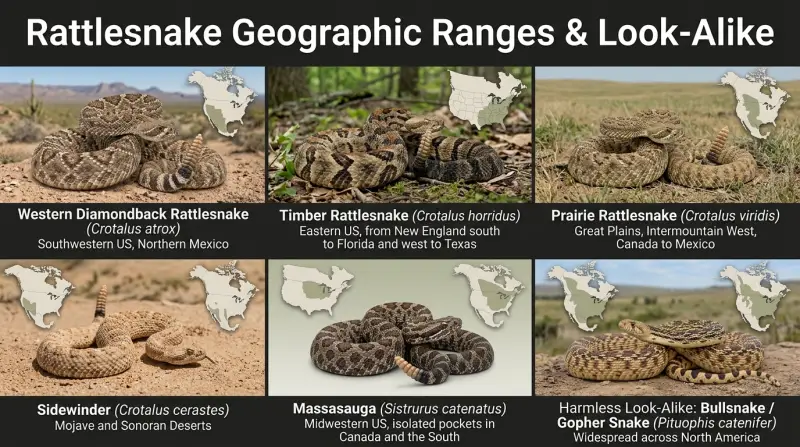
Rattlesnake Identification Chart
- Universal Pit Viper Features: Every true rattlesnake possesses a keratinous rattle, vertical elliptical (“cat-like”) pupils, heat-sensing loreal pits, and undivided subcaudal scales past the vent.
- Head Shape is Informative but Secondary: While rattlesnakes have broad, triangular heads distinct from slender necks, many harmless snakes (like water snakes and hog-nosed snakes) intentionally flatten their heads when threatened. Always look for loreal pits and pupils first.
- The Rattle Can Be Missing: Newborns possess only a small “pre-button,” and adult rattlesnakes can lose segments of their rattle due to trauma, weathering, or shedding cycles. Never assume a rattlesnake-like snake is harmless simply because it lacks a loud rattle.
- Geographic Range Context: Color and pattern variations within species (e.g., the Crotalus oreganus complex) mean geographic location is often the most reliable secondary filter for identification.
- Behavioral Mimicry: Bullsnakes, gopher snakes, and racers frequently perform aggressive defensive displays, striking postures, and tail-vibrating to mimic rattlesnakes.
To identify any snake efficiently in the field, field biologists and wildlife control experts rely on a structured anatomical checklist. The following master data table outlines the core morphological markers used to separate true rattlesnakes from harmless look-alikes and organizes major North American rattlesnake classifications.
| Taxonomic Group / Species | Primary Geographic Range | Distinctive Pattern & Coloration | Key Structural Identifier |
|---|---|---|---|
| Western Diamondback Rattlesnake (Crotalus atrox) | Southwestern US, Northern Mexico | Light-bordered dark diamond blotches along the back; distinct black and white alternating rings on the tail. | Robust body, heavy supraorbital ridges above the eyes, highly aggressive when cornered. |
| Timber Rattlesnake (Crotalus horridus) | Eastern US, from New England south to Florida and west to Texas | Varying phase; dark crossbands or chevrons on a yellowish, brown, or gray background; distinctive rust-colored dorsal stripe. | Velvety-smooth scales between bands; blocky, massive head; dark tail tip in light phases. |
| Prairie Rattlesnake (Crotalus viridis) | Great Plains, Intermountain West, Canada to Mexico | Light-edged greenish-brown, olive, or yellowish blotches running down the back, alternating with side spots. | Slenderer build than diamondbacks; distinct white facial stripes running diagonally from eye to jaw. |
| Sidewinder (Crotalus cerastes) | Mojave and Sonoran Deserts | Small, sandy-colored or cream body with faint darker blotches matching desert sand. | Prominent, horn-like raised scales directly above the eyes; distinctive lateral looping locomotion. |
| Massasauga (Sistrurus catenatus) | Midwestern US, isolated pockets in Canada and the South | Small, stocky body with bold, dark brown dorsal blotches and three rows of alternating smaller spots on flanks. | Pygmy rattlesnake relative: Features 9 large, symmetrical scales on the top of the head instead of small irregular scales. |
| Harmless Look-Alike: Bullsnake / Gopher Snake (Pituophis catenifer) | Widespread across North America | Yellowish or cream with dark brown, black, or reddish-brown blotches mimicking rattlesnakes. | Round pupils, narrow head that is not distinctly wider than the neck, smooth subcaudal scales split in two, no rattle. |
Reading this table requires examining specimens from head to tail. While color and blotch patterns help narrow down regional species, structural features such as pupil shape, facial pits, and tail undersides provide definitive verification.
Anatomical Markers: How to Spot a Pit Viper
Rattlesnakes belong to the subfamily Crotalinae, commonly known as pit vipers. This classification separates them from non-venomous colubrids and elapids through specialized evolutionary adaptations designed for nocturnal hunting and defensive strike accuracy.
When assessing a snake from a safe distance, you must look beyond surface camouflage and examine specific physiological components.
1. Facial Pit Organs (Loreal Pits)
The defining anatomical feature of all pit vipers is the deep loreal pit located on each side of the head, positioned between the nostril and the eye. These membrane-lined organs are sophisticated thermal sensors capable of detecting minute infrared radiation (heat signatures) emitted by warm-blooded prey, such as rodents and birds. If you spot a facial indentation between the eye and nostril that resembles a second nostril, you are looking at a venomous pit viper. Harmless North American snakes completely lack these pits.
2. Pupil Shape and Eye Structure
In bright lighting, rattlesnakes feature vertical, elliptical pupils—often described as cat-like—which help them regulate light intake across varying diurnal and nocturnal activity cycles. Most harmless snakes native to North America possess round pupils. However, caution is required: certain nocturnal or crepuscular non-venomous snakes (such as night snakes) can also exhibit vertical pupils. Therefore, pupil shape should never be used as the sole diagnostic criterion.
3. Head Geometry and Neck Constriction
Rattlesnakes typically possess broad, triangular, or spade-shaped heads that flare out dramatically behind a narrow neck. This triangular shape accommodates large venom glands and specialized jaw musculature. While this is a useful general rule, it is also one of the most frequently misunderstood traits. Many non-venomous species—including water snakes, garter snakes, and hog-nosed snakes—flatten their heads into wide, triangular shapes when threatened to mimic vipers. Always cross-reference head shape with the presence of loreal pits and rattles.
4. Scale Structure Underneath the Tail
If an expert must examine a deceased or safely immobilized specimen, the subcaudal scales (the scales on the underside of the tail between the vent and the tail tip) provide absolute confirmation. In rattlesnakes and other pit vipers, these scales are single plates (undivided). In most harmless North American snakes, these scales split into pairs.
The Rattle: Structure, Purpose, and Misconceptions
The iconic rattle is composed of modified, interlocking segments of keratin—the same protein found in human fingernails and hair. Each time the snake sheds its skin, a new segment is added to the base of the rattle.
Popular folklore dictates that you can determine a rattlesnake’s exact age by counting the segments on its rattle, adding one year for each segment. This is a biological fallacy for several reasons:
- Shedding Frequency: Rattlesnakes do not shed a fixed number of times per year. Shedding frequency depends on growth rate, food availability, and environmental temperature, often occurring two to four times annually in younger, fast-growing snakes.
- Mechanical Breakage: The fragile keratin segments frequently break off due to wear and tear as the snake navigates rocks, dense brush, and burrows. An adult rattlesnake with a massive body might only retain a three-segment stub.
- The Neonate “Pre-Button”: Newborn rattlesnakes are born with a single, rounded soft segment called a “pre-button.” They cannot make a sound until they undergo their first skin shed, which transforms the pre-button into the first functional interlocking rattle segment. Consequently, a young rattlesnake may strike silently without giving an audible warning.
Major Rattlesnake Species Classifications
North America is home to over 30 distinct species of rattlesnakes and numerous subspecies, spanning ecosystems from alpine forests and coastal chaparral to arid deserts and swampy wetlands. Below is a detailed breakdown of the major groups encountered in the field.
Arid and Desert Species
Desert-adapted rattlesnakes exhibit specialized coloration designed for cryptic camouflage against sand, caliche, and volcanic rock.
- Sidewinder (Crotalus cerastes): Found in the sandy deserts of the American Southwest, this smaller rattlesnake is easily identified by the raised, horn-like supraorbital scales above its eyes. Its unique “sidewinding” locomotion prevents its body from sinking into loose sand.
- Mojave Rattlesnake (Crotalus scutulatus): Renowned for possessing one of the most potent neurotoxic and hemotoxic venom combinations in North America. They vary from greenish-gray to olive, featuring light-bordered diamond blotches. They share habitats with the Western Diamondback, making scale count rows around the eye and tail band comparisons critical.
- Tiger Rattlesnake (Crotalus tigris): Native to south-central Arizona and northern Mexico, this species features a small head relative to its body and numerous narrow, vertical gray or purplish bands resembling a tiger’s stripes.
Eastern and Woodland Species
Eastern rattlesnakes favor forested hillsides, river bottoms, and coastal pine flatwoods.
- Timber Rattlesnake (Crotalus horridus): A heavy-bodied forest dweller with distinct dark chevron bands across a sulfur-yellow, tan, or charcoal background. They exhibit remarkable regional color polymorphism, with some northern populations appearing almost entirely black (melanistic).
- Massasauga and Pygmy Rattlesnakes (Genus Sistrurus): These are dwarf rattlesnakes. The Eastern Massasauga features striking brown blotches on a gray background and is distinguished from true Crotalus species by the presence of nine large, symmetrical plates on top of its head rather than numerous small scales. Their rattles produce a high-pitched, buzzing sound resembling an insect rather than a deep rattle hiss.
To further clarify the morphological differences across varied habitats, the following chart compares physical size, venom potency trends, and primary defense behaviors among representative species.
| Species Name | Average Adult Length | Primary Venom Component | Typical Defensive Posture |
|---|---|---|---|
| Western Diamondback | 3.5 – 5.5 feet | Hemotoxic (tissue destruction, clotting disruption) | Coiled tightly, elevated S-curve strike posture, aggressive rattling. |
| Timber Rattlesnake | 3.0 – 5.0 feet | Hemotoxic / Neurotoxic variance (regional) | Often docile initially; freezes or coils sluggishly before rattling. |
| Mojave Rattlesnake | 2.0 – 4.0 feet | Neurotoxic (Mojave toxin) + Hemotoxic | Highly reactive, nervous disposition, rapid rattling. |
| Sidewinder | 1.5 – 2.5 feet | Cytotoxic / Hemotoxic | Subtle coiling, frequently burrows into sand, active nocturnal movement. |
| Massasauga | 1.5 – 2.5 feet | Hemotoxic / Cytotoxic | Secretive, relies on camouflage; vibrates tail rapidly in grass. |
Harmless Look-Alikes and Mimicry
One of the greatest challenges in snake identification is distinguishing true rattlesnakes from harmless colubrids that have evolved defensive mimicry. Because rattlesnakes are formidable predators and dangerous to attack, many non-venomous snakes have evolved physical markings and behavioral routines that trick predators into believing they are venomous pit vipers.
1. Bullsnakes and Gopher Snakes (Pituophis catenifer)
Bullsnakes are frequently mistaken for Western Diamondbacks or Prairie Rattlesnakes due to their yellowish-tan skin and dark brown blotching. When threatened, a bullsnake will flatten its head into a triangular spade shape, inflate its lungs to hiss loudly, and rapidly vibrate its tail against dry leaves to produce a realistic rattling sound.
How to tell the difference: Check the tail and head. Bullsnakes have smooth subcaudal scales, round pupils, no loreal pits, and a tapering tail that ends in a solid point without keratin rattle segments.
2. Eastern and Western Hog-Nosed Snakes (Heterodon species)
Hog-nosed snakes feature upturned snouts used for digging up amphibians. When cornered, they flatten their necks like cobras, hiss loudly, and strike defensively. If that fails, they roll onto their backs, emit a foul musk, and play dead with their mouths open.
How to tell the difference: Their upturned snout, round pupils, lack of loreal pits, and completely non-venomous anatomy easily separate them from rattlesnakes.
3. Eastern Milk Snakes and Fox Snakes
Often confused with timber rattlesnakes or pigmy rattlesnakes in eastern and midwestern states due to their blotched patterns. Milk snakes belong to the kingsnake family and are completely harmless constrictors that feed on rodents and other snakes.
Field Identification Protocol: Step-by-Step Decision Framework
When you encounter a snake in the wild, panic is your worst enemy. Follow this methodical four-step field framework to identify the animal safely and maintain a safe distance.
- Freeze and Assess Distance: Stop moving immediately. Give the snake a minimum of six feet of clearance—or twice the snake’s estimated body length. Most rattlesnake strikes occur when people step on or attempt to handle or harass the animal.
- Scan the Tail End First: Look at the tail tip. Do you see interlocking rattle segments? Remember that neonates may have a silent pre-button, and adults may have damaged rattles, so a missing rattle does not guarantee a harmless snake.
- Examine Head Morphology and Pits: Look at the sides of the head. Can you spot a loreal pit between the eye and nostril? Is the head noticeably wider than the neck? Check the pupil shape if lighting and distance allow.
- Evaluate Pattern and Location: Compare the dorsal markings against regional field guides. Consider your geographic location: high-altitude mountains, Sonoran desert floor, or eastern deciduous forest. Location narrows down possibilities faster than color alone.
- Back Away Slowly: Once you have identified the snake, slowly back away in the direction you came. Give the snake room to slither away into cover. Never attempt to kill, capture, or move a rattlesnake yourself; the vast majority of snakebites happen when individuals attempt to engage the animal.
Common Mistakes in Snake Identification
Even experienced outdoorsmen occasionally misidentify snakes due to deeply ingrained myths. Avoid these common identification traps:
- Relying Solely on Head Shape: Assuming any snake with a triangular head is a rattlesnake will lead to killing harmless gopher snakes, water snakes, and green snakes that flatten their heads defensively.
- Assuming All Rattlesnakes Rattle First: Many rattlesnakes—particularly cooler individuals in the morning or heavily pressured specimens—will remain completely silent, relying on camouflage rather than revealing their position with an auditory warning.
- Believing Bright Colors Mean Non-Venomous: While coral snakes follow the “red on yellow, kill a fellow” rhyme for elapid identification, rattlesnakes vary from jet black (melanistic) to sandy pink, olive green, and stark white. Never use color brightness as a safety indicator.
- Counting Rattle Segments for Age: As established, shedding frequency and breakage render rattle-segment counting scientifically inaccurate.
Frequently Asked Questions
Yes, baby rattlesnakes can bite and possess fully functional venom from birth. The persistent myth that baby rattlesnakes are more dangerous because “they cannot control the amount of venom they inject” is false; however, neonates are more unpredictable, easily startled, and lack a fully developed rattle (possessing only a silent pre-button), making them harder to detect auditorily.
The vast majority of adult rattlesnakes possess a rattle. However, rare genetic anomalies, severe physical injuries, or shedding complications can result in a rattlesnake losing its rattle entirely. , newborn rattlesnakes only have a pre-button that makes no sound when vibrated.
A common misconception is that rattlesnakes can leap their entire body length. In reality, a rattlesnake can strike effectively from a coiled position at a distance equal to roughly one-third to one-half of its total body length (typically between 1.5 to 3 feet for average-sized adults).
Remain as calm as possible to keep your heart rate down and slow the spread of venom. Remove rings, watches, or tight clothing near the bite area before swelling begins. Do not cut the wound, attempt to suck out venom with your mouth or a commercial extractor, apply ice, or use a tourniquet. Call 911 immediately or transport the victim to the nearest emergency medical facility equipped with antivenom.
To make your property less hospitable to rattlesnakes, remove potential rodent habitats such as woodpiles, tall grass, dense brush, and debris piles. Seal gaps beneath porches, sheds, and foundations. Installing fine wire mesh fencing around property perimeters can also prevent snakes from entering living areas.
Conclusion
Accurate rattlesnake identification is a combination of understanding universal pit viper morphology—such as loreal pits, vertical pupils, and subcaudal scale structure—and recognizing regional species variations and behavioral mimicry. While color patterns and head shapes provide helpful initial clues, relying on a systematic identification checklist ensures you never mistake a harmless gopher snake for a venomous pit viper. By respecting wildlife boundaries, maintaining situational awareness in snake country, and applying the identification principles outlined in this chart, you can safely coexist with these vital native predators.