
Few migratory species capture the anticipation of anglers or the ecological complexity of river ecosystems quite like the clupeid family, commonly known as shad and river herring. Every spring, these anadromous travelers leave the open expanse of the Atlantic Ocean and coastal waters to push into tidal rivers, launching one of the most reliable seasonal runs in North America. For anglers tracking the famous spring shad run or fisheries biologists monitoring watershed health, accurate identification is essential. However, because multiple shad and herring species share overlapping habitats, similar silvery appearances, and parallel migration schedules, visual identification can easily lead to confusion.
This master guide provides a comprehensive shad identification chart framework, breaking down the anatomical markers, morphological differences, and behavioral traits that separate American shad, hickory shad, gizzard shad, threadfin shad, and related river herring. By examining key diagnostic features—ranging from jaw alignments and gill raker counts to pigmentation patterns and body depths—you can master the art of field identification.
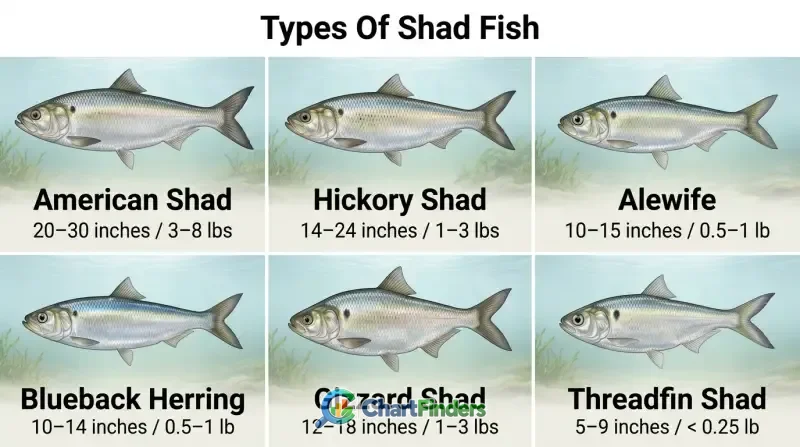
Shad Identification Chart
- Jaw Structure is Diagnostic: American shad have an equal jaw or a lower jaw fitting into a distinct upper notch; hickory shad have a pronounced, protruding lower jaw that extends past the upper jaw.
- Spot Patterns Vary: American shad typically show a single, prominent dark shoulder spot followed by faint rows; hickory shad exhibit a more extended series of dark spots running horizontally along the upper flank.
- Body Depth Matters: True anadromous shad (American and hickory) generally have deeper, more compressed bodies compared to the slender, streamlined profiles of river herring.
- Freshwater Residents Differ: Landlocked species like gizzard shad and threadfin shad feature a distinct last dorsal ray elongated into a whip-like filament, separating them from anadromous sea-run species.
- Internal Anatomy Clues: When external features overlap, checking the color of the abdominal lining (peritoneum) is the definitive method for separating alewife (milky-white) from blueback herring (jet-black).
To accurately identify members of the family Clupeidae in the field, biologists and knowledgeable anglers rely on a standardized matrix of external and internal characteristics. The following chart outlines the primary diagnostic features of the most common shad and herring species encountered in North American waters.
| Common Name | Scientific Name | Max Size / Weight | Jaw Alignment | Shoulder Spot Pattern | Key Identifying Feature | Primary Habitat |
|---|---|---|---|---|---|---|
| American Shad | Alosa sapidissima | 20–30 inches / 3–8 lbs | Lower jaw fits into notch in upper jaw | One prominent dark spot behind gill cover, often followed by 1–2 secondary spots | Deep, compressed body; silvery green back | Anadromous; Atlantic & Pacific coasts |
| Hickory Shad | Alosa mediocris | 14–24 inches / 1–3 lbs | Lower jaw clearly projects past upper jaw | Row of multiple dark spots extending horizontally along upper flank | Slender body compared to American shad; steep head profile | Anadromous; Atlantic coast (Florida to Gulf of Maine) |
| Alewife | Alosa pseudoharengus | 10–15 inches / 0.5–1 lb | Lower jaw slightly projects | Single dark shoulder spot | Large eye (greater than snout length); pale/milky peritoneum | Anadromous & landlocked populations |
| Blueback Herring | Alosa aestivalis | 10–14 inches / 0.5–1 lb | Lower jaw slightly projects | Single dark shoulder spot | Smaller eye; jet-black internal peritoneum | Anadromous; Atlantic coast rivers |
| Gizzard Shad | Dorosoma cepedianum | 12–18 inches / 1–3 lbs | Subterminal mouth (underslung) | Single dark shoulder spot behind gill | Elongated last dorsal fin ray (filament); blunt snout | Freshwater lakes, reservoirs, large rivers |
| Threadfin Shad | Dorosoma petenense | 5–9 inches / < 0.25 lb | Terminal to subterminal mouth | Faint shoulder spot | Extremely long dorsal filament; yellowish fins | Warm freshwater lakes and rivers |
When analyzing this table, notice how the family splits into two primary ecological groups: anadromous clupeids that spend their adult lives in the marine environment and spawn in freshwater rivers, and purely freshwater clupeids that complete their entire life cycle in lakes, reservoirs, and slow-moving river systems. Understanding this ecological context immediately narrows down your identification options based on geographic location and watershed type.
Visualizing Clupeid Size and Weight Comparisons
To further assist with field identification, comparing the average adult size and weight ranges of these species highlights why size alone is rarely sufficient for a positive ID. While American shad easily dwarf threadfin shad, overlapping size ranges between hickory shad, alewives, and blueback herring make anatomical markers essential.
| Species Group | Typical Adult Length Range | Average Adult Weight | Body Proportions |
|---|---|---|---|
| Large Anadromous Shad (American) | 18 to 30 inches | 3.0 to 8.0 lbs | Deep, highly compressed sides, robust dorsal hump |
| Medium Anadromous Shad (Hickory) | 14 to 24 inches | 1.0 to 3.0 lbs | Elongated, torpedo-shaped, less deep than American shad |
| River Herring (Alewife / Blueback) | 10 to 15 inches | 0.4 to 1.0 lb | Slender, sleek, laterally compressed |
| Freshwater Shad (Gizzard / Threadfin) | 6 to 18 inches | 0.2 to 3.0 lbs | Deep, disk-shaped body, highly compressed |
Anatomical Markers for Accurate Shad Identification
Differentiating between closely related shad species requires a systematic evaluation of physical anatomy. Because environmental conditions can cause slight variations in coloration, field biologists rely on fixed structural traits.
1. Mouth Structure and Jaw Alignment
The single most reliable external feature separating American shad from hickory shad is the mouth.
- American Shad: The lower jaw fits snugly into a distinct V-shaped notch located in the center of the upper jaw. When the mouth is closed, the jawlines are relatively even, giving the head a smooth, tapered profile.
- Hickory Shad: The lower jaw is heavily pronounced and projects significantly past the upper jaw. When closed, the lower jaw gives the fish an underslung, aggressive, almost predatory facial expression resembling a miniature tarpon.
2. Pigmentation and Spotting Patterns
While almost all clupeids feature a dark spot immediately behind the upper margin of the gill cover (the operculum), the secondary spots tell the story:
- American Shad: Features one primary shoulder spot, followed by one or two rows of smaller, fainter spots running along the upper flanks. These secondary spots are often difficult to see on freshly caught fish until the slime layer dries slightly.
- Hickory Shad: Features a prominent shoulder spot followed by a distinct horizontal row of 4 to 7 (or more) dark spots extending along the upper side toward the tail. This multi-spotted appearance is a hallmark of the species.
3. Body Depth and Proportions
Body depth relative to total length provides a strong visual cue when handling fish in hand:
- American Shad: Possesses a notably deep, wide body profile. The dorsal curve rises steeply behind the head, creating a broad, powerful swimming engine designed for long ocean migrations.
- Hickory Shad: Noticeably more slender and streamlined, with a narrower body depth and a more gradual taper from head to tail.
4. Gill Raker Counts and Internal Anatomy
For definitive taxonomic verification, fisheries scientists examine internal structures such as gill rakers and abdominal linings. Gill rakers are bony, comb-like structures along the inner gill arches that filter plankton from water:
- American Shad: Possess numerous, long, fine gill rakers (often exceeding 40 on the lower limb of the first arch in adults) to filter microscopic zooplankton.
- Hickory Shad: Feature fewer and shorter gill rakers compared to American shad, reflecting their more piscivorous (fish-eating) diet, as they actively hunt small baitfish in rivers.
- Peritoneum Analysis: As noted with river herring, checking internal membrane pigmentation prevents misidentifying alewives and blueback herring.
Detailed Breakdown of Individual Species
Examining each species individually ensures that you understand their unique ecological niches, geographical distributions, and specific identification nuances.
American Shad (Alosa sapidissima)
The American shad is the largest of the anadromous herrings found in North American waters. Its species name, sapidissima, translates literally to “most delicious,” reflecting its historical and culinary importance. Found natively along the Atlantic coast from Florida to the St. Lawrence River in Canada (as well as successfully introduced to the Pacific coast in the late 19th century), American shad are powerful swimmers.
Key ID Checklist:
- Bluish-green to dark metallic back shading into brilliant, mirror-like silvery sides.
- Lower jaw fitting neatly into the upper jaw notch.
- Single dark shoulder spot, sometimes accompanied by faint rows behind it.
- Deep, highly compressed body with sharp, serrated ventral scutes (keeled scales along the belly that feel rough like a saw blade).
Hickory Shad (Alosa mediocris)
Hickory shad are native exclusively to the Atlantic coast, ranging from Florida north to the Gulf of Maine, with strong runs concentrated in mid-Atlantic tidal rivers such as the Chesapeake Bay tributaries, the Roanoke, and the Connecticut River. They generally enter freshwater rivers slightly earlier in the spring than American shad, often arriving when water temperatures reach the upper 40s to low 50s Fahrenheit.
Key ID Checklist:
- Distinctly protruding lower jaw.
- Multiple dark spots aligned in horizontal rows along the upper back and shoulders.
- Slender, torpedo-like body profile.
- Steeper head angle compared to the smooth taper of the American shad.
River Herring: Alewife and Blueback Herring
Often grouped together under the general term “river herring,” the alewife (Alosa pseudoharengus) and blueback herring (Alosa aestivalis) are smaller anadromous clupeids that migrate alongside shad. Because their external appearances are nearly identical, positive identification in the field frequently requires examining internal anatomy.
External Comparison:
- Alewife: Features a noticeably larger eye (the diameter of the eye is typically greater than the length of the snout) and a deeper body than the blueback herring. The back is a bluish-gray.
- Blueback Herring: Features a smaller eye (diameter is less than or equal to snout length) and a more slender, elongated body with a distinctly deep-blue or indigo back.
Internal Diagnostic Test (Peritoneum Color):
When external features leave room for doubt, opening the abdominal cavity is definitive. The peritoneum (the lining of the body cavity surrounding the internal organs) is milky-white or silvery in the alewife, whereas it is jet-black in the blueback herring.
Freshwater Residents: Gizzard Shad and Threadfin Shad
Unlike the anadromous species mentioned above, gizzard shad (Dorosoma cepedianum) and threadfin shad (Dorosoma petenense) live entirely in freshwater lakes, reservoirs, and rivers. They are critically important forage species for freshwater game fish like largemouth bass, striped bass, and muskellunge.
Key ID Checklist:
- Dorsal Filament: Both species feature an easily identifiable, highly elongated last ray on the dorsal fin that streams backward like a whip or thread. This feature is entirely absent in anadromous shad and river herring.
- Mouth Position: Their mouths are subterminal (underslung), adapted for vacuuming detritus, algae, and microscopic plankton off the bottom substrate.
- Body Shape: Gizzard shad are deep-bodied and blunt-nosed, while threadfin shad are smaller, more streamlined, and often exhibit yellowish or golden hues on their fins.
Ecological Significance and Sensory Adaptations
Shad play a vital foundational role in aquatic ecosystems. As anadromous species, they act as a biological bridge, transporting marine-derived nutrients from the Atlantic Ocean into freshwater river systems during their massive spring spawning runs. Their eggs, juveniles, and adult bodies provide an essential energy source for a vast array of predators, including bald eagles, ospreys, striped bass, flathead catfish, and marine mammals.
, recent fisheries research highlights the extraordinary sensory biology of shad. American shad possess an acute auditory and lateral line system. They feature fine sensory hairs in their otoliths (inner ear bones), a complex network of water-filled cephalic lateral channels, and a specialized swim bladder extension that connects directly to the brain capsule. This hyper-sensitive biological radar allows shad to detect subtle pressure waves and high-frequency sounds, including the echolocation clicks of predatory dolphins and marine mammals.
For anglers, understanding this sensory awareness explains why shad are so responsive to flashing spoons, brightly colored jigs, and erratic retrieval movements that mimic injured baitfish or trigger lateral line vibrations in murky spring runoff.
Common Identification Mistakes and Pitfalls
Even experienced anglers and field technicians occasionally misidentify clupeids due to overlapping morphological traits and natural biological variation. Avoiding these common pitfalls ensures accurate identification:
- Assuming Size Equals Species: It is a common mistake to assume that any large shad is automatically an American shad and any small shad is a hickory shad. Large female hickory shad can easily equal or exceed the weight of smaller, male American shad. Always check jaw alignment and spot patterns rather than relying strictly on length or weight.
- Overlooking Hybridization: American shad and hickory shad are closely related and occasionally hybridize in shared spawning grounds. Hybrids display intermediate jaw structures and confusing spot arrangements, making positive identification difficult without genetic testing. When in doubt, note the primary diagnostic features and record it as a suspected hybrid.
- Confusing River Herring with Juvenile Shad: Young-of-the-year American and hickory shad look very similar to adult river herring. When sampling juvenile fish in tidal nurseries, scale counts and gill raker examinations under a microscope are often required for verification.
- Failing to Check Peritoneum Color: Trying to separate alewives from blueback herring by external coloration alone leads to frequent errors, as water staining and post-mortem fading alter appearance. Always perform the internal peritoneum check when conducting formal surveys.
Frequently Asked Questions
Look directly at the mouth. If the lower jaw fits neatly into a notch in the upper jaw, it is an American shad. If the lower jaw projects prominently past the upper jaw, giving the fish an underslung profile, it is a hickory shad. Additionally, check the flanks: American shad have one main shoulder spot, while hickory shad have a horizontal row of multiple spots.
No, although they belong to the same family (Clupeidae) and share similar migratory habits. Shad (such as American and hickory shad) generally grow larger and possess deeper bodies, whereas river herring (such as alewives and blueback herring) are smaller, sleeker, and have distinct anatomical and internal differences.
No. Gizzard shad and threadfin shad are strictly freshwater fish. They complete their entire life cycles in lakes, rivers, and reservoirs and do not migrate to the sea. They are easily distinguished from sea-run shad by the presence of a long, whip-like filament trailing from the back of their dorsal fin.
The dark shoulder spots serve as an evolutionary defense mechanism. In the fish world, these spots act as “false eyes” (eyespots or ocelli) designed to trick avian and aquatic predators into striking the less-vital shoulder area rather than the head, thereby increasing the fish’s chances of escaping a predator attack.
While American shad are prized for their rich, oily meat and roe, gizzard shad are generally considered unpalatable for human consumption. Gizzard shad have an extremely high bone count, oily flesh that spoils quickly, and a diet consisting heavily of bottom mud and detritus, making them valuable only as game fish bait or forage.
Conclusion
Mastering shad identification requires moving past a glance at a silvery, shimmering fish and examining specific anatomical details. By evaluating jaw alignment, shoulder spot distributions, body depth, and internal pigmentation, you can reliably distinguish between American shad, hickory shad, river herring, and freshwater residents. Whether you are participating in the celebrated spring coastal run or conducting ecological field surveys, utilizing this structured identification framework ensures accuracy and deepens your appreciation for these remarkable migratory fish.