
The discovery of a leathery pouch washed ashore along a coastline immediately prompts curiosity. Commonly referred to as a “mermaid’s purse,” these tough capsules house developing embryos of oviparous cartilaginous fish. However, casual beachcombers and even marine field biologists frequently misidentify these structures, confusing the eggcases of oviparous sharks with those of skates, rays, or chimaeras. Because elasmobranch reproductive strategies vary widely—spanning oviparity, viviparity, and ovoviviparous aplacental/placental modalities—finding an empty or intact eggcase provides a rare window into the benthic nursery grounds of local marine ecosystems.
Accurate identification requires moving beyond general assumptions and utilizing a systematic diagnostic framework. Global citizen science initiatives, such as the Shark Trust’s Great Eggcase Hunt, have cataloged hundreds of thousands of records spanning dozens of species across more than 35 countries, demonstrating that structural morphology is remarkably consistent within taxonomic groups. This guide establishes a rigorous morphological classification framework, comparing physical traits, regional occurrences, and diagnostic markers to help field observers accurately identify elasmobranch eggcases.
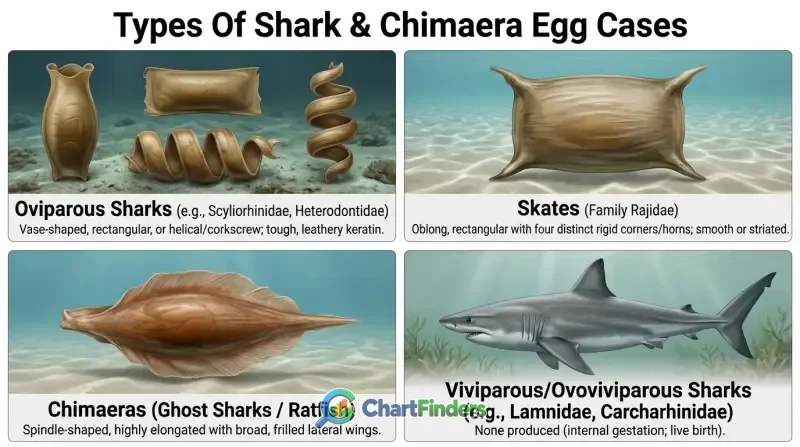
Shark Egg Identification Chart and Morphological Diagnostic Framework
- Shark eggcases are produced exclusively by oviparous (egg-laying) species, which comprise roughly 40% of all chondrichthyan species globally.
- Morphological markers such as helical flanges (corkscrew twists), tendrils, and square or oblong capsule geometry separate shark eggcases from skate and chimaera cases.
- Skate eggcases always feature four distinct rigid horns and are deposited in pairs, whereas shark eggcases are typically laid singly and often feature anchoring tendrils or spiral collars.
- Citizen science databases, including the Shark Trust’s Great Eggcase Hunt, track over 60 global species through verified shoreline discoveries and in situ underwater monitoring (>630,000 total records with an 88% verification rate).
- Post-hatching weathering, sand abrasion, and biological fouling can obscure diagnostic ridges and coloration, requiring tactile and structural examination rather than color matching.
- Eggcase size is a primary diagnostic filter; large capsules (over 15 cm) often indicate benthic catsharks or large skates, while miniature cases point toward smaller dogfish or deepwater species.
To properly interpret a shark egg identification chart, an observer must understand that chondrichthyan reproduction is not uniform. While many sharks are viviparous (giving birth to live young with placental connections) or ovoviviparous (yolk-sac dependent internal hatching), roughly 40% of shark species are oviparous. These egg-laying sharks deposit fertilized zygotes encased in a tough, proteinaceous matrix composed primarily of keratin-like collagen fibers secreted by the shell gland. Over weeks or months, these capsules protect the developing embryo from hydrodynamic stress, UV radiation, and microbial predators.
The physical design of an eggcase is directly tied to its microhabitat and hydrodynamic regime. Species that deposit eggs in high-energy intertidal or shallow subtidal zones often possess long, curling tendrils or sticky fibers that wrap tightly around macroalgae (such as kelp or sargassum) and gorgonian corals. Conversely, deepwater benthic species often produce smooth, rectangular or horned capsules designed to wedge securely into rocky crevices, carbonate ledges, or sandy substrate depressions.
Elasmobranch Reproductive Modes and Eggcase Origins
Before examining specific capsule shapes, it is vital to separate true shark eggcases from those of closely related cartilaginous fishes sharing the class Chondrichthyes. The phylum Chordata contains the class Chondrichthyes, which is divided into two primary subclasses: Holocephali (chimaeras, ghost sharks, and ratfish) and Elasmobranchii (sharks, skates, and rays). Within Elasmobranchii, true rays are almost exclusively viviparous or ovoviviparous, whereas skates (family Rajidae) are strictly oviparous. Consequently, a vast percentage of the “mermaid’s purses” found on temperate beaches originate from skates, not sharks.
Chimaeras (subclass Holocephali) produce spindle-shaped, highly elongated eggcases ornamented with velvety or fibrous lateral wings. Distinguishing between these three major groups prevents fundamental taxonomic errors during initial field sorting.
| Taxonomic Group | Reproductive Mode | Eggcase Shape & Texture | Attachment Mechanism | Common Look-Alikes |
|---|---|---|---|---|
| Oviparous Sharks (e.g., Scyliorhinidae, Heterodontidae) | Oviparous (External egg deposition) | Vase-shaped, rectangular, or helical/corkscrew; tough, leathery keratin. | Long curling tendrils, sticky threads, or rigid anchoring horns. | Skate eggcases, whelk egg masses, synthetic debris. |
| Skates (Family Rajidae) | Oviparous (Paired deposition in benthic sediment) | Oblong, rectangular with four distinct rigid corners/horns; smooth or striated. | Wedged into sediment or anchored via short corner threads/horns. | Shark eggcases, marine bivalve shells. |
| Chimaeras (Ghost Sharks / Ratfish) | Oviparous (Single deposition in deep water) | Spindle-shaped, highly elongated with broad, frilled lateral wings. | Buried partially upright in soft benthic sediment. | Macroalgae pods, strange synthetic pouches. |
| Viviparous/Ovoviviparous Sharks (e.g., Lamnidae, Carcharhinidae) | Viviparous / Aplacental Viviparous / Ovoviviparous | None produced (internal gestation; live birth). | Not applicable. | None (no external capsules). |
The table above outlines the broad diagnostic boundaries. When evaluating an unknown specimen, the presence of spiral flanges immediately narrows the origin to specific shark families like Heterodontidae (horn sharks), whereas four distinct, rigid pointed corners indicate a skate.
Morphological Characteristics Used in Identification
Field identification requires a granular breakdown of physical architecture. When analyzing a capsule, observers should evaluate five primary structural axes:
- Capsule Geometry: The overall silhouette, ranging from oblong rectangular boxes to pear-shaped vases and asymmetrical spiral screws.
- Lateral Flanges and Keels: Raised seams running along the outer edges of the capsule. Some species feature wide, membranous wings that help stabilize the egg in water currents, while others possess simple, narrow rims.
- Horns and Apical Projections: Pointed extensions at one or both ends of the capsule. Skate horns are typically stout and sharp; catshark horns are frequently modified into fine, coiling tendrils.
- Surface Texture and Sculpture: Transverse ridges, longitudinal striations, pits, or velvety coatings (formed by epibiotic fibers or specialized shell gland secretions).
- Coloration and Translucency: Ranging from amber-gold and olive-green when fresh to deep dark brown or jet black after prolonged oxidation and beach weathering. Fresh capsules are often semi-translucent, allowing field biologists to backlight the capsule and view the developing embryo or yolk sac.
Global Distribution and Major Oviparous Shark Families
Oviparous shark species are distributed across temperate, tropical, and deepwater marine environments, though they are particularly diverse within specific taxonomic families. Understanding these families allows researchers to narrow down identifications based on geographic region and habitat depth.
Scyliorhinidae (Catsharks)
Representing the largest family of oviparous sharks, catsharks inhabit shallow coastal waters as well as deep abyssal plains. Catshark eggcases are typically small (5 to 12 cm in length), vase-shaped or oblong, and equipped with long, fibrous tendrils at all four corners. These tendrils wrap around gorgonians or kelp holdfasts. Well-known species include the Lesser Spotted Dogfish (Scyliorhinus canicula) and the Nursehound (Scyliorhinus stellaris) in European waters, as well as various swellsharks (Cephaloscyllium species) in the Pacific.
Heterodontidae (Horn Sharks)
Endemic primarily to temperate and tropical waters of the Indo-Pacific and eastern Pacific, horn sharks are renowned for their unmistakable eggcases. The Port Jackson Shark (Heterodontus portusjacksoni) and related species produce large, dark, pear-shaped capsules wrapped in a prominent, hard, double-helical flange that resembles an auger or drill bit. This structural screw allows the female to wedge the egg securely into rocky crevices using her mouth, preventing dislodgement by heavy surf.
Hemiscylliidae (Bamboo Sharks and Epaulette Sharks)
Common throughout tropical Indo-Pacific coral reefs, bamboo sharks produce rounded or oval, purse-like eggcases lacking the elaborate tendrils of temperate catsharks. Instead, these capsules rely on broad lateral margins and sticky adhesive fibers secreted during deposition, anchoring directly onto flat coral rubble or reef pavement.
Step-by-Step Field Identification Protocol
When encountering an elasmobranch eggcase in the field or along a shoreline drift line, systematic evaluation prevents misclassification. Follow this sequential protocol to identify the specimen:
- Inspect Overall Shape and Symmetry: Is the capsule rectangular, vase-shaped, or corkscrew-shaped? If it features a distinct spiral twist, it is a horn shark (Heterodontidae). If it is a flat, rigid rectangle with four distinct corners, it is almost certainly a skate.
- Examine the Corners and Apical Ends: Look for horns, tendrils, or fibers. Measure the length of any tendrils relative to the body of the capsule. Catshark tendrils are typically exceptionally long and curly, whereas skate horns are stiff and pointed.
- Check for Lateral Keels or Flanges: Measure the width of the outer margin. Does the capsule have a wide, flat fin-like border, or is the edge smooth and rounded?
- Evaluate Texture and Rigidity: Press gently on the walls of the capsule. Fresh or recently stranded capsules retain a leathery, resilient flexibility, whereas dried, weathered specimens become brittle and opaque black. Note any transverse ridges running across the flat faces of the capsule.
- Consult Regional Identification Guides: Cross-reference the morphological traits against local distribution maps. For instance, finding a corkscrew eggcase in the North Atlantic indicates an accidental introduction or misidentification, as horn sharks are native to the Pacific and Indian Oceans.
Common Identification Mistakes and Look-Alikes
Even experienced naturalists occasionally misidentify marine objects washed ashore. Recognizing common pitfalls ensures scientific accuracy:
- Confusing Skate and Shark Eggcases: Because skate eggcases are vastly more common on many temperate beaches, beachcombers frequently label any black leathery pouch as a “shark egg.” Checking for the characteristic helical twist or long anchor tendrils distinguishes true sharks from skates.
- Invertebrate Egg Masses: The coiled, leathery egg masses of large marine gastropods (such as whelks and conchs) are frequently mistaken for elasmobranch capsules. Whelk egg cases consist of long strings of stacked, disc-like pockets rather than a single unified pouch.
- Weathering and Degradation Artifacts: Prolonged exposure to ultraviolet radiation, wave action, and sand scouring can strip away outer velvety layers, blunt delicate horns, and alter coloration from amber to pitch black, masking subtle diagnostic ridges.
- Geographic Range Overlaps: Assuming a species is local based solely on an isolated eggcase finding can be misleading. Ocean currents frequently transport buoyant, empty eggcases across hundreds of miles of open water before stranding them on foreign shores.
Frequently Asked Questions
An empty, successfully hatched shark eggcase typically features a neat, clearly defined slit or opening at the apical end through which the juvenile shark emerged. The walls may also show signs of internal wear or bio-fouling. If the capsule is intact with sealed ends, it may still contain a viable embryo (if found fresh in water) or it may have been aborted prematurely or washed ashore unfertilized. Dried eggcases feel stiff, brittle, and paper-thin.
No. Beach-cast shark and skate eggcases are completely safe to handle. They are composed of inert, non-toxic keratin protein. However, if an eggcase is found live in a tide pool or shallow water during a marine survey, it should be handled minimally and returned gently to the water to avoid disrupting the delicate embryonic development inside.
The distinctive corkscrew or auger flange on horn shark eggcases is an evolutionary adaptation for substrate anchoring. Female horn sharks use their mouths to grab the newly laid, pliable capsule and wedge it deep into rocky crevices or macroalgae beds. The spiral ridges bite into the surrounding substrate, acting like a screw anchor that prevents heavy ocean swells from dislodging the egg during its multi-month incubation period.
None of the large, pelagic apex predators traditionally associated with human attacks—such as Great White Sharks, Tiger Sharks, or Bull Sharks—lay eggs. These species are ovoviviparous or viviparous, giving birth to free-swimming live young. The sharks that produce eggcases are generally smaller, bottom-dwelling coastal or deepwater species, such as catsharks, bamboo sharks, and horn sharks, which pose no threat to humans.
Incubation periods vary widely depending on the species, water temperature, and local environmental conditions. For many temperate catshark and skate species, incubation ranges from 5 to 10 months. In colder deepwater environments, or for certain large species, development can extend past 12 months, making the embryos vulnerable to predation and environmental fluctuations for extended periods.
Conclusion
Mastering shark egg identification transforms a simple walk along the shoreline into an exercise in field ecology. By systematically examining capsule geometry, lateral flanges, surface textures, and anchoring structures, observers can accurately separate oviparous shark species from skates and chimaeras. As citizen science initiatives like the Shark Trust’s Great Eggcase Hunt continue to map global elasmobranch nursery grounds—cataloging hundreds of thousands of specimens across dozens of species—every verified shoreline find contributes vital data to marine conservation, helping researchers protect vulnerable benthic shark populations and their delicate coastal habitats.