
A Shark Identification Chart is a structured visual and taxonomic field reference used to distinguish shark species by analyzing morphology, anatomical landmarks, dentition, fin positioning, and markings. Accurate identification relies on systematic observation of primary features, including gill slit count, presence of an anal fin, nictitating membranes, caudal fin symmetry, and unique anatomical adaptations like lateral keels and subterminal notches.
The vast diversity of elasmobranchs—spanning over 500 recognized species—presents a significant challenge for researchers, commercial fisheries observers, divers, and marine conservationists alike. Because many species exhibit subtle morphological variations, field identification requires an uncompromising eye for structural detail. A single misclassification can distort fisheries catch data, compromise international trade regulations under CITES appendices, or misinform critical ecological conservation assessments. Modern reference tools must go beyond simplistic photographic catalogs, incorporating diagnostic anatomical keys, metric proportions, and biogeographical context.
This comprehensive guide explores the anatomy, taxonomic frameworks, classification challenges, and practical methods required to accurately identify sharks using field charts. By understanding the functional morphology of cartilaginous fishes, you can navigate complex taxonomic keys and distinguish between closely related look-alikes across global marine ecosystems.
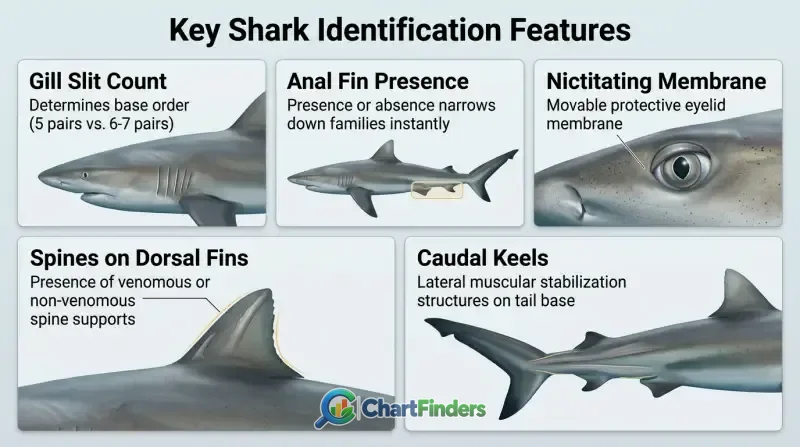
Shark Identification Chart
- Anatomical Landmarks: Reliable identification depends on examining permanent skeletal and soft-tissue structures, including gill slits, fin arrangements, and caudal fin shapes.
- Taxonomic Orders: Sharks are divided into distinct orders (such as Carcharhiniformes, Lamniformes, and Squaliformes) that share broad anatomical blueprints.
- Teeth and Denticles: Jaw structure, tooth cusp morphology, and dermal denticle alignment offer definitive micro-level validation for complex species.
- Geographic Context: Knowing regional distribution and habitat depth is often the fastest way to eliminate impossible look-alike species.
- Fisheries and Regulatory Needs: Accurate field charts support sustainable catch quotas, NOAA species restrictions, and compliance with international protection treaties.
- Common Pitfalls: Relying solely on temporary color patterns or unstandardized body lengths frequently leads to misidentification in the field.
A professional shark identification chart functions as a taxonomic roadmap. To utilize it effectively, one must understand how ichthyologists break down shark anatomy into discrete, measurable diagnostic criteria. The sections below dissect these components, providing the foundational knowledge necessary to interpret any marine field chart.
Core Anatomical Landmarks Used in Field Identification
When field-testing an identification chart, observers must look beyond the animal’s overall size and focus on fixed anatomical landmarks. These features remain stable across age classes and environmental conditions, making them invaluable for scientific documentation.
- Gill Slits: Ranging from five to seven pairs positioned laterally ahead of the pectoral fins. The exact count is a primary taxonomic divider between orders (e.g., Hexanchiformes possess six or seven, while most other sharks possess five).
- First and Second Dorsal Fins: The size, shape, and exact insertion point of the dorsal fins relative to the pectoral and pelvic fins are critical for distinguishing families like Carcharhinidae from Sphyrnidae.
- Anal Fin: Some major orders (such as Squaliformes, Squatiniformes, and Pristiophoriformes) completely lack an anal fin, providing an immediate high-level sorting mechanism.
- Caudal Fin (Tail): The asymmetry of the tail—ranging from heterocercal tails with elongated upper lobes to nearly symmetrical semi-lunate tails found in pelagic speedsters—reveals swimming mechanics and ecological niches.
- Caudal Keels and Pits: Horizontal ridges of skin on the caudal peduncle (the narrow section before the tail) and depressions above/below it indicate high-speed pelagic adaptations common in Lamniformes.
| Anatomical Feature | Diagnostic Purpose | Primary Taxonomic Application |
|---|---|---|
| Gill Slit Count | Determines base order (5 pairs vs. 6-7 pairs) | Separating cow sharks (Hexanchidae) from standard sharks. |
| Anal Fin Presence | Presence or absence narrows down families instantly | Distinguishing dogfishes/angelsharks (no anal fin) from ground sharks. |
| Nictitating Membrane | Movable protective eyelid membrane | Key diagnostic trait for Ground Sharks (Carcharhiniformes). |
| Spines on Dorsal Fins | Presence of venomous or non-venomous spine supports | Identifies Squaliformes (dogfishes) and Heterodontiformes (bullhead sharks). |
| Caudal Keels | Lateral muscular stabilization structures on tail base | Isolating Lamniformes (mackerels, great whites) from coastal bottom-dwellers. |
The table above outlines the foundational reference points found on standardized marine identification placards. Mastering these markers allows an observer to progress from general classification to species-level verification.
Major Shark Orders and Their Diagnostic Blueprint
Shark taxonomy is organized into hierarchical orders, each representing distinct evolutionary lineages. Understanding these orders prevents observers from confusing unrelated species that happen to share superficial body shapes.
Carcharhiniformes (Ground Sharks)
Representing the largest order of sharks, ground sharks account for over half of all living species. Key features include the presence of an anal fin, two spineless dorsal fins, and a nictitating membrane protecting the eye. This order includes iconic families such as Carcharhinidae (requiem sharks, including tiger, bull, and blue sharks) and Sphyrnidae (hammerheads).
Lamniformes (Mackerel Sharks)
Built for high-speed open-ocean cruising, mackerel sharks feature large gill slits, stout bodies, and strong caudal keels paired with nearly symmetrical caudal fins. This order includes apex predators like the Great White Shark, Shortfin Mako, and Porbeagle, alongside filter-feeding giants like the Basking Shark.
Squaliformes (Dogfish Sharks)
Typically smaller-bodied, deep-water or cold-water inhabitants, Squaliformes lack an anal fin and possess spines preceding both dorsal fins (with exceptions like sleeper sharks). The Spiny Dogfish is the most extensively documented species within this group.
Orectolobiformes (Carpet Sharks)
Characterized by barbels on the nostrils, small mouths positioned forward of the eyes, and often complex, mottled camouflage patterns. This diverse order ranges from bottom-dwelling wobbegongs and nurse sharks to the massive, pelagic Whale Shark.
Decoding Dentition: Tooth Morphology as a Definitive Key
When external body shape and color patterns fail to provide a definitive answer, shark teeth serve as the ultimate biological fingerprint. Shark dentition varies radically depending on diet and trophic level.
- Apex Predation (Generalist/Mammal Hunters): Broad, triangular, serrated teeth (e.g., Great White Shark) designed for slicing through blubber and bone.
- Piscivorous (Fish Eaters): Long, slender, needle-like or smooth-edged cusp teeth (e.g., Sand Tiger Shark or Shortfin Mako) engineered to pierce and hold slippery teleost fish.
- Durophagous (Shell Crushers): Flattened, pavement-like molariform teeth designed for crushing hard-shelled invertebrates like crabs, lobsters, and mollusks (e.g., Horn Sharks).
- Planktivorous (Filter Feeders): Vestigial or extremely minute, non-functional teeth arranged in dense rows, as the animal relies entirely on gill rakers for feeding (e.g., Basking Shark and Whale Shark).
Expert Field Insight: The Danger of Relying on Coloration
One of the most frequent errors made by amateur naturalists is relying heavily on dorsal skin coloration for identification. Shark skin color varies widely based on geographic population, water turbidity, post-mortem preservation, and individual age classes. Juveniles often exhibit darker countershading or pronounced spotting (such as tiger shark vertical banding) that fades significantly into uniform grey as the animal matures. Always prioritize skeletal proportions and anatomical counts over color.
Step-by-Step Field Identification Methodology
To use a physical shark identification chart successfully in the field or at a fisheries dock, follow a systematic elimination process:
- Check for the Anal Fin: Look immediately behind the pelvic fins. If there is no anal fin, you are looking at specialized groups like dogfishes, sawsharks, or angelsharks.
- Count the Gill Slits: If there are 6 or 7 pairs, you have identified the Cow Shark family. If there are 5 pairs, proceed to the next step.
- Examine the Dorsal Fins: Check for dorsal fin spines. If present, evaluate whether the first dorsal spine originates over the pectoral fins or behind them. Note the relative sizes of the first and second dorsal fins.
- Analyze Head and Snout Proportions: Measure or estimate snout length relative to mouth width. Examine the head laterally for lateral expansions (hammerheads) or barbels (carpet sharks).
- Inspect Caudal Peduncle and Keels: Feel or look at the base of the tail. Are lateral keels present? Is there a precaudal pit? These features separate pelagic mackerel sharks from coastal requiem sharks.
Common Identification Mistakes and Look-Alikes
Even seasoned observers encounter challenging identification hurdles due to convergent evolution and sexual dimorphism. Recognizing common look-alike traps prevents costly classification errors.
Scalloped Hammerhead vs. Smooth Hammerhead vs. Great Hammerhead
Distinguishing hammerhead species requires examining the front margin of the cephalofoil (the flattened head). The Great Hammerhead (Sphyrna mokarran) features a nearly straight anterior margin with a distinct central indentation. The Scalloped Hammerhead (Sphyrna lewini) features a central indentation accompanied by well-defined lateral indentations. The Smooth Hammerhead (Sphyrna zygaena) lacks a central indentation entirely and possesses a broadly rounded front margin.
| Hammerhead Species | Maximum Size | Cephalofoil Anterior Margin | Central/Lateral Indentations |
|---|---|---|---|
| Great Hammerhead (Sphyrna mokarran) | Up to 15 ft (4.5 m) | Nearly straight | Distinct central indentation, slight lateral indentations |
| Smooth Hammerhead (Sphyrna zygaena) | Up to 12 ft (3.7 m) | Broadly rounded | No central indentation |
| Scalloped Hammerhead (Sphyrna lewini) | Up to 11 ft (3.4 m) | Arched / Curved | Central indentation with prominent lateral indentations |
Sand Tiger vs. Sandbar vs. Dusky Shark
In coastal fisheries management, distinguishing between these medium-to-large sharks is critical due to conservation restrictions. The Sand Tiger (Carcharias taurus) has a distinct snout, prominent protruding teeth, and two nearly equal-sized dorsal fins. In contrast, the Sandbar Shark (Carcharhinus plumbeus) is instantly recognized by its extraordinarily tall first dorsal fin originating directly over the insertion point of the pectoral fins, coupled with an inter-dorsal ridge.
Frequently Asked Questions
The presence or absence of the anal fin is universally considered the primary top-level sorting criterion. Determining whether an anal fin exists immediately divides the entire shark population into two major groups, eliminating over half of potential family options instantly.
Dermal denticles (microscopic, tooth-like skin scales) dictate skin texture and hydrodynamics. In advanced taxonomy, scanning electron microscopy or tactile examination of denticle crown shapes, ridge counts, and overlap patterns provides definitive proof for cryptic species that look identical externally.
Fisheries management agencies, such as NOAA, distribute strict identification placards to commercial and recreational vessels. Certain species (like oceanic whitetips, hammerheads, and silky sharks) carry strict retention bans or seasonal closures. Observers rely on charts to enforce compliance and record accurate catch composition data.
While clear, high-resolution underwater photographs showing distinct markings, fin geometry, and eye structure can identify many common species, ambiguous angles, poor lighting, and juvenile coloration changes often make photographic ID unreliable without supporting anatomical measurements.
Professional identification guides are usually segregated by geographic region (e.g., Northeast Atlantic, Gulf of Mexico, Indo-Pacific) because many morphologically similar species inhabit entirely different oceans, allowing biogeography to assist in species separation.
Conclusion
Navigating the biological diversity of elasmobranchs requires more than casual observation; it demands a disciplined, analytical approach anchored in established morphological principles. Whether utilized by marine biologists monitoring ecosystem health, fisheries managers enforcing conservation policies, or divers documenting marine life, a well-structured shark identification chart transforms complex anatomical data into actionable clarity. By focusing on permanent structural markers—such as gill slit counts, fin arrangements, and dentition—observers can cut through superficial variations and achieve precise, reliable species identification across global waters.