
Managing turfgrass and garden soil damage often begins beneath the surface. When lawns develop irregular brown patches, feel spongy underfoot, or attract foraging wildlife like raccoons, skunks, and birds, the culprit is frequently a population of white grubs. These soil-dwelling organisms are not a single species, but rather the larval stage of various scarab beetles. Because different species vary significantly in their life cycles, feeding intensity, and resistance to cultural or chemical controls, generalized treatments rarely succeed. Proper identification is the of any effective lawn or garden management plan.
Distinguishing one white grub species from another requires looking past their uniform cream-colored bodies and C-shaped postures. While most grubs share a general appearance, microscopic and macroscopic features—most notably the rastral pattern, size at maturity, and head capsule coloration—allow field-experienced specialists to identify the specific pest. This guide provides a comprehensive framework, examining morphological traits, behavioral differences, seasonal lifecycles, and a detailed diagnostic chart to help turf managers, horticulturists, and property owners accurately identify and manage soil grubs.
Explore our detailed breakdown on Rabbit Breed Identification Chart [Full Reference Chart].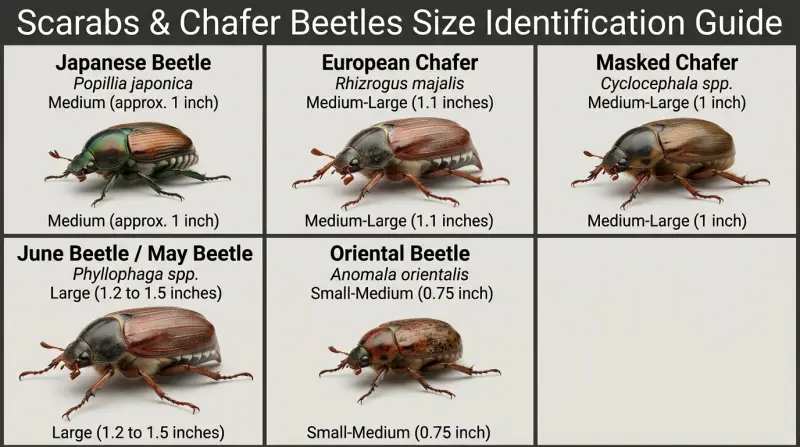
Grub Identification Chart
- White grubs are scarab beetle larvae characterized by soft, C-shaped bodies, brown head capsules, and three pairs of segmented thoracic legs.
- The single most reliable identification feature is the raster pattern—the arrangement of spines, hairs, and bare patches on the ventral side of the last abdominal segment.
- Adult beetle emergence timing, egg-laying habits, and turf damage windows vary significantly among species like Japanese beetles, European chafers, and June beetles.
- Late May through early July represents the most strategic window for scouting, species identification, and early-stage management when grubs are small and actively feeding near the soil surface.
- Secondary damage from vertebrate predators (skunks, crows, raccoons) often signals a high grub population that warrants immediate soil sampling.
- Soil type, irrigation practices, and thatch accumulation heavily influence grub population distribution and overall turf vulnerability.
To accurately identify white grub species in the field or laboratory, professionals rely on a standardized diagnostic approach. The following comprehensive reference guide outlines the defining physical and biological characteristics of the most common turf-damaging white grub species found in residential and commercial landscapes.
| Species | Mature Size | Raster Pattern (Ventral Tip) | Head Capsule Color | Primary Damage Window | Key Diagnostic Feature |
|---|---|---|---|---|---|
| Japanese Beetle Popillia japonica | Medium (approx. 1 inch) | V-shaped arrangement of bristles pointing inward, meeting at a distinct bare slit. | Reddish-brown | Late summer to autumn; spring rebound | Spines on raster form a distinct “V” shape resembling a zipper. |
| European Chafer Rhizrogus majalis | Medium-Large (1.1 inches) | Two parallel rows of short spines with no bare slit; parallel lines curve outward at ends. | Dark reddish-brown | Autumn through early winter; early spring | Raster features two distinctly parallel line segments of bristles. |
| Masked Chafer Cyclocephala spp. | Medium-Large (1 inch) | Randomly scattered bristles with no distinct parallel lines, zip pattern, or bare patch. | Light yellowish-brown | Late summer to mid-autumn | Completely random raster bristle distribution; lacks a zipper pattern. |
| June Beetle / May Beetle Phyllophaga spp. | Large (1.2 to 1.5 inches) | Two curved, parallel rows of bristles surrounded by dense, random hairs; opens outward. | Dark brown to reddish-black | 2-to-3-year lifecycle; damage spans multiple seasons | Large body size, multi-year lifecycle, and curved parallel raster lines. |
| Oriental Beetle Anomala orientalis | Small-Medium (0.75 inch) | U-shaped or horseshoe-shaped pattern of parallel rows with a wide open bottom. | Yellowish-brown | Late summer to mid-autumn | Smaller overall size with a distinct horseshoe raster configuration. |
When analyzing the data in the identification chart above, notice that while general body shapes remain consistent across scarab larvae, microscopic details on the anal raster provide definitive taxonomic separation. Using a 10x hand lens on a freshly washed grub sample is mandatory for distinguishing closely related species such as Japanese beetles and European chafers.
Understanding Grub Morphology: Anatomy of a Scarab Larva
Before attempting species-level identification, understanding the basic anatomy of a white grub ensures accurate classification. All white grubs belong to the family Scarabaeidae. Their morphology is adapted entirely for subterranean existence, feeding on decaying organic matter and living roots.
A typical grub exhibits a cylindrical, soft-bodied structure divided into distinct segments. The body is usually white or cream-colored, though the posterior segments often appear darker due to soil ingestion visible through the translucent cuticle. The head capsule is heavily sclerotized (hardened) and colored in shades ranging from pale yellow to deep reddish-black, equipped with strong, chewing mandibles designed to sever plant roots.
Key anatomical features used in identification include:
- Thoracic Legs: Grubs possess three pairs of distinct, segmented legs located immediately behind the head capsule. The presence of well-developed legs immediately separates scarab larvae from dipteran larvae (fly maggots) or beetle larvae from other families that may lack functional legs.
- Anal Segment (Raster): The ventral surface of the last abdominal segment features specialized bristles, hairs, and bare patches known collectively as the raster. The geometry of these hairs is the gold standard for entomological identification.
- Respiratory Spiracles: C-shaped breathing pores located along the lateral sides of the abdominal segments. While less frequently used for field ID compared to the raster, spiracle shape can help differentiate sub-families.
The Diagnostic Value of the Raster Pattern
The raster is undeniably the single most important diagnostic tool available to turf managers. To examine the raster properly, a grub must be gently rinsed of soil particles in water. Placing the grub under a stereomicroscope or using a high-powered 10x to 20x hand lens reveals the precise arrangement of anal bristles (tegmina) and bare spaces (palidia).
For example, the Japanese beetle larva features two rows of spines that converge toward the anal slit, forming a distinct “V” shape resembling a zipper. In contrast, the European chafer displays two parallel rows of spines that do not converge in a V, but rather run parallel down the center before turning outward at the base. Masked chafers show no geometric order whatsoever; their bristles are scattered randomly across the anal patch with no defined lines or bare slits. Mastering this visual distinction eliminates guesswork.
Detailed Profiles of Common Turf-Damaging White Grubs
Each white grub species follows a distinct biological timeline, responds differently to environmental stressors, and inflicts damage during specific seasonal windows. Examining individual species profiles reveals why generalized pest control approaches frequently underperform.
Japanese Beetle (Popillia japonica)
The Japanese beetle is among the most widespread and destructive turf pests in North America. Adults are metallic green and copper beetles that emerge in mid-summer to feed on the foliage, flowers, and fruits of over 300 plant species. After mating, females burrow into moist turfgrass soils to lay small clusters of eggs.
Japanese beetle grubs hatch in late summer and immediately begin feeding on fine grass roots. Because they feed aggressively near the soil surface during late summer and early autumn, this is when turf damage first becomes visible as wilting, drought-like brown patches that do not respond to irrigation. They overwinter deep in the soil profile as mature third-instar larvae, move upward to feed briefly in early spring, and pupate before emerging as adults in June.
European Chafer (Rhizotrogus majalis)
Introduced from Europe, the European chafer has established a strong presence across the northern United States and parts of Canada. Unlike Japanese beetle grubs, European chafer larvae continue feeding much later into the autumn and resume feeding earlier in the spring. In regions with mild winters or heavy snow cover that insulates the soil, European chafers may feed all winter long.
This extended feeding window makes European chafer infestations exceptionally destructive. Turf infested with European chafers can be easily rolled back like a carpet by late autumn or early spring because root systems are entirely chewed away. , European chafer adults fly earlier in the evening than Japanese beetles and prefer to oviposit in dry, sunny areas of the lawn.
Masked Chafers (Cyclocephala spp.)
Often referred to as annual white grubs or northern/southern masked chafers, these species are native insects whose adults are nocturnal and attracted to porch lights rather than feeding on foliage. Adult masked chafers do not damage plant leaves; instead, they emerge strictly to mate and lay eggs in mid-summer.
Masked chafer grubs feed heavily through August and September. They are particularly responsive to soil moisture during the egg-laying phase; dry soils during July significantly reduce egg survival. Visually, masked chafer grubs have a yellowish head capsule and lack any geometric pattern on the raster, relying entirely on random bristle distribution for identification.
May and June Beetles (Phyllophaga spp.)
May and June beetles represent a large genus of native scarab beetles characterized by a multi-year lifecycle—typically taking two to three years to complete development from egg to adult. Because multiple generations overlap in the soil, turf managers often encounter larvae of varying sizes simultaneously.
Due to their large size (often exceeding 1.2 inches in length) and multi-year residency, mature third-instar June beetle grubs consume substantial quantities of root mass. Turf damage caused by Phyllophaga spp. is frequently chronic, persisting across multiple seasons regardless of standard annual grub treatments timed for single-year pests.
Seasonal Lifecycle and Biological Timelines
Understanding the annual biological cycle of white grubs is essential for determining when identification matters most and when control measures will achieve maximum efficacy. While multi-year grubs like June beetles deviate from this pattern, the vast majority of turf-damaging scarab beetles (Japanese beetles, European chafers, masked chafers) follow a strict one-year univoltine lifecycle.
The Annual Univoltine Cycle
The standard annual cycle transitions through four distinct life stages: egg, larva (instars 1 through 3), pupa, and adult.
- Spring (April – May): Overwintered third-instar grubs migrate upward from deep soil layers as soil temperatures warm. They feed briefly on remaining roots before entering a non-feeding prepupal stage and transforming into pupae.
- Early Summer (June – Early July): Adult beetles emerge from the soil, feed, mate, and deposit eggs in irrigated turfgrass soils. This is the optimal window for preventive insecticide applications, as newly hatched first-instar grubs are exceptionally vulnerable.
- Late Summer (August – September): Eggs hatch into first-instar larvae, which quickly molt into second and third instars. This is the period of peak feeding intensity. Damage manifests rapidly as root mass is destroyed.
- Autumn (October – November): As soil temperatures drop below 50°F (10°C), third-instar grubs burrow downward 4 to 8 inches (or deeper in colder climates) to overwinter safely below the frost line.
Scouting, Sampling, and Threshold Management
Identifying grub species requires finding them in the soil. Guessing based on lawn symptoms alone is unreliable, as drought, fungal diseases (such as necrotic ring spot or summer patch), and chinch bug damage can easily mimic white grub injury.
How to Perform a Soil Cup Cut
To assess grub populations accurately, turf managers should conduct physical soil sampling using a golf cup cutter or a sturdy garden trowel:
- Select diagnostic zones at the margin between healthy turf and damaged, wilting grass patches. Grubs rarely populate the center of dead turf because food sources are already exhausted; they feed actively at the advancing boundary.
- Cut a 1-foot by 1-foot square (or use a standard 4-inch diameter turf cutter) to a depth of 2 to 3 inches, slicing through the root zone.
- Gently peel back the turf sample and inspect the exposed root zone and underlying soil. Break apart soil clumps by hand.
- Count the number of live grubs found within the sample area. Repeat this process across multiple locations to establish an average population density per square foot.
- Collect a representative sample of live grubs in a small vial for raster examination under magnification.
Interpreting Economic Thresholds
Finding a single grub in a square foot of turf does not justify treatment. Healthy, well-maintained turfgrass can easily tolerate low populations of white grubs without visible decline. Threshold guidelines help determine when intervention is economically and ecologically justified:
- Low Maintenance / Deeply Rooted Turf: Thresholds typically sit at 8 to 10 grubs per square foot before visible damage occurs.
- High Maintenance / Irrigated Turf: Tolerates 5 to 8 grubs per square foot, provided cultural practices (mowing height, fertilization) maintain deep roots.
- Stressed / Drought-Prone Turf: Thresholds drop to 3 to 5 grubs per square foot, as damaged root systems cannot sustain moisture uptake under environmental stress.
- Vertebrate Damage Pressure: If wildlife (skunks, raccoons, turkeys) is actively tearing up the lawn searching for grubs, treatment may be required even at lower insect densities to prevent secondary structural turf destruction.
Common Mistakes in Grub Identification and Management
Even experienced landscapers occasionally misidentify white grubs or mistiming control interventions. Avoiding these frequent pitfalls ensures efficient resource allocation and sustainable turf health.
1. Confusing White Grubs with Beneficial Soil Organisms
Not all soil-dwelling larvae are pests. Property owners occasionally mistake beneficial insects or non-pest larvae for white grubs. For instance, the larvae of certain dung beetles, soldier beetles, or flower chafers may inhabit high-organic-matter garden soils or compost piles. Checking for the presence of true thoracic legs, examining the raster pattern, and noting whether the organism is actively shearing live grass roots helps prevent the unnecessary destruction of beneficial soil macrofauna.
2. Relying Solely on Physical Size for Species ID
A common error is assuming all small white grubs are Japanese beetles and all large grubs are June beetles. Grub size fluctuates dramatically depending on the instar stage. A first-instar European chafer or masked chafer in July will look small, mimicking a mature Japanese beetle grub from an earlier brood. Always verify taxonomic features like the raster rather than relying on body length alone.
3. Treating Post-Damage Turf Too Late
Applying contact insecticides in late October or November when turf is already browning and grubs have reached large, resilient third-instar stages is rarely effective. Third-instar grubs possess thick cuticles and are less susceptible to standard insecticides; , they have already finished their heavy feeding cycle and are preparing to overwinter. Management must target either early-stage first instars in mid-summer or address spring feeding windows correctly.
Frequently Asked Questions
While definitive identification requires examining the raster pattern under magnification, geographic location, adult beetle flight timing, and seasonal damage windows offer strong clues. For example, if heavy turf damage occurs in late autumn and early spring with parallel raster lines, European chafer is the most likely suspect. However, positive field identification always benefits from a 10x hand lens.
Wildlife possess an acute sense of smell and hearing capable of detecting white grubs moving beneath the soil surface even when population densities appear low to the human eye. If animals are actively digging, a localized grub population is almost certainly present. Perform a soil cup cut at the margin of the damaged area to confirm.
Yes. As soil temperatures drop in late autumn, white grubs migrate downward into the soil profile, often reaching depths of 4 to 12 inches depending on regional frost lines and snow cover. In this dormant zone, they survive freezing conditions by purging excess water from their bodies and synthesizing natural antifreeze compounds (glycerol) before returning to the root zone in spring.
Beneficial entomopathogenic nematodes (such as Heterorhabditis bacteriophora) can be effective biological control agents against white grubs, but their success depends heavily on proper soil moisture, soil temperature, and species susceptibility. They perform best against young, first-instar larvae during late summer and require thorough post-application irrigation to prevent desiccation.
Adult scarab beetles are strongly attracted to well-irrigated, lush turfgrass during peak flight and egg-laying periods because moist soil makes it easier for females to burrow and keeps eggs from drying out. Consequently, heavily watered lawns in otherwise dry neighborhoods often suffer the highest concentrations of grub infestations.
Mastering white grub identification transforms turf management from reactive guessing into precision science. By utilizing diagnostic charts, examining rastral patterns, and timing scouting efforts to align with local biological cycles, property managers can protect turfgrass vitality, minimize chemical usage, and maintain resilient, healthy landscapes.