
Quick Answer: A sea bean identification chart is a field guide or visual reference used to classify drift seeds—durable seeds and pods from tropical plants that travel across ocean currents and wash ashore on beaches. Key identifiers include size, shape, color, buoyancy features (such as air pockets), and distinct structural markings like hilum scars or symmetry patterns, allowing beachcombers to distinguish among major families like Fabaceae (beans), such as Sea Hearts (Entada gigas), Hamburger Beans (Mucuna species), and Nickernuts (Caesalpinia species).
Beachcombing along the global tide line offers more than just seashells and weathered glass; it reveals an extraordinary botanical treasure hunt. Among the most fascinating organic artifacts to wash ashore are sea beans—also known as drift seeds, drift fruits, or lucky beans. These resilient travelers originate from flowering tropical and subtropical plants, often massive lianas and vines draping over riverbanks and rainforest canopies. When these plants drop their seeds into freshwater systems, the seeds embark on remarkable maritime odysseys, sometimes traversing entire ocean basins via major currents like the Gulf Stream before landing on distant shores.
Identifying these marine castaways requires a keen eye and a systematic approach. Because saltwater immersion, abrasion, and weathering alter a seed’s appearance, casual identification can be remarkably challenging. Without a reliable framework, a common nickernut might be mistaken for a rare endemic, or an ordinary pebble might be misidentified as a fossilized legume. This comprehensive guide and sea bean identification chart provide the deep domain knowledge, structural clues, and taxonomic distinctions necessary to accurately identify, classify, and appreciate the diverse drift seeds found along coastal drift lines.
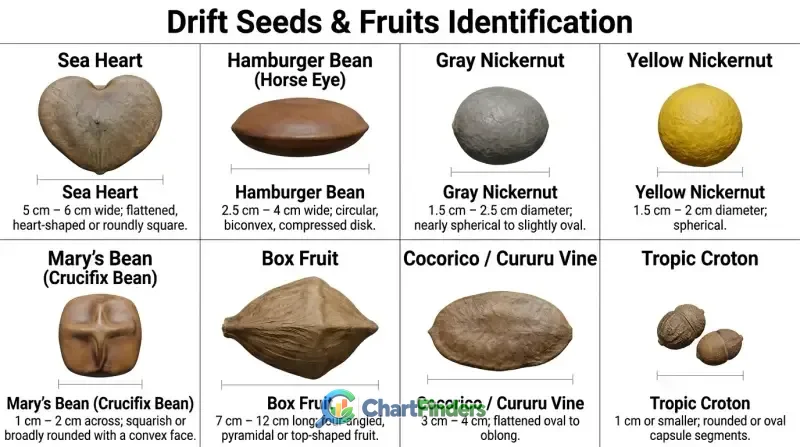
Sea Bean Identification Chart
- Botanical Origin: Most true sea beans are seeds from woody tropical vines (lianas) belonging to the legume family (Fabaceae).
- Oceanic Longevity: Hard, impermeable seed coats (testas) and internal air pockets allow these seeds to float for months or years without losing viability.
- Primary Diagnostic Markers: Identification relies primarily on shape, overall dimensions, hilum (attachment scar) structure, color variations, and surface texture.
- Geographic Distribution: Found worldwide along tropical drift lines, with the Gulf Stream delivering Caribbean and South American species as far north as the British Isles and Scandinavia.
- Common Groupings: Major categories include Sea Hearts, Hamburger Beans, Nickernuts, Stizolobium, and Mary’s Beans.
- Preservation & Care: Dried drift seeds require minimal maintenance, though light oiling can restore natural luster and prevent excessive splitting.
To master drift seed identification, beachcombers must examine physical morphology with the precision of a field botanist. The following comprehensive reference table categorizes the most common and sought-after sea beans found globally, detailing their structural characteristics, biological sources, oceanic transport traits, and distinctive visual markers.
| Common Name | Scientific Name | Typical Size & Shape | Color & Surface Texture | Key Diagnostic Feature | Native Region & Drift Pathway |
|---|---|---|---|---|---|
| Sea Heart | Entada gigas | 5 cm – 6 cm wide; flattened, heart-shaped or roundly square. | Rich dark brown to mahogany; smooth, highly polished hard testa. | Distinctive indented notch at the base; flat profile with internal air cavity. | Neotropical rainforests; travels via Caribbean currents and Gulf Stream. |
| Hamburger Bean (Horse Eye) | Mucuna sloanei / M. urens | 2.5 cm – 4 cm wide; circular, biconvex, compressed disk. | Chestnut brown center with a distinctive darker band wrapping the rim. | Long, dark, woody hilum scar running around 50% to 80% of the seed’s circumference. | Pan-tropical; washed down tropical rivers into oceanic currents. |
| Gray Nickernut | Caesalpinia bonduc | 1.5 cm – 2.5 cm diameter; nearly spherical to slightly oval. | Steel-gray, slate-blue, or greenish-gray; hard, stony, pitted surface. | Extremely hard, marble-like texture; circular scar near base. | Pantropical coastal thickets; highly buoyant due to internal cavity. |
| Yellow Nickernut | Caesalpinia ciliata | 1.5 cm – 2 cm diameter; spherical. | Vibrant yellow to golden-tan; smooth or finely speckled. | Brilliant yellow color distinguishing it from its gray relative. | Caribbean and tropical Atlantic coastal zones. |
| Mary’s Bean (Crucifix Bean) | Merremia discoidespera | 1 cm – 2 cm across; squarish or broadly rounded with a convex face. | Mottled brown and tan; woody and durable. | Four-part facial cross or distinct geometric markings on one surface. | Central and South American riverine habitats; Caribbean drift. |
| Box Fruit | Barringtonia asiatica | 7 cm – 12 cm long; four-angled, pyramidal or top-shaped fruit. | Fibrous, woody husk weathering to brown or gray. | Massive size with distinct four-angled structural ridges; floating fibrous husk. | Indo-Pacific mangrove and coastal forests. |
| Cocorico / Cururu Vine | Mucuna altissima | 3 cm – 4 cm; flattened oval to oblong. | Mottled brown, reddish-tan with dark speckling. | Shorter hilum scar than M. sloanei and lighter overall background tone. | South American river systems; Atlantic drift lines. |
| Tropic Croton | Croton species / related spurges | 1 cm or smaller; rounded or oval capsule segments. | Mottled earth tones, gray, and brown. | Small size with distinct segmented surface ridges or remnants of three-celled capsules. | Tropical coastal scrub and disturbed soils. |
Reading this identification table requires looking past mere surface coloration, as seawater exposure frequently bleaches or stains drift seeds. Focus primarily on structural morphology, particularly the nature of the seed coat (testa), the presence and length of the hilum scar, and overall dimensional geometry.
Anatomical Structure and Terminology of Drift Seeds
Successful sea bean identification relies on mastering specific botanical terminology. Unlike garden seeds, drift seeds have evolved specialized structural adaptations to survive prolonged immersion in saltwater, abrasion against sand, and ingestion or handling by wildlife.
- Testa: The outer seed coat. In sea beans, the testa is usually exceptionally thick, lignified, and waterproof, acting as a biological armor against marine bacteria and salt intrusion.
- Hilum: The scar left where the seed broke away from its stalk inside the pod. The length, texture, and color of the hilum are among the most reliable diagnostic keys for separating genera like Mucuna and Canavalia.
- Micropyle: A tiny pore adjacent to the hilum through which water traditionally enters germinating seeds; in drift seeds, this pore is tightly sealed to maintain buoyancy.
- Air Cavity: Many true sea beans develop an internal shrinkage gap between the cotyledons and the seed coat during drying on the vine, creating a natural flotation chamber that keeps the seed buoyant for years.
Major Families and Genera of Drift Seeds
The vast majority of drift seeds belong to the bean family (Fabaceae), specifically subfamily Faboideae and Caesalpinioideae, though other families like Euphorbiaceae and Barringtoniaceae contribute notable specimens. Understanding these broader botanical families narrows down possibilities instantly.
The Legume Family (Fabaceae): Kings of the Drift Line
Fabaceae dominates the world of sea beans due to the incredible durability of legume seed coats. Within this family, certain genera have perfected long-distance maritime dispersal.
Entada Species (Sea Hearts and Matchbox Beans)
The genus Entada produces some of the largest pods in the plant kingdom, often exceeding one meter in length on massive woody vines scaling rainforest emergents. Entada gigas yields the iconic “Sea Heart,” prized by beachcombers worldwide. These heart-shaped seeds feature a hard, glossy mahogany exterior and a compressed profile designed to slide through water currents with minimal drag. A smaller relative, Entada rheedii (Matchbox Bean), produces squarish, darker brown seeds found predominantly in Indo-Pacific drift collections.
Mucuna Species (Hamburger Beans and Horse Eyes)
Mucuna is a genus of tropical lianas famous for producing biconvex seeds that bear an uncanny resemblance to miniature hamburgers or horse eyes. The seed body is typically tan or chestnut-brown in the center, encircled by a dark, raised band representing the massive hilum that wraps around 50% to over 80% of hazel-to-dark-brown perimeters. Species differentiation within Mucuna (such as M. sloanei, M. urens, and M. andreana) depends heavily on the exact length of this dark band, seed thickness, and overall coloration profile.
Caesalpinia Species (Nickernuts)
Nickernuts are the marbles of the sea bean world. Produced by woody, prickly shrubs and vines scrambling along tropical shorelines, these seeds are remarkably hard and durable. The Gray Nickernut (Caesalpinia bonduc) and Yellow Nickernut (Caesalpinia ciliata) possess stony testas that can withstand being pounded against coral reefs for months. Their round shapes and pitted surfaces make them instantly recognizable once separated from their spiny pods.
Other Notable Drift Families
While Fabaceae reigns supreme, non-legume drift fruits and seeds add immense variety to beach collections.
- Convolvulaceae (Morning Glory Family): Genera like Merremia produce seeds such as Mary’s Beans, characterized by their geometric, box-like shapes and internal cavity rattles.
- Barringtoniaceae: The fish-poison tree (Barringtonia asiatica) produces giant, four-angled pyramid fruits containing a single large seed filled with buoyant, fibrous tissue adapted for floating across entire ocean archipelagos.
- Euphorbiaceae (Spurge Family): Various tropical shrubs and trees contribute small, mottled seeds and capsules that frequently appear in high-tide shell lines.
Geographical Distribution and Oceanographic Pathways
Sea beans do not wash ashore at random; their distribution is dictated by global ocean conveyor belts, surface wind vectors, and seasonal storm activity. Understanding oceanography transforms random beachcombing into targeted exploration.
The Gulf Stream and North Atlantic Gyre
For beachcombers along the eastern coast of North America, the Caribbean, and Western Europe, the Gulf Stream acts as a botanical superhighway. Seeds dropped into rivers in Central and South America are swept into the Caribbean Sea, channeled through the Yucatán Channel, accelerated through the Straits of Florida, and carried northward.
From there, portions of the current branch eastward across the North Atlantic, depositing tropical seeds onto the shores of the Azores, Portugal, the British Isles (particularly southwest England, Wales, and western Scotland), and even Norway. Finding a pristine Entada gigas on an Irish beach is a to a multi-thousand-mile journey powered solely by marine currents.
Pacific and Indian Ocean Drift Systems
In the Indo-Pacific basin, trade winds and equatorial currents drive seeds from Southeast Asia, Indonesia, and northern Australia across vast archipelagos. Beaches in Western Australia, the Hawaiian Islands, and South Africa receive distinct suites of drift seeds, including massive Barringtonia fruits, large Entada species, and specialized nickernuts unique to the eastern hemisphere.
Step-by-Step Field Identification Method
When you spot an unfamiliar seed on the wrack line, follow this systematic evaluation sequence to identify its family and species accurately.
- Inspect the Overall Shape and Symmetry: Is it flat (Sea Heart), round/biconvex (Hamburger Bean), spherical/stony (Nickernut), or irregular/angular (Box Fruit)? Shape immediately eliminates 80% of potential families.
- Examine the Hilum (Scar): Look closely for the attachment scar. Does it wrap around the entire edge like a belt (Mucuna)? Is it a tiny dot near the base (Nickernut)? Is it a distinct notch (Sea Heart)?
- Test Buoyancy and Hardness: Tap the seed gently. Is it rock-solid? Does it rattle slightly from an internal air pocket? True drift seeds will not dent under moderate pressure and will float in saltwater.
- Evaluate Color and Surface Texture: Note whether the surface is glossy and polished (indicating abrasion-resistant liana seeds), dull and pitted (nickernuts), or fibrous and woody (fruits). Keep in mind that saltwater bleaching can lighten dark browns to pale tans.
- Measure Dimensions: Use a caliper or ruler. Size is often the definitive factor separating closely related species within the same genus, such as distinguishing Mucuna sloanei from smaller regional variants.
Common Mistakes and Identification Pitfalls
Even experienced beachcombers occasionally misidentify drift items due to convergent evolution, weathering, and anthropogenic debris.
Weathered Seeds vs. Modern Artifacts
Long-term exposure to marine environments alters organic materials significantly. A sea bean tumbled in sand for a year may lose its glossy finish, appearing dull, pitted, and deceptively similar to a smooth river stone. Conversely, hard plastic pellets, industrial resin beads, and synthetic bottle caps frequently wash ashore, mimicking the shape and weight of nickernuts or small beans. Always perform a physical scratch test or check for natural cellular structure under a magnifying glass if in doubt.
Look-Alikes: Native Terrestrial Seeds
Not every seed found on a beach arrived via the ocean. Many coastal parks and dunes feature native trees and invasive plants that drop seeds directly onto the sand. For example, large native oak acorns, pine nuts, and seeds from introduced ornamental trees frequently mingle with true drift seeds. The critical differentiator is buoyancy and wear: local land seeds usually show fresh detachment scars, lack specialized marine air pockets, and quickly waterlog and sink.
Frequently Asked Questions
True drift seeds possess specific structural adaptations: an impermeable, multi-layered seed coat (testa) that prevents water absorption, an internal air cavity created as the seed matures and shrinks slightly inside its shell, and exceptional physical hardness designed to withstand months of abrasion in saltwater currents.
Prime locations include tropical and subtropical beaches with strong onshore winds and major current influences. Famous spots include the beaches of Florida (especially the Space Coast and Sanibel Island), the Caribbean islands, the Pacific coast of Costa Rica, the west coast of the UK (carried by the Gulf Stream), and remote beaches in Western Australia.
Yes, many drift seeds remain viable for months or even years thanks to their waterproof seed coats. Botanists and enthusiasts have successfully germinated sea beans like Entada gigas and various Mucuna species after soaking them to break their natural dormancy, though filing or nicking the hard testa (scarification) is usually required.
Wash newly found sea beans in fresh water to remove salt residue, then let them dry thoroughly in a shaded area. To restore their natural luster and prevent cracking caused by extreme humidity changes, you can apply a very light coat of mineral oil or natural beeswax, buffing them gently with a soft cloth.
Historically, because these strange, polished seeds washed ashore on northern European and British beaches with no local source plant, finders regarded them as rare, mysterious gifts from the sea. Sailors and coastal dwellers carried them as protective amulets, good-luck charms, and talismans against shipwreck, disease, and misfortune.
Conclusion
Mastering sea bean identification turns a simple coastal stroll into an engaging botanical adventure. By understanding the anatomical markers, family traits, and oceanographic pathways that guide these remarkable seeds across the globe, beachcombers can unlock the hidden stories behind every drift line discovery. Whether you unearth a glossy mahogany Sea Heart, a classic Hamburger Bean, or a stony Gray Nickernut, each specimen represents a resilient triumph of nature’s design, bridging distant rainforests with your local shoreline.