
Discovering a bird feather on a forest floor, field, or backyard lawn immediately sparks curiosity. Among the most striking avian artifacts are those left behind by hawks. However, looking at a single plume removed from its context reveals how challenging natural history detective work can be. Feather identification requires analyzing physical morphology, structural classification, pigmentation, and anatomical placement on the bird. A primary flight feather from a red-tailed hawk shares little in common with a covert feather from a sharp-shinned hawk, yet every nuance follows strict evolutionary and functional rules.
This master guide provides a comprehensive framework for hawk feather identification. By dissecting anatomical terminology, comparing buteos against accipiters, analyzing barrings and colorations, and detailing legal and ethical responsibilities, this resource equips naturalists, students, and outdoor enthusiasts with the tools needed to decode the avian record left in the wild.
Explore our detailed breakdown on Rabbit Breed Identification Chart [Full Reference Chart].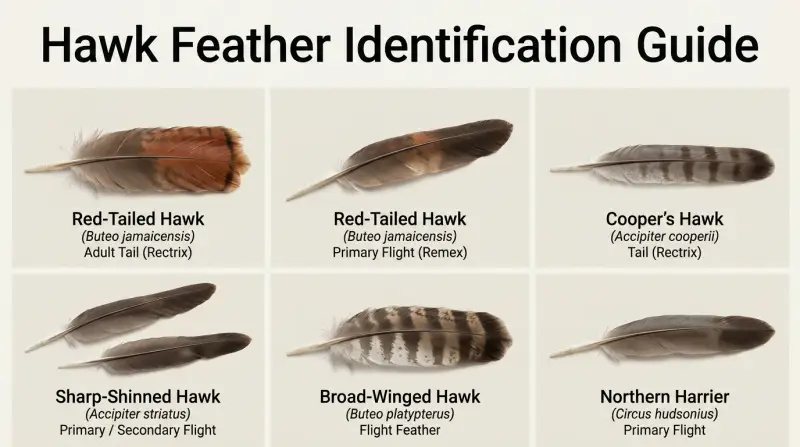
Hawk Feather Identification Chart
- Anatomical Context: A feather’s identity depends heavily on where it grew on the bird, distinguishing flight feathers (remiges and rectrices) from body contour and covert feathers.
- Buteos vs. Accipiters: Buteos typically feature longer, wider, broader feathers designed for soaring, whereas accipiters possess stiffer, shorter, more rounded feathers built for rapid forest maneuvering.
- Banding Patterns: Transverse dark bars alternating with lighter grey, brown, or rust tones serve as primary diagnostic clues for species differentiation.
- Legal Restrictions: In the United States and many other jurisdictions, the Migratory Bird Treaty Act strictly prohibits the collection or possession of native hawk feathers.
- Structural Integrity: Examining the rachis, barbs, barbules, and hooklets provides clues regarding whether a feather endured wear, sun bleaching, or molt replacement.
- Digital Tools: Modern field guides and specialized wildlife identification applications assist with visual comparisons, though manual morphological inspection remains essential for accuracy.
Navigating the vast array of raptor plumage demands a structured system of comparison. The following comprehensive reference table outlines key morphological traits, typical dimensions, color configurations, and diagnostic banding characteristics across major North American hawk groups and representative species.
| Species Group / Species | Feather Type | Average Length | Primary Coloration | Banding / Pattern Characteristics | Diagnostic Field Clues |
|---|---|---|---|---|---|
| Red-Tailed Hawk (Buteo jamaicensis) | Adult Tail (Rectrix) | 8.0 – 11.0 inches | Brick red to rust-brown | Subterminal narrow dark band near the white tip; faint fine dark barring sometimes visible. | Distinctive cinnamon-rust hue with high structural rigidity and minimal barring except near the tip. |
| Red-Tailed Hawk (Buteo jamaicensis) | Primary Flight (Remex) | 10.0 – 14.0 inches | Dark brown, charcoal, greyish-white | Prominent dark brown barring across a paler greyish or whitish background; checkered appearance on inner webs. | Emarginated outer primaries (P7–P10); frosted whitish tips on fresh autumn feathers. |
| Cooper’s Hawk (Accipiter cooperii) | Tail (Rectrix) | 6.0 – 9.0 inches | Slate-grey to dark charcoal | Three to four broad, dark blackish bands alternating with lighter grey bands; squared or slightly rounded white tip. | Evenly spaced wide dark bands across a long, graduated tail feather shaft. |
| Sharp-Shinned Hawk (Accipiter striatus) | Primary / Secondary Flight | 3.5 – 6.5 inches | Blue-grey or dark brownish-grey | Narrow, distinct dark brown or black bars; white mottling frequently present near the basal quill. | Small scale, delicate structure, highly square-cut or slightly notched tip. |
| Broad-Winged Hawk (Buteo platypterus) | Flight Feather | 6.0 – 9.0 inches | Dark brown with pale edges | Bold, wide dark bands alternating with clean white or light grey bands on inner webs. | Compact, broad build reflecting soaring habits; distinct high-contrast black-and-white banding on secondaries. |
| Northern Harrier (Circus hudsonius) | Primary Flight | 8.0 – 12.0 inches | Muted grey-brown to buff | Diffuse, mottled brownish-grey barring with a powdery texture and soft margins. | Flexible barb structure allowing silent flight; specialized for low-altitude marsh hunting. |
Reading this table requires understanding that individual variation, age (juvenile versus adult), and wear from sun and friction can slightly alter feather appearance. Juveniles often display narrower, more numerous bands, whereas adults exhibit bolder, simplified color fields.
Understanding Hawk Anatomy and Feather Terminology
To accurately identify any hawk feather, one must master the basic structural and anatomical terminology used by ornithologists. A feather is not merely a uniform object; it is an , highly specialized integumentary structure composed of keratin.
Macroscopic Anatomy of a Feather
Every typical contour or flight feather consists of a central axis divided into two main sections:
- Calamus (Quill): The hollow, unbarbed base anchored directly into the bird’s follicle beneath the skin.
- Rachis: The solid, rigid upper shaft that supports the flat vane of the feather.
- Vane: The flexible web extending on both sides of the rachis, composed of parallel branches called barbs.
- Barbules and Hooklets: Microscopic structures projecting from the barbs that interlock to form a continuous, wind-resistant surface.
Anatomical Placement Categories
Where a feather grows determines its shape, strength, and aerodynamic function. Hawk feathers generally fall into three major functional categories:
- Remiges (Flight Feathers): Long, asymmetrical feathers attached to the wing. Primaries (attached to the hand bones) provide forward propulsion and steering, while secondaries (attached to the ulna) provide lift.
- Rectrices (Tail Feathers): Symmetrical or nearly symmetrical feathers attached to the pygostyle (tail bone), acting as brakes and rudders during flight.
- Coverts and Contour Feathers: Shorter, softer feathers covering the base of the flight feathers and streamlining the body contours against drag.
Buteos vs. Accipiters: Morphological Differences in Plumage
North American diurnal raptors are broadly split into distinct subfamilies and genera that reflect entirely different hunting strategies. These ecological niches dictate the physical engineering of their feathers.
Buteo Feathers: Built for Soaring
Buteos—such as the Red-Tailed Hawk, Broad-Winged Hawk, and Swainson’s Hawk—are large, bulky raptors that spend hours soaring over open fields and forest clearings on thermal updrafts. Their flight feathers exhibit specific adaptations:
- Emargination: The outer primary feathers often feature a distinct narrowing or “notch” along the outer web near the tip. This creates slots in the wingtip during flight, reducing turbulence and increasing lift at low speeds.
- Broad Vanes: Feathers are exceptionally wide relative to their length, designed to catch maximum air volume.
- Muted Earth Tones: Predominantly featuring browns, creams, whites, and the iconic rusty-red of adult red-tailed hawk tails.
Accipiter Feathers: Built for Agility
Accipiters—such as the Northern Goshawk, Cooper’s Hawk, and Sharp-Shinned Hawk—are forest specialists. They rely on surprise, explosive acceleration, and high-speed maneuvering through dense timber to catch avian prey. Their plumage reflects this dynamic lifestyle:
- Stiffer Shafts: The rachis is often thicker relative to the overall vane size to withstand high-impact collisions with tree branches.
- Shorter, Rounded Profiles: Wings are short and rounded, translating to shorter, stiffer flight feathers that resist bending during sharp turns.
- High-Contrast Banding: Tail feathers feature clean, alternating dark and light bars that provide visual camouflage against vertical tree trunks and dappled forest light.
Detailed Species Profiles and Identification Markers
Examining individual species reveals unique microscopic and macroscopic fingerprints that separate closely related raptors.
Red-Tailed Hawk (Buteo jamaicensis)
As the most common and widespread hawk in North America, the red-tailed hawk generates the most frequent identification queries. Adult tail feathers are unmistakable due to their solid brick-red coloration, though immature red-tailed hawks possess grey-brown tails crossed by numerous thin, dark transverse bars. Primary flight feathers are heavily barred with dark brown against a pale, greyish-white background, often displaying a distinctive “salt-and-pepper” frosting on the tips of fresh feathers acquired during the annual autumn molt.
Cooper’s Hawk (Accipiter cooperii)
Cooper’s hawk feathers reflect an ambush predator’s need for stealth and speed. Tail feathers are long, graduated, and marked by three to four broad, dark charcoal bands separated by narrower ash-grey bands. The tip of a fresh Cooper’s hawk tail feather terminates in a clean, narrow white band. Body contour feathers on the back exhibit slate-grey bases with hidden white patches, providing disruptive coloration when the bird perches quietly within dense canopy layers.
Sharp-Shinned Hawk (Accipiter striatus)
A miniature version of the Cooper’s hawk, the sharp-shinned hawk possesses remarkably delicate plumage. Its flight and tail feathers mirror the patterning of the Cooper’s hawk—slate-grey with dark transverse bands—but are differentiated primarily by scale. A sharp-shinned primary feather rarely exceeds 6.5 inches in length, and the tip of the tail feather is often square or slightly notched rather than distinctly rounded.
Broad-Winged Hawk (Buteo platypterus)
The broad-winged hawk is a compact forest buteo famous for massive migratory flocks known as “kettles.” Its secondary flight feathers are particularly striking, featuring bold, high-contrast black-and-white horizontal bands that remain visible even from a considerable distance. The tips of these feathers are rounded, reflecting their dual need for thermal soaring and forest navigation during migration.
The Legal and Ethical Framework: Wildlife Protection Laws
An essential aspect of studying hawk feathers involves understanding the strict legal frameworks governing wildlife conservation. In the United States, Canada, and many other nations, raptors receive rigorous federal protection.
In the United States, all diurnal raptors (hawks, eagles, falcons, and harriers) are protected under the Migratory Bird Treaty Act (MBTA) of 1918. , many species fall under the protection of the Bald and Golden Eagle Protection Act and state-level wildlife conservation statutes.
- Prohibition of Possession: It is strictly illegal for private citizens to collect, possess, buy, sell, barter, or transport feathers from native hawks, regardless of whether the feather was found lying on the ground or recovered from a deceased bird.
- Scientific and Educational Exemptions: Accredited museums, educational institutions, and Native American religious practitioners may apply for specialized federal permits to possess eagle and hawk feathers for cultural or scientific purposes.
- Ethical Alternative: Naturalists should practice “leave-no-trace” ethics when encountering feathers in the wild. Photographing the feather in situ, recording GPS coordinates, and uploading observations to citizen science platforms like iNaturalist contributes to ornithological databases without violating wildlife protection laws.
Common Identification Mistakes and Pitfalls
Even experienced birders occasionally misidentify raptor feathers due to several common traps in avian morphology.
1. Confusing Raptor Feathers with Gamebird Plumage
Wild turkeys, ring-necked pheasants, and ruffed grouse produce large, beautifully patterned feathers that frequently trick novices into suspecting a hawk or owl. Gamebird feathers often feature warm buff, chestnut, and vermiculated (worm-like) patterns that lack the structural rigidity and specific emargination found in soaring raptors.
2. Overlooking Wear, Fading, and Sun Bleaching
Ultraviolet radiation from the sun aggressively degrades feather keratin and melanin pigments. A dark brown hawk feather exposed to months of summer sunlight can bleach to a pale, sandy blonde or ginger hue, obscuring diagnostic banding patterns and leading to misidentification.
3. Age-Related Variation (Juvenile vs. Adult Plumage)
Many hawk species undergo significant plumage shifts between their first-year juvenile stage and their definitive adult plumage. Assuming that an all-brown, heavily barred tail feather belongs to a specific adult species without checking for juvenile molt stage indicators frequently leads to diagnostic errors.
Frequently Asked Questions
Hawk feathers are engineered for fast, dynamic flight and feature smooth, firm barbs that produce a rustling or whistling sound in the wind. Owl feathers are specially adapted for completely silent flight, possessing velvety, comb-like fringes on the leading edge of the primaries and a soft, powdery down covering the entire vane to muffle sound.
No. Under the Migratory Bird Treaty Act in the United States, possessing feathers from native migratory birds—including all hawks, eagles, and owls—is strictly illegal, regardless of whether you found the feather on public parkland, private property, or state forests.
The dark transverse bands (bars) on hawk feathers represent daily deposition patterns of melanin pigments during the growth phase of the feather. Stress, nutritional deficits, or hormonal fluctuations during feather development can create variations in band width and darkness, known as stress bars.
Primary flight feathers are characteristically asymmetrical—with a narrow leading edge (outer web) and a wide trailing edge (inner web)—to act as aerodynamic airfoils. Tail feathers (rectrices) are generally symmetrical or nearly symmetrical across the central rachis, functioning primarily as rudders and brakes.
If you encounter a hawk feather in the wild, the safest and most scientifically valuable approach is to leave it where it lies, take high-resolution macro photographs from multiple angles, note the surrounding habitat, and log the observation into citizen science databases such as eBird or iNaturalist.
Conclusion
Mastering hawk feather identification requires patience, attention to structural detail, and a firm grasp of avian anatomy. By systematically evaluating whether a feather belongs to a soaring buteo or a forest-dwelling accipiter, analyzing banding patterns, and understanding primary versus secondary placement, observers can decode the complex life histories of North American raptors. Always pair field curiosity with a strict respect for wildlife conservation laws, ensuring that these magnificent apex predators remain protected both in the sky and on the forest floor.