
Gulls are among the most widespread and ecologically successful birds on the planet, yet they remain one of the most notoriously intimidating groups for birders at all levels. Often dismissed simply as “seagulls,” the family Laridae contains dozens of distinct species whose identification is complicated by hybridization, protracted maturation cycles, and striking plumage shifts that take up to four years to complete. A reliable gull identification chart cuts through this visual noise by turning a chaotic flock of grey-and-white birds into a structured exercise in morphology, structural geometry, and pigmentation.
For decades, mastering gulls meant diving into dense, highly academic monographs laden with complex molting terminology. Modern approaches, however, emphasize practical field recognition—focusing on what can actually be seen through binoculars or a spotting scope under variable coastal or inland lighting conditions. Whether you are sorting through a winter roost of white-headed gulls at a municipal landfill, scanning a sandy ocean beach, or watching a mixed flock gather behind a freshwater reservoir, understanding how to read a gull identification chart transforms frustration into confidence.
Explore our detailed breakdown on Seagull Identification Chart (Complete Data Matrix).This comprehensive master guide explores the anatomy, structural cues, soft-part colors, age-related plumage sequences, and specific diagnostic traits of key gull species. By breaking down the identification process into repeatable, systematic steps, you will learn to look past superficial similarities and focus on the immutable structural markers that define each species.
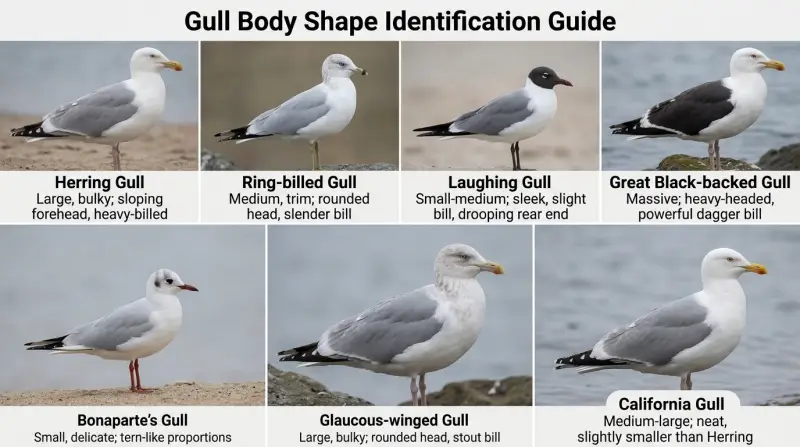
Gull Identification Chart and Core Morphology
- Structure Over Plumage: Bill shape, head profile, and wing-to-tail proportions remain constant across most plumages, making structural geometry more reliable than feather color alone.
- The Multi-Year Challenge: Most large gulls take three to four years to reach definitive adult plumage, transitioning through juvenile, first-winter, second-winter, and third-winter/sub-adult stages.
- Soft-Part Indicators: Bill markings, ring colors around the eye (orbital rings), and leg colors provide instant diagnostic clues when cross-referenced on a standard ID chart.
- Mantle Shade Contrast: The grey shade of the mantle and upper wings ranges from pale silvery-grey (such as Iceland Gull) to jet black (Great Black-backed Gull), serving as a primary separation tool.
- Wingtip Patterns: The distribution of black, white mirrors, and subterminal spots on the primary wingtips helps separate look-alike large white-headed gulls.
- Contextual Clues: Geographic location, seasonal timing, habitat preference, and flock association heavily narrow down the statistical probability of a given species.
When approaching a complex gull identification chart, the eye must be trained to process multiple distinct morphometric features simultaneously. Unlike passerines that change into distinct breeding outfits annually, large gulls undergo slow, overlapping molts that create an array of transitional looks. To make sense of this variation, field guides and charts rely on a standardized vocabulary of soft parts, plumage tracts, and structural zones.
Decoding Gull Topography and Soft Parts
Before examining individual species, it is essential to master the anatomical terminology used in field charts. The mantle refers to the back and upper surface of the wings; its shade of grey is traditionally measured against darkness scales from pale pearl-grey to coal-black. The bill provides multiple diagnostic clues: its overall length-to-depth ratio, the curve of the culmen (upper mandible), and the presence of a gonys (the angular drop on the lower mandible) or a red subterminal spot.
Soft parts—meaning parts of the bird that are not feathers—are critical identification pillars:
- Leg Color: Ranges from bright pink or flesh-colored to yellow, greenish-yellow, or pale grey. Leg color is generally stable within a species, though age and breeding condition can cause slight tonal shifts.
- Orbital Ring: The bare skin surrounding the eye. Its color (yellow, red, orange, or deep purple-black) often intensifies during the peak breeding season.
- Iris Color: Eye color can shift from dark brown in juveniles to pale yellow, straw, or even white in mature adults, though some species retain dark eyes throughout life.
| Species | Relative Size & Structure | Mantle Shade | Leg Color | Key Diagnostic Feature |
|---|---|---|---|---|
| Herring Gull | Large, bulky; sloping forehead, heavy-billed | Medium grey | Pink/Flesh | Pink legs, pale yellow eye, classic “standard” large gull look. |
| Ring-billed Gull | Medium, trim; rounded head, slender bill | Pale grey | Yellowish-green | Distinct dark ring around the yellow bill tip. |
| Laughing Gull | Small-medium; sleek, slight bill, drooping rear end | Darker slate-grey | Dark/Blackish-red | Black hood in summer, white crescent above/below eye. |
| Great Black-backed Gull | Massive; heavy-headed, powerful dagger bill | Jet black | Pink/Flesh | Enormous size, stark contrast of black back against white underparts. |
| Bonaparte’s Gull | Small, delicate; tern-like proportions | Very pale pearl-grey | Orange-red | Tiny black bill, dark ear spot in winter, white wedge in outer primaries. |
| Glaucous-winged Gull | Large, bulky; rounded head, stout bill | Very pale grey | Pink | Paler grey wingtips that match the mantle with no black contrast. |
| California Gull | Medium-large; neat, slightly smaller than Herring | Medium-dark grey | Yellowish-green | Both red and black spots on the lower mandible in adults. |
This reference matrix provides a high-level comparison of common North American gulls. Reading across the columns reveals how structural proportions and soft-part combinations prevent misidentification between similarly plumaged taxa.
Plumage Progression: Understanding Age Classes
One of the greatest stumbling blocks in gull identification is the multi-year maturation cycle. Unlike songbirds that attain adult plumage in their first year, large gulls (such as Herring, Lesser Black-backed, and Great Black-backed Gulls) require up to four years to reach full adult status. Smaller gulls, such as Bonaparte’s and Laughing Gulls, typically mature in two years.
When reading an advanced gull identification chart, you must categorize the bird into one of four primary age classes:
1. Juvenile Plumage (First Autumn)
Newly fledged birds display fresh, feather patterns designed for maximum camouflage. Juveniles feature heavily checkered or scaled upperparts with dark brown centers and pale fringes, broad dark tail bands, dark bills, and dark eyes. The overall impression is often a rich, warm chocolate-brown or grey-brown tones.
2. First-Winter and First-Summer Plumage
As the winter progresses, wear and partial molts alter the juvenile appearance. First-winter gulls often show bleached brown feathers mixed with emerging grey feathers on the mantle. The bill begins to show a pale base, and the tail band remains a solid dark bar contrasting with a white rump.
3. Second- and Third-Year Sub-Adults
Intermediate birds exhibit a patchwork quilt of grey mantle feathers, remaining brown juvenile wing coverts, and increasingly pale heads. By their second or third year, bills develop adult-like color patterns with dusky subterminal smudges, and eyes begin to lighten from dark brown to amber or yellow.
4. Definitive Adult Plumage
Adult gulls display clean white heads (in non-breeding season, often streaked with greyish-brown hood smudges), pure white underparts and tails, grey mantles, and brightly colored soft parts. Wingtips show patterns of black and white mirrors (subterminal white spots).
Detailed Breakdown of Major Gull Groups
To successfully navigate a complex identification chart, it helps to cluster gulls into functional morphological groups. These groups share general ecological niches, body plans, and identification hurdles.
The Large “White-Headed” Gulls (Herring and Larus Complex)
The genus Larus contains the quintessential large gulls. Separating these species requires careful attention to primary feather patterns, mantle darkness, and head shape.
- Herring Gull (Larus smithsonianus / argentatus): The baseline large gull. Bulky with a sloping forehead and strong pink legs. Adults show a pale yellow eye, yellow bill with a red gonys spot, and black wingtips with white spots (“mirrors”).
- Lesser Black-backed Gull (Larus fuscus): Sleeker than the Herring Gull with distinctly yellow legs and a much darker charcoal-to-black mantle. Originally a European vagrant, it is now regular across North America.
- Yellow-footed and Western Gulls: Heavy-billed Pacific coast specialists. Western Gulls feature dark grey mantles and pink legs, while Yellow-footed Gulls show bright yellow legs and slightly larger builds.
Medium-Sized Gulls (Ring-billed and Mew/Short-billed Gulls)
These species occupy an intermediate size tier, often frequenting inland agricultural fields, parking lots, and freshwater lakes.
- Ring-billed Gull (Larus delawarensis): Extremely common across North America. Easily identified by its neat size, pale grey mantle, greenish-yellow legs, and the crisp black ring encircling its yellow bill tip.
- Short-billed Gull (Larus brachyrhynchus) — formerly Mew Gull: Smaller and more delicate than the Ring-billed Gull, featuring a rounded “sweet” head profile, unmarked greenish-yellow bill, and extensive white spots on the black wingtips.
Small Gulls and Hooded Species
These gulls often behave more like terns, possessing slender bills, buoyant flight styles, and dark chocolate-brown or black breeding hoods.
- Laughing Gull (Leucophaea atricilla): Characteristic of Atlantic and Gulf coasts. Recognized in summer by its complete black hood, dark grey mantle, and drooping rear end profile. In winter, it retains a dark smudge behind the eye.
- Bonaparte’s Gull (Chroicocephalus philadelphia): A delicate, arboreal-nesting gull with a tiny black bill, pale grey mantle, and striking white wedge on the outer wing. Breeds in boreal forests and winters along both marine coasts.
Glaucous and Arctic Specialists (White-Winged Gulls)
High-latitude breeders that winter further south, the white-winged gulls lack black pigment in their primary wingtips, making them distinctively pale.
- Glaucous Gull (Larus hyperboreus): A massive, formidable predator of the Arctic. Adults are entirely white-headed and pale grey above, with pure white wingtips that blend into the mantle. Eyes are pale yellow with prominent pinkish-red orbital rings.
- Iceland Gull (Larus glaucoides): Noticeably smaller and more delicate than the Glaucous Gull, with a rounded head, small bill, and long, elegant wings that project far past the tail at rest. Includes the darker-mantled Thayer’s subspecies complex.
Step-by-Step Field Identification Framework
When confronting a large, confusing flock of gulls, relying on a random scanning method leads to missed details. Use this structured, step-by-step decision framework to narrow down unfamiliar birds:
- Assess Overall Size and Structure First: Before looking at feather patterns, determine if the bird is large and bulky (Herring/Great Black-backed size), medium (Ring-billed size), or small/tern-like (Bonaparte’s size). Look at the head profile—is it flat-topped and angular, or rounded and gentle?
- Check Leg Color: Instantly scan the legs. Are they bright pink, yellow, greenish-yellow, or dark? This single character instantly splits many look-alike species (e.g., Herring vs. Lesser Black-backed).
- Examine Mantle Darkness: Compare the grey tone of the back against surrounding gulls. Is it very pale pearl-grey, medium grey, dark slate, or jet black?
- Analyze Bill Morphology and Markings: Is the bill long and dagger-like, or short and blunt? Does it feature a subterminal ring, a red spot, or dual coloration?
- Evaluate Wingtip Patterns: In flight or at rest, examine the primaries. Are the wingtips pitch black with white mirrors, grey matching the back, or pure white?
Common Pitfalls and Identification Mistakes
Even experienced birders occasionally stumble when identifying gulls. Awareness of common traps prevents frequent misdiagnoses:
- Lighting Distortions: Strong overhead sunlight can wash out pale mantle greys, making an ordinary Herring Gull look deceptively like an Iceland Gull. Always seek comparative lighting across multiple individuals in the same flock.
- Stained Plumage: Gulls feeding in landfills, iron-rich mud, or sewage treatment plants frequently acquire rusty, yellowish staining on their heads and underparts. Do not mistake environmental staining for natural plumage coloration or immature brown tones.
- Primary Wear and Molt: Worn or missing primary feathers can alter the perceived wing length and tail projection, creating false structural impressions. Check symmetrical wear across both wings before diagnosing unusual proportions.
- Hybridization: Hybrid gulls (such as Glaucous-winged × Western Gull hybrids, commonly known as “Olympic Gulls”) occur regularly where breeding ranges overlap. These individuals display intermediate mantle shades, bill shapes, and wingtip markings that defy clean identification chart categories.
Frequently Asked Questions
Gulls are challenging because most species take three to four years to attain adult plumage, passing through multiple transitional age classes. , extensive individual variation, geographical subspecies, and frequent hybridization between closely related taxa add layers of complexity that require careful structural analysis.
The primary separators are leg color and mantle shade. Lesser Black-backed Gulls have bright yellow legs and a much darker charcoal-grey to black mantle. Herring Gulls feature pink or flesh-colored legs and a medium grey mantle. Lesser Black-backed Gulls are also noticeably sleeker and more slender-billed.
Yes. Many adult gulls develop dark streaking, smudging, or complete hoods on their heads during the breeding (summer) season, which are lost or reduced during the non-breeding (winter) molt. Soft-part colors like orbital rings and bill brightness also intensify during peak breeding condition.
The term “white-winged gull” refers to Arctic-nesting species—specifically the Glaucous Gull and the Iceland Gull—which lack black pigment in their primary wingtips. Their wingtips appear white or very pale silvery-grey, contrasting sharply with dark-winged species.
No, they are distinct species, though they share similar medium builds. The Ring-billed Gull is slightly larger with a distinct black ring around its yellow bill tip and yellowish-green legs. The Short-billed Gull (formerly Mew Gull) features a smaller, unmarked greenish-yellow bill, darker eyes, and a more rounded, gentle head profile.
Conclusion
Mastering gull identification is a rewarding journey that elevates your overall birding proficiency. By shifting your primary focus from ephemeral plumage patterns to immutable structural markers—such as bill geometry, head shape, mantle shade, and soft-part coloration—you can systematically decode even the most complex mixed-species flocks. Utilize a reliable field chart, practice examining posture and proportions before feather details, and approach each flock with patience. With time and repetition, the intimidating sea of grey-and-white gulls resolves into an orderly, fascinating world of distinct avian adaptations.