
Quick Answer: The only true hornet native or established in North America is the European hornet (Vespa crabro), identified by its golden-yellow, black, and dark brownish-black abdomen. Invasive look-alikes like the yellow-legged hornet (Vespa velutina) feature distinct bright yellow legs, while the giant Asian giant hornet (Vespa mandarinia) displays a massive orange-yellow head. Proper hornet identification requires examining distinct coloration patterns on the head, thorax, abdomen, and leg segments, as well as recognizing nest architecture.
Accurately identifying hornets is critical for environmental management, public safety, and ecological conservation. Across North America and parts of Europe, property owners and outdoor enthusiasts frequently confuse true hornets with large yellowjackets, paper wasps, and cicada killers. This confusion often leads to unnecessary eradication efforts against beneficial native species or, conversely, a dangerous failure to report invasive species that threaten local honeybee populations and agricultural stability. Because physical characteristics can vary slightly between workers, drones, and queens, field identification demands a systematic approach that looks beyond mere size.
Explore our detailed breakdown on Rabbit Breed Identification Chart [Full Reference Chart].This master guide provides an authoritative reference framework for distinguishing true hornets from look-alikes. By breaking down morphological traits, nesting habits, and geographic distributions, this article equips homeowners, pest management professionals, and naturalists with the tools needed for reliable identification.
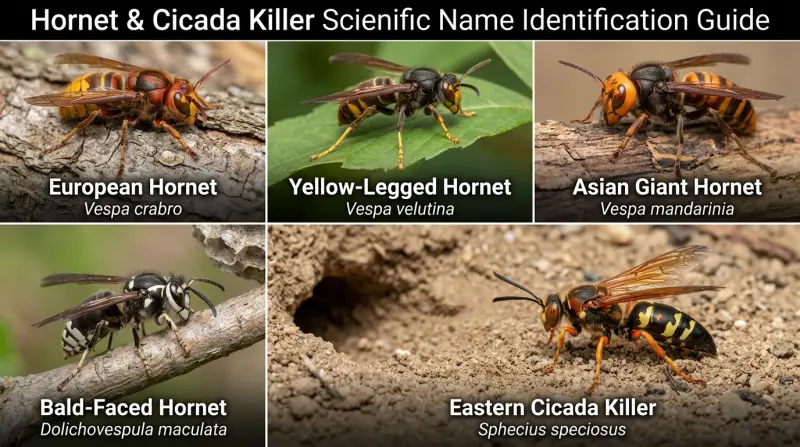
Hornet Identification Chart
- The European hornet is the sole true hornet established in the United States, marked by distinct golden-yellow, black, and dark brownish-black markings.
- True hornets belong exclusively to the genus Vespa, whereas common pests like the bald-faced hornet are actually large aerial-nesting yellowjackets.
- Invasive species such as the yellow-legged hornet are tracked closely by agricultural authorities due to their severe predatory impact on honeybees.
- Nest structure provides an essential secondary identifier: true hornets typically build paper-envelope nests in hollow trees or elevated cavities, while yellowjackets frequently nest underground or in exposed building voids.
- Body size alone is an unreliable identification metric because queens are dramatically larger than workers within the exact same colony.
To establish a clear visual and diagnostic baseline, the following identification matrix categorizes the primary true hornets and common look-alikes encountered in North America and Europe. Use this reference to cross-reference physical morphology, primary nesting habits, and geographic presence.
| Species Name | Scientific Name | Size Range | Key Coloration Markers | Primary Nesting Habit | Geographic Status |
|---|---|---|---|---|---|
| European Hornet | Vespa crabro | 0.75″ – 1.5″ (Workers up to 2.25″ for queens) | Golden-yellow abdomen with black tear-drop markings; reddish-brown thorax and head. | Hollow trees, wall voids, elevated cavities; wrapped in coarse brown paper. | Established across Europe and eastern North America. |
| Yellow-Legged Hornet | Vespa velutina | 0.75″ – 1.2″ | Dark brown/black body with an orange-yellow fourth abdominal segment and distinct bright yellow lower legs. | High in tall deciduous trees; large pear-shaped paper nests with a side entrance. | Invasive in parts of Europe; monitored under strict quarantine in the U.S. |
| Asian Giant Hornet | Vespa mandarinia | 1.5″ – 2.0″ (Queens up to 2.2″ or larger) | Massive orange-yellow head; dark brown and yellow banded abdomen; prominent cheek plates (genae). | Subterranean cavities, often utilizing abandoned rodent burrows or rotting roots. | Native to East/Southeast Asia; subject to eradication tracking in North America. |
| Bald-Faced Hornet | Dolichovespula maculata | 0.5″ – 0.75″ | Predominantly black with distinct white/ivory markings on the face and terminal abdominal segments. | Hanging aerial nests attached to tree branches, bushes, or building overhangs. | Native throughout North America (technically an aerial yellowjacket). |
| Eastern Cicada Killer | Sphecius speciosus | 1.5″ – 2.0″ | Black and yellow striped abdomen; amber-tinted wings; prominent reddish-orange legs. | Solitary ground burrows in well-drained, sandy soil lawns. | Native to eastern and midwestern North America. |
When analyzing this data, note that size ranges frequently overlap between queens, workers, and males (drones). Relying solely on color bands and leg pigmentation prevents misidentification between harmless solitary look-alikes and aggressive social species.
Visualizing Hornet Size and Geographic Distribution
To further contextualize these species, comparing their average worker body length and establishment status provides immediate clarity for field monitoring.
| Species | Average Worker Length (Inches) | Primary Threat Level | Primary Identification Focus |
|---|---|---|---|
| Asian Giant Hornet | 1.5″ – 2.0″ | High (Apiaries / Ecosystem) | Massive head, broad orange face |
| European Hornet | 0.75″ – 1.5″ | Moderate (Nuisance / Night Flight) | Reddish-brown thorax, yellow/black abdomen |
| Yellow-Legged Hornet | 0.75″ – 1.2″ | High (Honeybee Predation) | Bright yellow tarsi (feet/lower legs) |
| Bald-Faced Hornet | 0.5″ – 0.75″ | Moderate (Defensive Nests) | Black and white facial/body markings |
Taxonomic Foundations: What Defines a True Hornet?
In entomology, the term “hornet” is frequently misapplied to any large stinging insect, paper wasp, or yellowjacket. True hornets belong strictly to the genus Vespa within the family Vespidae. There are approximately 22 recognized species of true hornets worldwide, nearly all native to the Old World (Europe, Asia, and Africa). Only one true hornet species, the European hornet, has been successfully introduced and established in North America.
Key Anatomical Distinctions of the Genus Vespa
Distinguishing a true hornet from other social wasps requires a close examination of head structure and body proportions:
- Vertex Width: In true hornets, the vertex (the top of the head behind the compound eyes) is exceptionally wide and extended. When viewed from the side, the distance from the rear margin of the compound eye to the back of the head capsule is markedly broader than in yellowjackets.
- Clypeus Shape: The clypeus (the lower face plate above the mandibles) terminates in a distinct, rounded or slightly notched margin that overlaps the base of the mouthparts.
- Abdominal Profile: The abdomen of a true hornet is relatively broad and sessile, attaching closely to the thorax without a long, slender petiole (waist).
Detailed Species Breakdown
Field identification requires isolating each species by its specific morphological adaptations, behavioral quirks, and geographic presence.
The European Hornet (Vespa crabro)
As the only true hornet established in North America, the European hornet is often feared due to its imposing size—workers range from 0.75 to 1.5 inches, while queens can exceed 2.2 inches. Despite its intimidating appearance, it is generally less aggressive away from its nest than standard yellowjackets.
Coloration and Morphology
The head and thorax are a distinctive reddish-brown or chestnut color. The abdomen is predominantly golden-yellow with bold, black teardrop or triangular markings along the anterior edges of each segment. The legs are dark brown to reddish, lacking the bright yellow coloration seen in invasive Asian species.
Behavioral Nuances
Unlike most social wasps that strictly adhere to diurnal schedules, European hornets are famously nocturnal. They are routinely attracted to exterior porch lights, glowing windows, and outdoor lighting fixtures during warm summer evenings. They also feed heavily on tree sap, stripping bark from lilac bushes, ash trees, and birch branches to access plant fluids.
The Yellow-Legged Hornet (Vespa velutina)
The yellow-legged hornet has emerged as a high-priority invasive species in parts of Europe and is subject to aggressive surveillance protocols by agricultural departments globally. Its primary ecological threat is specialized predation on honeybee colonies, hovering outside hives to intercept returning foragers.
Coloration and Morphology
Workers are slightly smaller than European hornets, averaging 0.75 to 1.2 inches. The thorax is a velvety dark brown-black. The abdominal segments are dark brown, save for a prominent orange-yellow band on the fourth segment. The defining diagnostic feature is its lower legs (tarsi), which are bright, vivid yellow—giving the species its common name.
Nesting Behavior
Colonies construct massive, pear-shaped paper nests high in the canopy of tall deciduous trees, often 30 to 50 feet above ground. These aerial nests can house thousands of workers by late autumn.
The Asian Giant Hornet (Vespa mandarinia)
Often sensationalized in media reports, the Asian giant hornet is the largest social wasp in the world. While occasional specimens have been detected and eradicated in northwestern North America, it does not currently have an established, self-sustaining population on the continent.
Coloration and Morphology
Queens can reach lengths of over 2 inches with a wingspan stretching 3 inches. The most striking identifier is its massive, bright orange-yellow head, which contrasts sharply with its dark brown and yellow striped abdomen. It also features broad, rounded cheek plates behind the eyes.
Nesting Habits
Unlike species that favor high tree branches, the Asian giant hornet almost exclusively nests underground, utilizing subterranean cavities, abandoned rodent burrows, or root systems beneath forested slopes.
Common Look-Alikes and Misidentifications
Homeowners frequently submit identification requests for insects that bear superficial resemblances to hornets but belong to entirely different families or genera.
The Bald-Faced Hornet (Dolichovespula maculata)
Despite its common name containing the word “hornet,” the bald-faced hornet is actually a large aerial-nesting yellowjacket. It is native throughout North America.
Identification Markers
Measuring between 0.5 and 0.75 inches, it is smaller than true hornets. Its body is stout and predominantly black, but it is easily recognized by the striking white or ivory markings across its face and the terminal segments of its abdomen.
Nesting Habits
They construct large, football-to-basketball-sized paper-pulp nests attached to tree branches, utility poles, and the eaves of houses. These gray, papery enclosures feature a single entrance hole near the bottom.
The Eastern Cicada Killer (Sphecius speciosus)
Because of its immense size (up to 2 inches) and striking black-and-yellow coloration, the cicada killer is routinely mistaken for a dangerous hornet or giant wasp.
Identification Markers
Cicada killers feature a black thorax, amber-tinted wings, reddish-orange legs, and distinct yellow-and-black abdominal bands. Unlike social wasps, females possess large, heavy-duty digging legs adapted for excavating soil.
Behavior and Stinging Risk
Cicada killers are solitary wasps. Females hunt cicadas to provision their underground nests. They do not defend a communal nest; consequently, they are exceptionally docile. Males are territorial and will aggressively buzz humans, but they lack stingers entirely. Females can sting only if firmly trapped against bare skin.
Nest Architecture as an Identification Tool
When adult specimens are difficult to capture or observe closely, the physical architecture and location of the nest provide an infallible secondary diagnostic clue.
| Nest Type | Typical Location | Paper Texture / Color | Associated Species |
|---|---|---|---|
| Cavity Nest (Coarse) | Hollow tree trunks, wall voids, chimneys | Brittle, coarse, dark brown wood-pulp layers | European Hornet (Vespa crabro) |
| Canopy Nest (Pear-Shaped) | High branches of tall deciduous trees | Thin, layered brown paper with side entrance | Yellow-Legged Hornet (Vespa velutina) |
| Aerial Ball Nest | Tree branches, bushes, house eaves | Gray, papery, multi-layered envelope with bottom hole | Bald-Faced Hornet (Dolichovespula maculata) |
| Subterranean Nest | Underground burrows, rotting tree roots | Hidden underground; exposed comb layers | Asian Giant Hornet / Yellowjackets |
Understanding nest placement prevents dangerous missteps. For example, attempting to treat an aerial bald-faced hornet nest requires different equipment than eradicating a subterranean yellowjacket or giant hornet colony.
Step-by-Step Field Identification Framework
When encountering an unfamiliar stinging insect in the yard or garden, use this systematic diagnostic workflow to determine its exact identity:
- Assess the Size and Proportions: Is the insect under 0.75 inches, or is it a massive specimen exceeding 1.5 inches? If it is under an inch with stark black-and-white face markings, suspect a bald-faced hornet.
- Examine the Head and Thorax:
- Reddish-brown head/thorax + golden-yellow abdomen = European Hornet.
- Massive orange head + striped body = Asian Giant Hornet.
- Black thorax + amber wings + reddish legs = Cicada Killer.
- Check Leg Coloration: Look closely at the lower legs and feet. Bright yellow lower legs on a dark-bodied hornet point directly to the Yellow-Legged Hornet.
- Observe Flight and Activity Patterns: Is the insect active around exterior lighting at night? If so, it is almost certainly a European hornet. Is it hovering rigidly near an underground hole in a sandy lawn? It is likely a solitary cicada killer.
- Inspect the Nest Site: Is the nest hanging high in a tree canopy, tucked inside a hollow tree cavity, or hidden underground? Matching the nest structure confirms visual taxonomy.
Common Mistakes in Hornet Identification
Even experienced gardeners and pest technicians occasionally fall victim to common identification traps. Avoid these frequent errors:
- Relying Solely on Size: Assuming all small wasps are workers and all large wasps are queens can lead to errors. Worker size within a single colony fluctuates, and environmental factors can stunt growth.
- Confusing Color Morphs: Certain yellowjacket species (such as the aerial yellowjacket or German yellowjacket) exhibit extensive black-and-yellow patterning that mirrors true hornets. Always check the shape of the head vertex and clypeus.
- Mistaking Hoverflies for Hornets: Syrphid flies (hoverflies) mimic stinging wasps for protection. However, flies possess only two wings (compared to the four wings of wasps), short stubby antennae, and large compound eyes that meet at the top of the head. They are entirely harmless pollinators.
- Panicking Over Solitary Wasps: Mud daubers and paper wasps are frequently labeled as aggressive hornets. Because solitary and semi-social wasps rarely sting unless handled, killing them needlessly disrupts local garden ecosystems.
Frequently Asked Questions
All hornets are technically a specific subset of yellowjackets (belonging to the wasp family Vespidae), but not all yellowjackets are hornets. True hornets belong exclusively to the genus Vespa, feature a distinctly broad head vertex, and generally build large paper nests in trees or cavities. Yellowjackets belong to the genera Vespula and Dolichovespula, are typically smaller, feature brighter yellow-and-black striped faces, and frequently build nests underground or inside building foundations.
European hornets are generally docile when foraging away from their nest. Unlike aggressive yellowjackets that swarm food at picnics, European hornets rarely sting unprovoked. However, they will defend their nest vigorously if vibrations or physical disturbances threaten the colony. Their sting is painful due to deep-penetrating venom, but they are not inherently more venomous than standard honeybees.
An active nest exhibits a steady stream of worker hornets entering and exiting the primary nest opening throughout the day. In contrast, an abandoned nest will show no insect traffic. Most hornet colonies die off naturally in late autumn, leaving behind empty paper envelopes that are never reoccupied the following spring.
Female cicada killers possess stingers but rarely use them, as their primary focus is hunting cicadas for their larvae. They lack the defensive guarding behavior seen in social hornets. Males are completely incapable of stinging because they lack an ovipositor, though their territorial buzzing behavior can startle homeowners.
If you suspect you have encountered an invasive yellow-legged hornet or an Asian giant hornet, do not attempt to destroy or remove the nest yourself. Capture a clear photograph if safe to do so, note the exact geographic location, and immediately report the sighting to your local state department of agriculture or university extension service.
Conclusion
Mastering hornet identification requires moving beyond generalized fears and focusing on specific morphological markers: head width, coloration patterns, leg pigmentation, and nest architecture. By correctly distinguishing native species like the European hornet and the bald-faced hornet from high-consequence invasive pests like the yellow-legged hornet, property owners can ensure personal safety while protecting vital native pollinators. When in doubt, rely on systematic field guides, avoid disturbing unidentified nests, and consult local agricultural extension agents for official verification.