
The vast, open stretches of coastal mudflats, tidal estuaries, and inland wetlands present observers with one of ornithology’s most demanding visual challenges. Shorebirds—collectively comprising sandpipers, plovers, oystercatchers, avocets, and their allies—often gather in dense, highly active mixed-species flocks. At a distance, these congregations can appear as a shifting, monochromatic sea of gray and brown feathers. Yet, separating a Semipalmated Sandpiper from a Western Sandpiper or distinguishing between a Greater and a Lesser Yellowlegs requires a keen eye for subtle morphological details.
Field observation in this niche has evolved far beyond traditional text-based descriptions. Modern ornithological resources, including comprehensive photographic ID guides such as the New England Shorebird Guide (NESG), have transformed how researchers and enthusiasts document species diversity. Whether preparing for standardized seasonal monitoring efforts—such as the regional shorebird surveys coordinated by conservation groups and federal agencies—or simply refining backyard coastal birding skills, observers need a structured framework. This guide provides a deep, multi-dimensional analysis of shorebird morphology, behavioral typologies, and comparative identification metrics to help you master field identification.
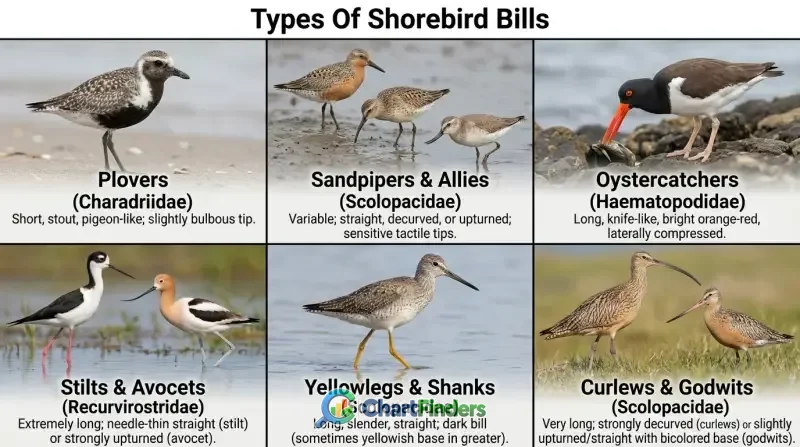
Shore Bird Identification Chart
- Bill Morphology Dictates Foraging Niche: Probing bills (long, curved, or straight) target subsurface invertebrates, whereas short, stout bills are adapted for surface-picking insects and small crustaceans.
- Proportions Matter Most at a Distance: Leg-to-body ratios, head shape, and primary projection beyond the tail often separate look-alike species faster than plumage alone.
- Seasonal Molts Transform Appearance: Many migratory shorebirds exhibit striking contrasts between their brightly colored breeding plumage and their drab, uniform winter-gray non-breeding attire.
- Behavioral Cues Are Diagnostic: Walking styles, running cadences, and feeding actions (such as the sewing-machine probing of dowitchers or the frantic darting of plovers) provide immediate taxonomic clues.
- Geographic and Temporal Context: Knowing migration windows and local high-tide roost locations dramatically narrows down potential species candidates during field surveys.
To navigate the complexity of shorebird identification, observers must rely on standardized comparative metrics. The following reference chart breaks down key taxonomic groups by their primary structural and behavioral field marks, serving as an analytical baseline for field surveys.
| Family / Group | Representative Species | Bill Characteristics | Leg Color & Length | Behavioral & Habitat Clues |
|---|---|---|---|---|
| Plovers (Charadriidae) | Black-bellied Plover, Semipalmated Plover, American Golden-Plover | Short, stout, pigeon-like; slightly bulbous tip. | Medium length; dark or yellowish depending on species. | Run-and-pause foraging style; inhabit open sandy beaches and mudflats; large rounded heads. |
| Sandpipers & Allies (Scolopacidae) | Western Sandpiper, Dunlin, Red Knot, Baird’s Sandpiper | Variable; straight, decurved, or upturned; sensitive tactile tips. | Short to long; colors range from black and green to bright yellow. | Continuous probing or pecking; often feed in tight, synchronized flocks along muddy edges. |
| Oystercatchers (Haematopodidae) | American Oystercatcher | Long, knife-like, bright orange-red, laterally compressed. | Stocky, pale pinkish-white; medium length. | Specialized mollusk opener; rocky shores, oyster reefs, and sandy beaches. |
| Stilts & Avocets (Recurvirostridae) | American Avocet, Black-necked Stilt | Extremely long; needle-thin straight (stilt) or strongly upturned (avocet). | Extremely long, bright pink or blue-gray. | Wading in shallow water; scythes water surface (avocets) or picks from surface (stilts). |
| Yellowlegs & Shanks (Scolopacidae) | Greater Yellowlegs, Lesser Yellowlegs | Long, slender, straight; dark bill (sometimes yellowish base in greater). | Very long, bright yellow; striking contrast against dark body. | Active waders in shallow marshes; vocal “teew-teew” alarm calls; nods while walking. |
| Curlews & Godwits (Scolopacidae) | Whimbrel, Hudsonian Godwit, Hudsonian Whimbrel | Very long; strongly decurved (curlews) or slightly upturned/straight with bicolored base (godwits). | Long, bluish-gray or dark. | Large, bulky bodies; probe deep into substrate; upland fields or wet mudflats. |
This table illustrates how morphological specialization corresponds directly to ecological niches. Understanding these foundational splits allows observers to rapidly narrow down unfamiliar birds to specific families before attempting species-level confirmation.
Anatomical Markers and Structural Morphology
When visual conditions are poor—such as under hazy coastal skies or against glaring wet sand—plumage colors can wash out or appear deceptive. Expert field ornithologists rely primarily on structural morphology. Evaluating skeletal proportions, bill mechanics, and feather topography provides an objective framework that remains constant regardless of lighting or seasonal molt stage.
Bill Shape, Length, and Biomechanics
The avian bill is a highly specialized evolutionary tool shaped by diet and foraging strategy. Shorebird bills contain Herbst corpuscles—specialized mechanoreceptors clustered near the tip that allow birds to detect subsurface invertebrate movement through mud and sand without visual cues.
- Straight and Probing: Species like the Dunlin and dowitchers possess relatively straight, rigid bills designed for vertical probing. Dowitchers use a distinctive “sewing-machine” motion, driving their bills straight up and down into soft substrate.
- Curved and Decurved: Curlews and Whimbrels feature dramatic, down-curved bills that match the burrow depth of large crabs and deep-dwelling marine worms. Conversely, avocets possess an upturned bill used to sweep side-to-side through shallow water.
- Short and Stiff: Plovers rely on visual foraging rather than tactile probing. Their bills are short, stout, and slightly swollen at the tip, optimized for snatching surface-dwelling beetles, flies, and small amphipods.
Proportions: Leg Length, Head Shape, and Primary Projection
Body geometry offers immediate clues when multiple species stand side-by-side in a roost. Consider the classic identification challenge between Greater and Lesser Yellowlegs. While the Greater Yellowlegs is noticeably larger with a heavier, slightly upturned bill, proportion is the ultimate diagnostic: its bill length is typically greater than the distance from the base of the bill to the back of the eye. In the Lesser Yellowlegs, the bill is shorter and more delicate, roughly equal to that same cranial distance.
, examine the primary projection—the distance the folded wingtips extend beyond the tip of the tail. Long-distance migrants, such as Baird’s Sandpiper and White-rumped Sandpiper, feature prominent primary projections that give their rear ends a sleek, elongated appearance. Short-distance or resident shorebirds often have primary tips that align neatly with the tail end.
Plumage Cycles and Seasonal Variation
One of the greatest pitfalls in shorebird identification is the dramatic transformation birds undergo between breeding and non-breeding seasons. A species that looks rust-red and heavily patterned in August may appear completely plain gray by November.
Breeding (Alternate) Plumage
During spring migration and the summer breeding grounds tenure, shorebirds invest heavily in vibrant alternate plumage to attract mates and establish territories. Rich chestnut tones, black-and-white scapular spangles, and bold chest bands dominate. For instance, the Red Knot in full breeding plumage exhibits a striking brick-red face and underparts, whereas its winter plumage is a uniform, pale silvery-gray that easily causes it to be overlooked among Dunlins.
Non-Breeding (Basic) Plumage
By late autumn and winter, most shorebirds undergo a complete body molt into basic plumage. This drab attire provides camouflage against barren winter mudflats and sandy shorelines. Identification during this period relies almost entirely on upper-part patterns (such as mantle feather fringes), facial markings (supercilliums and eyelines), and subtle structural dimensions.
Juvenile Plumage
Fall migration brings a massive influx of juvenile birds hatched in the Arctic. Juveniles often display crisp, freshly grown plumage bordered by neat pale or buffy fringes, creating a scaly or patterned “neat” appearance that differs from both adult breeding and winter states. Recognizing juvenile characteristics is essential during peak autumn survey windows, such as the mid-August survey periods standard across many regional monitoring protocols.
Behavioral and Ecological Field Cues
Morphology tells only half the story; behavior provides the context necessary to confirm difficult identifications. Different genera have evolved distinct locomotor and social patterns.
Foraging Cadence and Locomotion
Plovers are visual hunters characterized by a distinct “run-stop-peck” cadence. They sprint a short distance across the sand, halt abruptly, cock their heads, and dart forward to pick an item from the surface. Sandpipers, by contrast, are continuous probers; they move through mudflats with a steady, metronomic rhythm, rarely stopping until disturbed.
Flocking and Roosting Behavior
Flight formations offer valuable clues. Species like Western Sandpipers and Dunlins form tight, highly synchronized flocks that twist and wheel in unison above the water, flashing alternating silver underwings and dark backs. Larger species, such as Black-bellied Plovers and Whimbrels, fly in looser, more ragged V-formations or diagonal lines. During high-tide roosts, mixed flocks compress tightly together on elevated dry sand, making it an ideal time for stationary comparative study.
Regional Survey Data and Population Context
Understanding local abundance and historical survey data helps set realistic expectations in the field. Shorebird populations fluctuate significantly based on tide cycles, weather events, and seasonal migration bottlenecks. For example, comprehensive regional monitoring efforts—such as coastal waterfowl and shorebird counts conducted along the Great Salt Lake, Atlantic estuaries, and standardized survey frameworks—reveal stark differences in species dominance.
Data compiled from standardized wetland surveys highlight the immense numerical dominance of certain small sandpipers compared to scarcer coastal visitors. Reviewing a snapshot of recorded species counts from standardized multi-hour survey windows demonstrates this distribution:
| Shorebird Species | Recorded Survey Count (Benchmark Census) | Relative Abundance Classification |
|---|---|---|
| Western Sandpiper | 15,300 | Extremely Abundant (Peak Migration Staging) |
| Dunlin | 3,900 | Abundant (Winter / Late Migration Roost) |
| Black-bellied Plover | 189 | Common (Scattered Coastal Flocks) |
| Semipalmated Plover | 184 | Common (Mudflat / Beach Foragers) |
| Dowitcher (sp.) | 67 | Uncommon to Localized |
| Whimbrel | 16 | Low Density / Scrutiny Required |
| Red Knot | 20 | Low Density / Conservation Focus |
| Yellowlegs (sp.) | 2 | Rare / Transient Marsh Visitor |
This demographic reality means that while rare vagrants are always possible, an unidentified small “peep” sandpiper on a mudflat is statistically most likely to be a Western or Semipalmated Sandpiper. Keeping local context in mind prevents over-complicating identifications.
Common Identification Pitfalls and How to Avoid Them
Even experienced birders occasionally misidentify shorebirds due to optical illusions, lighting, or overlapping morphological traits. Recognizing these traps is the key to improving accuracy.
The “Peep” Identification Trap
Small, short-billed sandpipers collectively known as “peeps”—including Least, Semipalmated, Western, and Baird’s Sandpipers—are notoriously difficult to separate.
- Common Mistake: Relying on leg color alone. While Least Sandpipers consistently show greenish-yellow legs and Semipalmated/Western show dark legs, lighting conditions and mud coverage can easily obscure leg color.
- Correction: Always evaluate bill length and shape in relation to head size. The Western Sandpiper features a longer, slightly drooped bill tip compared to the stubby, blunt-tipped bill of the Semipalmated Sandpiper. , Least Sandpipers are noticeably smaller, warmer-toned brown above, and frequent muddy, vegetated freshwater edges rather than open marine mudflats.
Plumage Wear and Tear
By late summer, adult shorebirds are undergoing heavy feather wear. Worn contour feathers can eliminate diagnostic wing bars, and bleached margins can mimic juvenile scaling. Observers should look for structural cues—such as bill-to-head proportions and structural posture—rather than relying solely on worn plumage patterns.
Frequently Asked Questions
Size and bill structure are the most reliable indicators. The Greater Yellowlegs is significantly larger (approaching the size of a small duck) with a heavier, longer bill that often shows a slight upward curve and a paler base. Its bill is noticeably longer than the distance from the base of the bill to the back of the eye. The Lesser Yellowlegs is smaller, daintier, and possesses a straight, fine needle-like bill roughly equal to that same cranial distance.
Plovers belong to the family Charadriidae and are characterized by large, rounded heads, short necks, and stout, pigeon-like bills. They forage visually using a run-and-stop technique. Sandpipers belong to the family Scolopacidae, possessing more elongated, delicate bodies, longer necks, and sensitive tactile bills designed for continuous probing in mud and wet sand.
August marks the peak of southward fall migration for many Arctic-nesting shorebirds. Adult birds often migrate south first (frequently in worn breeding or early winter plumage), quickly followed by large waves of newly fledged juveniles. Juveniles possess fresh, distinctly patterned plumage with neat buffy or pale fringes, making them much easier to identify to the species level than worn adults.
Tide cycles dictate shorebird feeding behavior and roosting locations. At low tide, shorebirds disperse across vast mudflats and exposed sandbars to forage widely, making counts difficult. As the tide rises, water covers the mudflats, forcing birds to concentrate in dense, high-tide roosts on upper beaches or salt marshes. These roosting concentrations provide optimal conditions for comparative study and accurate census surveys.
Photographic guides, such as the New England Shorebird Guide (NESG), complement traditional illustrated field guides by showcasing real-world lighting variations, plumage wear, and diverse body angles captured in the field. While illustrated guides remain superior for showing schematic comparative plates of all global plumages, photographic guides excel at training the eye to recognize the subtle, imperfect reality of birds encountered in nature.
Conclusion
Mastering shorebird identification is a cumulative process that rewards patience, careful observation, and a systematic approach to morphology. By looking past fleeting plumage colors and focusing instead on structural proportions, bill mechanics, seasonal molt cycles, and behavioral cadences, observers can reliably decode even the densest mixed-species flocks. Whether you are participating in standardized coastal surveys or simply enjoying the autumn migration spectacle along a tidal mudflat, applying these analytical principles will transform a confusing sea of gray feathers into a vibrant, identifiable ecosystem.