
Avian longevity is rarely a uniform statistic, and few bird families illustrate this as clearly as the Old World and New World quails (Galliformes). While backyard enthusiasts and commercial breeders frequently focus on short-term production metrics, field ornithologists observe complex survivorship curves governed by habitat stability, metabolic rates, predation pressures, and physiological exhaustion. Understanding how long these ground-dwelling birds live requires looking past simple averages to examine the distinct biological differences between wild populations facing natural selection and captive flocks managed for intensive egg and meat yields.
This master guide examines the structural, environmental, and biological factors that dictate quail longevity. From the high-mortality realities of wild coveys to the carefully optimized parameters of modern domestic setups, we explore the distinct life stages, physiological limitations, selective breeding impacts, and management protocols that define the lifespan of these resilient gallinaceous birds.
Quail Bird Lifespan: Complete Longevity Analysis
- Wild vs. Captive Disparity: Wild quail rarely exceed 1 to 3 years of age due to intense natural selection, avian and mammalian predators, and harsh weather.
- Domestic Potential: Domestic Coturnix quail have a physiological lifespan potential of 2 to 5 years under optimal low-stress conditions.
- Commercial Utility Peak: High reproductive effort and heavy egg-laying strains shorten the productive window, leading commercial operations to cycle out birds at 12 to 24 months.
- Metabolic Rate Impact: Small-bodied gallinaceous birds possess rapid metabolisms, high heart rates, and accelerated life histories compared to larger poultry.
- Environmental Determinants: Biosecurity, nutrition, thermal regulation, and stocking density are the primary moderators of captive longevity.
The temporal span of a quail’s life is best understood by categorizing specimens into their ecological niches. The following data synthesis outlines the baseline survival metrics across the most common wild and domestic quail categories encountered by field researchers and aviculturists.
| Quail Classification | Primary Environment | Average Field Lifespan | Maximum Potential Lifespan | Primary Mortality Factors |
|---|---|---|---|---|
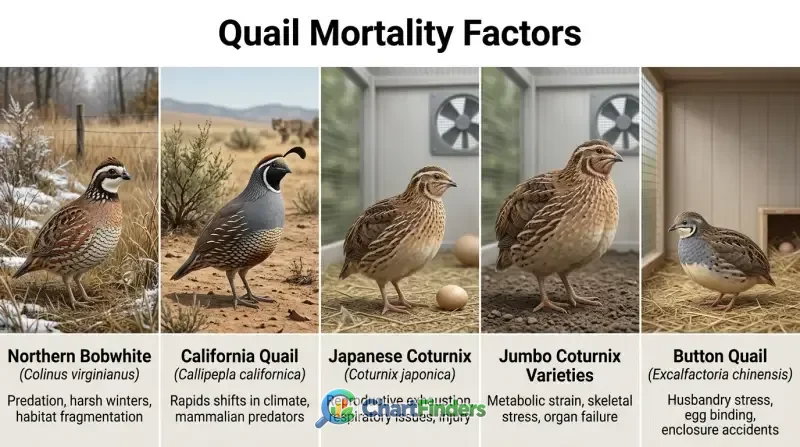
| Northern Bobwhite (Colinus virginianus) | Wild / Grassland | < 1 Year | 2–3 Years | Predation, harsh winters, habitat fragmentation |
| California Quail (Callipepla californica) | Wild / Chaparral | 1–2 Years | 3–4 Years | Rapids shifts in climate, mammalian predators |
| Japanese Coturnix (Coturnix japonica) | Domestic / Captive | 1.5–2 Years (Productive) | 3–5 Years | Reproductive exhaustion, respiratory issues, injury |
| Jumbo Coturnix Varieties | Domestic / Captive | 1–2 Years | 3 Years | Metabolic strain, skeletal stress, organ failure |
| Button Quail (Excalfactoria chinensis) | Avicultural / Captive | 2–3 Years | 4–5 Years | Husbandry stress, egg binding, enclosure accidents |
Interpreting these metrics requires acknowledging that a quail’s age is heavily skewed by juvenile mortality. In wild populations, over 70 to 80 percent of chicks perish within their first few weeks of life. Those individuals that survive the vulnerable juvenile phase enter a more stable adult demographic, though annual attrition rates remain exceptionally high.
Biological and Physiological Drivers of Quail Longevity
To comprehend why quails exhibit relatively short lifespans compared to larger avian species like parrots, raptors, or even standard gallinaceous poultry like standard chickens and turkeys, one must examine their underlying physiology.
Metabolic Rate and Life-History Strategy
Quails operate on a “live fast, die hard” biological timeline. As small-bodied prey species situated low on the food web, their evolutionary strategy prioritizes high reproductive output over physiological longevity. They reach sexual maturity rapidly—often by 6 to 8 weeks of age in Coturnix species—and begin producing large clutches of eggs immediately. This high metabolic output burns energy at an accelerated rate, correlating with shorter cellular lifespans and quicker physical degradation.
The Toll of Reproductive Effort
In both wild and domestic settings, reproduction imposes a severe physiological toll. Female quail expend massive amounts of calcium, protein, and metabolic energy to manufacture eggshells and yolks, sometimes laying an egg daily. This continuous depletion leads to common late-life conditions such as:
- Calcium Depletion & Osteoporosis: Depleted medullary bone reserves weaken the skeletal structure, making older hens prone to fractures.
- Reproductive Tract Pathology: Conditions such as egg-yolk peritonitis, internal laying, and oviductal prolapse frequently terminate the lives of aging laying hens.
- Systemic Exhaustion: Organs operating at peak capacity for consecutive laying seasons suffer accelerated wear.
Wild Quail Populations: Survivorship and Environmental Pressures
Wild quail species—including the Northern Bobwhite, California Quail, Scaled Quail, and Mountain Quail—face constant external pressures that restrict their lifespans in their natural habitats.
| Life Stage | Typical Duration | Key Survival Challenges |
|---|---|---|
| Egg & Incubation | 21–23 Days | Nest predation by snakes, rodents, and corvids; abandonment by parents due to weather or disturbance. |
| Altricial/Precocial Chick Phase | Weeks 1–4 | Hypothermia from wet grass, inability to thermoregulate, insect availability, direct predation. |
| Juvenile Covey Phase | Months 2–6 | Learning predator evasion, securing territory, maintaining covey cohesion during winter. |
| Adult Phase | Months 6+ (Rarely >2 Years) | Harsh winter weather, hunting pressure, habitat loss, cumulative parasite loads. |
Annual mortality in wild quail populations routinely reaches 70% to 85%. Because of this rapid turnover, a wild covey observed in autumn is composed almost entirely of birds hatched that same spring. Consequently, a wild quail that survives three full years is considered an extreme outlier in field biology.
Domestic and Captive Quail: Management, Housing, and Lifespan Extension
When removed from the harsh realities of natural predation and food scarcity, domestic quails—predominantly color mutations and variants of the Japanese Coturnix (such as Pharaoh, Tuxedo, Italian, and Tibetan strains)—experience extended life expectancies, though captive environments introduce their own set of artificial challenges.
Color Variations and Genotypic Considerations in Coturnix Quail
While color mutations do not inherently dictate lifespan differences on their own, distinct genetic lines exhibit behavioral or structural characteristics that indirectly influence longevity:
- Pharaoh (Wild Type): Retains baseline hardiness and standard flight reflexes; typically less modified by selective over-sizing.
- Tuxedo and Italian: Standard domestic varieties with stable productivity; require standard pen management to prevent injury.
- Tibetan: Known for deep chocolate-brown plumage; shares similar hardiness profiles to the Pharaoh wild type.
- Jumbo Strains: Bred selectively for maximum body mass and heavy meat yield, placing added strain on internal organs and skeletal frames, often resulting in shorter overall life expectancy.
The Commercial vs. Backyard
In commercial egg and meat production facilities, Coturnix quail are treated as short-cycle livestock. Their lifespan is artificially truncated to 12 to 24 months. After their first primary laying year, hens experience a natural drop in egg production and shell quality. From an economic standpoint, maintaining older birds is inefficient, leading producers to cull or replace flocks.
Conversely, backyard hobbyists who treat quail as companion animals or pet fowl often employ husbandry strategies that maximize longevity:
- Optimized Nutrition: Providing balanced gamebird rations (20% to 28% protein) supplemented with targeted vitamins, trace minerals, and free-choice oyster shell for calcium balance.
- Biosecurity and Disease Mitigation: Implementing strict sanitation protocols, preventing overcrowding, and managing litter moisture to suppress coccidiosis and respiratory pathogens.
- Predator-Proof Enclosures: Using heavy-gauge hardware cloth and secure latches to keep out domestic and wild predators (cats, raccoons, hawks, and rodents) that frequently cause premature death in backyard setups.
Common Causes of Premature Mortality in Captive Quail
Aviculturists frequently note that captive quails possess an uncanny ability to succumb to accidental or environmental hazards. Understanding these failure points is essential for extending their lifespan past the two-year mark.
1. Panic-Induced Trauma (“Scalping”)
Quails possess a strong startle reflex. When frightened by sudden loud noises, shadows, or predators, they burst vertically into the air at high velocity. In low-ceilinged hutches or pens, this results in severe head trauma, cranial lacerations, and broken necks. Utilizing netting ceilings in aviaries or padded ceilings in low cages prevents this mortality vector.
2. Thermal Stress
Quails are sensitive to extreme weather fluctuations. Temperatures exceeding 90°F (32°C) without adequate ventilation and shade trigger fatal heatstroke. Conversely, damp, uninsulated drafts during sub-freezing winters quickly overwhelm their small bodies, leading to respiratory failure.
3. Cannibalism and Pecking Orders
Overcrowding, nutritional deficiencies (such as amino acid imbalances), or excessive light intensity can trigger aggressive feather-pecking and cannibalism. Once a bird sustains a bleeding wound, flock mates will often target it, resulting in rapid mortality if the injured bird is not immediately isolated.
Frequently Asked Questions
Yes, but it is rare. While the physiological ceiling for a well-cared-for Coturnix quail is roughly 3 to 5 years, most succumb to natural aging, reproductive organ failure, or husbandry-related stress before reaching their fifth year. Birds living past 3 years are typically non-laying pets or retired breeders kept in low-stress environments.
Wild quail experience intense predatory pressure from raptors, snakes, foxes, and domestic animals. Combined with severe winter weather, food shortages, habitat loss, and high parasite loads, annual mortality rates exceed 75%, preventing most individuals from surviving past their second year.
Yes. Selecting for exaggerated body weight and massive muscle mass in “Jumbo” Coturnix strains places heavy demands on the cardiovascular and skeletal systems. Jumbo lines frequently experience higher rates of leg deformities, heart failure, and metabolic disorders, which can shorten their average lifespan compared to standard wild-type strains.
Domestic Coturnix quail reach peak egg production between 2 and 6 months of age. Production begins to decline noticeably after 12 months, and by 18 to 24 months, many hens cease laying entirely or produce irregularly shelled eggs, marking the transition into post-productive old age.
Accurately aging an adult live quail is difficult once they attain full adult plumage at around 6 weeks of age. In field studies, biologists examine the wear and bleaching on the primary flight feathers or inspect the bursa of Fabricius in young specimens, but these methods require specialized handling and post-mortem examination for definitive results.
Conclusion
The lifespan of a quail bird is fundamentally defined by the tension between its high-stress biological design and the environment in which it lives. Whether navigating the high-attrition realities of grassland ecosystems as a vital prey species or residing in carefully managed backyard aviaries, quails live brief, intense lives characterized by rapid maturity and high metabolic output. Recognizing these biological limitations allows conservationists to better protect wild coveys and empowers aviculturists to optimize husbandry practices, ensuring that captive flocks achieve their maximum potential longevity and health.