
Accurately identifying insect waste—universally known as frass—is one of the most reliable forensic tools available to pest control operators, agronomists, homeowners, and naturalists. Because many destructive and nuisance insects spend the vast majority of their life cycles hidden inside structural timbers, dense foliage, soil, or packaging materials, direct observation of the live insect is often difficult or impossible during the early stages of an infestation. However, these organisms leave a continuous biological record behind them.
The physical characteristics of insect feces act as a direct fingerprint of the organism’s digestive anatomy, feeding habits, and life stage. By understanding how to read these microscopic and macroscopic signatures, professionals can differentiate between wood-destroying pests, structural invaders, stored-product contaminants, and harmless garden visitors. This guide provides a comprehensive framework for diagnosing insect infestations based on frass morphology, behavior, and physical context, moving far beyond superficial descriptions to offer a rigorous field identification manual.
Explore our detailed breakdown on Rodent Poop Identification Chart: Complete Data Matrix.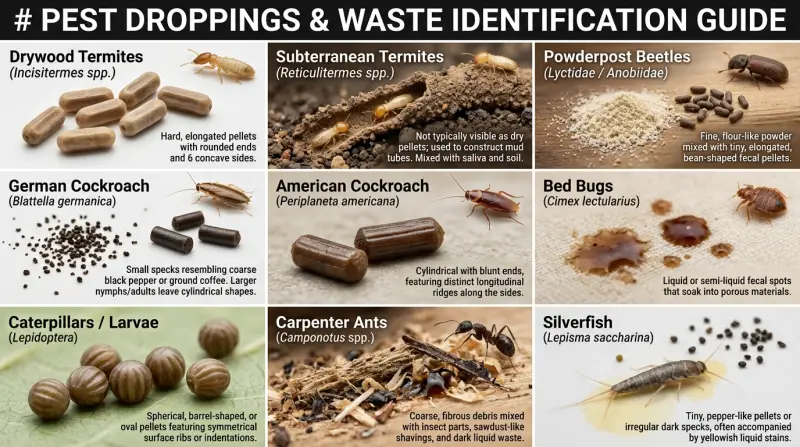
Insect Poop Identification Chart
- Frass Morphology: Insect droppings vary significantly based on diet and digestive tract structure, ranging from hexagonal pellets to liquid stains and powdery dust.
- Wood-Destroying Pests: Drywood termite frass consists of hard, elongated pellets with distinct concave surfaces, whereas powderpost beetle frass resembles fine flour or talcum powder.
- Household Invaders: Cockroach feces vary by species, appearing as blunt-ended cylinders with ridges or as coarse black pepper-like specks near harborage areas.
- Agricultural & Garden Pests: Caterpillar frass is typically round, barrel-shaped, and ribbed, accumulating in distinct pellet piles directly beneath feeding sites.
- Diagnostic Context: Location, accumulation pattern, texture, and moisture level are just as important as individual pellet shape when confirming an identification.
When conducting a field inspection, an insect poop identification chart serves as a primary diagnostic tool. Different insect orders possess specialized digestive systems that process organic matter in distinct ways, producing waste that can be systematically categorized. The following reference table outlines the key morphological and behavioral indicators for the most common insect groups encountered in residential, commercial, and agricultural settings.
| Insect Group / Species | Shape & Morphology | Color | Size | Typical Location | Key Diagnostic Indicator |
|---|---|---|---|---|---|
| Drywood Termites (Incisitermes spp.) | Hard, elongated pellets with rounded ends and 6 concave sides. | Variable (tan, light brown, dark brown, or multi-colored depending on wood consumed). | Approx. 1mm long (resembles grains of sand or poppy seeds). | Piled in conical mounds directly beneath kick-out holes in structural wood. | Distinct concave depressions on the sides of each hard pellet under magnification. |
| Subterranean Termites (Reticulitermes spp.) | Not typically visible as dry pellets; used to construct mud tubes. Mixed with saliva and soil. | Dark brown to earthy gray. | Microscopic to amorphous paste. | Inside mud shelter tubes, earthen packing inside damaged wood galleries. | Lack of distinct dry frass piles; presence of mud-lined galleries and carton material. |
| Powderpost Beetles (Lyctidae / Anobiidae) | Fine, flour-like powder mixed with tiny, elongated, bean-shaped fecal pellets. | Off-white, light beige, or matches the color of the host wood. | Microscopic dust particles; pellets are under 0.5mm. | Pushing out from tiny circular exit holes in hardwood flooring, furniture, or framing. | Fine powdery consistency that feels like talcum powder when rubbed between fingers. |
| German Cockroach (Blattella germanica) | Small specks resembling coarse black pepper or ground coffee. Larger nymphs/adults leave cylindrical shapes. | Dark brown to jet black. | 0.5mm to 1mm. | Near kitchen appliances, baseboards, hinges, cracks, and crevices in high-moisture zones. | Accumulates in corners and crevices; often accompanied by dark liquid smear marks. |
| American Cockroach (Periplaneta americana) | Cylindrical with blunt ends, featuring distinct longitudinal ridges along the sides. | Dark brown to black. | 2mm to 4mm long. | Basements, crawlspaces, utility rooms, floor drains, and near sewer lines. | Visible ridges running the length of the dropping, often mistaken for mouse droppings. |
| Bed Bugs (Cimex lectularius) | Liquid or semi-liquid fecal spots that soak into porous materials. | Dark brown, black, or rusty red. | Microscopic spots that merge into larger stains. | Mattress seams, bed frame joints, headboards, electrical outlets, and baseboards. | Bleeds into fabric like ink; leaves a permanent stain that does not flake off easily. |
| Caterpillars / Larvae (Lepidoptera) | Spherical, barrel-shaped, or oval pellets featuring symmetrical surface ribs or indentations. | Green, brown, gray, or black (matches ingested foliage). | 1mm to 5mm depending on larval instar and species. | On leaves, hanging in webs, or piled heavily on the soil surface beneath host plants. | Symmetrical geometric patterning and ribbing visible under a hand lens; uniform size distribution. |
| Carpenter Ants (Camponotus spp.) | Coarse, fibrous debris mixed with insect parts, sawdust-like shavings, and dark liquid waste. | Light wood shavings mixed with dark frass. | Varies; sawdust fractions are matchstick-sized. | Piled outside nesting sites in hollow trees, wall voids, or rotting structural timbers. | Contains recognizable insect body parts (mandibles, legs) mixed with coarse wood fibers. |
| Silverfish (Lepisma saccharina) | Tiny, pepper-like pellets or irregular dark specks, often accompanied by yellowish liquid stains. | Black or dark grey. | Under 1mm. | Dark, humid areas such as bathrooms, basements, libraries, and inside stored paper goods. | Found alongside chewed paper edges, wallpaper glue damage, and synthetic fabric grazing. |
Interpreting this data requires careful attention to environmental context. For example, while both drywood termites and powderpost beetles infest wood, the physical state of their waste separates them instantly: drywood termites eject hard, distinct geometric pellets, whereas beetles reduce wood down to an impalpable powder.
The Anatomy and Physics of Insect Frass
To master insect poop identification, one must understand why insects produce specific types of waste. Frass is not merely digested food; it is a complex metabolic byproduct influenced by the insect’s trophic level, digestive tract physiology, and environmental adaptations.
Dietary Influence on Frass Composition
An insect’s diet dictates the moisture content, chemical composition, and physical structure of its excrement:
- Xylophagous (Wood-Eating) Insects: Termites and wood-boring beetles consume cellulose and lignin. Because wood is low in nitrogen and high in complex structural carbohydrates, these insects must process massive volumes of material. Symbiotic gut fauna (protozoa and bacteria in termites) break down the cellulose, resulting in dry, highly compressed, nutrient-depleted pellets or fine dust.
- Herbophagous (Plant-Eating) Insects: Caterpillars, beetles, and orthopterans consume succulent leaves, stems, and fruits. Their frass is typically high in moisture when fresh, rich in chlorophyll pigments (often green or brown), and frequently molded into distinct geometric shapes by the rectal valves before expulsion.
- Carnivorous and Predatory Insects: Mantids, assassin bugs, and predatory beetles produce frass that is high in protein and uric acid. This waste often dries into chalky white or dark crusts, frequently mixed with chitinous fragments of their prey.
- Fluid Feeders (Hematophagous and Sap-Sucking): Bed bugs, fleas, aphids, and leafhoppers ingest liquid diets (blood or plant sap). Because sap and blood consist primarily of water and simple sugars or proteins, these insects process excess fluids rapidly. Aphids excrete clear, sugary “honeydew,” while blood-feeding insects excrete dark, digested liquid hemoglobin that oxidizes quickly upon exposure to air.
Moisture Regulation and Pellet Formation
Terrestrial insects face a constant physiological challenge: conserving water. The Malpighian tubule system extracts nitrogenous wastes from the hemolymph and dumps them into the hindgut, where water is actively reabsorbed before excretion. Insects that live in dry environments (such as drywood termites and stored-product beetles) extract nearly all available moisture, yielding exceptionally dry, hard pellets that do not mold or decay easily. Conversely, moisture-dependent insects operating in high-humidity microclimates produce softer, less desiccated waste.
Detailed Breakdown of Structural and Household Pest Frass
Distinguishing between the waste of household pests is critical for determining whether an infestation requires structural remediation, localized treatment, or basic sanitation improvements.
Wood-Destroying Organism (WDO) Frass Signatures
When inspecting buildings, the presence of frass is often the earliest diagnostic warning sign of structural compromise.
Drywood Termites: Drywood colonies do not maintain contact with the soil. They excavate galleries within sound, dry wood and actively kick out accumulated fecal pellets through tiny “kick-out holes” (approximately 1 to 2 millimeters in diameter). When homeowners sweep up small piles of hard, sand-like pellets that reappear repeatedly in the exact same spot beneath a ceiling beam or window frame, it is a definitive indicator of drywood termite activity. Under a 10x hand lens, each pellet displays six distinct, rounded sides with concave indentations where the pellet was compressed inside the termite’s rectum.
Powderpost Beetles: Encompassing Lyctid, Anobiid, and Bostrichid beetles, these wood-boring pests leave an entirely different trace. Instead of clean pellets dropped from kick-out holes, powderpost beetle infestations produce extensive flour-like frass that spills outward whenever infested wood is disturbed. If you run your hand across old hardwood flooring or antique furniture and notice fine, talcum-powder dust sifting from pin-sized holes, beetles are actively tunneling within.
Carpenter Ants: Unlike termites, carpenter ants do not consume wood; they excavate it solely to create nesting galleries. Consequently, their waste—often called “coarse frass”—consists of rejected wood shavings that resemble coarse sawdust, mixed with dead ant parts, soil particles, and metabolic waste. Finding a pile of wood shavings beneath a wall void or hollow core door, especially one containing insect parts, points directly to carpenter ant activity.
Nuisance and Health-Related Pest Frass
Urban and domestic pests leave waste in locations associated with harborage, feeding trails, and nesting zones.
Cockroaches: German cockroaches deposit small, dark specs resembling black pepper along the hinges of kitchen cabinets, under sinks, and behind refrigerators. American and Oriental cockroaches produce larger, cylindrical droppings with blunt ends and distinct longitudinal ridges. These ridges are a key anatomical identifier separating cockroach waste from rodent droppings (mice droppings are smooth, spindle-shaped, and tapered at the ends without longitudinal ridges).
Bed Bugs: Bed bug frass is frequently confused with ink stains or mold. Because it is expelled as a liquid digested blood meal, it absorbs directly into porous surfaces like mattress fabric, box springs, and wooden bed frames. When tested with a drop of water or hydrogen peroxide, fresh bed bug stains will often smear or reactivate slightly, whereas mold remains stable and ink does not bleed in the same biochemical manner.
Agricultural and Stored-Product Insect Frass Identification
In agronomy, horticulture, and grain storage facilities, frass identification prevents catastrophic crop loss and post-harvest spoilage. The Mississippi State University Extension Service and related agricultural authorities emphasize monitoring frass accumulation as an early-warning metric for field and granary pests.
Field Crop and Foliar Pests
Lepidopteran larvae (caterpillars such as corn earworms, fall armyworms, and cotton bollworms) consume immense quantities of vegetative tissue. Their frass is regularly distributed across plant leaves, whorls, and soil surfaces. Agronomists use frass density and size distribution to estimate larval instars and population pressure before economic injury thresholds are breached.
- Corn Earworm Frass: Dark green to brown, barrel-shaped pellets packed tightly within corn silks and ear tips, often accompanied by sticky moisture secretions that encourage fungal mold growth.
- Tobacco Budworm Frass: Distinctly ribbed pellets found on terminal buds and squares of cotton and solanaceous crops, serving as an indicator of hidden feeding damage long before outward wilting occurs.
Stored-Product Pests (Granary and Pantry Infestations)
In stored grains (corn, wheat, rice, and sorghum) and packaged dry goods (flour, cereals, beans), insect contamination is measured directly by frass density and insect fragment counts.
- Indianmeal Moth (Plodia interpunctella): Larvae produce fine webbing mixed with frass and chewed grain particles, creating clumps that foul stored grains and contaminate packaging.
- Weevils (Sitophilus spp.): Granary and rice weevil larvae develop entirely inside individual grain kernels. Their frass remains concealed inside the hollowed-out kernel until the adult chews its way out, leaving a clean circular exit hole and powdery residue inside the storage bin.
Step-by-Step Field Identification Protocol
When encountering unknown particulate matter or stains during an inspection, field professionals follow a standardized diagnostic sequence to prevent misidentification.
- Visual Location Assessment: Note the exact micro-habitat where the material is found. Is it suspended in mid-air webbing? Piled in a cone on a horizontal surface? Smudged onto vertical fabric? Sifting from a hole in wood?
- Physical Manipulation Test: Using forceps or a gloved finger, test the texture. Does it crush into fine powder (beetles/moths), roll into hard geometric pellets (drywood termites), smear like liquid ink (bed bugs), or feel gritty and fibrous (carpenter ants)?
- Magnification Examination: Place a sample under a 10x to 30x hand lens or pocket microscope. Look for surface geometry, such as hexagonal facets, longitudinal ridges, or bean-like contours.
- Solubility and Chemical Testing: Apply a drop of water to test for liquid absorption or bleeding (characteristic of blood-feeding bugs). Check for water-repellent waxy coatings typical of certain wax-secreting insects.
- Exclusionary Comparison: Compare the physical sample against known non-insect debris, such as insulation fibers, rodent droppings, soil particles, or rust flakes.
Common Identification Mistakes and Pitfalls
Even experienced inspectors occasionally misidentify insect waste due to morphological overlap and environmental weathering. Avoiding these common errors ensures accurate pest management interventions.
- Confusing Rodent Droppings with Cockroach Frass: Mouse droppings are larger (ranging from 3 to 8 mm), taper to a point at one or both ends, and feature smooth surfaces. Large cockroach droppings are blunt-ended and display sharp longitudinal grooves. Attributing mouse droppings to large roaches leads to completely ineffective baiting strategies.
- Mistaking Termite Frass for Sawdust: Homeowners frequently sweep up drywood termite pellets and label them “sawdust.” However, drywood termite pellets never contain fibrous wood shavings or dust; they are hard, uniform, discrete capsules. True sawdust or wood shavings indicate carpenter ants, carpenter bees, or boring beetles.
- Overlooking Weathered Frass: Old frass that has been exposed to moisture or attic heat for years can lose its structural integrity, caking together into amorphous crusts. Inspectors must search for fresh, dry deposition zones or uncompromised pellets protected inside wall voids or deep cracks.
- Assuming All Wood Damage is Termite-Related: Finding powdery frass and concluding termites are present is a critical error. Subterranean termites do not push out fine powder; that is the exclusive hallmark of powderpost beetles or furniture beetles. Misidentifying the pest results in improper chemical treatments (e.g., applying termiticides for wood-boring beetles).
Frequently Asked Questions
Termite poop appearance depends entirely on the species. Drywood termite frass consists of hard, dry, elongated pellets roughly 1mm long with six distinct concave sides and rounded ends, resembling tiny sand grains or poppy seeds. Subterranean termites, on the other hand, do not produce dry, free-flowing pellets; they mix their waste with saliva and digested soil to construct mud tubes and pack structural galleries.
Mouse droppings are relatively large (3mm to 8mm+), cylindrical, taper at the ends, and have smooth surfaces. Insect poop—such as that from large American cockroaches—is typically smaller, features blunt ends, and exhibits distinct longitudinal ridges running down its length. Smaller insect waste, like German cockroach or silverfish frass, looks like fine black pepper granules rather than distinct multi-millimeter pellets.
Yes. Bed bug waste is composed of digested blood. When expelled onto porous surfaces like mattress ticking, cotton sheets, or unsealed wood, it liquefies and penetrates the fibers, creating a permanent dark brown, black, or reddish ink-like stain that does not easily brush off.
Insect frass is generally not acutely toxic, but accumulated frass from cockroaches, bed bugs, and dust-producing beetles can trigger severe allergic reactions, contact dermatitis, and asthma attacks due to airborne proteins, shed skin fragments, and mold growth fostered by organic waste deposits.
Recent agricultural studies indicate that insect frass—particularly from mass-reared herbivores like mealworms and black soldier fly larvae—makes an exceptional organic fertilizer and soil amendment. It is rich in nitrogen, phosphorus, and potassium, and contains chitin, which stimulates natural plant defense mechanisms and beneficial soil microbial populations.
Conclusion
Mastering insect poop identification transforms guesswork into precise entomological science. By analyzing the morphology, texture, color, and deposition context of frass, pest management professionals and property owners can identify hidden infestations during their earliest stages. Whether distinguishing between the hard, six-sided pellets of drywood termites and the fine, flour-like dust of powderpost beetles, or recognizing the unmistakable ink-like stains of bed bugs, understanding insect waste provides a powerful diagnostic advantage in protecting structures, crops, and health.