
Urban and suburban encounters with small, agile spiders often trigger alarm, yet most of these tiny interlopers are harmless jumping spiders. Unlike web-weaving species that remain stationary in corners, jumping spiders are active daytime hunters that patrol exterior walls, garden foliage, window sills, and interior baseboards. For pest control professionals, property managers, and homeowners alike, accurate identification is the critical first step toward avoiding unnecessary chemical treatments and properly managing these beneficial predators.
(Reference: Jumping spider – Wikipedia)This master guide provides a comprehensive jumping spider identification chart, detailing physical traits, regional species variations, behavioral markers, and structural differences that separate harmless Salticidae from medically significant spiders like recluses or widows. By understanding their morphology, visual tracking capabilities, and habitat preferences, you can quickly distinguish jumping spiders from potential indoor pests.
Explore our detailed breakdown on Spider Bites Identification Chart (Complete Data Matrix).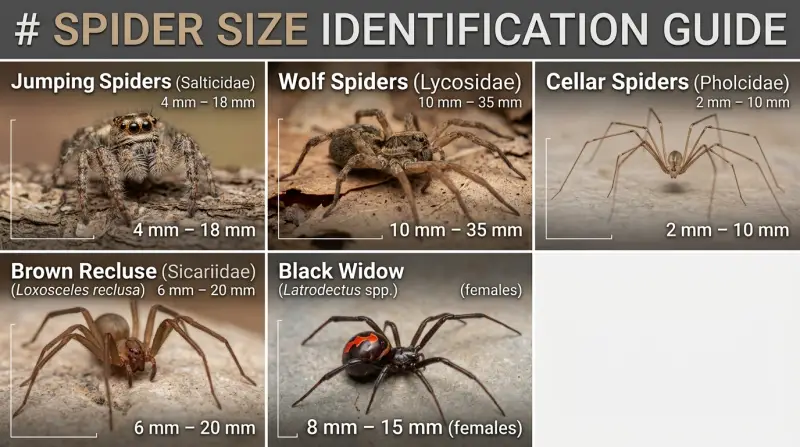
Jumping Spider Identification Chart
- Ocular Arrangement: Jumping spiders feature eight eyes arranged in three rows, with two exceptionally large anterior median eyes dominating the face, providing acute stereoscopic vision and active retinas that scan the environment.
- Locomotion: Movement is characterized by rapid, jerky starts and stops, interspersed with sudden leaps rather than steady crawling or running, powered by hydraulic hemolymph pressure in their hind legs.
- Web Habits: They do not construct traditional orb or irregular cobwebs to trap prey; instead, they spin silken retreat sacs (nests) in cracks, crevices, or under bark to molt, sleep, lay eggs, or diapause.
- Venom and Threat Level: Their venom is specialized for subduing insects and poses no systemic medical threat to humans. Bites are exceedingly rare and typically occur only when trapped directly against skin.
- Ecological Role: Acting as natural pest controllers, jumping spiders actively suppress populations of flies, mosquitoes, aphids, and other nuisance insects across urban and agricultural landscapes.
- Physical Dimensions: Most common urban species measure between 4 mm and 18 mm in body length, typically fitting within the circumference of a dime or nickel including leg span.
Navigating the sheer diversity of the Salticidae family requires a systematic breakdown of morphological traits. The following reference table contrasts jumping spiders with other common household and structural spiders to prevent misidentification.
| Spider Category | Size Range | Eye Arrangement | Web Pattern | Behavioral Profile | Medical Significance |
|---|---|---|---|---|---|
| Jumping Spiders (Salticidae) | 4 mm – 18 mm | 8 eyes; 2 massive forward-facing center eyes | No hunting web; spins silken retreat sacs only | Active daytime hunter; erratic movements; leaps on prey | None; non-aggressive |
| Wolf Spiders (Lycosidae) | 10 mm – 35 mm | 8 eyes in 3 rows; prominent mid-sized upper eyes | No web; burrows or ground runner | Fast ground runner; night hunter; carries egg sac on spinnerets | Minor local reaction (comparable to bee sting) |
| Cellar Spiders (Pholcidae) | 2 mm – 10 mm | 8 clustered eyes on raised tubercle | Irregular, messy spatial webs in corners | Vibrates web defensively when disturbed; fragile long legs | None (persistent urban myth of extreme toxicity is false) |
| Brown Recluse (Loxosceles reclusa) | 6 mm – 20 mm | 6 eyes arranged in three pairs (dyads) | Loose, sticky retreat web near ground level | Seclusive nocturnal hunter; dark violin mark on cephalothorax | Medically significant; necrotic venom |
| Black Widow (Latrodectus spp.) | 8 mm – 15 mm (females) | 8 small eyes in two rows | Irregular, three-dimensional tangled scaffolding web | Seclusive; hangs upside down in web; red hourglass on abdomen | Medically significant; neurotoxic venom |
The table above highlights that jumping spiders occupy a distinct biological niche. Their massive forward-facing eyes and compact, robust bodies immediately separate them from slender cellar spiders or long-legged wolf spiders.
Common North American Jumping Spider Species
More than 300 species of jumping spiders inhabit North America. Recognizing the most frequently encountered urban and suburban species ensures rapid, accurate field identification.
Bold Jumping Spider (Phidippus audax)
One of the largest and most recognizable species, the bold jumping spider features a stocky, black body adorned with striking white and sometimes orange markings on its abdomen. Their chelicerae (mouthparts) exhibit a metallic, iridescent green or blue sheen. Ranging from 12 to 18 mm, Phidippus audax is frequently observed on exterior concrete walls, fences, and sunny garden features.
Zebra Spider (Salticus scenicus)
Named for its distinct black and white alternating vertical stripes, the zebra spider is a smaller species (typically 5 to 7 mm) commonly found on vertical building facades, brickwork, and wooden decks where they hunt small flies. They are exceptionally tolerant of human proximity and can often be observed tracking movement from short distances.
Fencepost Jumping Spider (Marpissa muscosa)
Elongated and flattened compared to its stockier relatives, the fencepost jumping spider exhibits mottled gray, brown, and black camouflage patterns. Measuring around 8 to 11 mm, this species prefers rough wooden surfaces, bark, and weathered lumber, blending into its background until it leaps.
Anatomy and Physical Characteristics
Proper identification relies heavily on understanding the unique anatomical blueprint of jumping spiders. Unlike web-spinning spiders that depend primarily on vibrations transmitted through silk lines, jumping spiders rely overwhelmingly on acute visual acuity.
Ocular Morphology: The Three-Row Eye Arrangement
The visual system of Salticidae is among the most advanced in the arthropod world. They possess eight eyes distributed across three distinct rows on the cephalothorax:
- Anterior Median Eyes (AME): These two massive, lens-tube eyes dominate the face. They provide high-resolution, color vision (including sensitivity to ultraviolet and green wavelengths) and a narrow stereoscopic field of view. The spider can actively swivel the retinas inside these tubes to scan its environment.
- Anterior Lateral Eyes (ALE): Positioned flanking the median eyes, these provide a wider peripheral view and assist in motion detection.
- Posterior Eyes: Two small rows of eyes situated further back on the head carapace monitor overhead movement and broad environmental changes, giving the spider nearly 360-degree awareness.
Body Structure and Coloration
Jumping spiders have a stout, compact body divided into two main segments: the cephalothorax (head and thorax fused) and the abdomen. Their legs are relatively short, thick, and heavily muscled—particularly the posterior pairs—to generate explosive hydraulic pressure for jumping. Many species feature dense, iridescent scales or setae (hairs) that create vibrant metallic green, red, copper, or blue highlights.
Behavioral and Ecological Markers
Observing behavior is often faster than examining morphological details under a magnifying glass. Jumping spiders exhibit several unmistakable behavioral traits.
Hunting Strategy without Webs
Jumping spiders do not spin webs to capture prey. Instead, they operate as visual stalkers. When a fly, gnat, or small moth enters their field of vision, the spider freezes, calculates distance and trajectory, crouches, and launches itself forward with precise kinetic force. Before leaping, they anchor a safety line of silk to the substrate to prevent falls, acting much like a rappelling mountaineer.
Sensory Perception and Hearing
Recent entomological research highlights that jumping spiders “hear” via specialized sensory hairs located across their legs and bodies. These hairs detect airborne acoustic vibrations and substrate micro-vibrations from distances up to ten feet away. This acute sensitivity allows them to detect approaching predators or prey long before visual confirmation.
Habitat, Distribution, and Seasonality
Jumping spiders are cosmopolitan, thriving in virtually every terrestrial biome except extreme polar regions and deep deserts. In urban environments, they are classified as synanthropic—meaning they benefit from human-made structures.
Where to Find Jumping Spiders
- Exterior Surfaces: Sunny exterior walls, stucco, brick siding, porch railings, and garden fences where solar radiation elevates ambient temperatures.
- Vegetation: Broad-leafed plants, tall grasses, tree bark, and flower gardens hosting abundant insect populations.
- Indoor Spaces: Window sills, sliding glass doors, bright sunrooms, and upper wall corners where flying insects congregate.
Seasonal Activity Cycles
Activity peaks during late spring, summer, and early autumn when ambient temperatures support high metabolic rates and insect prey is abundant. As temperatures drop in late autumn, jumping spiders seek protected sheltered crevices—such as loose bark, wall voids, or window frames—to spin a dense silken overwintering sac (hibernaculum) where they diapause until spring.
Differentiating Jumping Spiders from Dangerous Look-Alikes
A primary concern for property owners is distinguishing harmless jumping spiders from medically significant species, specifically the brown recluse and the black widow. Misidentification frequently leads to unnecessary panic and improper chemical applications.
Jumping Spider vs. Brown Recluse
The brown recluse (Loxosceles reclusa) is a shy, nocturnal spider found primarily in the central and southern United States. Key differentiators include:
- Eye Count: Brown recluses possess six eyes arranged in three pairs (dyads); jumping spiders have eight eyes with two massive central eyes.
- Markings: Recluses feature a characteristic dark violin-shaped pattern on the cephalothorax with the neck pointing backward; jumping spiders lack this pattern and often display vibrant colors or hairy textures.
- Behavior: Recluses flee from light and hide in dark, undisturbed areas (woodpiles, cardboard boxes, closets); jumping spiders actively hunt in bright daylight and exhibit inquisitive behavior.
Jumping Spider vs. Black Widow
Black widows (Latrodectus species) are notorious for their potent neurotoxic venom. Key differentiators include:
- Body Shape: Black widows feature glossy, spherical, bulbous abdomens; jumping spiders have compact, rectangular or oval abdomens covered in dense hair or scales.
- Web Architecture: Widows construct messy, tangled, three-dimensional scaffolding webs in dark corners; jumping spiders build no hunting webs.
- Ventral Markings: Female black widows display a distinct red or orange hourglass mark on the underside of the abdomen.
Frequently Asked Questions
No. Jumping spiders possess venom to immobilize small insect prey, but it is not medically significant to humans or domestic pets. They are exceptionally docile and will only attempt to bite if pressed directly against bare skin with no escape route. A bite typically results in mild, localized irritation comparable to a minor mosquito bite.
Jumping spiders do not target humans aggressively. When they leap in the direction of a human, it is usually because they are fleeing toward a shadow, escaping a perceived threat, or navigating across vertical surfaces where human hands or clothing happen to be in their direct line of transit.
They do not infest homes in the manner of termites, ants, or bed bugs. Jumping spiders are solitary hunters that wander indoors accidentally through open doors, windows, or tiny gaps in weatherstripping. They do not damage building materials, contaminate stored food, or reproduce in massive colonies indoors.
Integrated Pest Management (IPM) exclusion techniques are the most effective deterrents. Seal cracks around windows and doors with silicone caulk, install fine-mesh insect screens, repair damaged weatherstripping, and eliminate outdoor clutter near the foundation that attracts insect prey.
From an ecological and pest management perspective, killing jumping spiders is counterproductive. They act as natural biological control agents, relentlessly consuming houseflies, gnats, mosquitoes, and other genuine indoor pests. Gently relocating them outside using a small container and a piece of cardstock is the recommended course of action.
Conclusion
Jumping spiders are fascinating, highly evolved beneficial predators easily recognized by their compact bodies, erratic movements, and oversized forward-facing eyes. Armed with this identification chart and behavioral framework, property owners can accurately distinguish these harmless hunters from medically significant spiders. Rather than resorting to chemical elimination, recognizing jumping spiders as natural allies allows for sustainable, non-toxic urban pest management that preserves ecological balance while keeping living spaces comfortable.