
The feline cultural landscape of Japan is a fascinating intersection of ancient folklore, natural geographical isolation, and modern domestic refinement. Unlike Western breeding programs that often focused heavily on extreme morphological transformations during the Victorian era, historical Japanese breeding philosophy prioritized natural selection, hardiness, and compatibility with agrarian and urban island living. Cats arrived in Japan from the Asian mainland via trade ships—initially deployed to protect sacred Buddhist scriptures from rodents—and rapidly integrated into the daily life, art, and mythology of the archipelago.
Understanding Japanese cat breeds requires a departure from simple Western categorization. It demands an examination of how natural landraces developed distinctive genetic traits in relative isolation, how traditional folklore preserved specific colorations like the tri-color calico, and how modern cat fanciers manage the delicate balance between preserving ancient lineages and outcrossing for genetic diversity. This master resource explores the history, physical characteristics, behavioral profiles, care requirements, comparative metrics, and cultural significance of the feline lineages native to or historically rooted in Japan.
Explore our detailed breakdown on Quokka Lifespan Chart.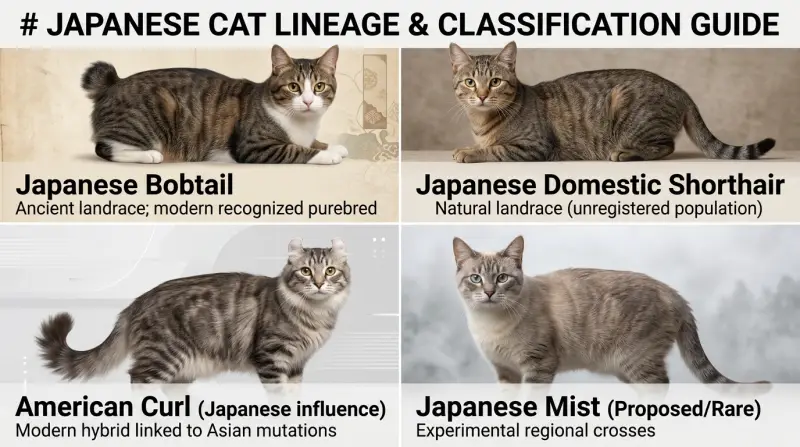
Japanese Cat Breeds
- The Japanese Bobtail is the definitive internationally recognized purebred feline originating from Japan, distinguished by its unique pom-pom tail caused by a natural recessive genetic mutation.
- Japanese Domestic Shorthairs (Neko) represent the hardy, free-roaming landrace population, celebrated for their exceptional health, adaptability, and high genetic diversity.
- The traditional Mi-Ke (calico) pattern holds deep cultural significance in Japanese folklore, almost exclusively female due to sex-linked genetics and traditionally believed to bring good fortune and maritime safety.
- Centuries of close coexistence with humans have endowed Japanese native cats with high intelligence, communicative vocalizations, and exceptional agility.
- Modern care for Japanese cat breeds emphasizes mental stimulation, vertical territory, and protection against obesity due to their naturally high metabolisms and active hunting instincts.
To fully grasp the scope of Japanese felines, we must examine both the formal registered breeds recognized by international registries such as the Cat Fanciers’ Association (CFA) and The International Cat Association (TICA), as well as the informal landraces that populate Japanese neighborhoods. The following comparative overview outlines the primary classifications.
| Breed / Type | Origin & Status | Tail Type | Key Temperament | Health & Hardiness | Grooming Need |
|---|---|---|---|---|---|
| Japanese Bobtail | Ancient landrace; modern recognized purebred | Kinked, rigid “pom-pom” (4–8 inches) | Active, highly vocal, clever, social | Robust; generally free from hereditary defects | Low (Shorthand & Longhair variants) |
| Japanese Domestic Shorthair | Natural landrace (unregistered population) | Full length (straight) or occasional natural bob | Curious, adaptable, independent yet affectionate | Exceptional; high genetic diversity | Minimal (Weekly brush) |
| American Curl (Japanese influence) | Modern hybrid linked to Asian mutations | Full length | People-oriented, playful, high energy | Good; minor focus on ear cartilage care | Low to Moderate |
| Japanese Mist (Proposed/Rare) | Experimental regional crosses | Full length | Reserved, observant, athletic | Moderate; monitored in specialized breeding pools | Low |
The table above highlights the foundational division between formalized registry breeds like the Japanese Bobtail and the abundant domestic shorthairs that form the daily reality of feline companionship across Japan.
Comparative Metrics: Temperament, Activity, and Care
Evaluating cat breeds for home compatibility requires an objective look at behavioral intensity, physical activity demands, and daily maintenance needs. The following matrix contrasts the primary Japanese feline types against popular global companions frequently kept in modern Japanese households (such as Maine Coons and Abyssinians) to benchmark their care profiles.
| Breed Profile | Beginner Friendliness | Affection Level | Activity Level | Care & Grooming Effort | Average Lifespan |
|---|---|---|---|---|---|
| Japanese Domestic Shorthair | ★★★★★ (High) | ★★★☆☆ (Variable/Balanced) | ★★★★☆ (Active) | ★☆☆☆☆ (Very Low) | 15 – 18 Years |
| Japanese Bobtail | ★★★★☆ (Good) | ★★★★☆ (Affectionate/Social) | ★★★★★ (Very High) | ★★☆☆☆ (Low) | 15 – 17 Years |
| Maine Coon | ★★★★☆ (Good) | ★★★★★ (High/Gentle Giant) | ★★★☆☆ (Moderate) | ★★★★☆ (High – Matting risk) | 12 – 15 Years |
| Abyssinian | ★★★☆☆ (Moderate) | ★★★★☆ (Demands attention) | ★★★★★ (Extreme energy) | ★☆☆☆☆ (Low) | 12 – 15 Years |
The Japanese Bobtail: History, Genetics, and Morphology
The Japanese Bobtail stands as Japan’s preeminent contribution to the purebred cat world. Documented in Japanese art and literature as early as the 6th century—particularly during the Edo period when they were deployed to protect the silk industry and imperial granaries from rodents—these cats possess a distinct anatomical profile that separates them from other short-tailed breeds like the Manx.
Unlike the Manx mutation, which can be linked to spinal deformities and severe health complications when bred improperly, the Japanese Bobtail’s tail is the result of a simple recessive gene that shortens the caudal vertebrae. Each tail is completely unique, featuring distinct curves, kinks, or angles, covered in fur that fans out to resemble a rabbit’s or powder puff’s pom-pom. , the breed comes in both shorthaired and longhaired varieties, with the longhaired version featuring a soft, silky coat that plumes dramatically.
Physically, the Japanese Bobtail is a medium-sized, slender yet muscular cat with clean lines and high cheekbones. They possess large, expressive oval eyes set at a distinct slant, giving them an alert, oriental facial expression. Their back legs are noticeably longer than their front legs, contributing to their explosive jumping power and athletic agility.
The Japanese Domestic Shorthair (Neko): The Heartland Landrace
While purebreds like the Bobtail capture registry attention, the vast majority of cats in Japan are Japanese Domestic Shorthairs, colloquially known simply as Neko (cat). These are not a standardized breed in the Western sense, but rather a landrace shaped by centuries of natural selection within the diverse climates of the Japanese archipelago—ranging from the snowy winters of Hokkaido to the subtropical summers of Okinawa.
Japanese Domestic Shorthairs are celebrated for their strong, wedge-shaped heads, sturdy bone structures, and exceptional adaptability. Because their gene pool has remained largely unconstrained by artificial human selection for extreme traits, they exhibit high genetic diversity. This diversity translates to robust immune systems, high baseline resistance to common feline illnesses, and long lifespans averaging 15 to 18 years.
Coat variations within this landrace are vast, but certain patterns hold special cultural prominence:
- Mi-Ke (Three-Fur / Calico): Combining black, orange, and white patches, these cats are almost exclusively female due to sex-linked genetic coloring. Historically prized by sailors and fishermen, they were believed to protect ships from ghosts and bad weather.
- Kiji-wato (Tabby): Brown, grey, or red mackerel tabbies that mirror the wild forest cats from which early domesticates evolved.
- Chatora (Red Tabby): Often noted in Japanese media and internet culture for their relaxed, affectionate, and sometimes demanding personalities.
- Kuro-neko (Black Cat): Unlike Western superstitions that historically linked black cats to misfortune, traditional Japanese folklore often views black cats (fuku-neko) as bringers of prosperity and wardens against evil spirits.
- Hachiware (Split-Crown / V-Pattern): Cats featuring a white face with a distinct V-shaped or symmetrical colored marking on the crown, considered auspicious because the Japanese kanji for eight (八) widens toward the bottom, symbolizing expanding prosperity.
Behavioral Traits and Psychological Profile
The behavioral profile of Japanese cat breeds and landraces is deeply influenced by their historical roles as working animals and close household companions. They are rarely passive lap ornaments; instead, they maintain a high degree of situational awareness and active curiosity.
Japanese Bobtails and Domestic Shorthairs are renowned for their high intelligence and interactive nature. They frequently engage in games of fetch, learn household routines rapidly, and communicate with a wide vocal repertoire ranging from soft chirps and trills to complex conversational meows. Unlike some European or American breeds that may lean toward extreme independence or couch-potato tendencies, Japanese felines maintain a balanced equilibrium: they seek out human companionship and affection on their own terms while remaining fiercely capable of independent play and environmental exploration.
Their high energy levels require purposeful environmental enrichment. Access to vertical space—such as floor-to-ceiling scratching posts, high perches, and window hammocks—is vital for satisfying their instinctual need to survey their territory from an elevated vantage point.
Health, Nutritional Management, and Longevity
The overall hardiness of Japanese cat breeds is one of their most celebrated attributes, but maintaining their long-term health requires attention to specific physiological needs.
Because these cats possess high metabolisms and active predatory drives, maintaining proper portion control is essential. Free-feeding can quickly lead to canine-like gorging behavior, resulting in feline obesity and subsequent secondary conditions such as diabetes and joint stress. High-protein, moisture-rich diets that mimic natural prey profiles support their muscular physiques and protect urinary tract health.
Joint health is another critical consideration, particularly for athletic breeds like the Japanese Bobtail whose powerful hindquarters propel them into high-impact leaps. Ensuring soft landings with adequately placed rugs, monitoring for early signs of arthritis in senior years, and keeping claws neatly trimmed will significantly extend their active lifespan.
Cultural Impact and Folklore Surrounding Japanese Cats
It is impossible to discuss Japanese cat breeds without acknowledging their profound integration into Japanese cultural history. Felines in Japan have occupied roles ranging from sacred temple guardians to beloved pop-culture icons.
The most famous cultural ambassador is the Maneki-Neko (Beckoning Cat), a figurine modeled after the Japanese Bobtail. Depicted with one paw raised in a welcoming gesture, the Maneki-Neko is placed at shop entrances, restaurants, and homes to summon wealth, good fortune, and happiness. Different paw positions carry specific meanings: a raised left paw invites customers, a raised right paw invites wealth, and both paws raised offer protection against household misfortune.
Historical texts from the Edo period also document the transition of cats from imperial luxury items—initially owned exclusively by emperors, aristocrats, and Buddhist monks—to common household protectors. This democratization of cat ownership allowed the native shorthair population to flourish across farms and fishing villages, cementing their reputation as resilient, self-sufficient partners to working people.
Frequently Asked Questions
No. Both shorthaired and longhaired varieties of the Japanese Bobtail have minimal undercoats, making their fur relatively resistant to matting. Weekly brushing is generally sufficient to remove loose hairs, making their grooming requirements far lower than double-coated breeds like Persians or Maine Coons.
Yes. Despite their active and curious natures, Japanese Domestic Shorthairs adapt exceptionally well to indoor apartment living provided their environment is properly enriched. Providing vertical territory, interactive puzzle feeders, and daily play sessions satisfies their need for stimulation without requiring outdoor access.
The genes responsible for orange and black coat colorations are carried on the X chromosome. Because a cat requires two X chromosomes to display both colors simultaneously alongside white spotting, almost all calico cats are genetically female (XX). Male calicos (XXY) occur only through rare genetic anomalies such as Klinefelter syndrome and are typically sterile.
While both breeds are famous for short tails, they stem from entirely different genetic mutations. The Manx gene can cause severe spinal and neurological complications if bred improperly. The Japanese Bobtail mutation specifically shortens the caudal vertebrae without affecting the spinal cord, resulting in a healthy, structurally sound cat with no associated neural defects.
Yes. Japanese Bobtails and Japanese Domestic Shorthairs are known for their confident, social, and adaptable temperaments. They generally tolerate children well when properly socialized and can coexist peacefully with cat-friendly dogs and other felines due to their strong communicative skills and self-assured nature.
Conclusion
Japanese cat breeds and landraces represent a harmonious blend of natural resilience, striking aesthetics, and deep-rooted cultural heritage. From the iconic, pom-pom-tailed Japanese Bobtail recognized by global registries to the hardworking, adaptable Japanese Domestic Shorthair found across neighborhoods in Japan, these felines offer a compelling mix of intelligence, affection, and low-maintenance hardiness. By understanding their history, respecting their high activity levels, and providing thoughtful environmental enrichment, owners can ensure these remarkable cats thrive as cherished family companions for well over a decade and a half.