
Encountering a spider in a Kentucky basement, garage, or garden can instantly trigger anxiety, but reacting with indiscriminate chemical sprays or panic is rarely an effective strategy. Understanding which arachnids pose a genuine health risk and which are harmless neighborhood residents is critical for maintaining a balanced, pest-free living space. Urban pest management relies on accurate identification rather than fear-driven eradication. Because Kentucky’s unique geographical and climatic zones support diverse wildlife, recognizing local spiders requires reliable diagnostic tools, clear physical descriptions, and a firm grasp of behavioral habits.
(Reference: Urban Spider Chart | Entomology)This master guide explores Kentucky’s arachnid population, drawing on entomological standards to provide a comprehensive reference for homeowners, property managers, and outdoor enthusiasts. From deciphering official identification charts and mapping dangerous encounters to implementing non-chemical exclusion strategies, this resource equips you with the knowledge needed to manage urban spider populations safely and effectively.
Explore our detailed breakdown on Spider Bites Identification Chart (Complete Data Matrix).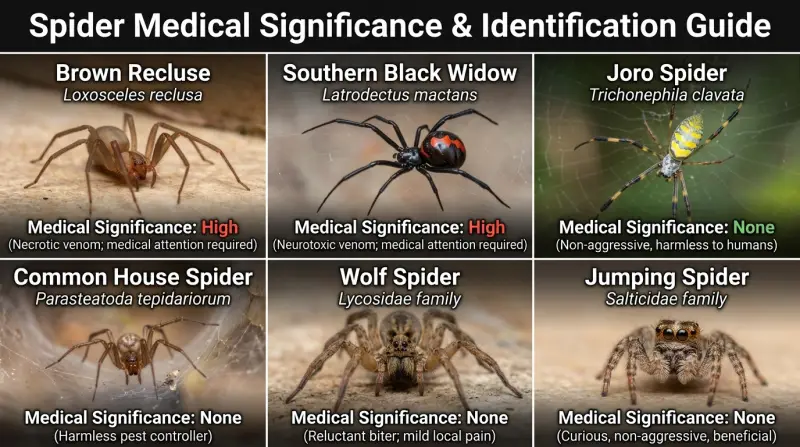
Kentucky Spider Identification Chart
- Most spiders found inside Kentucky homes are harmless predators that feed on nuisance insects like flies, roaches, and mosquitoes.
- Medically significant spiders in Kentucky are limited to the brown recluse and the black widow; other species pose no systemic threat to humans.
- The non-dangerous, invasive Joro spider has expanded its geographic range into Kentucky, creating a visible presence in yards and wooded edges without presenting a health hazard.
- Official identification resources, such as the University of Kentucky Urban Spider Chart, focus on distinct morphological markers like eye patterns, body shapes, and signature web structures.
- Effective urban spider control prioritizes habitat modification, moisture reduction, and structural sealing over routine pesticide applications.
- Bites from native harmless species typically result in minor, localized irritation comparable to a mosquito bite, whereas recluse or widow bites require prompt medical evaluation.
The University of Kentucky College of Agriculture, Food and Environment, through its Department of Entomology, publishes essential reference materials like the Urban Spider Chart to demystify local arachnids. Navigating this chart requires looking past initial impressions of size or color and focusing on distinct structural identifiers. Spiders do not behave uniformly; their web-building strategies, hunting styles, and preferred micro-habitats offer immediate clues to their identity.
When reviewing spider identification aids, pest control strategies are most successful when categorized by risk level, web architecture, and habitat preference. The following comparative reference outlines the primary spider groups encountered across Kentucky urban and suburban environments.
| Spider Group / Common Name | Medical Significance | Web / Hunting Style | Primary Kentucky Habitat | Key Visual Identifier |
|---|---|---|---|---|
| Brown Recluse Loxosceles reclusa | High (Necrotic venom; medical attention required) | Irregular, sticky sheet webs in hidden spaces | Dark, undisturbed indoor areas (basements, closets, cardboard boxes) | Uniform brown color, violin marking on cephalothorax, 6 eyes in pairs. |
| Southern Black Widow Latrodectus mactans | High (Neurotoxic venom; medical attention required) | Tangled, three-dimensional irregular webs near ground level | Outdoors in woodpiles, under crawlspaces, cluttered sheds | Shiny jet-black body with a red hourglass marking on the underside. |
| Joro Spider Trichonephila clavata | None (Non-aggressive, harmless to humans) | Large, strong orb webs spun horizontally between trees or structures | Outdoor trees, porches, gardens, and utility lines | Large size, bright yellow and blue-gray stripes on the abdomen. |
| Common House Spider Parasteatoda tepidariorum | None (Harmless pest controller) | Messy, tangled cobwebs in corners and ceiling junctions | Corners of rooms, garages, attics, and window frames | Mottled brown, bulbous abdomen, varying pattern markings. |
| Wolf Spider Lycosidae family | None (Reluctant biter; mild local pain) | Active ground hunter (does not spin webs to catch prey) | Lawns, gardens, under rocks, occasionally wandering indoors | Hairy, robust build, mottled gray/brown, distinct large anterior eyes. |
| Jumping Spider Salticidae family | None (Curious, non-aggressive, beneficial) | Active daytime stalker (uses silk only for safety lines/nests) | Sunlit walls, fences, garden foliage, window sills | Compact body, large front-facing eyes, often metallic or fuzzy coloration. |
Reading this table correctly involves assessing where the specimen was found and matching its physical silhouette to the listed traits. For instance, a spider found wandering openly across a sunlit living room floor during daytime is almost certainly a hunting spider, such as a wolf spider or jumping spider, rather than a secretive web-spinner like the brown recluse.
Understanding Medically Significant Spiders in Kentucky
While the vast majority of Kentucky spiders are harmless, urban property owners must remain vigilant regarding two distinct groups: the brown recluse and the black widow. Proper identification of these species prevents unnecessary panic while ensuring prompt medical care when a genuine encounter occurs.
The Brown Recluse (Loxosceles reclusa)
The brown recluse is widely distributed across the southern and western regions of Kentucky, though isolated populations occur statewide. True to their name, these spiders are reclusive, preferring dark, undisturbed environments where they hide during daylight hours.
- Coloration and Markings: Uniform light brown to dark brown body with no prominent stripes or multi-colored patterns on the abdomen. The defining feature is a darker violin-shaped marking on the dorsal side of the cephalothorax (the fused head and thorax), with the neck of the violin pointing backward.
- Eye Arrangement: Unlike most spiders that possess eight eyes, the brown recluse has six eyes arranged in three distinct pairs (dyads) forming a semicircle.
- Behavioral Risks: Recluse bites typically occur when a spider is trapped against human skin inside clothing, shoes, or heavy bedding. The venom contains enzymes that can cause localized tissue destruction (necrosis). Bites often go unnoticed initially, developing into a painful, stinging lesion within hours.
The Black Widow (Latrodectus mactans)
The black widow is found throughout Kentucky, inhabiting sheltered outdoor niches where insect prey is abundant. They are rarely found out in the open or roaming freely across living spaces.
- Coloration and Markings: Adult females are glossy, jet-black with a distinct, bright red or orange hourglass-shaped marking on the ventral side of the rounded abdomen. Immature females and males may feature varied white or red spots on their backs.
- Web Structure: Black widows construct coarse, highly irregular, and remarkably strong scaffolding webs close to ground level in sheltered crevices.
- Behavioral Risks: Widows are non-aggressive and bite only when directly squeezed or threatened. Their venom is neurotoxic, affecting the nervous system and causing severe muscle cramps, abdominal rigidity, sweating, and intense pain that requires immediate medical intervention.
Common Harmless and Beneficial Kentucky Spiders
Misidentifying harmless spiders as dangerous pests leads to unnecessary chemical applications and disrupts natural biological control. Kentucky yards and homes host numerous beneficial species that actively suppress harmful insect populations.
Wolf Spiders (Family Lycosidae)
Wolf spiders are robust, hairy hunters that do not build webs. Instead, they patrol lawns, garden beds, and foundation perimeters at night, running down insect prey. They frequently wander indoors during autumn as temperatures drop. Female wolf spiders exhibit unique maternal behavior, carrying their egg sacs attached to their spinnerets and later carrying hundreds of spiderlings on their backs.
Jumping Spiders (Family Salticidae)
Recognizable by their compact builds, fuzzy textures, and exceptionally large, expressive forward-facing eyes, jumping spiders are diurnal hunters. They possess phenomenal vision and can leap distances many times their body length. They are completely harmless to humans, often displaying curious behavior by turning to watch human observers.
Orb Weavers (Family Araneidae)
Orb weavers are famous for constructing large, geometric, wheel-shaped webs in gardens, between shrubs, and across porches. Familiar examples include garden spiders and the newly expanding Joro spider. Their webs are architectural masterpieces designed to catch flying insects like mosquitoes, moths, and flies. Joro spiders, an invasive species spreading across Kentucky, produce striking yellow and blue-gray banded bodies and massive webs, yet they remain entirely non-aggressive and pose no medical threat.
Habitat Modification and Urban Prevention Strategies
Applying insecticides directly to every spider seen outdoors is inefficient and ecologically unsound. Because spiders follow their food sources (insects) and seek shelter from environmental extremes, effective urban pest management centers on habitat modification and environmental control.
- Eliminate Shelter and Clutter: Clear out piles of firewood, lumber, bricks, and dense vegetation from the immediate perimeter of building foundations. Store items off the floor in plastic, sealed storage bins rather than cardboard boxes, which attract brown recluses.
- Seal Entry Points: Inspect and repair damaged window screens, seal gaps around utility penetrations, and install tight-fitting door sweeps on exterior doors to prevent wandering spiders from entering living areas.
- Manage Moisture and Humidity: Basements, crawlspaces, and attics attract insects, which in turn draw spiders. Utilize dehumidifiers, ensure proper sub-floor ventilation, and repair plumbing leaks promptly.
- Reduce Exterior Lighting: High-intensity outdoor lights attract flying insects at night, creating a primary feeding station for web-building spiders near entryways. Switch to yellow-toned or sodium-vapor exterior bulbs that attract fewer insects.
- Regular Sanitation: Vacuum regularly along baseboards, behind furniture, in corners, and inside undisturbed closets to remove egg sacs, webs, and hiding spiders before populations establish.
Common Mistakes in Spider Management
Property owners frequently make avoidable errors when dealing with perceived spider infestations. Recognizing these pitfalls ensures safer and more efficient pest control outcomes.
- Relying Solely on Broad-Spectrum Sprays: Spraying baseboards with aerosol insecticides rarely eliminates subterranean or hidden spiders like the brown recluse, as these chemicals do not penetrate deep harbourages. Physical exclusion and dusting wall voids are far more effective.
- Failing to Inspect Stored Items: Reaching blindly into dark boxes stored in garages or attics is the primary cause of brown recluse bites. Always wear thick work gloves and shake out clothing or shoes left undisturbed for extended periods.
- Confusing Safe Spiders with Recluses: Many harmless brown spiders—such as grass spiders, wolf spiders, and nursery web spiders—are routinely misidentified as brown recluses simply because of their color. Check for the definitive violin pattern and eye arrangement before panicking.
- Ignoring Insect Populations: Spiders do not infest homes without a food source. Addressing underlying moisture and general insect infestations automatically reduces the spider population.
Frequently Asked Questions
No. Joro spiders are large and visually intimidating, but they are timid, non-aggressive, and possess venom that is completely harmless to humans and household pets. Their primary impact is ecological as an invasive orb weaver, and their large webs can become a nuisance around outdoor living areas.
Look for three key diagnostic features: a uniform brown color without patterned bands on the abdomen, a distinct dark violin-shaped marking on the top of the cephalothorax with the neck pointing backward, and six eyes arranged in three distinct pairs. If the spider has hairy legs with distinct stripes or patterns, it is not a brown recluse.
Wolf spiders are agile runners and can jump short distances when startled or attempting to escape. However, they are reluctant biters. If cornered or pressed against skin, a wolf spider may bite defensively, resulting in mild localized pain, redness, and swelling similar to a bee sting, but without systemic medical complications.
Wash the bite area thoroughly with soap and water, apply a cold compress to minimize swelling, and seek immediate medical evaluation. Capture or photograph the spider if it can be done safely, as positive identification assists healthcare providers in determining the appropriate clinical treatment.
As outdoor temperatures drop and food sources dwindle in late summer and autumn, many outdoor-dwelling spiders (such as wolf spiders and house spiders) migrate indoors seeking warmth and shelter for the winter. Routine structural sealing and weather-stripping maintenance significantly reduce this seasonal migration.
Mastering spider identification in Kentucky protects both your household safety and the local ecosystem. By relying on objective entomological charts, prioritizing physical habitat control, and treating medically significant species with appropriate caution, property owners can maintain a comfortable, pest-balanced environment year-round.