
The term “pitbull” is one of the most widely used yet frequently misunderstood labels in the canine world. To the general public, it often evokes a single, uniform breed of dog. In reality, “pitbull” functions as a phenotypic descriptor—an umbrella classification encompassing distinct breeds that share a common historical lineage rooted in bulldogs and terriers. Because visual identification is notoriously difficult even for shelter workers, veterinarians, and animal control officers, a structured pitbull identification chart is essential for accurately recognizing the physical characteristics, proportions, and subtle variations that define these dogs.
Understanding these distinctions requires moving past generalized assumptions and examining concrete anatomical traits. While genetic testing remains the only definitive method to determine a dog’s exact lineage, morphology-based identification charts provide a reliable framework for assessing phenotype. This comprehensive guide explores the structural anatomy, recognized breeds, measurements, common identification mistakes, comparative metrics, and distinct behavioral and physical markers associated with pitbull-type dogs.
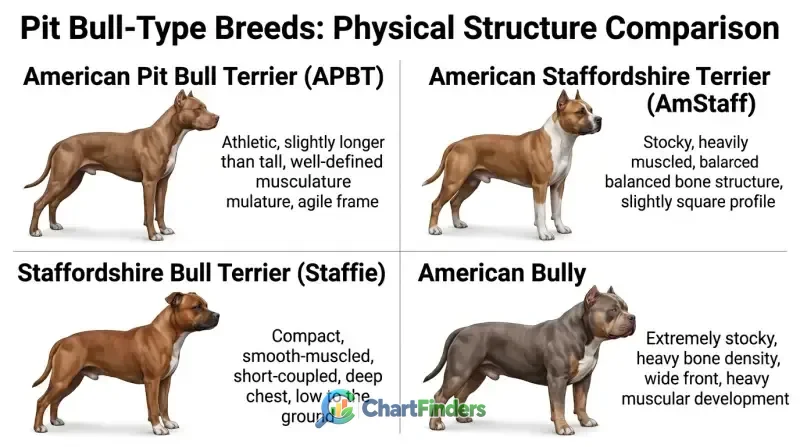
Pitbull Identification Chart
- “Pitbull” is an umbrella term representing multiple distinct breeds and their mixes rather than a single purebred dog.
- The four primary breeds associated with the pitbull classification are the American Pit Bull Terrier, American Staffordshire Terrier, Staffordshire Bull Terrier, and American Bully.
- Accurate physical identification relies on evaluating skull shape (broad, wedge-shaped), jaw width, chest depth, and muscular definition.
- Visual identification alone is frequently inaccurate; studies show that shelter staff and professionals misidentify pitbull mixes approximately 50% of the time without DNA confirmation.
- Height, weight, and skeletal proportions vary significantly across the umbrella group, ranging from the compact Staffordshire Bull Terrier to the heavy, wide-set American Bully.
A functional pitbull identification chart breaks down complex canine anatomy into manageable, observable markers. When evaluating a dog against standard morphological profiles, professionals look at specific skeletal and muscular landmarks. The following reference table outlines the four primary breeds under the pitbull umbrella, detailing their distinct height, weight ranges, head shapes, and primary body proportions.
| Breed Name | Height Range (Adult) | Weight Range (Adult) | Head Shape & Skull | Body Proportions & Build |
|---|---|---|---|---|
| American Pit Bull Terrier (APBT) | 17–21 inches (male) 16–20 inches (female) | 35–60 lbs (male) 30–50 lbs (female) | Wedge-shaped, flat skull, pronounced cheek muscles, clean-cut. | Athletic, slightly longer than tall, well-defined musculature, agile frame. |
| American Staffordshire Terrier (AmStaff) | 17–19 inches (male) 16–18 inches (female) | 55–70 lbs (male) 40–55 lbs (female) | Medium length, deep skull, distinct stop, broad cheeks. | Stocky, heavily muscled, balanced bone structure, slightly square profile. |
| Staffordshire Bull Terrier (Staffie) | 14–16 inches (male) 13–15 inches (female) | 28–38 lbs (male) 24–34 lbs (female) | Short, deep skull, very broad cheeks, minimal stop, distinct jaw muscles. | Compact, smooth-muscled, short-coupled, deep chest, low to the ground. |
| American Bully | 13–22+ inches (varies by class) Pocket to XL variations | 30–120+ lbs (highly variable based on sub-type) | Blocky, massive, very wide skull with heavy cheek definition. | Extremely stocky, heavy bone density, wide front, heavy muscular development. |
Reading this table requires understanding that individual dogs—especially mixed-breed shelter dogs—frequently display intermediate traits combining features from two or more of these categories. The primary value of the chart lies in recognizing the foundational skeletal geometry that separates these breeds from other molosser or terrier types.
The Four Recognized Pitbull Breeds
To use an identification chart effectively, one must understand the distinct history and physical standards of the four core breeds that make up the pitbull umbrella. While kennel clubs and registries maintain separate definitions, everyday observers often lump them together due to shared ancestral traits.
American Pit Bull Terrier (APBT)
The American Pit Bull Terrier is the foundational breed of the group. Developed originally for working and athletic versatility, the APBT prioritizes function, agility, and stamina over massive bulk. According to UKC standards, they possess a dry, muscular build where every pound is functional. Their skull is typically wedge-shaped when viewed from the front or side, and their ears are set high on the head (natural or cropped). They are generally taller and leaner than Staffordshire Bull Terriers, possessing an intense, alert expression.
American Staffordshire Terrier (AmStaff)
Recognized primarily by the American Kennel Club (AKC), the AmStaff shares a common history with the APBT but was bred selectively for conformation show rings and standardized appearance. AmStaffs tend to be slightly heavier-boned and more squarely proportioned than the APBT. Their chest is often broader, and their overall silhouette appears more blocky and compact, though they maintain a high degree of athletic agility.
Staffordshire Bull Terrier (Staffie)
Originating in the UK, the Staffordshire Bull Terrier is the smallest of the group. Often affectionately called the “Staffie,” this breed is characterized by its short, stocky stature, wide stance, and deep chest. Unlike the taller APBT, the Staffie is noticeably low to the ground with a very short muzzle and extremely pronounced cheek muscles that give its face a distinct, broad expression.
American Bully
Developed more recently (beginning in the late 1980s and 1990s) by selectively crossing APBTs and AmStaffs with other bulldog and mastiff breeds, the American Bully is bred specifically for companionship, show, and an exaggerated, heavy-muscled physique. The breed is divided into multiple size categories—Pocket, Standard, Classic, and XL—with the XL and extreme variations displaying massive bone density, very wide fronts, and heavy blocky heads that easily distinguish them from traditional, agile APBTs.
Anatomical Identification Markers
When executing visual identification in the field, specialists evaluate specific anatomical zones systematically. A comprehensive chart focuses on the head, ears, chest, coat, and tail structure.
- Skull and Muzzle: The skull is characteristically broad and flat or slightly rounded between the ears, tapering toward a well-defined stop. The muzzle is broad, deep, and blocky, though the APBT muzzle tends to be slightly longer and more wedge-like compared to the ultra-short muzzle of the Staffordshire Bull Terrier or American Bully.
- Jaw and Bite: A powerful, scissor bite is standard across all four breeds. The cheek muscles (masseter muscles) are heavily developed, giving the sides of the face a wide, rounded appearance when the dog is mature.
- Eyes and Ears: Eyes are round to almond-shaped, set low on the skull and wide apart. Any color is permissible under standard rules except merle (in purebred APBTs/AmStaffs). Ears are set high and may be cropped or natural (rose, half-prick, or drop), though prick ears are considered a structural fault in standard APBT guidelines.
- Chest and Ribcage: The chest is deep and moderately wide. In athletic types (APBT), the ribcage extends far back with well-sprung ribs; in heavier types (AmStaff, Bully), the chest is notably wide, sometimes resulting in a slightly wider front stance (“roll” or “bully” front).
- Coat and Skin: The coat is short, stiff to the touch, and single-layered (lacking a dense undercoat). It lies flat against the body and comes in virtually every color and pattern, including brindle, fawn, black, blue, white, and tri-color.
Comparative Morphological Matrix
To further assist in differentiating pitbull-type phenotypes from related molosser and terrier groups, the comparative matrix below highlights key skeletal, proportional, and behavioral traits across similar canine classifications.
| Canine Classification | Primary Skull Shape | Ear Set / Carriage | Chest & Stance Width | Typical Temperament Focus |
|---|---|---|---|---|
| Pitbull Umbrella (APBT / AmStaff) | Broad, wedge-to-blocky, flat skull | High set; natural rose/drop or cropped | Deep, moderately wide; balanced | High drive, athletic, eager, alert |
| Boxer | Square, moderate stop, pushed-in muzzle | High set, folded forward (or cropped) | Deep chest, narrower front than Bully | Playful, energetic, exuberant |
| Mastiff (e.g., Cane Corso) | Massive, heavy wrinkles, very broad skull | Drop or cropped; medium set | Extremely broad and deep chest | Calm, protective, commanding |
| English / American Bulldog | Heavy, wrinkled, extreme brachycephalic | Rose ears, small, thin | Very wide front, low rolling gait | Docile, stubborn, steady |
| Labrador Retriever | Clean, broad skull, moderate stop | Hanging, fold close to cheeks | Moderate width, athletic barrel | Social, retrieval-driven, friendly |
Visual Identification Challenges and Misidentifications
A critical component of pitbull identification mastery is recognizing the severe limitations of visual classification. Countless mixed-breed dogs share physical traits with pitbulls—such as short coats, blocky heads, or rose ears—without having any genetic lineage from the recognized pitbull breeds.
Research published in veterinary and animal science literature consistently demonstrates that shelter workers and canine professionals misidentify dog breeds visually, particularly when assigning dogs to the “pitbull” category. Dogs possessing blocky heads are frequently labeled as pitbull mixes regardless of their actual DNA composition. Common look-alike breeds include:
- Boxers: Share a similar muscular build and short coat, but are distinguished by an undershot jaw, pushed-in muzzle, and distinct square head profile.
- Mastiff Breeds (e.g., Cane Corso, Dogue de Bordeaux): Possess heavy bone structures and blocky heads, but grow to significantly larger adult sizes and feature looser facial skin or jowls.
- Bulldogs (American and English): Feature heavy wrinkles, extremely short muzzles, and a low, rolling gait.
- Labrador Retrievers and Lab Mixes: Frequently misidentified due to stocky bodies and broad skulls, despite having different skull geometry and softer expressions.
Step-by-Step Field Identification Process
For animal control officers, shelter intake coordinators, and veterinary professionals, following a systematic evaluation protocol minimizes subjective error when utilizing a pitbull identification chart.
- Overall Silhouette Assessment: Observe the dog standing naturally from a side profile. Determine whether the dog is longer than it is tall (typical APBT) or squarely proportioned (AmStaff/Bully).
- Head and Facial Geometry: Examine the skull-to-muzzle ratio. Check for the characteristic wedge shape and assess jaw width relative to cheek muscle development.
- Bone Density and Stance: Feel the leg bones and observe how the dog carries its weight. Check for heavy bone density (Bully/Mastiff traits) versus fine-boned agility (Terrier traits).
- Coat and Pigmentation Check: Verify single-coat texture. Note any atypical coat patterns (such as merle in traditional APBT registries, which indicates outcrossing with other breeds).
- DNA Verification Consideration: Recognize that when visual classification is inconclusive or legally consequential, a commercial canine DNA test should be utilized to confirm genetic heritage.
Frequently Asked Questions
While both breeds share a common ancestry, they diverged through decades of separate registry standards. The American Pit Bull Terrier (APBT) was bred primarily for athletic performance and working capability, resulting in a slightly taller, leaner, and more agile frame. The American Staffordshire Terrier (AmStaff) was bred for conformation show rings under AKC standards, resulting in a slightly more stocky, square, and heavier-boned physique. Genetically, however, the two populations overlap significantly.
No. Visual identification is notoriously unreliable. Studies comparing visual identification by shelter professionals against DNA test results show error rates as high as 50% for pitbull-type dogs. Many dogs possessing blocky heads and short coats are labeled as pitbulls despite having no genetic connection to the recognized breeds.
Core physical traits include a short, single-layered coat that lies flat; a broad, wedge- or block-shaped skull with well-defined cheek muscles; a strong, deep muzzle; a muscular, athletic neck; a deep chest; and a powerful, balanced frame that prioritizes strength and agility.
The American Bully is recognized as a distinct breed by major registries (such as the UKC and ABKC), having been developed by crossing APBTs and AmStaffs with various bulldog and mastiff breeds. However, because of their shared ancestry and blocky physical appearance, they are frequently grouped under the colloquial umbrella term “pitbull” by the general public.
Pitbull-type dogs and their mixes appear in virtually every known canine color and pattern, including solid, brindle, fawn, piebald, and tri-color. While certain registries exclude specific colors (like merle in purebred APBTs), coat color alone provides no reliable diagnostic value for breed identification because mixed-breed dogs of entirely different lineages frequently display identical color variations.
Conclusion
Navigating canine morphology requires moving beyond generalizations to evaluate structural anatomy, skeletal proportions, and breed history objectively. A pitbull identification chart serves as a valuable framework for understanding the physical diversity within the APBT, AmStaff, Staffordshire Bull Terrier, and American Bully classifications. Because visual phenotype can be deceptive—frequently leading to mislabeling of look-alike breeds—combining morphological charts with an understanding of genetic variation ensures the most accurate approach to canine identification.