
When most people think of potassium, the humble banana immediately comes to mind. Yet, relying on bananas alone is rarely enough to hit optimal daily intake goals—typically recommended around 2,600 mg for adult women and 3,400 mg for adult men, barring specific medical restrictions. Potassium functions as a vital electrolyte inside every cell, balancing sodium levels to maintain healthy blood pressure, smooth cellular communication, and steady cardiac rhythm. Despite its widespread importance, modern diets frequently fall short of adequate intake because processed foods are stripped of potassium during manufacturing while being heavily loaded with sodium.
Navigating nutritional choices requires more than casual awareness; it demands a structured look at which foods deliver the highest concentrations without excessive calories, sodium, or added sugars. This master guide explores the science of dietary potassium, breaks down the absolute best sources through a detailed potassium rich foods chart, and equips you with actionable strategies to balance your intake safely and effectively.
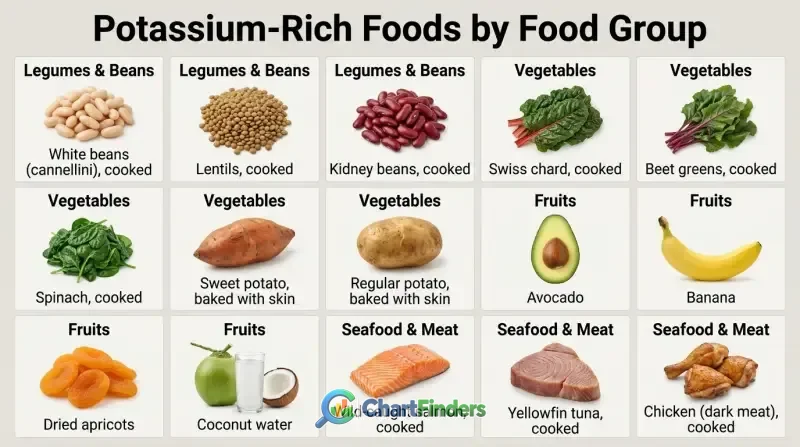
Understanding the Potassium Rich Foods Chart: A Comprehensive Blueprint
- Potassium is a crucial electrolyte that supports fluid balance, nerve transmission, and muscle contraction, particularly for the heart.
- Many everyday foods—including white beans, avocados, Swiss chard, and sweet potatoes—surpass the potassium content found in a medium-sized banana.
- Processing and boiling can leach water-soluble potassium out of foods; steaming, roasting, or consuming foods raw preserves more of the mineral.
- A well-balanced potassium rich foods chart must account for preparation methods, portion sizes, and individual health factors such as kidney function.
- Consuming a diverse mix of vegetables, fruits, legumes, and lean proteins helps prevent electrolyte imbalances without requiring synthetic supplements.
- Medical supervision is mandatory for individuals with chronic kidney disease or those taking potassium-sparing diuretics to prevent dangerous hyperkalemia.
A functional potassium rich foods chart does more than list isolated numbers; it categorizes foods by their practical serving sizes, preparation states, and overall nutrient density. Potassium content varies dramatically based on whether a food is raw, cooked, dried, or concentrated into a liquid. For instance, cooking spinach down concentrates its physical mass, resulting in significantly higher potassium levels per cup compared to raw leaves. Conversely, boiling root vegetables in large quantities of water can strip away substantial amounts of water-soluble minerals unless the cooking liquid is consumed.
To help you navigate your dietary choices, the master reference table below details common and exceptional dietary sources of potassium, outlining approximate values per standard serving size based on standard nutritional databases.
| Food Category | Food Item | Serving Size | Approximate Potassium (mg) |
|---|---|---|---|
| Legumes & Beans | White beans (cannellini), cooked | 1 cup | 1,000 – 1,180 |
| Legumes & Beans | Lentils, cooked | 1 cup | 730 |
| Legumes & Beans | Kidney beans, cooked | 1 cup | 600 – 700 |
| Vegetables | Swiss chard, cooked | 1 cup | 960 |
| Vegetables | Beet greens, cooked | 1 cup | 1,300 |
| Vegetables | Spinach, cooked | 1 cup | 840 |
| Vegetables | Sweet potato, baked with skin | 1 medium (approx. 5″ long) | 700 – 950 |
| Vegetables | Regular potato, baked with skin | 1 medium | 900 – 940 |
| Fruits | Avocado | 1 whole (medium) | 975 – 1,000 |
| Fruits | Banana | 1 medium (7″–8″ long) | 422 |
| Fruits | Dried apricots | 1/2 cup | 750 – 800 |
| Fruits | Coconut water | 1 cup (8 oz) | 600 |
| Seafood & Meat | Wild-caught salmon, cooked | 3 ounces (approx. 85g) | 350 – 500 |
| Seafood & Meat | Yellowfin tuna, cooked | 3 ounces | 400 – 450 |
| Seafood & Meat | Chicken (dark meat), cooked | 1 cup | 354 |
Interpreting the Data: Why Preparation Matters
As illustrated in the chart, preparation and concentration change the mathematical reality of nutrient delivery. A whole baked potato with skin provides upwards of 900 milligrams of potassium, whereas removing the skin discards a significant portion of the mineral and fiber content. Similarly, dried fruits like apricots concentrate natural sugars alongside minerals, meaning portion control is necessary to avoid excessive caloric intake while reaping the potassium benefits.
The Physiological Role of Potassium in the Human Body
Potassium is classified as a macromineral and a primary intracellular electrolyte. Approximately 98% of the body’s total potassium resides inside cells—predominantly within skeletal muscle tissue—while the remaining 2% circulates in extracellular fluids like blood plasma. This precise distribution is maintained by cellular pumps, most notably the sodium-potassium adenosine triphosphatase ($Na^+/K^+-ATPase$) pump, which expels sodium ions from cells while drawing potassium ions in.
Fluid Balance and Cellular Osmolarity
Electrolytes govern how fluids are distributed between intracellular and extracellular compartments. While sodium tends to pull water outward and hold fluid in the extracellular spaces, potassium works synergistically to balance this osmotic pressure internally. When sodium and potassium intake are out of alignment—a common outcome in diets high in processed foods and low in fresh produce—fluid retention, elevated blood pressure, and vascular strain often follow.
Nerve Transmission and Muscular Contraction
Every heartbeat, voluntary movement, and neurological reflex relies on electrical gradients generated across cell membranes. Potassium ions rush out of nerve and muscle cells during depolarization, creating the electrical impulse necessary for signal propagation. Without adequate internal potassium concentrations, muscles can experience cramping, fatigue, and weakness. In cardiac muscle tissue, a severe deficiency or surplus can trigger dangerous arrhythmias.
Top Potassium-Rich Food Categories Detailed
To build an effective dietary strategy, it helps to examine the distinct food groups that anchor any reliable potassium rich foods chart. Each category offers unique micronutrient profiles, allowing you to diversify your meals while meeting your daily targets.
1. Root Vegetables and Tubers
Tubers are among the most accessible and filling sources of dietary potassium. Regular white potatoes and sweet potatoes both rank exceptionally high, particularly when consumed with their skins intact.
- White Potatoes: A single medium-sized baked potato with skin delivers nearly 940 milligrams of potassium.
- Sweet Potatoes: Packed with beta-carotene, fiber, and complex carbohydrates, a medium baked sweet potato provides roughly 700 to 950 milligrams.
- Beets and Turnips: Root vegetables frequently get overshadowed by their roots, but beet greens (the leafy tops) are potassium powerhouses, delivering over 1,300 milligrams per cooked cup.
2. Leafy Greens and Cruciferous Vegetables
Dark leafy greens are nutritional heavyweights across nearly every vitamin and mineral category. When cooked, their cellular structure softens, allowing larger volumes to fit into standard serving sizes, which concentrates their potassium density.
- Swiss Chard: One of the absolute highest plant-based sources, providing approximately 960 milligrams per cooked cup.
- Spinach: Steamed or boiled spinach delivers about 840 milligrams per cooked cup.
- Collard Greens and Kale: Excellent secondary options that provide robust mineral support alongside high antioxidant levels.
3. Legumes, Beans, and Lentils
For individuals seeking plant-based protein alongside heavy mineral fortification, legumes are unmatched. Dried beans that are soaked and boiled at home—or rinsed thoroughly from canned varieties—yield impressive potassium totals.
- White Beans (Cannellini and Navy Beans): Leading the category at over 1,000 milligrams per cooked cup.
- Lima Beans and Kidney Beans: Reliable alternatives providing between 600 and 700 milligrams per cooked cup.
- Lentils: Offering roughly 730 milligrams per cooked cup, lentils easily integrate into soups, stews, and grain bowls.
4. Fruits and Plant-Based Hydration
While bananas are famous, tropical and dried fruits often pack a denser punch.
- Avocados: Containing roughly 1,000 milligrams per whole fruit, avocados combine high potassium with healthy monounsaturated fats.
- Dried Apricots and Prunes: Dehydration concentrates nutrients; a half-cup of dried apricots yields around 750 milligrams.
- Coconut Water: A natural electrolyte beverage that supplies approximately 600 milligrams of potassium per cup, making it popular for post-exercise rehydration.
Comparative Analysis of Potassium Sources
To visualize how various foods stack up against each other beyond simple text lists, it is helpful to examine comparative metrics. The following analysis evaluates common potassium sources relative to the standard benchmark of a medium banana (approx. 422 mg).
| Food Item | Serving Size | Potassium (mg) | Multiple of a Banana (422 mg) |
|---|---|---|---|
| Beet greens (cooked) | 1 cup | 1,309 | ~3.1x |
| White beans (cooked) | 1 cup | 1,189 | ~2.8x |
| Swiss chard (cooked) | 1 cup | 961 | ~2.3x |
| Avocado (whole) | 1 medium | 975 | ~2.3x |
| Baked potato with skin | 1 medium | 926 | ~2.2x |
| Spinach (cooked) | 1 cup | 839 | ~2.0x |
| Dried apricots | 1/2 cup | 755 | ~1.8x |
| Sweet potato (baked) | 1 medium | 694 | ~1.6x |
| Coconut water | 1 cup | 600 | ~1.4x |
| Banana (medium) | 1 medium | 422 | 1.0x (Baseline) |
This comparison highlights why clinical dietitians and nutritionists encourage expanding dietary perspectives beyond standard fruits. Incorporating just a half-cup of white beans or a single cooked cup of Swiss chard fulfills nearly a third of an adult’s entire daily potassium requirement in one sitting.
Practical Strategies for Integrating Potassium into Daily Meals
Translating nutritional data into sustainable eating habits requires practical meal-planning strategies. Because cooking methods influence mineral retention, mindful preparation ensures you maximize your intake without adding unwanted sodium, fats, or calories.
Optimizing Cooking Methods to Prevent Nutrient Loss
Potassium is water-soluble. When vegetables are boiled in large amounts of water and that water is discarded, a substantial percentage of the mineral leaches out. To minimize loss:
- Steam Instead of Boil: Steaming vegetables keeps them out of direct contact with boiling water, preserving water-soluble vitamins and minerals.
- Roast or Bake: Roasting root vegetables like potatoes, sweet potatoes, and beets caramelizes their natural sugars while locking in internal minerals.
- Utilize Broths: If you do boil vegetables, use the remaining liquid as the base for soups, stews, or grain cookery so that the leached minerals are retained and consumed.
Sample Daily Meal Framework Enhancing Potassium
A balanced day of eating can effortlessly achieve recommended potassium targets through whole foods:
- Breakfast: A savory bowl of oatmeal or a smoothie featuring spinach, half an avocado, Greek yogurt, and a handful of berries. (Estimated Potassium: ~800–1,000 mg)
- Lunch: A mixed green salad topped with sliced grilled chicken or salmon, canned white beans, cherry tomatoes, and a dressing made with olive oil and lemon juice. (Estimated Potassium: ~1,200 mg)
- Dinner: Baked salmon or lean beef served alongside a roasted sweet potato with skin and a side of steamed Swiss chard. (Estimated Potassium: ~1,400 mg)
- Snack: A handful of dried apricots or a cup of coconut water. (Estimated Potassium: ~600 mg)
Common Mistakes and Clinical Limitations
While increasing dietary potassium is beneficial for the vast majority of the population, certain conditions, misconceptions, and clinical pitfalls require careful attention.
The Danger of Assuming “More is Always Better”
Healthy kidneys tightly regulate potassium excretion, filtering out excess amounts through urine. However, pushing intake to extreme levels—particularly via high-dose synthetic supplements without medical guidance—can overwhelm renal clearance capacity, leading to hyperkalemia (dangerously elevated blood potassium). Hyperkalemia can cause severe cardiac conduction abnormalities, muscle paralysis, and cardiac arrest.
Chronic Kidney Disease (CKD) and Potassium Restrictions
Individuals diagnosed with advanced chronic kidney disease or those undergoing dialysis lose the physiological ability to filter potassium efficiently. For this specific demographic, consuming high-potassium foods listed on a standard chart can be life-threatening. Nephrologists and renal dietitians typically prescribe specialized, low-potassium dietary plans that require leaching vegetables (soaking them in water before cooking) and strictly monitoring intake.
Relying on Processed “Fortified” Foods
Some commercial food manufacturers attempt to market processed snacks or beverages as potassium-rich by adding synthetic mineral salts. However, these products frequently contain ultra-processed ingredients, high amounts of sodium, and added sugars that negate the cardiovascular benefits of the potassium content. True health optimization relies on whole, unprocessed, or minimally processed plant and animal foods.
Frequently Asked Questions
Cooked beet greens and white beans rank among the highest per standard serving. Beet greens provide over 1,300 milligrams per cooked cup, while white beans deliver roughly 1,180 milligrams per cup. Among fruits, avocados are exceptionally dense, offering nearly 1,000 milligrams per whole fruit.
Yes, absolutely. While bananas are a convenient and healthy food, many other options match or exceed their potassium content. Leafy greens like Swiss chard and spinach, root vegetables like potatoes and sweet potatoes, and legumes like lentils and white beans all provide substantial quantities of potassium.
Cooking does not destroy potassium chemically, but it can cause the mineral to leach out if the food is boiled in water that is subsequently discarded. Steaming, roasting, and baking preserve significantly more minerals. If boiling, using the cooking liquid in soups or stocks prevents nutrient loss.
Mild to moderate potassium deficiency (hypokalemia) can manifest as muscle cramps, generalized fatigue, muscle weakness, and constipation. Severe deficiency can lead to abnormal heart rhythms (arrhythmias), muscle paralysis, and respiratory distress. If you suspect a deficiency, blood tests ordered by a healthcare provider can confirm your electrolyte status.
Individuals with chronic kidney disease (CKD), end-stage renal disease (ESRD), or those taking specific medications that reduce potassium excretion—such as ACE inhibitors, angiotensin receptor blockers (ARBs), or potassium-sparing diuretics—must restrict their potassium intake under strict medical supervision. Always consult a qualified physician or registered dietitian before making radical changes to your mineral intake.
Conclusion
Mastering your daily electrolyte intake begins with understanding where essential minerals are found and how preparation impacts their bioavailability. While bananas remain a dietary staple, a comprehensive potassium rich foods chart reveals an expansive world of nutrient-dense options—from leafy greens and root vegetables to legumes and avocados. By prioritizing whole, unprocessed foods, tailoring your cooking methods to preserve water-soluble nutrients, and consulting healthcare professionals when managing underlying medical conditions, you can safely the power of potassium to support lifelong cardiovascular and metabolic wellness.