
Few feline breeds command as much admiration for their size, plush coats, and docile temperaments as the Ragdoll. Known affectionately as “gentle giants,” these cats possess a physical presence that sets them apart from standard domestic shorthairs. However, because they grow at such an exceptionally slow rate, cat owners frequently find themselves guessing whether their kitten’s growth trajectory is normal or if their adult cat is carrying excess weight. Understanding the unique developmental timeline of a Ragdoll requires looking past generic cat growth charts and examining breed-specific milestones.
(Reference: How Big Do Ragdoll Cats Get? (Size & Weight Chart))Managing a giant breed’s nutrition and physical development is a long-term commitment. A kitten that appears underweight at six months might simply be experiencing a structural growth spurt, whereas a young adult cat hovering near the upper end of the scale at age two might still have a substantial amount of muscle mass to build. This comprehensive guide explores the Ragdoll cat weight chart across every life stage, examines the genetic and environmental factors that influence their size, provides accurate tracking methods, and helps owners distinguish between healthy heavy-set frames and dangerous canine-like obesity.
Explore our detailed breakdown on Raccoon Lifespan Chart.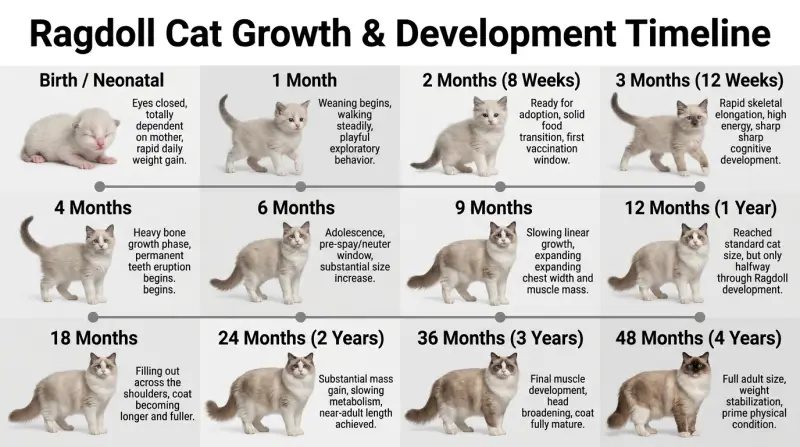
Ragdoll Cat Weight Chart
- Extended Growth Period: Unlike standard breeds that stop growing at 12 months, Ragdolls continue developing bone density and muscle mass until they reach 3 to 4 years of age.
- Significant Sexual Dimorphism: Adult male Ragdolls typically weigh between 15 and 25 pounds, whereas females usually range from 10 to 15 pounds.
- Length and Bone Structure: A mature Ragdoll can measure up to 40 inches from nose to tail tip, featuring a broad chest, heavy bone structure, and a rectangular frame.
- Coat Illusion vs. True Mass: Their thick, semi-longhair plush coats can easily mask underlying weight fluctuations, making hands-on body condition scoring essential.
- Nutritional Needs Shift: High-protein, nutrient-dense diets are critical during their prolonged kittenhood to support skeletal and muscular development without encouraging metabolic strain.
- Obesity Risks: Due to their generally laid-back, sedentary nature, adult Ragdolls are prone to weight gain if calorie intake is not managed post-neutering/spaying.
Navigating the growth journey of a giant breed requires clear benchmarks. The following comprehensive reference details the expected weight ranges for male and female Ragdoll cats from birth through full maturity at 48 months.
| Age | Male Weight Range (lbs) | Female Weight Range (lbs) | Key Developmental Milestones |
|---|---|---|---|
| Birth / Neonatal | 0.25 – 0.35 lbs (110–160g) | 0.22 – 0.30 lbs (100–140g) | Eyes closed, totally dependent on mother, rapid daily weight gain. |
| 1 Month | 1.0 – 1.5 lbs | 0.8 – 1.2 lbs | Weaning begins, walking steadily, playful exploratory behavior. |
| 2 Months (8 Weeks) | 2.5 – 3.5 lbs | 2.0 – 3.0 lbs | Ready for adoption, solid food transition, first vaccination window. |
| 3 Months (12 Weeks) | 4.0 – 5.5 lbs | 3.5 – 4.5 lbs | Rapid skeletal elongation, high energy, sharp cognitive development. |
| 4 Months | 6.0 – 8.0 lbs | 5.0 – 6.5 lbs | Heavy bone growth phase, permanent teeth eruption begins. |
| 6 Months | 8.5 – 11.0 lbs | 6.5 – 9.0 lbs | Adolescence, pre-spay/neuter window, substantial size increase. |
| 9 Months | 11.0 – 14.5 lbs | 8.0 – 11.0 lbs | Slowing linear growth, expanding chest width and muscle mass. |
| 12 Months (1 Year) | 13.0 – 17.0 lbs | 9.5 – 12.5 lbs | Reached standard cat size, but only halfway through Ragdoll development. |
| 18 Months | 14.5 – 19.0 lbs | 10.0 – 13.5 lbs | Filling out across the shoulders, coat becoming longer and fuller. |
| 24 Months (2 Years) | 16.0 – 21.0 lbs | 11.0 – 14.0 lbs | Substantial mass gain, slowing metabolism, near-adult length achieved. |
| 36 Months (3 Years) | 15.0 – 24.0 lbs | 10.0 – 15.0 lbs | Final muscle development, head broadening, coat fully mature. |
| 48 Months (4 Years) | 15.0 – 25.0+ lbs | 10.0 – 15.0+ lbs | Full adult size, weight stabilization, prime physical condition. |
The data in the table above highlights a critical truth about the breed: a one-year-old Ragdoll may look large compared to a domestic shorthair, but they are still essentially teenagers. Expecting a Ragdoll to reach its ultimate size and weight by its first birthday is one of the most common misconceptions in cat ownership.
To further illustrate the distinct divergence in growth patterns between males and females over a four-year timeline, the following conceptual breakdown outlines their physical maturation curves:
- Months 0 to 6 (The Hyper-Growth Phase): Both males and females experience exponential weight gain, adding roughly one pound or more per month. Skeletal frames lengthen rapidly.
- Months 6 to 18 (The Adolescent Expansion): Linear growth slows down, but bone density increases significantly. Muscle mass begins to layer over the broad chest and heavy bone structure.
- Months 18 to 48 (The Filling-Out Period): Growth becomes incremental. Males pack on heavier muscle mass, widening across the shoulders and chest, while females solidify their sleek yet substantial frames.
Understanding Ragdoll Growth Stages and Milestones
To effectively manage your cat’s health, you must evaluate their development within the context of their specific life stage. Ragdolls do not mature linearly; their growth occurs in intense spurts followed by periods where they appear to focus entirely on building width rather than weight.
The Kitten Phase (Birth to 6 Months)
During the first six months of life, a Ragdoll kitten’s metabolism runs at maximum capacity. Newborns double their birth weight within their first week. By week eight, when kittens typically transition to their permanent homes, they should weigh between two and three and a half pounds. Owners must provide unrestricted access to high-quality kitten food formulated for growth during this period. Restricting food intake out of fear of creating a fat kitten can permanently stunt bone and joint development.
The Adolescent Phase (6 to 18 Months)
As Ragdolls enter adolescence, hormonal changes from spaying or neutering often coincide with a natural shift in metabolic rate. While their bones are still lengthening, they begin to develop the characteristic heavy chest and broad head of the breed. This is the stage where owners frequently misinterpret normal weight gain as overfeeding. A six-month-old male weighing 10 pounds is not overweight; he is simply tracking on the upper percentiles of a large-breed growth curve.
The Prime Maturation Phase (18 to 48 Months)
This extended window is unique to giant breeds. Between two and four years of age, a Ragdoll’s coat reaches its full plush texture, and their underlying muscle mass hardens. Many owners notice their cats gaining two to three pounds during their third year alone, even though their food intake and activity levels remain constant. This is simply the final phase of skeletal and muscular filling out.
Factors Influencing Ragdoll Size and Weight
While the weight chart provides a reliable baseline, individual Ragdolls can fall outside standard ranges due to several biological and environmental variables. Recognizing these factors prevents unnecessary panic when a cat deviates from the statistical average.
Genetics and Bloodlines
Genetics play the single largest role in determining adult size. Traditional European Ragdoll lines generally produce heavier, more substantial cats with broader bone structures compared to some American lines, which may lean toward a slightly more refined, slender presentation. Examining the weights of the kitten’s sire and dam provides the most accurate preview of your cat’s eventual adult size.
Gender Differences
Sexual dimorphism is remarkably pronounced in Ragdolls. Males are fundamentally built on a larger architectural scale, featuring wider skulls, heavier shoulder blades, and thicker leg bones. Females are notably more dainty—though still heavy relative to standard cats—with refined facial structures and more compact bodies.
Spaying and Neutering Impact
Spaying or neutering alters a cat’s endocrine system, lowering resting energy expenditure while often increasing appetite. Because Ragdolls are already prone to a sedentary lifestyle, altering them without appropriately adjusting their caloric intake can trigger rapid fat accumulation. Veterinary supervision during the post-operative period is crucial for establishing baseline portions.
Dietary Quality and Feeding Practices
Feeding a growing Ragdoll cheap, filler-heavy commercial kibble can result in malnutrition despite caloric excess. Because they build heavy bone and dense muscle, they require a diet rich in animal protein, essential amino acids (such as taurine), and balanced calcium-to-phosphorus ratios. Free-feeding dry food can work for some high-energy kittens, but adult Ragdolls almost universally require portion-controlled meals to prevent obesity.
How to Assess Your Ragdoll’s Body Condition Score (BCS)
Relying purely on a bathroom scale can be misleading. A 20-pound male Ragdoll with a large frame might be perfectly lean, while a 16-pound male with a smaller frame might be dangerously overweight. Because Ragdolls possess a dense, fluffy double coat and a natural primordial pouch (the sagging belly flap of skin designed to protect internal organs), visual inspection alone is insufficient.
The World Small Animal Veterinary Association (WSAVA) Body Condition Score system provides a hands-on method to evaluate whether your cat’s weight is healthy:
- BCS 1–3 (Underweight): Ribs, lumbar vertebrae, and pelvic bones are easily visible from a distance. There is no discernible body fat, and severe muscle wasting may be present along the spine.
- BCS 4–5 (Ideal Weight): Ribs can be felt easily with a slight layer of fat covering them. When viewed from above, a clear waist is visible behind the ribs. When viewed from the side, the abdomen tucks up neatly toward the hind legs.
- BCS 6–7 (Overweight): Ribs are difficult to palpate due to a moderate layer of excess fat. The waist is barely perceptible from above, and the back appears broadened. The primordial pouch may swing heavily.
- BCS 8–9 (Obese): Ribs are completely untraceable beneath thick pads of fat. Heavy fat deposits cover the lumbar spine and face. The abdomen is distended with a pronounced fat pad, and physical activity is severely impaired.
To perform a check at home, run your hands gently along your cat’s ribcage. You should feel the ribs with about as much resistance as pressing your fingers over the back of your hand. If it feels like touching a tabletop, your cat is underweight; if it feels like touching a mattress, your cat is carrying excess fat.
Health Risks Associated with Abnormal Weight
Allowing a Ragdoll to deviate significantly from its ideal weight curve invites serious, life-shortening medical complications. Managing their size is not merely an aesthetic concern; it is a foundational component of feline preventative medicine.
Risks of Canine-Like Obesity
Obesity in giant-breed cats is an inflammatory disease state. Excess body weight places extraordinary mechanical stress on the hip joints, elbows, and spine, accelerating the onset of feline osteoarthritis—a condition to which large cats are already genetically predisposed. , overweight Ragdolls face drastically elevated risks of:
- Feline Diabetes Mellitus: Excess adipose tissue disrupts insulin sensitivity, often requiring lifelong insulin therapy.
- Hepatic Lipidosis (Fatty Liver Disease): If an overweight cat stops eating for even a few days due to stress or illness, fat floods the liver, causing acute organ failure.
- Cardiovascular Strain: Their already large hearts must work exponentially harder to pump blood through an enlarged body mass.
Risks of Underweight Status
Conversely, a cat that fails to gain adequate weight during its four-year maturation window may be suffering from underlying pathology. Chronic enteropathies, feline infectious peritonitis (FIP), hyperthyroidism (rare in young cats but possible), exocrine pancreatic insufficiency, or heavy internal parasite loads can suppress weight gain. Any Ragdoll failing to track upward on the growth chart or experiencing unexplained weight loss requires an immediate veterinary diagnostic workup.
Nutritional Management and Exercise for Growing Ragdolls
Maintaining a healthy weight throughout a Ragdoll’s four-year growth cycle requires a proactive approach to both feeding protocols and environmental enrichment.
Nutritional Strategies by Life Stage
During the first year, feed high-protein kitten food designed for large breeds, ensuring unlimited access or frequent scheduled meals. Between one and two years of age, transition the cat smoothly to an adult maintenance diet. Opt for high-moisture wet food formulations alongside measured portions of grain-free kibble. Wet food helps promote satiety, supports urinary tract health, and prevents the chronic dehydration common in cats fed exclusively dry diets.
Combating Sedentary Tendencies
Ragdolls earned their name from their tendency to go limp when picked up, a trait reflecting their exceptionally relaxed demeanor. Unfortunately, this placid nature translates into a reluctance to exercise spontaneously. Owners must actively curate physical activity:
- Interactive Play Sessions: Engage your Ragdoll with wand toys, feather teasers, and laser pointers for 15 minutes twice a day to stimulate hunting instincts.
- Vertical Territory: Invest in heavy-duty, multi-tiered cat trees designed for large breeds. Ensure platforms are wide and stable enough to support a 20-pound cat launching upward.
- Food Puzzles: Replace traditional bowls with puzzle feeders or slow-feeder mats to mentally stimulate the cat and prevent frantic, rapid eating.
Frequently Asked Questions
Ragdolls are exceptionally slow-maturing cats. While standard domestic breeds reach adult size by 12 months, Ragdolls continue to grow, develop bone density, and build muscle mass until they are 3 to 4 years old. Their coat also continues to fill out and thicken throughout this entire developmental window.
Individual genetics heavily dictate size. If your male Ragdoll came from lines emphasizing a more traditional, moderate build, he may naturally fall on the lower end of the weight spectrum. However, ensure he has been evaluated for internal parasites, nutritional absorption issues, or underlying systemic illness by a veterinarian if he appears significantly underweight.
Because Ragdolls possess a dense semi-longhair coat, visual inspection is unreliable. You must use hands-on palpation. Run your fingers firmly along the sides of their ribcage and spine. You should be able to feel the individual bones beneath a thin layer of tissue without pressing hard. If you cannot feel the ribs easily, your cat is carrying excess fat beneath that fluff.
Free-feeding dry food is generally discouraged for adult Ragdolls. Because they lack self-regulation once their kitten metabolism slows down around 12 to 18 months, free-feeding almost invariably leads to severe weight gain and obesity. Transition adult Ragdolls to scheduled, measured meals split into two to three portions daily.
Yes. That prominent belly flap—often referred to as the primordial pouch—is a completely normal anatomical feature in cats, and it is particularly pronounced in large breeds like Ragdolls. It protects internal organs during fights and allows for full-extension running strides. However, ensure the pouch feels soft and loose rather than tight and distended with hard fat deposits.
Monitoring your Ragdoll cat’s weight using a structured growth timeline ensures these magnificent gentle giants live long, vibrant, and mobile lives. By recognizing their unique four-year maturation cycle, prioritizing hands-on body condition scoring over mere scale numbers, and pairing proper nutrition with active play, you can keep your Ragdoll in prime physical condition through every stage of their development.