
Navigating the complex ecosystem of modern North American and international rail transport requires a precise method for identifying and categorizing rolling stock. Whether operating within a busy Class I freight classification yard, managing industrial plant switching operations, or ensuring compliance with hazardous materials handling regulations, rail personnel, logistics managers, and supply chain analysts depend on systematic identification frameworks. A railcar identification chart acts as the definitive roadmap for decoding the physical and regulatory attributes of any piece of equipment moving along the rail network.
(Reference: Train WiFi: The Complete Guide for Rail Operators | Purple)Every single railcar rolling across the tracks tells a detailed operational story through its exterior markings, structural geometry, and dimensional data. From reporting marks assigned by the Association of American Railroads (AAR) to consolidated stencils detailing brake inspection dates, height limits, and hazardous material placards, these symbols prevent costly misroutes, operational delays, and severe safety violations. This master guide explores the anatomy of railcar identification, breaks down the major car classifications, decodes reporting marks and data stencils, and provides a comprehensive framework for reading and utilizing railcar identification charts in the field.
Explore our detailed breakdown on Sparrow Identification Chart (Complete Data Matrix).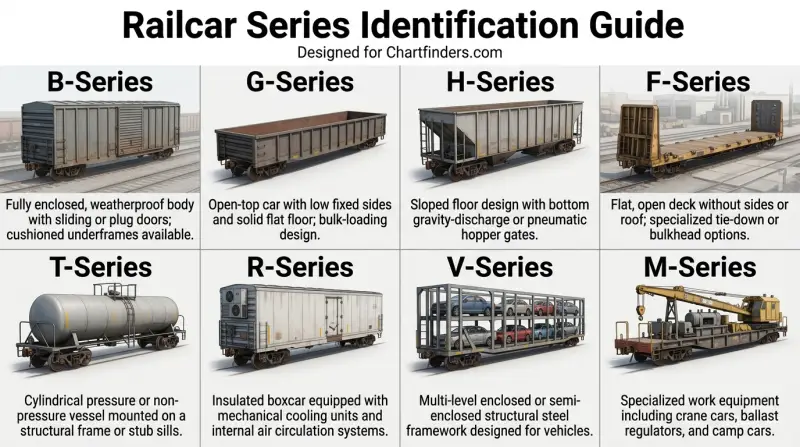
Railcar Identification Chart
- Standardized Coding: Railcar reporting marks consist of a two- to four-letter alpha prefix indicating ownership, followed by a unique numeric sequence, and ending with an equipment type suffix (e.g., ‘X’ for privately owned cars).
- AAR Classifications: Freight equipment is categorized using an alphabetic system where the first letter denotes the broad class (e.g., ‘B’ for Boxcar, ‘G’ for Gondola, ‘H’ for Hopper, ‘T’ for Tank).
- Dimensional Data: Exterior stencils must display exterior length, extreme height, width, load limit (LD LMT), light weight (LT WT), and cubic capacity to ensure proper clearance and weight distribution.
- Safety & Compliance: Hazardous materials require specific United Nations (UN) four-digit identification numbers, proper shipping names, and diamond-shaped hazard classification placards on all four sides.
- Operational Utility: Field identification charts streamline switching operations, maintenance tracking, interline accounting, and emergency response protocols across North American rail interchanges.
To make sense of the vast array of equipment in modern interchange service, rail operators rely on structured classification systems. The chart below synthesizes the primary AAR mechanical designations, structural descriptions, and typical commodity applications for standard North American railcar types.
| Car Class / Code | Railcar Type | Primary Structural Features | Typical Commodities Transported |
|---|---|---|---|
| B-Series | Boxcar | Fully enclosed, weatherproof body with sliding or plug doors; cushioned underframes available. | Finished paper, packaged goods, palletized freight, appliances, electronics. |
| G-Series | Gondola | Open-top car with low fixed sides and solid flat floor; bulk-loading design. | Structural steel, scrap metal, coiled steel, aggregates, heavy industrial parts. |
| H-Series | Hopper (Open/Covered) | Sloped floor design with bottom gravity-discharge or pneumatic hopper gates. | Coal, aggregates, ballast (open); grain, plastic pellets, cement, potash (covered). |
| F-Series | Flatcar | Flat, open deck without sides or roof; specialized tie-down or bulkhead options. | Intermodal containers, highway trailers, heavy machinery, military vehicles, lumber. |
| T-Series | Tank Car | Cylindrical pressure or non-pressure vessel mounted on a structural frame or stub sills. | Petroleum, liquefied compressed gases, chemicals, acids, edible oils, biofuels. |
| R-Series | Refrigerator (Reefer) | Insulated boxcar equipped with mechanical cooling units and internal air circulation systems. | Fresh produce, meat, dairy, frozen foods, temperature-sensitive chemicals. |
| V-Series | Specialty / Autorack | Multi-level enclosed or semi-enclosed structural steel framework designed for vehicles. | Fully assembled automobiles, light trucks, SUVs, and commercial vans. |
| M-Series | Maintenance of Way (MOW) | Specialized work equipment including crane cars, ballast regulators, and camp cars. | Railroad infrastructure repair, tie replacement, track ballasting, engineering support. |
Reviewing this tabular breakdown illustrates how structural morphology dictates car classification. Next, we will examine the specific anatomical elements that make physical and digital railcar identification possible in the field.
Anatomy of a Railcar: Exterior Identification Elements
When inspecting a railcar, identification is not limited to a single stencil or label. Instead, it involves reading a standardized arrangement of reporting marks, capacity data, safety appliance indicators, and inspection decals painted or welded onto the car body. Every stenciled data block serves a distinct operational, legal, or mechanical purpose.
Reporting Marks and Equipment Initials
The most prominent identifier on any railcar is its reporting mark, painted in large lettering near the upper left or center of the car sides and on both ends. This mark consists of a two- to four-letter code followed by a series of numbers.
- Railroad Ownership: Marks consisting solely of letters belonging to railroad companies (e.g., BNSF, UP, CSXT) indicate equipment owned or leased directly by that carrier.
- Private Ownership (The ‘X’ Rule): Per AAR rules, all privately owned railcars—whether belonging to leasing companies, chemical corporations, or agricultural shippers—must end their reporting mark with the letter X (e.g., TTX, TILX, GATX).
- Trailer/Container Marks (The ‘U’ and ‘Z’ Rule): Intermodal trailers and containers utilize marks ending in U (containers) or Z (trailer on flatcar).
Dimensional Data and Weight Stencils
To ensure safe train makeup, bridge load compliance, and clearance through tunnels and underpasses, every car must display precise dimensional stencils, typically grouped in a data block on the lower left side of the car body:
- LD LMT (Load Limit): The maximum weight of lading (cargo) that can be loaded into or onto the car without exceeding the structural limits of the trucks and axles.
- LT WT (Light Weight): The actual empty weight of the railcar itself. Adding the LD LMT to the LT WT yields the total maximum gross rail load (GRL), typically 263,000 lbs or 286,000 lbs for standard heavy freight cars.
- CU FT (Cubic Capacity): The interior volumetric capacity of enclosed cars like boxcars, hoppers, and gondolas, measured in cubic feet.
- EXT HGT / EXTREME WIDTH: Measurements detailing the absolute highest and widest points of the car, critical for high-wide route clearance auditing.
Major Railcar Types and Their Sub-Classifications
Understanding a railcar identification chart requires diving deeper into the distinct sub-classifications within major equipment groups. Each type features unique mechanical configurations engineered for specific loading, transit, and unloading environments.
Boxcars and Specialized Mechanical Service
Boxcars represent the traditional workhorse of general merchandise freight. While standard boxcars feature sliding doors for palletized goods, specialized variants include:
- Equipped Boxcars: Fitted with internal load-restraining devices, movable bulkheads, and cushioned underframes to absorb coupling impacts without damaging fragile cargo like automotive parts.
- Paper Service Boxcars: Featuring specialized plug doors, smooth interior wall linings, and heavy-duty floor strength to support multi-ton paper rolls handled by clamp trucks.
Open-Top and Covered Hopper Configurations
Hoppers are divided sharply by weather protection requirements:
- Open Hoppers: Designed with steep sloped interior sheets and bottom discharge gates that open automatically or manually to empty bulk commodities like coal and ballast directly into trackside pits.
- Covered Hoppers: Weatherproofed with roof hatches (trough or circular gravity-pneumatic types) protecting sensitive ladings like food-grade grains, soda ash, and plastic pellets from moisture and contamination.
Tank Cars: Pressure versus Non-Pressure Vessels
Tank cars are among the most strictly regulated rail equipment due to the hazardous nature of their contents. They are broadly divided into two structural categories:
- Non-Pressure Tank Cars: Typically transport low-vapor-pressure liquids such as crude oil, ethanol, refined petroleum products, and molten sulfur. They feature top-loading/unloading fittings or bottom-outlet valves protected by heavy skid structures.
- Pressure Tank Cars: Designed for liquefied compressed gases like propane, anhydrous ammonia, and chlorine. These cylindrical tanks feature rounded heads, thick thermal insulation jackets, protective housings over top fittings, and no bottom outlet valves to eliminate potential leak paths.
Flatcars and Intermodal Equipment
Flatcars provide unobstructed decks for oversized or modular freight. Sub-types include:
- Intermodal Well Cars (Double-Stack): Featuring depressed center “wells” that lower the center of gravity, allowing two standard shipping containers to be stacked securely one atop the other.
- Bulkhead Flatcars: Fitted with massive vertical end-walls (bulkheads) that prevent shifting loads of lumber, steel pipe, or poles from sliding forward into the train crew or cab during sudden braking events.
Hazardous Materials Placarding and Identification Systems
When a railcar transports hazardous materials, physical identification goes far beyond standard AAR mechanical codes. North American rail operations adhere to strict federal and international regulations requiring standardized hazardous materials identification.
UN/NA Four-Digit Identification Numbers
Hazardous materials tank cars and placarded freight cars must display a four-digit UN (United Nations) or NA (North American) identification number. These numbers can be displayed in three primary ways:
- On orange rectangular panels adjacent to hazard placards.
- Centrally printed directly across the face of the hazard placard itself.
- On white rectangular panels affixed to the sides and ends of the car.
Hazard Classes and Diamond Placards
The 9 primary hazard classes established by regulatory bodies are communicated via 10.75-inch square-on-point diamond placards. Railcar identification charts must account for these primary divisions:
- Class 1: Explosives (Orange background with bursting ball icon)
- Class 2: Gases (Flammable gas in red, non-flammable compressed gas in green, toxic gas in white with skull and crossbones)
- Class 3: Flammable Liquids (Red background with flame icon)
- Class 4: Flammable Solids (Red/white vertical stripes or solid red/blue patterns)
- Class 5: Oxidizers and Organic Peroxides (Yellow background with oxidizing flame)
- Class 6: Toxic and Infectious Substances (White background with skull and crossbones)
- Class 7: Radioactive Materials (Yellow/white background with trefoil symbol)
- Class 8: Corrosive Materials (White/black split background showing corrosion on metal and skin)
- Class 9: Miscellaneous Dangerous Goods (Black/white vertical stripes on top half)
Reading and Utilizing Railcar Data in Field Operations
Field personnel—including conductors, switchmen, car inspectors, and mechanical department workers—must interpret railcar identification data rapidly and accurately. This section outlines the practical methodology for conducting a comprehensive railcar audit.
- Verify Reporting Marks: Locate the equipment initial and number on the side of the car. Verify that the reporting marks match the consist documentation or switching list exactly.
- Check Mechanical Designation: Identify the AAR car type code stenciled near the reporting marks to confirm the car’s structural classification matches the commodity being loaded or transported.
- Inspect Dimensional Limits: Review the LD LMT and LT WT figures. Calculate the gross weight to ensure it does not exceed line-segment weight limits or bridge restrictions.
- Examine Safety Appliances and Brake Stencils: Check the consolidated equipment data stencils for air brake cleaning dates (e.g., COT&S – Clean, Oil, Test, and Stenciled) to ensure the car is within its legal maintenance window.
- Validate Hazmat Documentation: If carrying regulated materials, match the UN/NA four-digit number on the placard against the train shipping papers (train list or dangerous cargo manifest) to ensure absolute compliance.
Common Identification Mistakes and Edge Cases
Even experienced rail personnel encounter ambiguous situations where standard railcar identification rules require careful navigation. Recognizing common pitfalls prevents operational errors and safety incidents.
- Leased Equipment Confusion: Confusing the operating railroad with the actual owner due to shared locomotive or car leasing pools. Always rely on the reporting mark prefix rather than exterior corporate paint schemes.
- Obscured or Weathered Stencils: Over time, grime, rust, and graffiti can obscure critical capacity data and reporting marks. Inspectors must utilize secondary frame numbers stamped directly into the structural steel sills when painted stencils are illegible.
- Multi-Unit Articulated Sets: Modern intermodal well cars and autoracks often consist of multiple permanently coupled platforms sharing a single reporting mark followed by a platform identifier (e.g., A, B, C). Treating each platform as a standalone car leads to serious yard inventory errors.
- Expired Brake and Inspection Dates: Failing to verify maintenance stencils can result in moving overdue equipment through interchange, triggering substantial fines from regulatory authorities such as the Federal Railroad Administration (FRA).
Frequently Asked Questions
The letters represent the owner or lessee of the railcar. If the code ends in the letter ‘X’, it signifies a private owner or leasing company rather than a traditional freight railroad. Railroad-owned cars use codes consisting exclusively of the operating railroad’s assigned reporting letters.
Non-pressure tank cars feature visible external fittings, top-loading access platforms, and often bottom-outlet valves. Pressure tank cars feature heavily insulated cylindrical bodies, rounded tank heads without bottom outlets, and thick protective housing domes shielding all top-mounted valves and relief devices.
Gross Rail Load (GRL) is the absolute maximum allowable combined weight of the railcar and its cargo (commonly 263,000 lbs or 286,000 lbs in North America). Load Limit (LD LMT) is the maximum weight of the cargo alone that can be placed into the car, calculated by subtracting the car’s empty Light Weight (LT WT) from the maximum GRL.
Yes. Every single railcar, intermodal container, and trailer registered for interchange service in North America possesses a completely unique combination of reporting letters and serial numbers, managed centrally through industry registries.
UN numbers are displayed either directly across the center of the diamond-shaped hazard placard, on an orange rectangular panel placed immediately next to the placard, or on white rectangular panels affixed to the car sides and ends.
Conclusion
A railcar identification chart is far more than a simple visual reference guide; it is an indispensable operational, safety, and regulatory instrument for the modern rail transportation industry. By mastering the system of reporting marks, AAR mechanical classifications, dimensional data stencils, and hazardous materials placarding, rail professionals ensure seamless interline operations, protect critical infrastructure, and maintain uncompromising safety standards across the entire rail network.