
The life cycle of the reindeer (Rangifer tarandus) is an extraordinary to survival in some of the harshest environments on Earth. Spanning the Arctic tundra, boreal forests, and rugged mountainous regions, these migratory cervids navigate extreme seasonal shifts, deep snowpacks, and intense predatory pressures. Understanding how long reindeer live requires looking past a simple numerical average and exploring the complex interplay between biology, environment, human management, and climate dynamics.
(Reference: How Can the Bible Be Authoritative? – NTWrightPage)In recent years, changing ecological conditions across the circumpolar north have altered traditional demographic curves. While captive and semi-domesticated herds managed by indigenous herders often experience more predictable veterinary care and supplemental feeding, wild populations face mounting cumulative stressors. This comprehensive examination explores the biological drivers of reindeer longevity, the stages of their life cycle, demographic variations across different habitats, and the external pressures reshaping their survival trajectories today.
Explore our detailed breakdown on Squirrel Lifespan Chart.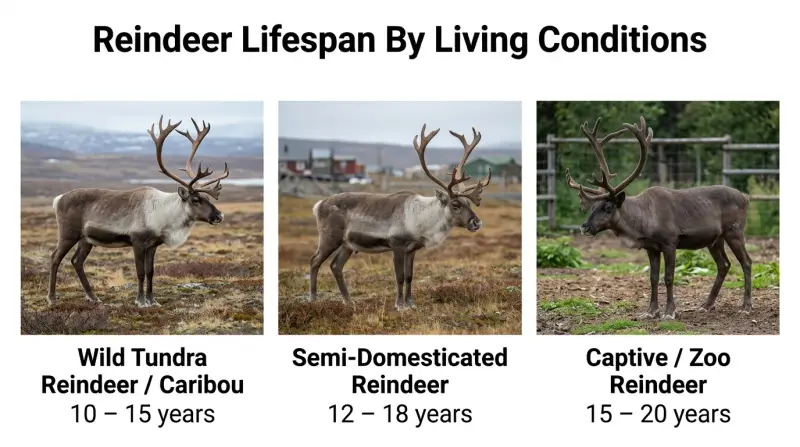
Reindeer Lifespan
- Typical Lifespan: Wild reindeer generally live between 15 and 20 years under favorable conditions, though most succumb to predation, starvation, or disease much earlier.
- Captive vs. Wild Longevity: Reindeer in captivity or well-managed semi-domesticated herds can occasionally reach up to 21 to 22 years due to the absence of natural predators and guaranteed nutrition.
- Sexual Dimorphism in Survival: Prime breeding bulls often experience higher mortality rates during the intense autumn rut, leading to a shorter average lifespan compared to adult females.
- Climate Change Impacts: Rain-on-snow events create impenetrable ice crusts over lichen pastures, causing massive starvation events (locked pastures) that drastically depress overall population life expectancy.
- Key Mortality Bottlenecks: The highest vulnerability occurs during the first year of life (calf mortality from predators and harsh weather) and among senescent adults over 12 years old.
Evaluating reindeer lifespan requires distinguishing between potential biological longevity and ecological life expectancy. Biologically, the cellular and structural composition of Rangifer tarandus can support roughly two decades of life. Ecologically, however, real-world mortality factors truncate this curve for the vast majority of animals. The following table contrasts baseline survival metrics across different management and environmental contexts.
| Population Category | Typical Lifespan Range | Maximum Recorded Age | Primary Mortality Factors |
|---|---|---|---|
| Wild Tundra Reindeer / Caribou | 10 – 15 years | 18 – 20 years | Predation (wolves, bears), malnutrition, severe weather |
| Semi-Domesticated Reindeer | 12 – 18 years | 20 – 21 years | Human harvesting, parasites, vehicular collisions, disease |
| Captive / Zoo Reindeer | 15 – 20 years | 21 – 22 years | Age-related organ failure, captivity-related metabolic issues |
As detailed in the table above, the environment dictates the realized lifespan. Wild herds must constantly expend energy to evade predators and locate forage beneath packed winter snow, accelerating physical wear and tear. Conversely, captive reindeer live in controlled environments insulated from predatory threats, yet they remain susceptible to captivity-specific ailments such as copper deficiency or hoof overgrowth if husbandry is suboptimal.
Stages of the Reindeer Life Cycle
The life history of a reindeer is divided into distinct developmental phases, each characterized by specific physiological adaptations and vulnerability thresholds.
1. The Neonatal and Calf Phase (Ages 0–1)
Reindeer calves are born in late spring (May to June) after a gestation period of approximately 7.5 to 8 months. Unlike many other cervids that hide their young, reindeer mothers (cows) give birth in open tundra where mobility is essential against predators like golden eagles, wolverines, and wolves. Calves are precocial, standing and nursing within hours of birth. Despite this, the first year is the most perilous: neonatal mortality can range from 30% to over 50% depending on spring weather severity, neonatal birth weight, and local predator density.
2. The Sub-Adult and Prime Years (Ages 2–10)
By age two, young reindeer achieve functional maturity, though physical growth continues—particularly in males, which continue to build mass and antler architecture until roughly age five or six. This is the prime reproductive window. Prime-age females produce a single calf annually, provided body condition is sufficient. Prime-age males engage in sparring and aggressive dominance displays during the autumn rut, expending massive energy reserves that leave them depleted entering winter.
3. Senescence and Old Age (Ages 11–20+)
Reindeer entering their second decade exhibit clear signs of senescence. Tooth wear is a primary limiting factor; as molars wear down from chewing abrasive lichens and coarse vegetation, digestive efficiency drops. Older reindeer struggle to maintain body condition during harsh winters. Their immune systems decline, and they become increasingly vulnerable to parasitic infections (such as warble flies and botflies) and severe weather events.
Sexual Dimorphism and Lifespan Discrepancies
A notable aspect of reindeer demographics is the divergence in survival rates between males and females. Female reindeer typically outlive males by several years in both wild and semi-domesticated populations.
This disparity stems largely from behavioral ecology and physiological stress. During the autumn rut, mature bulls invest heavily in establishing harems and defending territory. They frequently stop eating entirely for weeks, losing up to 25% to 30% of their body weight. Entering winter in an exhausted, depleted physical state makes older bulls exceptionally vulnerable to winter starvation, disease, and predation. Females, by contrast, conserve energy more effectively during winter, prioritizing somatic maintenance to support ongoing lactation and gestation.
Environmental and Ecological Pressures on Longevity
Reindeer lifespan is inextricably linked to the health of Arctic and sub-Arctic ecosystems. Several large-scale environmental variables continuously shape population age structures:
- Climate Change and Rain-on-Snow Events: Rising global temperatures cause mid-winter rain events in the Arctic. When this water freezes on the ground, it forms hard ice sheets over lichen pastures. Reindeer cannot dig through thick ice, leading to catastrophic starvation events that decimate both the very young and the elderly within a herd.
- Predator Dynamics: Natural predators such as gray wolves (Canis lupus), brown bears (Ursus arctos), and wolverines (Gulo gulo) selectively target the weakest members of a herd—typically calves and senescent adults over 12 years old. This predation pressure acts as an evolutionary filter, removing older animals with compromised mobility.
- Parasites and Pathogens: Warble flies (Hypoderma tarandi) and nose botflies (Cephenemyia trompe) inflict severe distress, impairing feeding efficiency and reducing body condition. , warming temperatures have expanded the range of biting insects and novel pathogens, increasing disease-induced mortality across northern latitudes.
- Human Infrastructure and Fragmentation: Industrial development, mining roads, pipelines, and fencing fragment traditional migration corridors. Reindeer forced to navigate human barriers expend critical energy reserves, and vehicular or train collisions account for significant annual mortality in semi-domesticated and wild herds alike.
Comparative Longevity Across Cervid Species
To contextualize reindeer lifespan, it is helpful to examine how Rangifer tarandus compares to other members of the deer family (Cervidae) inhabiting northern or temperate zones.
| Species | Scientific Name | Typical Wild Lifespan | Maximum Captive Lifespan |
|---|---|---|---|
| Reindeer / Caribou | Rangifer tarandus | 10 – 15 years | 20 – 22 years |
| Moose | Alces alces | 8 – 12 years | 15 – 20 years |
| White-tailed Deer | Odocoileus virginianus | 4 – 8 years | 15 – 20 years |
| Elk / Wapiti | Cervus canadensis | 10 – 13 years | 20 – 25 years |
As shown in the comparative data, reindeer maintain a moderate to high natural lifespan relative to smaller deer species, largely due to their relatively low baseline metabolic rate during harsh winters and their social, herd-based defense mechanisms. However, their specialized reliance on slow-growing terrestrial lichens leaves them uniquely vulnerable to localized ecological disruptions compared to generalist browsers like white-tailed deer.
Frequently Asked Questions
Wild reindeer typically live 10 to 15 years, constrained by natural predators, harsh winters, and scarcity of winter forage. Captive reindeer, shielded from predation and provided with consistent veterinary care and supplemental feed, routinely live 15 to 20 years.
No. Female reindeer generally outlive males. Mature bulls suffer severe physical exhaustion and significant weight loss during the autumn rut, leaving them vulnerable to winter starvation and disease, whereas cows maintain more stable body condition across seasons.
The leading natural causes of death are predation (primarily by wolves and bears), winter starvation due to deep snow or rain-on-snow ice crusts locking away lichen pastures, and disease or heavy parasite loads.
While exceptional individual records exist of captive or semi-domesticated reindeer reaching 21 to 22 years of age, 25 years is biologically outside the normal parameters for the species. Severe tooth wear and systemic cellular senescence generally prevent survival past the early twenties.
Climate change shortens overall life expectancy by increasing the frequency of winter rain-on-snow events that encapsulate ground forage in ice. Additionally, warming summers increase insect harassment, forcing reindeer to expend vital energy fleeing bugs rather than foraging, which depresses body condition heading into winter.
Conclusion
The lifespan of the reindeer (Rangifer tarandus) is a dynamic ecological indicator shaped by the harsh realities of northern latitudes. While their biological architecture supports a potential existence of up to two decades, real-world survival is governed by the delicate balance of climate stability, forage availability, predator-prey dynamics, and human stewardship. As Arctic environments undergo rapid climatic transformation, safeguarding traditional migration routes and protecting sensitive winter lichen pastures remain essential to ensuring that wild and managed reindeer populations can achieve their natural longevity.