
Quick Answer: There is no single bird scientifically called a “seagull”; rather, “gulls” comprise a diverse family (Laridae) requiring careful visual diagnosis. Effective seagull identification relies on a structured approach that examines primary wingtip patterns (black, white, or patterned tips), bill morphology (length, thickness, markings), mantle color (shades of gray to deep slate black), leg color (pink, yellow, or greenish), and age-dependent plumage transitions (which can take up to four years to reach adult breeding status).
For casual observers strolling along a shoreline, nearly any web-footed, gray-and-white seabird is simply branded a “seagull.” Yet to field ornithologists and dedicated birders, lumping these adaptable avian specialists into a single category overlooks one of nature’s most fascinating and subtly complex identification challenges. The family Laridae spans an immense spectrum of forms, from tiny, graceful surface-feeders to massive apex predators of the marine ecosystem. Mastering gull identification requires moving beyond generic assumptions and learning to read the subtle visual vocabulary written in their wingtip patterns, bill structures, and multi-year plumage cycles.
The complexity that makes gulls notoriously difficult to identify also makes them deeply rewarding. Rather than relying on a single field mark, successful identification demands a evaluation of structural build, posture, proportional measurements, and feather development stages. Whether you are untangling the complex molts of large white-headed gulls, distinguishing a pelagic surface specialist like the Black-legged Kittiwake, or sizing up the powerful mantle of a Great Black-backed Gull, a systematic approach transforms confusion into clarity.
This master guide provides a comprehensive field reference, breaking down the essential anatomy, diagnostic metrics, and species-specific traits necessary to navigate the world of gulls with absolute confidence.
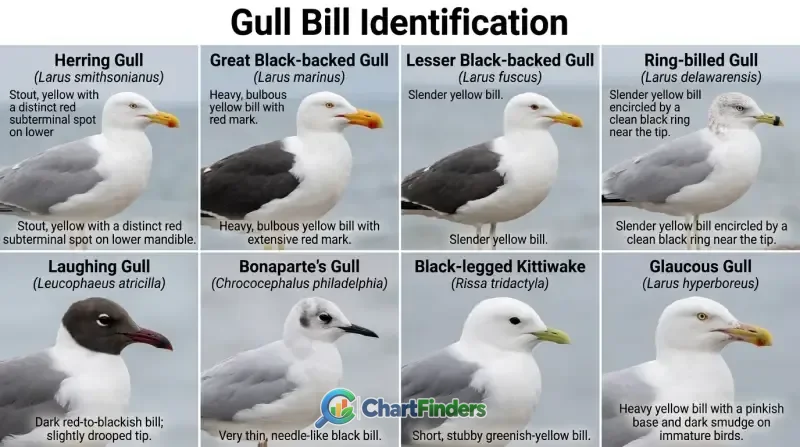
Seagull Identification Chart
- “Seagull” is a colloquial term; ornithologically, birds are categorized into distinct species within the family Laridae, each adapted to specific ecological niches.
- Primary feather patterns—specifically the presence, distribution, and extent of black markings and white “mirrors” at the wingtips—serve as primary diagnostic clues.
- Large white-headed gulls undergo a multi-year maturation process, meaning juvenile, immature, and sub-adult plumages look drastically different from breeding adults.
- Mantle color (the upperparts of the wings and back) ranges from palest pearl-gray to jet-black, providing an immediate baseline separation between species.
- Bill size, shape, and gonydeal angle (the upward bend on the lower mandible) offer critical structural indicators for separating similar-looking species.
- Modern field methodologies emphasize regional expectation and structural gestalt over chasing rare vagrants.
- Leg coloration (pink, yellow, flesh-toned, or red) is a stable, highly reliable taxonomic marker within specific age and species brackets.
Foundational Concepts in Gull Morphology and Taxonomy
To successfully utilize any gull identification chart, one must first master the specialized anatomical terminology used by field ornithologists. Unlike songbirds, where plumage often settles into predictable seasonal variations, gulls present a moving target shaped by complex molts, age-related coloration shifts, and subtle structural variations.
The upper surface of a gull’s wings and back is known as the mantle. Mantle shade is measured against standardized grayscale palettes, ranging from the ghostly pale gray of the Glaucous Gull to the heavy charcoal-slate of the Lesser Black-backed and Great Black-backed Gulls. Understanding mantle tone is often the first logical step when scanning a mixed flock.
Next comes the wingtip pattern, which focuses on the outermost primary flight feathers (p10 down to p1). The arrangement of black pigmentation, white apical spots (known as “mirrors”), and subterminal black bands forms unique visual fingerprints that separate look-alike species. For example, the absence of black wingtips is the defining characteristic of white-winged gulls like the Glaucous and Iceland Gulls.
Bill structure requires careful scrutiny. Birders examine the length-to-depth ratio, the curve of the culmen (upper mandible profile), and the gonys—the distinct angular swelling near the tip of the lower mandible. In many species, a bright red spot on the lower mandible acts as a visual target for begging chicks, but its presence and exact placement can also distinguish adult gulls from one another.
Comprehensive Gull Identification Matrix
The following reference table outlines North America’s most prominent gull species, comparing their critical diagnostic features, size categories, mantle tones, and geographical distribution tendencies.
| Species Name | Size & Build | Mantle Color | Bill Characteristics | Leg Color | Diagnostic Wingtip / Tail Markings |
|---|---|---|---|---|---|
| Herring Gull (Larus smithsonianus) | Large, robust, heavy-chested; flat-crowned profile. | Medium pearl-gray. | Stout, yellow with a distinct red subterminal spot on lower mandible. | Pink to flesh-toned (rarely yellowish in older adults). | Black outer primaries with prominent white mirror spots near tips. |
| Great Black-backed Gull (Larus marinus) | Very large, massive, powerful bill and heavy body. | Very dark slate-black / charcoal. | Heavy, bulbous yellow bill with extensive red mark. | Flesh-pink, robust. | Extensive black primaries contrasted with clean, white trailing edges and large white wingtip mirrors. |
| Lesser Black-backed Gull (Larus fuscus) | Medium-large, sleek, elegant proportions, long-winged. | Dark slate-gray to black (varies by subspecies). | Slender yellow bill. | Bright yellow (occasionally dull flesh in rare forms). | Dark primaries with minimal white mirroring; striking contrast against dark mantle. |
| Ring-billed Gull (Larus delawarensis) | Medium, trim, dainty head, neat proportions. | Light gray. | Slender yellow bill encircled by a clean black ring near the tip. | Yellowish-green to bright yellow. | Black wingtips with small white spots; tail is stark white in adults. |
| Laughing Gull (Leucophaeus atricilla) | Medium-small, elegant, slight downward bill curve. | Dark grayish-brown. | Dark red-to-blackish bill; slightly drooped tip. | Blackish to dark red. | Breeding adults show a complete black hood and white trailing wing edges; primaries are solid black without mirrors. |
| Bonaparte’s Gull (Chroicocephalus philadelphia) | Small, tern-like, dainty, highly buoyant flight. | Pale pearl-gray. | Very thin, needle-like black bill. | Bright orange-red. | White leading-edge triangle on outer primaries during flight; dark slate head in breeding plumage. |
| Black-legged Kittiwake (Rissa tridactyla) | Medium, pelagic specialist, extremely graceful. | Medium-pale gray. | Short, stubby greenish-yellow bill. | Dark blackish-brown (lacks a hind toe). | Poured-ink black wingtips appearing as though dipped in ink, completely lacking white mirrors. |
| Glaucous Gull (Larus hyperboreus) | Very large, bulky, fierce expression, sloping forehead. | Very pale, icy pearl-gray. | Heavy yellow bill with a pinkish base and dark smudge on immature birds. | Pink. | Completely white primaries and wingtips; no black pigment anywhere on the wingtips. |
When analyzing this data, notice how taxonomic separation often hinges on a combination of mantle shade and soft-part coloration (legs and bill). For instance, while both the Herring Gull and the Lesser Black-backed Gull share large body dimensions, their mantle shades and leg colors diverge sharply, providing an immediate visual split in mixed-species loafing flocks.
Plumage Maturation Cycles: Understanding Age Classes
One of the greatest stumbling blocks in gull identification is the multi-year plumage progression. Unlike songbirds that acquire adult plumage within their first year, large gulls undergo a slow, four-year maturation process. Recognizing these age classes is essential to avoid misidentifying a young bird as an entirely different species.
First-Cycle (Juvenile & First-Winter) Plumage: Newly fledged gulls are remarkably complex, featuring mottled brown, buff, and cream plumage that provides camouflage against predators. Their bills are typically dark or pinkish with black tips, and their tails display a sharp, dark terminal band contrasting with a pale rump. First-winter birds have undergone some body molt, but retain their juvenile flight feathers, showing heavily notched and barred patterns.
Second-Cycle (Second-Winter) Plumage: By their second year, gulls begin acquiring paler gray feathers on the mantle, signaling the emergence of adult traits. However, wings still retain retained juvenile or first-generation feathers, and the tail band may be broken or fading. The bill often develops a paler base with a dark tip, bridging the gap between juvenile blackness and adult yellowness.
Third-Cycle (Third-Winter) Plumage: Approaching maturity, third-year gulls look remarkably like adults. The mantle is almost entirely gray, and the head is mostly white with minor dusky streaking behind the eye. Subtle remnants of immature plumage can still be detected in the wingtip patterns, where black markings may appear slightly faded or smudged.
Adult (Definitive) Plumage: Fully mature gulls exhibit clean gray mantles, pure white heads (during breeding season), white underparts, bright yellow or pink legs, and sharply defined primary patterns featuring white mirrors. Non-breeding adults often acquire faint brown streaking on the head and nape, known as “winter head smudge.”
Pelagic vs. Coastal vs. Inland Habitats
Geography and habitat serve as powerful filters in gull identification. Knowing which species are expected in a specific environment drastically narrows down the field of possibilities.
- Pelagic Specialists: Species like the Black-legged Kittiwake and Sabine’s Gull spend the vast majority of their lives far out at sea, returning to steep coastal cliffs only to breed. They possess specialized physiological adaptations for sustained oceanic flight and rarely visit inland garbage dumps or agricultural fields.
- Coastal Generalists: Large gulls like the Herring Gull, Great Black-backed Gull, and Western Gull dominate rocky shorelines, sandy beaches, and tidal estuaries. They thrive on intertidal invertebrates, fish, and human refuse along coastlines.
- Inland and Terrestrial Foragers: Species such as the Ring-billed Gull and Franklin’s Gull readily push hundreds of miles inland. They frequent agricultural plowed fields, municipal parks, parking lots, and freshwater lakes, taking advantage of terrestrial insects and earthworms exposed by human activity.
Detailed Species Profiles and Diagnostic Breakdowns
To deepen your diagnostic skills, examine the specific behavioral and morphological traits that separate closely related species within challenging complexes.
The Herring Gull vs. Lesser Black-backed Gull Complex
In many regions of North America and Europe, Herring Gulls and Lesser Black-backed Gulls mix freely in resting flocks. While the Herring Gull features a classic medium-gray mantle and flesh-colored legs, the Lesser Black-backed Gull boasts a much darker mantle—ranging from slate-gray to deep charcoal—paired with striking yellow legs. Structurally, the Lesser Black-backed Gull appears noticeably more slender, with longer primary projections that extend past the tail tip when perched, creating a distinctly torpedo-shaped profile.
The White-Winged Giants: Glaucous vs. Iceland Gull
Arctic-breeding gulls lack black pigmentation on their wingtips, presenting an entirely white or pale-tipped wing array. Separating the massive Glaucous Gull from the smaller Iceland Gull relies entirely on structural gestalt. The Glaucous Gull is a hulking brute with a massive, parallel-sided yellow bill, a fierce, sloping forehead, and a heavy, lumbering flight style. The Iceland Gull is much daintier, featuring a rounded head, a small and stubby bill, and long, elegant wings that give it a tern-like buoyancy in flight.
Small Hooded Gulls: Bonaparte’s vs. Laughing Gull
During the breeding season, smaller gulls often sport striking dark hoods. The Bonaparte’s Gull is a petite, delicate bird with a needle-thin black bill and bright orange-red legs, favoring freshwater lakes and coastal bays. In contrast, the Laughing Gull is noticeably bulkier, with a dark red-to-blackish bill that exhibits a slight downward droop at the tip, accompanied by darker gray upperparts and a distinct white trailing edge on the secondaries during flight.
Common Pitfalls and Identification Mistakes
Even experienced birders occasionally fall into well-documented traps when studying gulls. Recognizing these common errors ensures greater accuracy in the field.
- Over-Reliance on Plumage Alone: Relying exclusively on feather color without factoring in structural build (such as head shape, bill depth, and leg length) frequently leads to misidentifying hybrids or age variants.
- Ignoring Lighting Conditions: Harsh overhead sunlight can bleach pale mantle grays into stark whites, while overcast maritime light can darken medium-gray mantles into near-black slate. Always evaluate color relative to surrounding reference gulls in the same lighting.
- Failing to Account for Hybridization: Gulls hybridize frequently, particularly where breeding ranges overlap (such as Glaucous-winged x Western Gulls on the Pacific Coast). Hybrids display intermediate structural and plumage traits that defy clean classification.
- Assuming Bill Markings are Constant: Bill color can shift seasonally, particularly in breeding adults where vibrant yellow and red tones intensify, and during winter when dusky smudges temporarily appear on the bills of immature or transitioning birds.
Frequently Asked Questions
What is the difference between a “seagull” and a gull?
Scientifically, there is no such bird as a “seagull.” All species belong to the family Laridae and are simply called gulls. Many species live far inland, frequenting freshwater lakes, agricultural fields, and deserts, meaning the prefix “sea” is both inaccurate and misleading.
How many years does it take for a gull to reach adult plumage?
Most large white-headed gulls (such as Herring Gulls and Great Black-backed Gulls) require a full four-year cycle to transition from juvenile brown plumage into definitive adult plumage. Smaller gulls and terns typically reach maturity much faster, often within two or three years.
Why do gulls have red spots on their bills?
The red spot on the lower mandible of adult gulls functions as a visual target. When hungry chicks peck at this red spot, it stimulates the parent bird to regurgitate food. In field identification, the precise location and presence of this spot help separate species.
Are gulls migratory?
Many gull species are strongly migratory, breeding in high northern latitudes and moving south along coastlines or major river systems during winter. However, populations near human settlements with reliable food sources (such as landfills and fisheries) often remain resident year-round.
Can gulls interbreed?
Yes. Many gull species are closely related and readily hybridize where their breeding ranges overlap. This creates complex identification challenges, as hybrid offspring often exhibit intermediate physical characteristics that do not match standard field guide descriptions.
Conclusion
Mastering gull identification transforms what initially appears to be an intimidating sea of anonymous gray-and-white birds into a fascinating study in avian diversity. By shifting your focus away from generic color labels and toward a rigorous examination of mantle tones, primary wingtip patterns, bill structures, and multi-year age classes, you unlock the ability to accurately name nearly any gull you encounter. Embrace the complexity, study the structural nuances, and let systematic observation elevate your birding expertise.