
Botanical discovery and field ecology often begin long after a plant’s flowers have faded. While petal colors and leaf arrangements dominate seasonal identification guides, nature leaves behind a durable signature in the autumn and winter months: the seed pod. Whether you are managing native restoration projects, harvesting seed stock for propagation, clearing invasive weeds, or simply examining an unfamiliar natural artifact found on a trail walk, learning how to read these botanical containers is an invaluable skill.
Seed pods evolve specific structural designs to protect developing embryos and optimize dispersal across landscapes. By breaking down these structures systematically, field naturalists, botanists, and gardeners can narrow down a plant’s identity to the family or genus level even in the dead of winter. This guide explores the anatomy of seed pods, outlines the diagnostic mechanics of dehiscence, presents a detailed comparative reference chart, and provides a methodical field framework for accurate identification.
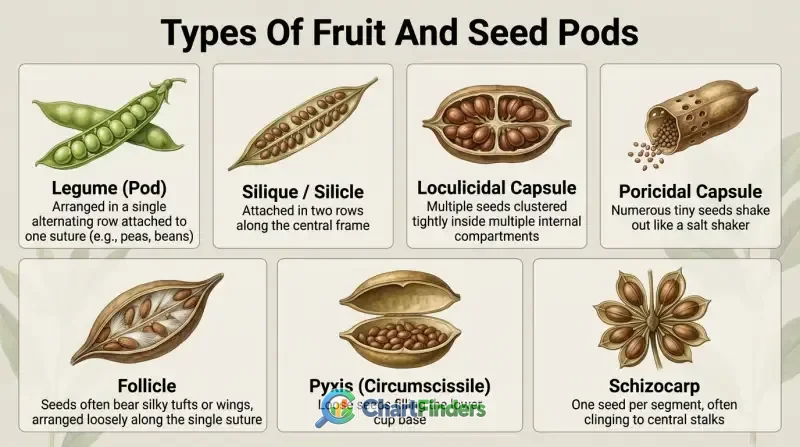
Seed Pod Seed Identification Chart: A Field Botanist’s Framework
- Pod geometry ranges from flattened legumes to inflated bladders and woody capsules, dictating how seeds are protected from environmental hazards.
- Dehiscence mechanisms—how a pod opens—provide critical taxonomic clues, distinguishing between explosive valves, longitudinal seams, circular lids, and terminal pores.
- Seed layout within the chamber (such as stacked coin-roll alignments, free-tumbling loose arrangements, or attachment to a persistent central septum) separates closely related plant families.
- Plant context, including growth habit, residual stem structure, geographic location, and habitat, narrows down field identification candidates.
- Digital tools and photographic apps can assist with initial sorting, but manual verification using structural botanical charts is necessary for definitive identification.
Mastering seed pod identification requires shifting focus from ephemeral floral traits to rigid, architectural markers. Plants invest significant evolutionary pressure into the design of their fruit structures. A pod is not merely a passive wrapper; it is an active mechanical dispersal unit engineered to catch the wind, float on water, or latch onto passing animals.
To use an identification chart effectively, you must understand the anatomical language of fruits and pods. Botanically speaking, many structures colloquially called “pods” belong to distinct fruit categories—including true legumes (Fabaceae), siliques and silicles (Brassicaceae), capsules (various families like Papaveraceae and Liliaceae), follicles (Ranunculaceae and Apocynaceae), and akhenes or schizocarps enclosed in specialized calyces.
Anatomical Foundations of Seed Pods
Before examining the charts, every observer must parse the external and internal morphology of the specimen:
- Pericarp: The fruit wall, which may be leathery, paper-thin, woody, fleshy, or inflated. The pericarp typically consists of three distinct layers: the exocarp (outer skin), mesocarp (middle layer), and endocarp (inner lining).
- Valves: The separate segments or doors into which a capsule or pod splits when mature.
- Sutures: The natural seams or lines of weakness where the pod wall splits open. These often correspond to dorsal and ventral margins where carpel edges fused during flower development.
- Septum: A dividing partition wall running through the interior of certain pods (such as the replum in mustard family siliques).
- Funiculus: The tiny stalk attaching individual seeds to the inner wall of the pod.
- Placenta: The specific region within the ovary wall where ovules (and later seeds) are attached.
Recognizing these parts prevents common misidentifications—such as confusing a multi-valved woody capsule with a simple single-chambered legume.
Comparative Seed Pod Identification Matrix
The following reference table outlines the primary categories of seed pods, their structural mechanics, seed arrangement patterns, and common plant families associated with each profile. Use this table to cross-reference unknown field specimens.
| Pod Type | External Shape & Texture | Opening / Dehiscence Style | Seed Layout & Attachment | Representative Families / Examples |
|---|---|---|---|---|
| Legume (Pod) | Elongated, flattened, or cylindrical; leathery or paper-like | Splits along two distinct longitudinal seams (valves) | Arranged in a single alternating row attached to one suture (e.g., peas, beans) | Fabaceae (Pea family: Lupine, Vetch, Redbud) |
| Silique / Silicle | Elongated (silique) or short/broad (silicle); dry valves | Opens from base upward, shedding valves and leaving a persistent central membrane (replum) | Attached in two rows along the central frame | Brassicaceae (Mustard family: Shepherd’s Purse, Honesty) |
| Loculicidal Capsule | Globular, conical, or oblong; woody or papery | Splits directly down the middle of the chambers (locules) | Multiple seeds clustered tightly inside multiple internal compartments | Liliaceae, Ericaceae, Iridaceae (Iris, Lily) |
| Poricidal Capsule | Bell-shaped, urn-shaped, or globose; rigid texture | Opens via small terminal pores, valves, or a circular lid (pyxis) near the apex | Numerous tiny seeds shake out like a salt shaker | Papaveraceae (Poppy), Campanulaceae |
| Follicle | Single-chambered, boat-shaped, often curved | Splits open along only one single longitudinal seam | Seeds often bear silky tufts or wings, arranged loosely along the single suture | Apocynaceae (Milkweed), Magnoliaceae, Ranunculaceae |
| Pyxis (Circumscissile) | Globular or cylindrical urn | Opens via a horizontal circular lid that pops completely off the top | Loose seeds filling the lower cup base | Plantaginaceae (Plantain), Amaranthaceae (Celosia) |
| Schizocarp | Lobed or segmented aggregate casing | Splits into individual, single-seeded segments (mericarps) without breaking the seed coat | One seed per segment, often clinging to central stalks | Apiaceae (Carrot/Parsley family), Malvaceae (Mallow) |
When analyzing an unknown pod against this matrix, check whether the pod opens along one seam (follicle) or two (legume), or if it does not split at all (nutlets or indehiscent samaras). These structural invariants remain consistent within plant genera, providing reliable identification clues.
Visualizing Pod Distribution Across Plant Families
To further understand the ecological prevalence of different pod morphologies, we can examine how widely these structural types distribute across common angiosperm orders. The chart below illustrates the relative representation of major pod types within temperate flora.
Relative Frequency of Pod Dehiscence Mechanisms in Temperate Flora
Note: Percentages reflect representation across general botanical survey orders in temperate North American and European ecosystems.
As demonstrated in the distribution chart above, valvular and capsular dehiscence account for the vast majority of dry fruit mechanisms in temperate zones. This evolutionary preference correlates with efficient mechanical wind dispersal (anemochory) and ballistichory (ballistic seed ejection).
Decoding Seed Layout and Internal Architecture
Once you examine the outer shell of a seed pod, the next step in identification requires opening the chamber to inspect seed morphology and layout. The internal arrangement of seeds is tightly constrained by evolutionary adaptations for survival and transport.
Seed Packaging Patterns
- Coin-Roll Stacked: Seeds are flattened and stacked tightly on top of one another like coins inside a paper wrapper. This is characteristic of many Fabaceae species (such as beans, peas, and redbud trees), where space within the narrow legume is maximized.
- Free-Tumbling Loose: Seeds rest unattached or loosely tethered inside a hollow cavity, rattling when the pod shakes. This mechanical design relies on animal agitation or violent wind gusts to spill seeds out through upper pores or split valves (common in poppies and lilies).
- Comose (Silky Tufted): Seeds feature feather-like hairs or parachutes attached to one end, packed densely around a central upright column or replum. When the pod splits (as seen in milkweeds and dogbanes), the hairs expand instantly to catch passing air currents.
- Embedded in Pulp or Resin: Although less common in dry pods, some dehiscent capsules house seeds coated in sticky resins or dry pulpy residues designed to adhere to avian or mammalian vectors.
Surface Textures and Markings
The seeds themselves carry microscopic or macro-sculptural signatures. Under a hand lens, examine the seed coat (testa):
- Reticulate: Covered in a net-like web of fine ridges.
- Punctate: Dotted with tiny pits or depressions.
- Smooth and Glossy: Highly polished seed coats, often impervious to moisture until scarified, common in hard-seeded legumes.
- Winged: Encircled by a papery flange designed to slow descent and catch horizontal wind drift.
Step-by-Step Field Identification Protocol
When you encounter an unfamiliar seed pod in the field, follow a structured sequence of elimination to arrive at a positive identification. Rushing to match photos without checking mechanical structure frequently leads to false leads.
- Examine Attachment and Persistence: Is the pod still attached to a woody branch, a herbaceous dried stem, or lying on the ground beneath the canopy? Check the remnant calyx or stem scars at the base.
- Inspect the Outer Pericarp: Is the pod paper-thin, leathery, woody, or inflated like a balloon? Note surface features such as spines, glandular hairs, ribs, or wings.
- Determine Dehiscence (Opening Style): Gently squeeze or pry the pod. Does it split down one side (follicle), two sides (legume/silique), shatter explosively (some touch-me-nots), or drop a top lid (pyxis)? If it does not open at all, evaluate whether it is an indehiscent nutlet, samara, or achene cluster.
- Count Chambers and Inspect Septums: Slice the pod crosswise. Is it a single hollow room, or is it divided into two, three, or five internal locules? Look for a central dividing wall.
- Analyze Seed Count and Layout: Count the seeds, observe their attachment points, and check their shape (flat, globular, kidney-shaped, or winged).
- Synthesize Plant Context: Factor in the surrounding vegetation, geographic location, soil type, and season. A woody pod on a climbing vine in a riparian zone points to entirely different families than a stiff pod on a desert shrub.
Common Identification Mistakes and Edge Cases
Even experienced field naturalists occasionally encounter botanical mimicry and developmental anomalies that complicate identification.
Premature vs. Mature Pods
The single most frequent error in seed pod identification is analyzing an immature green fruit. Pods undergo drastic morphological transformations as they dry. A green, inflated pod may dry down into a flattened, woody valve with completely different textural characteristics. Always seek out fully mature, weathered pods from the previous season still clinging to the plant when possible.
Weathered and Decayed Specimens
Winter weathering can strip away outer valves, leaving only the persistent internal skeleton of a pod—such as the silvery, translucent central septum of honesty plants (Lunaria annua) or wild mustards. If you only find the skeleton, use the shape of the remaining frame rather than the outer walls for your chart comparison.
Convergent Evolution Look-Alikes
Unrelated plant families often evolve remarkably similar pod structures in response to identical environmental pressures. For example, the inflated bladder-like pods of bladderpod (Physaria in the mustard family) look strikingly similar to bladder senna (Colutea in the legume family). Checking internal seed attachment—specifically looking for the central replum membrane characteristic of mustards—resolves this ambiguity instantly.
Frequently Asked Questions
The primary difference lies in their opening seams. A true legume (characteristic of the pea family, Fabaceae) splits open along two longitudinal sutures, releasing seeds from both halves. A follicle (found in families like Apocynaceae and Ranunculaceae) is a single-chambered fruit that splits along only one single longitudinal seam.
While most dry seed pods are safe to handle, certain plant families—such as the spurge family (Euphorbiaceae) or nightshades (Solanaceae)—produce toxic pods and seeds. Avoid touching pods with irritating hairs (such as certain legumes or mucilaginous pods) without gloves, and never ingest wild seeds unless positive identification has been verified by a qualified botanist.
Explosive dehiscence, or ballistichory, is an active mechanical dispersal strategy. As the pod dries, unequal tension builds up within the cellular layers of the pericarp valves. When fully ripe, the tension snaps the valves violently backward or twists them into a spiral coil, hurling seeds several feet away from the parent plant to reduce competition.
Yes, in many cases. Because pod morphology, valve count, and internal seed arrangement are highly conserved at the genus and family levels, a well-preserved pod is often more diagnostic for winter identification than a dried leaf or stem. However, cross-referencing regional flora guides is recommended to confirm species-level matches.
Field identification requires only a few basic tools: a 10x jeweler’s loupe or hand lens for examining seed coats and microscopic hairs, a pair of fine forceps for safely opening delicate capsules, a small sharp blade for cross-sectioning pods, and a comprehensive regional seed pod or plant morphology field chart.
Conclusion
Seed pod and seed identification transforms winter botanizing and field exploration into a rewarding puzzle. By moving beyond superficial guesswork and analyzing the architectural blueprint of pods—evaluating their outer walls, dehiscence seams, internal partitions, and seed layouts—you unlock a reliable method for tracking plant biodiversity year-round. Utilize systematic charts, inspect internal mechanics with care, and always factor in the broader ecological context to achieve confident, accurate identifications in the field.