
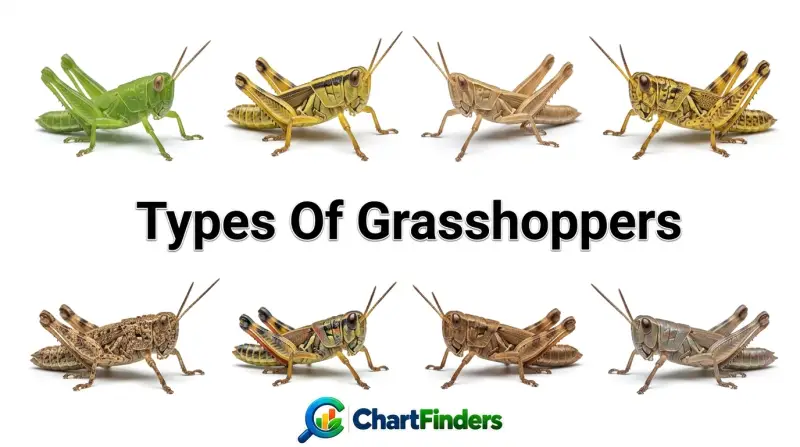
Grasshoppers are among the most recognizable and successful herbivorous insects on Earth, occupying nearly every terrestrial ecosystem where green vegetation is available. Yet, looking at a grasshopper and assuming it is just “a bug in the grass” overlooks a vast, complex taxonomic group with specialized behaviors, distinct ecological roles, and wildly varying life histories. While casual observers might notice only a generic green or brown jumper, entomologists and agricultural specialists recognize that managing or appreciating these insects requires understanding the exact species involved.
The challenge of studying types of grasshoppers lies in both their sheer diversity and the subtle morphological variations that separate harmless native species from devastating agricultural defoliators. From high-elevation specialists that communicate through clicking and hovering flight to high-density migratory species capable of stripping agricultural valleys bare, grasshoppers present a fascinating study in adaptation. This comprehensive guide explores the taxonomy, identification, behavioral traits, regional distribution, and ecological impact of the major types of grasshoppers, providing an authoritative resource for naturalists, gardeners, and land managers alike.
Types Of Grasshoppers: Classification, Identification, and Regional Diversity
- All true grasshoppers belong to the order Orthoptera and the suborder Caelifera, distinguished from crickets and katydids by their short antennae and diurnal habits.
- The family Acrididae contains the vast majority of economically and ecologically significant grasshopper species worldwide.
- Regional diversity varies widely; for instance, Idaho harbors approximately forty documented species (such as those in the Treasure Valley agricultural zones), whereas agricultural hubs like South Dakota contend primarily with a core triad of pest species.
- Identification relies on examining hind femur patterns, tegmina (forewings) length, pronotal shape, and specialized acoustic or visual mating displays.
- Management strategies must be tailored to specific species life cycles, as broad-spectrum eradication often fails to account for non-pest native biodiversity.
To understand the types of grasshoppers, one must first navigate their classification. Grasshoppers are split into two major suborders: the Caelifera (short-horned grasshoppers) and the Ensifera (long-horned grasshoppers, which include katydids and crickets). Within Caelifera, the family Acrididae represents the overwhelming majority of species encountered in fields, meadows, and agricultural croplands. Acridids are further broken down into several subfamilies, each exhibiting unique feeding habits, physical structures, and behavioral adaptations.
Major Subfamilies and Morphological Divisions
The classification of grasshoppers is largely rooted in structural morphology—specifically the shape of the prosternum (the space between the front legs), the structure of the antennae, and the venation of the wings. Knowing these subfamilies helps separate migratory outbreak species from solitary, localized grasshoppers.
- Melanoplinae (Spur-throated Grasshoppers): This subfamily contains some of the most notorious agricultural pests in North America, including the redlegged, migratory, and differential grasshoppers. They are easily identified by a distinct spine or tubercle protruding from the prosternum between their front legs.
- Gomphocerinae (Slant-faced Grasshoppers): Characterized by a slanted face profile and narrow forewings, slant-faced grasshoppers feed almost exclusively on grasses rather than broadleaf weeds or crops. Many species in this group rely heavily on acoustic signaling, rubbing their hind legs against their forewings to produce characteristic stridulation sounds.
- Oedipodinae (Band-winged Grasshoppers): Band-winged grasshoppers are famous for their conspicuous flight displays. Their hind wings are often brightly colored (yellow, red, or black) with contrasting dark bands, flashing vibrant hues when they take flight and often making crackling or snapping noises. Their faces are typically vertical, and they favor bare ground, rocky soils, and sparse vegetation.
| Subfamily | Common Name Examples | Key Identification Feature | Primary Diet / Habitat |
|---|---|---|---|
| Melanoplinae | Redlegged, Two-striped, Differential | Prosternal spine present between front legs | Polyphagous (broadleaf crops, weeds, grasses); fields and crop borders |
| Gomphocerinae | Pasture grasshopper, Meadow grasshopper | Slanted facial profile, narrow forewings | Graminivorous (grasses); prairies, pastures, and rangelands |
| Oedipodinae | Carolina grasshopper, Wrangler grasshopper | Colored/banded hind wings, vertical face | Mixed vegetation; bare soil, rocky outcrops, and high-elevation areas |
The table above outlines the three primary subfamilies of grasshoppers encountered in North America and Europe. Understanding these structural divisions allows field observers to narrow down an identification before examining specific species markings.
Notable Regional Grasshopper Species and Distribution
Grasshopper populations fluctuate dramatically based on geography, climate, and local agricultural practices. While some species maintain a cosmopolitan distribution across entire continents, others are strictly bound to specific ecological niches, mountain elevations, or agricultural valleys.
Agricultural Pests of the American Plains and Valleys
In states with intensive agricultural economies, grasshopper management focuses heavily on a small group of resilient, high-fecundity species. In South Dakota, Nebraska, and neighboring Midwestern agricultural zones, a core triad of species drives nearly all economic damage:
- The Two-Striped Grasshopper (Melanoplus bivittatus): Recognized by the two distinct yellow or light-colored stripes running from behind its eyes down the length of its back to the tip of its wings. This is a large, robust species that feeds heavily on both broadleaf crops and grasses.
- The Redlegged Grasshopper (Melanoplus femurrubrum): Smaller than the two-striped grasshopper, this species is easily identified by its bright, brick-red hind tibiae. It is widely distributed and adapts well to both cultivated fields and undisturbed pastures.
- The Differential Grasshopper (Melanoplus differentialis): One of the largest pest grasshoppers, characterized by a brownish-green body and distinct chevron (V-shaped) black markings on its hind femora. It is exceptionally destructive to corn, soybeans, and alfalfa.
Moving westward to states like Idaho, particularly within agricultural hubs like the Treasure Valley, the ecosystem hosts approximately forty distinct grasshopper species. While many remain harmless native inhabitants of sagebrush steppe and rangeland, seasonal outbreaks of migratory and spur-throated species frequently threaten specialty crops, orchards, and hayfields. Cataloging these regional populations requires careful specimen photography and examination of genital plates and femur patterns.
Specialized Native and Mountain Species
Not all grasshoppers are agricultural menaces. Many native species play critical ecological roles as prey for birds, reptiles, and small mammals, while contributing to nutrient cycling in natural landscapes.
- The Wrangler Grasshopper (Aulocara elliotti): Frequently observed in high-elevation, open rocky environments such as the Sandia Mountains or mountain foothills. Males are known for dramatic mating flights where they hover above the ground, producing loud snapping and crackling sounds to attract females.
- The Carolina Grasshopper (Dissosteira carolina): Often mistaken for a butterfly when in flight due to its broad, black hind wings bordered with a pale yellow margin. It thrives along dusty roadsides, railway embankments, and bare urban lots.
Life Cycle, Biology, and Behavioral Adaptations
All true grasshoppers undergo incomplete metamorphosis (hemimetabolous development), passing through three distinct life stages: egg, nymph, and adult. Understanding this life cycle is essential for differentiating grasshopper types and timing any necessary population management.
Females deposit eggs in late summer or early autumn, using specialized ovipositor valves at the tip of the abdomen to drill into the soil. They secrete a frothy substance that hardens around the egg mass, creating a protective pod (ootheca) buried one to two inches underground. Most pest and native species overwinter in this egg stage. When spring temperatures rise and soil moisture reaches optimal levels, the nymphs hatch.
Nymphs resemble miniature, wingless adults. They pass through five distinct instars, shedding their exoskeletons (molting) between each stage. As they grow, wing pads develop progressively until their final molt produces a fully winged, sexually mature adult. Most temperate species complete one generation per year, though warmer southern climates can support multiple generations.
Visualizing Grasshopper Diversity and Population Dynamics
Analyzing population distributions and species dominance across different agricultural and natural environments provides clear insight into why certain regions experience severe pest outbreaks while others maintain ecological equilibrium.
Chart: Dominant Grasshopper Pest Distribution in Mid-Plains Agriculture
The following bar chart illustrates the relative prevalence and agricultural impact rating (on a scale of 1 to 10 based on crop defoliation severity) of the three primary pest species driving management decisions in Midwestern farming states.
Impact Score: 9.2 / 10
Impact Score: 8.5 / 10
Impact Score: 7.8 / 10
As demonstrated in the comparison above, species with high polyphagous feeding habits—such as the differential grasshopper—pose the greatest threat to row crops because they readily transition from field margins to cash crops as wild vegetation dries out during midsummer.
Field Identification Framework
Accurately identifying grasshopper types in the field requires a systematic approach. Observers should avoid relying solely on body color, as many species exhibit extreme color polymorphism (ranging from bright green to dark brown or purple within the exact same species).
- Examine the Antennae Length: Confirm they are noticeably shorter than the body. If the antennae are longer than the body, you are observing a cricket or katydid (suborder Ensifera), not a true grasshopper.
- Check the Prosternum: Look between the front legs for a raised spine or peg. Its presence immediately places the specimen in the subfamily Melanoplinae (spur-throated pests).
- Observe Facial Profile: Note whether the face is vertical (Oedipodinae) or slanted backward at an angle (Gomphocerinae). Slanted faces typically indicate grass-specialist feeders.
- Recognize Flight Behavior and Wing Patterns: Flush the insect and observe its flight. Does it fly silently in a straight line, or does it make a crackling/snapping sound while displaying brightly colored hind wings? Band-winged species use color and sound for communication and defense.
Common Mistakes and Identification Pitfalls
Amateur naturalists and even agricultural scouts frequently misidentify grasshoppers or misinterpret field signs. Avoiding these common errors ensures accurate pest assessment and ecological appreciation.
- Confusing Color Morphs for Separate Species: Many grasshoppers change shades between molts or occur in multiple color phases depending on population density. Relying on color rather than structural morphology leads to persistent misidentifications.
- Overlooking Nymphal Stages: Early-instar nymphs look drastically different from adults, lacking fully formed wings and distinct markings. Assuming nymphs are an entirely separate, smaller species is a frequent error.
- Blaming All Herbivore Damage on Grasshoppers: Chewed foliage in gardens or fields is often blamed on grasshoppers when caterpillars, beetles, or crickets are the actual culprits. Always scout for the insects themselves rather than relying solely on damage patterns.
- Treating All Grasshoppers as Pests: Spraying broad-spectrum insecticides indiscriminately destroys beneficial native grasshopper species that pose zero threat to crops, destabilizing local food webs that rely on them for prey.
Frequently Asked Questions
What is the difference between a grasshopper and a cricket?
While both belong to the order Orthoptera, grasshoppers belong to the suborder Caelifera and feature short antennae, daytime activity, and robust jumping legs. Crickets and katydids belong to the suborder Ensifera, distinguished by very long, thread-like antennae, nocturnal habits, and specialized auditory organs located on their front legs rather than the abdomen.
Do all grasshoppers migrate and form swarms?
No. The vast majority of grasshopper species are solitary and maintain localized home ranges. Only a small subset of species—most notably migratory locusts and certain spur-throated species under specific high-density environmental conditions—undergo phase polyphenism, altering their behavior, color, and physiology to form destructive migratory swarms.
Why do some grasshoppers make a snapping or crackling sound in flight?
Band-winged species (subfamily Oedipodinae) snap their hind wings or rub their wings and legs together during flight to signal mates, establish territories, or startle potential predators. This acoustic display is a key behavioral adaptation used in open, sunny habitats.
How many grasshopper species exist in North America?
There are over 600 described species of grasshoppers in North America alone, inhabiting environments ranging from coastal marshes and high alpine tundra to arid deserts and agricultural valleys. State-level counts vary widely, with states like Idaho supporting around forty documented species and South Dakota and Nebraska tracking smaller core groups of damaging agricultural pests.
Are grasshoppers dangerous to humans or pets?
Grasshoppers do not bite humans defensively, nor do they sting or transmit venom. However, handling them roughly can result in a pinch from their mandibles or defensive regurgitation of a dark digestive fluid (“tobacco juice”). They are non-toxic to pets, though heavy ingestion of wild grasshoppers can occasionally harbor parasites.
Conclusion
Understanding the diverse types of grasshoppers bridges the gap between basic pest control and advanced ecological literacy. Whether managing agricultural threats in the grain-producing plains or cataloging native biodiversity in high-elevation mountain valleys, recognizing morphological structures, subfamilies, and regional species distributions transforms these leaping insects from generic pests into fascinating subjects of scientific study. By utilizing systematic identification and targeted management, land stewards can protect agricultural yields while preserving the rich ecological of native rangelands.