
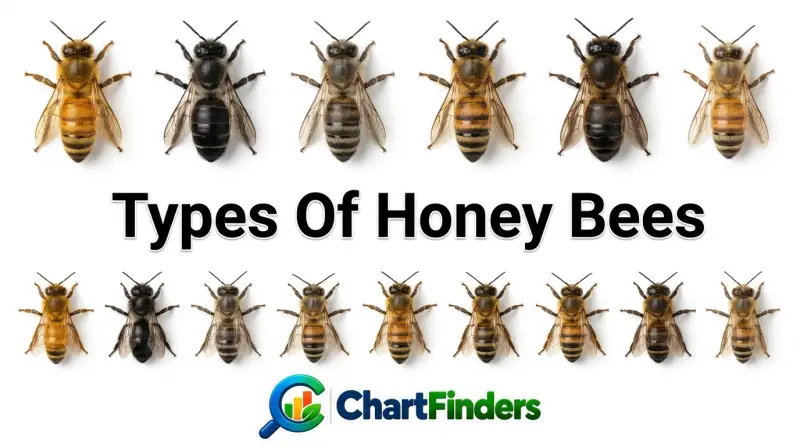
Honey bees are among the most ecologically and economically vital insects on the planet. Operating within complex, highly organized super-organisms, they sustain global agricultural output through targeted pollination while producing honey, beeswax, and propolis. However, not all honey bees behave identically. Subspecies have evolved across distinct geographic regions, developing specialized physical traits, defensive thresholds, and environmental tolerances. Understanding these differences is essential for effective apiary management, urban pest control evaluation, and agricultural planning.
This comprehensive guide explores the taxonomy, physical characteristics, behavioral traits, and geographical origins of the primary honey bee types. It also examines Varroa mite management considerations, safety precautions, and structural defense strategies necessary for property owners and professional pest managers.
Understanding the Core Types Of Honey Bees
- Species Dominance: The Western honey bee (Apis mellifera) is the most widely distributed species globally, featuring several distinct regional subspecies adapted to diverse climates.
- Italian Bees: Known for high honey production and gentle temperament, they remain the most popular choice among commercial and hobbyist beekeepers despite high winter feed consumption.
- Carniolan Bees: Exceptional at surviving harsh, cold winters and conserving winter stores by scaling brood production, making them ideal for northern continental climates.
- Russian Bees: Bred specifically for natural hygienic resistance against parasitic Varroa mites and tracheal mites, though they require alert management during inspections.
- Caucasian Bees: Distinguished by the longest proboscis of any honey bee, enabling them to harvest nectar from deep blossoms, though they produce heavy propolis.
- Africanized Bees: Highly defensive “killer bees” requiring extreme caution, rapid swarming tendencies, and strict professional removal protocols to protect public safety.
While hundreds of wild bee species exist, managed apiculture primarily relies on variations of the Western honey bee (Apis mellifera). Over centuries of natural selection and selective breeding, distinct subspecies have emerged. Below is a detailed breakdown of the primary honey bee types encountered in North America and Europe.
1. Italian Honey Bee (Apis mellifera ligustica)
Originating from the Italian peninsula, this subspecies is the undisputed workhorse of modern commercial beekeeping. Italian bees are easily recognizable by their golden-yellow or leather-colored abdominal bands.
- Temperament: Generally calm and gentle, making hive inspections manageable for handlers wearing standard protective gear.
- Productivity: Outstanding honey producers with a strong proclivity for foraging across diverse floral sources.
- Drawbacks: They tend to drift into neighboring hives easily and exhibit a high rate of robbing weaker colonies. They also maintain larger brood nests year-round, requiring higher winter feed consumption.
2. Carniolan Honey Bee (Apis mellifera carnica)
Native to Slovenia, Austria, and parts of Eastern Europe, the Carniolan bee is uniquely adapted to mountainous and colder continental climates. Visually, they are darker in color, often featuring gray or brown bands.
- Climate Adaptability: Excellent winter survivability. They rapidly scale down brood production when forage is scarce and expand explosively during spring nectar flows.
- Foraging Efficiency: Superior orientation skills reduce drifting. They forage effectively in cooler, damp weather conditions where other subspecies remain inside the hive.
- Drawbacks: Prone to swarming if they run out of space or honey storage capacity within the brood chamber.
3. Russian Honey Bee (Apis mellifera stock from Primorsky Krai)
Imported by the United States Department of Agriculture in 1997 from the Primorsky region of Russia, these bees were bred specifically to combat the devastation caused by parasitic Varroa mites.
- Parasite Resistance: Exhibits strong hygienic behavior, actively grooming themselves and nest-mates to remove Varroa mites and chewing down infested brood cells.
- Defensive Traits: Moderately defensive; they are more alert and reactive during hive inspections compared to Italian bees.
- Foraging & Brood: Brood rearing is closely tied to external nectar and pollen availability, conserving resources during lean periods.
4. Caucasian Honey Bee (Apis mellifera caucasia)
Hailing from the high valleys of the Central Caucasus mountains, this subspecies boasts the longest tongue reach (proboscis) of any honey bee, allowing them to extract nectar from deep-throated blossoms such as red clover.
- Temperament: Exceptionally gentle and calm on the comb.
- Drawbacks: They produce massive amounts of propolis (bee glue) to seal cracks in the hive, which can make equipment management difficult. They are also susceptible to nosema disease in damp, cold winters.
5. Africanized Honey Bee (Apis mellifera scutellata hybrid)
Often sensationalized as the “killer bee,” the Africanized honey bee is a hybrid resulting from the intentional crossing of lowland East African bees with European subspecies in Brazil during the 1950s. They have since expanded through Central and South America into the southern United States.
- Defensive Behavior: Highly sensitive to colony disturbance. They deploy in massive numbers, pursue perceived threats over significantly greater distances (up to a quarter-mile), and remain agitated longer than European bees.
- Nesting Habits: Less selective about nesting cavities; they readily occupy old tires, utility boxes, wall voids, and underground spaces.
- Management Risk: Unsuitable for standard backyard beekeeping in urban or suburban environments without rigorous genetic re-queening.
Comparative Analysis of Honey Bee Subspecies
To effectively manage, identify, or evaluate honey bee populations for agricultural or urban intervention, pest control strategists and beekeepers rely on key biological and behavioral indicators. The following table contrasts the defining traits, origin, temperament, and operational strengths of the major honey bee types.
| Subspecies | Geographic Origin | Color / Physical Traits | Temperament | Varroa Resistance | Primary Strengths |
|---|---|---|---|---|---|
| Italian | Italy | Golden-yellow bands | Docile, calm | Low | High honey yield, rapid buildup |
| Carniolan | Slovenia / Balkans | Dark gray/brown bands | Gentle, quiet on comb | Low to Moderate | Cold hardy, excellent foragers in damp weather |
| Russian | Eastern Russia | Dark, nondescript | Alert, moderately defensive | High | Superior hygienic mite removal |
| Caucasian | Central Caucasus | Dark with gray tones | Exceptionally gentle | Low | Longest proboscis for deep nectar sources |
| Africanized | East Africa / S. America | Slightly smaller, dark | Extremely defensive, volatile | Moderate | Rapid reproduction, resilient foragers |
Varroa Mite Management Across Bee Types
Regardless of the subspecies managed, Varroa destructor remains the single greatest biological threat to honey bee colonies worldwide. These external parasitic mites feed on the fat body tissue of adult bees and developing brood, transmitting debilitating viruses such as Deformed Wing Virus (DWV) and paralyzing the immune system of the colony.
Different honey bee types handle mite pressure through varying degrees of hygienic behavior and physiological resilience:
- Hygienic Behavior: Russian and selectively bred VSh (Varroa Sensitive Hygiene) Italian lines can detect diseased or mite-infested pupae, uncap the cells, and remove the larvae before mites can reproduce.
- Chemical Interventions: Traditional Italian and Carniolan lines often require active chemical treatments (such as oxalic acid, formic acid, or thymol) to keep mite loads below economic injury thresholds.
- Integrated Pest Management (IPM): Combining resistant stock with screened bottom boards, drone brood removal, and biochemical treatments ensures long-term colony survival.
Urban Pest Control and Safety Protocols
In urban and suburban environments, honey bee swarms or established feral colonies present unique management challenges. Unlike solitary stinging insects like wasps or hornets, honey bee colonies represent a substantial biological biomass capable of organized defense.
Swarms vs. Established Nests
Distinguishing between a temporary swarm and a permanent nest is critical for determining the appropriate intervention:
- Swarm Phase: A temporary cluster of bees resting while scout bees search for a permanent cavity. They are generally docile during this stage because they have no brood or honey stores to defend.
- Established Nests: Colonies that have built wax combs inside structural voids (walls, chimneys, soffits). These colonies exhibit high defensive behavior, especially when structural vibrations or heat disturbance occurs.
Professional Removal Strategies
When honey bees establish nests within inhabited structures, standard insecticide treatments are often counterproductive and hazardous. Poisoning a hive leaves behind pounds of melting honey, decaying brood, and wax that attracts secondary pests such as rodents, ants, and wax moths, alongside severe structural odor issues.
- Live Removal (Cut-Outs): Professional beekeepers or structural pest management technicians open the wall cavity, vacuum or brush bees into a transport box, and physically remove comb structures.
- Trap-Outs: Utilizing a one-way escape cone mounted over the primary entrance, foraging bees are allowed out but cannot return. They cluster in a temporary hive box placed nearby, eventually drawing the queen out if combined with pheromone lures.
- Sealing and Prevention: Post-removal, all entry points must be sealed with silicone caulk, copper mesh, or flashing to prevent future swarms from utilizing the same cavity.
Common Mistakes in Honey Bee Identification and Management
Property owners and novice handlers frequently make critical errors when encountering honey bees:
- Misidentifying Wasps as Honey Bees: Yellowjackets and bald-faced hornets are aggressive predatory wasps that nest in soil or paper carton nests. Treating them like docile honey bees leads to severe stings.
- Applying DIY Aerosol Sprays to Structural Hives: Spraying commercial wasp killer into a wall void agitates the colony, causing thousands of bees to chew through interior drywall into living spaces.
- Ignoring Africanized Genetics in Warm Regions: Assuming all feral colonies in southern latitudes share the gentle temperament of commercial Italian stock. Always treat unmanaged feral swarms with high caution.
Frequently Asked Questions
What is the most popular honey bee for commercial beekeeping?
The Italian honey bee (Apis mellifera ligustica) is the most widely utilized subspecies globally. Beekeepers favor them for their high honey yields, gentle disposition, and rapid population expansion during nectar flows.
Can you visually distinguish an Africanized honey bee from a European honey bee?
Visually, they are almost identical to standard European honey bees, being only slightly smaller in body size. Accurate identification requires morphometric measurement (measuring wing and body dimensions) or DNA testing.
Why do Russian bees resist Varroa mites better than other types?
Russian bees exhibit heightened hygienic behavior. They actively groom themselves and detect mites inside sealed brood cells much faster than standard Italian strains, interrupting the reproductive cycle of the parasite.
Are honey bees protected pests?
While honey bees are not legally protected endangered species in most jurisdictions, their critical role in agriculture makes live removal and relocation strongly preferred over extermination by environmental agencies and pest control standards.
How far do honey bees travel from their hive for foraging?
Forager bees routinely travel up to two to three miles from their hive in search of nectar, pollen, and water sources, though they prefer closer resources when available.
Conclusion
Recognizing the distinct types of honey bees is for successful apiculture, agricultural pollination, and safe urban pest management. From the docile and productive Italian bee to the rugged Carniolan and the defensive Africanized hybrid, each subspecies carries evolutionary adaptations tailored to specific climates and survival pressures. Whether establishing an apiary or managing a feral colony intrusion in a residential structure, applying informed, species-specific strategies ensures both human safety and ecological preservation.