
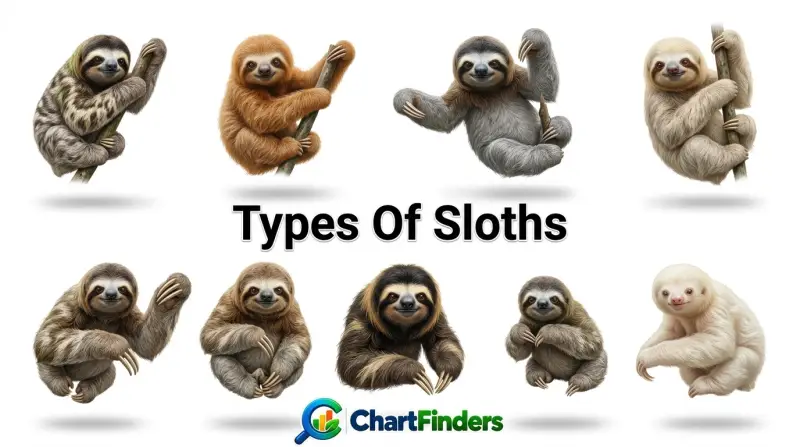
To understand the living representatives of the suborder Folivora, one must look beyond the sluggish stereotype and examine a masterclass in mammalian evolutionary adaptation. Sloths are specialized arboreal residents of Central and South American tropical rainforests, designed over millennia to occupy a high-canopy niche where few other large mammals can survive on a low-energy diet of leaves. Yet, grouping all sloths into a single category obscures a remarkable evolutionary split. The two surviving families—three-toed sloths and two-toed sloths—are distant cousins separated by millions of years of separate evolution, differing in skeletal structure, organ systems, digestive strategies, and daily rhythms.
This comprehensive guide explores the taxonomy, physical traits, ecological roles, and conservation realities of the various types of sloths. By examining the physiological mechanisms that allow them to thrive in the canopy, the distinctions between genera, and the specific conservation challenges each species faces in the modern world, we gain a deeper appreciation for these iconic inhabitants of the Neotropics.
Types Of Sloths
- Sloths are split into two distinct families: three-toed sloths (Bradypodidae) and two-toed sloths (Megalonychidae), which diverged 30 to 40 million years ago.
- There are six extant species: four three-toed species and two two-toed species, each adapted to specific forest niches.
- Three-toed sloths possess specialized cervical vertebrae that allow them to turn their heads up to 270 degrees, a feature absent in two-toed sloths.
- Two-toed sloths are generally larger, nocturnal to crepuscular, more omnivorous, and notably better at adapting to human-disturbed habitats.
- Habitat fragmentation, illegal pet trade, power line electrocutions, and deforestation represent the primary modern threats to wild sloth populations across Central and South America.
The living representatives of the suborder Folivora are classified into two families, six species, and various subspecies. While all sloths share an existence defined by arboreal locomotion, low body temperature, and extremely slow metabolic rates, each species has carved out a unique ecological strategy. Understanding the taxonomy of sloths requires separating the structural and physiological traits that define their respective genera.
| Common Name | Scientific Name | Family | Front Digits | Primary Distribution | Conservation Status |
|---|---|---|---|---|---|
| Brown-throated Three-toed Sloth | Bradypus variegatus | Bradypodidae | 3 | Central & South America | Least Concern |
| Pale-throated Three-toed Sloth | Bradypus tridactylus | Bradypodidae | 3 | Guiana Shield, Northern South America | Least Concern |
| Maned Three-toed Sloth | Bradypus torquatus | Bradypodidae | 3 | Atlantic Forest, Brazil | Vulnerable |
| Pygmy Three-toed Sloth | Bradypus pygmaeus | Bradypodidae | 3 | Isla Escudo de Veraguas, Panama | Critically Endangered |
| Linnaeus’s Two-toed Sloth | Choloepus didactylus | Megalonychidae | 2 | Northern & Central South America | Least Concern |
| Hofmann’s Two-toed Sloth | Choloepus hoffmanni | Megalonychidae | 2 | Central America & Northwestern South America | Least Concern |
The table above outlines the core taxonomic divisions. Examining these species individually reveals how subtle variations in geography, diet, and morphology dictate their survival strategies in the wild.
Three-Toed Sloths (Genus Bradypus)
Three-toed sloths belong to the family Bradypodidae. They are characterized by three clawed digits on all four limbs (though their hind feet also feature three digits, all sloths technically possess clawed fingers and toes). Their facial features give them a perpetual, gentle smile due to the structure of their zygomatic arches. Obligate folivores, three-toed sloths subsist almost exclusively on leaves, buds, and tender shoots from a narrow selection of canopy trees.
A defining anatomical characteristic of the genus Bradypus is the presence of extra cervical (neck) vertebrae. Most mammals, including two-toed sloths, have seven cervical vertebrae. Three-toed sloths typically possess eight or nine, allowing them to rotate their heads up to 270 degrees horizontally. This adaptation compensates for their poor eyesight and limited mobility, enabling them to scan for predators and locate leaves without moving their entire bodies.
Brown-Throated Three-Toed Sloth (Bradypus variegatus)
The brown-throated three-toed sloth is the most widespread, abundant, and frequently encountered sloth species in Central and South America. Ranging from Honduras through the Amazon basin to northern Argentina, this adaptable animal occupies lowland tropical rainforests, secondary growth forests, and even urban-adjacent shade-coffee plantations.
They display distinctive facial markings that resemble a dark bandit mask across the eyes. Their fur, coarse and grooved, serves as a habitat for symbiotic green algae (mostly Trichophilus species) and various fungi, which provide camouflage against avian and mammalian predators like harpy eagles and jaguars. Despite facing local pressures from deforestation and dog attacks, the brown-throated sloth maintains robust wild populations.
Pale-Throated Three-Toed Sloth (Bradypus tridactylus)
Inhabiting the Guiana Shield region of northern South America—including Venezuela, the Guianas, and northern Brazil—the pale-throated three-toed sloth is closely related to the brown-throated sloth. It is easily distinguished by its striking golden-yellow or pale cream throat patch, which contrasts sharply with its darker body fur.
This species is deeply tied to undisturbed, continuous primary rainforests and riverine ecosystems. Because they rely heavily on specialized canopy trees for both food and cover, they are less tolerant of severe habitat fragmentation than their brown-throated cousins. Their conservation status remains stable across vast stretches of the Amazonian interior, though localized mining and logging pose ongoing threats.
Maned Three-Toed Sloth (Bradypus torquatus)
Endemic to the highly threatened Atlantic Forest (Mata Atlântica) of eastern Brazil, the maned three-toed sloth is a specialized species fighting for survival in one of the world’s most fragmented biomes. It is characterized by a prominent mane of long, dark hair that extends from its shoulders down its neck and back.
The maned sloth depends heavily on mature forest fragments containing specific tree species favored for foraging. Due to historic deforestation for agriculture and urban expansion, its habitat has been reduced to isolated pockets. Conservation breeding programs, wildlife corridors, and strict legal protection are essential for preventing the extinction of this vulnerable species.
Pygmy Three-Toed Sloth (Bradypus pygmaeus)
Discovered and formally described as a distinct species in 2001, the pygmy three-toed sloth is an evolutionary marvel of island dwarfism (insular nanism). Restricted entirely to Isla Escudo de Veraguas, a tiny, uninhabited mangrove island off the coast of Caribbean Panama, this species is classified as Critically Endangered.
Pygmy sloths are approximately 40% smaller and 30% lighter than mainland three-toed relatives. They live almost exclusively in red mangrove (Rhizophora mangle) canopies, feeding on mangrove leaves and algae. Their restricted geographic range, numbering only in the hundreds of individuals, makes them exceptionally vulnerable to sea-level rise, illegal mangrove cutting, and potential stochastic events like tropical storms.
Two-Toed Sloths (Genus Choloepus)
Two-toed sloths, belonging to the family Megalonychidae, are larger, more robust, and structurally distinct from their three-toed counterparts. They possess two clawed digits on their forelimbs and three on their hind limbs. Unlike the strict folivory of Bradypus, two-toed sloths are opportunistic omnivores; while leaves still make up the bulk of their diet, they regularly consume flowers, fruit, small twigs, bark, and occasionally insect larvae or small vertebrates.
Behaviorally, two-toed sloths are more active, more agile, and possess a wider range of vocalizations and defensive postures. They are primarily nocturnal to crepuscular, spending the daylight hours curled into tight balls high in the canopy or hanging beneath sturdy branches. Their metabolic rate, while still exceptionally slow compared to other mammals, is slightly higher than that of three-toed sloths, supporting their broader dietary breadth.
Linnaeus’s Two-Toed Sloth (Choloepus didactylus)
Also known as the southern two-toed sloth, Choloepus didactylus ranges across the northern half of South America, including the Amazon basin, the Guianas, parts of Colombia, Ecuador, Peru, and northern Bolivia. They favor dense, primary rainforests and flooded forest zones.
This species features shaggy, brownish-blonde fur that often takes on a greenish tint from embedded algae during the rainy season. They have longer snouts, prominent nostrils, and powerful limbs equipped with sharp, curved claws that serve as formidable defensive weapons against predators. Because of their broad distribution across the vast Amazonian basin, their populations remain stable.
Hofmann’s Two-Toed Sloth (Choloepus hoffmanni)
Hofmann’s two-toed sloth has a discontinuous distribution, inhabiting parts of Central America (from Honduras down through Costa Rica and Panama) and northwestern South America (including Colombia, Ecuador, Peru, and Venezuela). They inhabit various forest types, ranging from lowland tropical rainforests to cloud forests at elevations exceeding 2,000 meters.
This species is frequently encountered in wildlife rehabilitation centers and ecotourism reserves in Costa Rica. Hofmann’s two-toed sloth displays remarkable adaptability; unlike three-toed sloths, they frequently navigate secondary forests, cacao and citrus plantations, and suburban gardens, provided continuous canopy bridges remain intact. They are solitary, arboreal, and fiercely territorial when defending preferred feeding trees.
Comparative Physiology and Evolutionary Divergence
The morphological similarities between the two sloth families are the result of convergent evolution driven by a shared arboreal lifestyle, rather than close genetic relatedness. In fact, genetic analyses confirm that the two sloth genera diverged roughly 30 to 40 million years ago. Their ancestors belonged to entirely separate lineages within the superorder Xenarthra (which also includes anteaters and armadillos).
Anatomical and physiological differences run deep across multiple biological systems:
- Skeletal Structure: Two-toed sloths possess 5 to 7 cervical vertebrae and lack the specialized neck rotation of three-toed sloths. They also possess more ribs (up to 24 pairs in some individuals) compared to the 15 to 18 pairs found in three-toed species, creating a more rigid torso cage.
- Dental Anatomy: Neither family possesses incisors or canines. Instead, they have simple, peg-like molariform teeth that lack enamel and grow continuously throughout their lives, worn down by fibrous leaf matter. Two-toed sloths feature prominent, tusk-like anterior teeth that can deliver a severe bite when threatened.
- Digestive System: Both families utilize multi-chambered stomachs functioning similarly to the rumen of cattle, fermenting cellulose via specialized symbiotic bacteria. However, the three-toed sloth’s digestive tract is remarkably slower; a single leaf can take up to a month to pass through its system, dictating their strict limitation on metabolic output.
| Comparison Metric | Three-Toed Sloths (Bradypus) | Two-Toed Sloths (Choloepus) |
|---|---|---|
| Cervical Vertebrae | 8 to 9 (enables 270° head rotation) | 5 to 7 (standard mammalian count) |
| Front Digits | 3 prominent claws | 2 prominent claws |
| Dietary Strategy | Strict folivore (specialized leaf diet) | Omnivore (leaves, fruit, flowers, insects) |
| Active Period | Diurnal and nocturnal (variable patterns) | Primarily nocturnal to crepuscular |
| Habitat Adaptability | Low (sensitive to habitat fragmentation) | High (tolerates secondary growth and plantations) |
Ecological Role and Symbiotic Relationships
Sloths play an essential, foundational role in Neotropical forest ecosystems. Far from being passive inhabitants, they act as ecosystem engineers and hosts for complex micro-ecosystems.
The fur of a sloth is unique among mammals. The hairs feature structural longitudinal cracks and grooves that trap moisture, creating an ideal greenhouse for green algae. This symbiotic relationship provides mutual benefits: the algae receive a stable, humid substrate and nitrogenous waste from the sloth’s skin, while the sloth gains cryptic green camouflage that shields it from aerial hunters like the harpy eagle (Harpia harpyja) and mammalian carnivores such as ocelots and jaguars.
, sloth fur hosts a specialized ecosystem of insects, most notably sloth moths (family Cryptophycini). These moths live out their entire life cycle within the sloth’s fur. When a sloth descends to the forest floor once a week to defecate—a dangerous ritual that exposes them to 50% of their annual predation risk—female moths lay their eggs in the fresh dung. The hatched larvae feed on the feces, mature into adult moths, and fly back up into the canopy to colonize the same or another sloth. The presence of moths and algae enriches the nitrogen content of the sloth’s fur, which the sloth can absorb through its skin as a nutritional supplement or consume while grooming.
Modern Threats and Conservation Realities
While some widespread species like the brown-throated and Hofmann’s sloths maintain stable populations, all sloth species face escalating anthropogenic pressures across their range. The primary threats include:
- Habitat Destruction and Fragmentation: Clear-cutting for cattle ranching, agriculture, and urban sprawl breaks continuous forest canopies into isolated islands. Sloths forced to cross open ground on the forest floor face extreme vulnerability to predation and vehicular strikes.
- Power Line Electrocutations: In developing rural and suburban interfaces, uninsulated electrical wires running through trees act as lethal traps for arboreal mammals. Sloths grabbing high-voltage lines suffer severe injuries or instant mortality. Wildlife organizations increasingly install insulated cables and artificial “canopy bridges” to mitigate this hazard.
- The Illegal Pet and Tourism Trade: Infant sloths are frequently captured for the illegal pet trade or used as tourist photo props. Poachers often kill the mothers to capture the clinging babies, resulting in high infant mortality rates due to improper diet, stress, and lack of specialized maternal care.
Conservation efforts rely heavily on grassroots initiatives, specialized wildlife rescue and rehabilitation centers (such as the Sloth Institute in Costa Rica and Jaguar Rescue Center), and legal protections enforced by regional environmental ministries. Ecotourism, when conducted ethically, provides local communities with economic incentives to preserve standing forests rather than clearing them for timber or pasture.
Frequently Asked Questions
What is the main difference between two-toed and three-toed sloths?
The most obvious physical difference is the number of visible claws on their forelimbs (two vs. three). Beyond morphology, they belong to entirely different taxonomic families. Three-toed sloths are strict folivores with specialized neck vertebrae allowing a 270-degree head rotation and a slower metabolism, whereas two-toed sloths are larger, nocturnal omnivores with slightly more flexible dietary habits and better adaptability to disturbed habitats.
Do sloths really only come down from the trees once a week?
Yes. Both three-toed and two-toed sloths descend to the forest floor approximately once every seven to ten days solely to defecate and urinate. This ritualistic behavior is energetically costly and risky, exposing them to predators. Scientists still debate the exact evolutionary reason for this habit, though current hypotheses suggest it helps maintain scent-marking communication among neighboring sloths or supports the life cycle of symbiotic sloth moths.
Are sloths related to monkeys?
No. Despite sharing an arboreal lifestyle in the same tropical forests, sloths are not primates. They belong to the superorder Xenarthra, an ancient lineage of placental mammals that also includes anteaters and armadillos. Primates evolved along a completely separate mammalian branch.
Can sloths swim?
Yes, sloths are surprisingly strong and capable swimmers. When crossing rivers or flooded rainforest floors, they use their long arms in an alternating breaststroke motion to propel themselves through the water. Their low metabolic rate, buoyant bodies, and ability to hold their breath for up to 40 minutes by slowing their heart rate make them adept aquatic travelers when necessary.
Are any sloth species currently endangered?
Yes. The pygmy three-toed sloth (Bradypus pygmaeus) is classified as Critically Endangered, restricted entirely to a single small island off the coast of Panama. Additionally, the maned three-toed sloth (Bradypus torquatus) of Brazil is classified as Vulnerable due to severe habitat loss in the Atlantic Forest biome.
How effective are current protected areas in preventing extinction?
Protected zones and national parks play a in safeguarding primary forest tracts, yet many reserves suffer from enforcement gaps, illegal logging, and boundary fragmentation. Two-toed sloths often adapt better to disturbed buffer zones compared to three-toed sloths, which are exceptionally sensitive to microclimate changes and habitat disruption. Targeted protection and wildlife corridors remain vital priorities.
The survival of the various types of sloths depends entirely on the preservation of Neotropical forest canopies. By supporting ethical ecotourism, advocating for wildlife-friendly infrastructure such as insulated power lines and canopy bridges, and backing conservation organizations dedicated to habitat restoration, humanity can ensure that these remarkable mammals continue to inhabit the rainforest canopies for generations to come.