
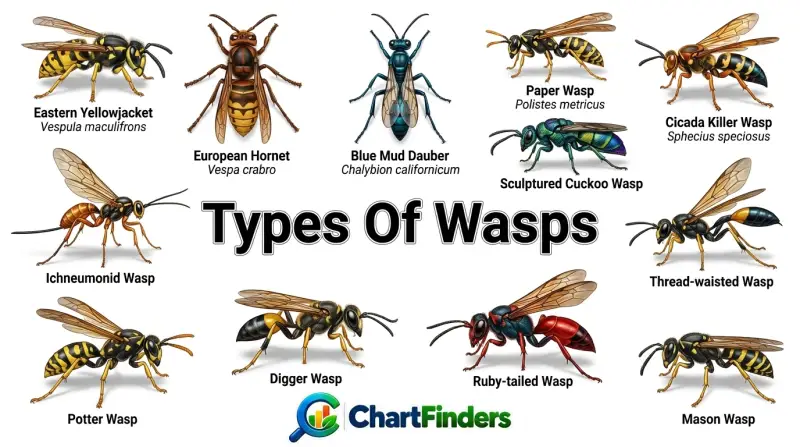
The taxonomic order Hymenoptera encompasses a vast array of stinging insects, yet few groups elicit as much ecological interest—and human apprehension—as social wasps. While solitary wasps hunt independently and rarely construct permanent communal infrastructure, social vespids engineer paper nests, provision complex colonies, and exhibit sophisticated division of labor among queens, workers, and reproductives. Understanding the diverse array of species requires looking beyond a simplistic yellow-and-black color scheme to examine anatomical structures, nesting micro-habitats, foraging preferences, and seasonal colony cycles. Whether managing agricultural pests, studying ecological predation webs, or assessing structural mitigation risks, a rigorous entomological breakdown of wasp types provides the necessary foundation for accurate identification and management.
Types Of Wasps
- Social wasps are divided into key groups: yellowjackets, paper wasps, bald-faced hornets, and European hornets.
- Nesting architecture varies significantly, ranging from subterranean cavities and dense shrubbery to exposed eaves and hollow tree trunks.
- Colony cycles are typically annual in temperate zones, initiated by overwintered mated queens in spring and culminating in colony senescence by late autumn.
- Morphological differentiation relies on examining clypeus patterns, genal width, abdominal banding, and structural caste variations.
- Defensive aggressiveness is highly species-specific, with yellowjackets and hornets displaying heightened territoriality compared to docile paper wasps.
To accurately navigate the world of vespine and polistine wasps, researchers and pest management professionals must analyze several distinct taxonomic categories. Each type possesses specialized behavioral adaptations, physiological markers, and ecological niches.
| Common Name | Scientific Name | Primary Nesting Location | Colony Size (Peak) | Defensive Aggressiveness |
|---|---|---|---|---|
| Yellowjacket | Vespula / Dolichovespula spp. | Subterranean cavities, wall voids | 1,000 – 5,000+ workers | High; readily stings when disturbed |
| Paper Wasp | Polistes spp. | Exposed single-comb nests under eaves, branches | 20 – 200 workers | Moderate; defensive only near the nest |
| Bald-faced Hornet | Dolichovespula maculata | Aerial trees, shrubs, structural overhangs | 100 – 400 workers | High; aggressive defenders of large carton nests |
| European Hornet | Vespa crabro | Hollow trees, wall voids, dark cavities | 200 – 400 workers | Moderate-High; active nocturnal foragers |
The table above summarizes the fundamental macro-characteristics of the four primary social wasp groups encountered in North America and Europe. Reading across these dimensions reveals how nesting habits directly correlate with colony scale and defensive temperament.
Yellowjackets (Vespula and Dolichovespula spp.)
Yellowjackets are short-coupled, robust-bodied vespids characterized by bright, contrasting yellow and black abdominal banding. The term “yellowjacket” applies primarily to genera Vespula and certain Dolichovespula species. Unlike paper wasps, their legs tuck closely against their bodies during flight, and they possess lancets modified for repeated stinging without barbed anchorages.
Subterranean and Cavity Nesting Habits
The vast majority of yellowjacket species establish subterranean nests, frequently utilizing abandoned rodent burrows, natural soil depressions, or hollows beneath tree roots. Certain synanthropic species, such as the German yellowjacket (Vespula germanica), routinely exploit structural wall voids, attic spaces, and crawlspaces. Workers construct multi-tiered combs enclosed within a protective envelope composed of chewed wood pulp mixed with saliva, creating a papery carton material.
Foraging Ecology and Late-Season Behavior
Early in the summer, yellowjacket workers act as beneficial insect predators, capturing caterpillars, flies, and other soft-bodied arthropods to feed developing larvae. As the colony transitions from brood-rearing to carbohydrate acquisition in late summer and autumn, foraging shifts toward sugary exudates, fallen fruit, and human refuse. This biological shift explains why yellowjackets become aggressive nuisances around outdoor dining areas during late summer.
Paper Wasps (Polistes spp.)
Paper wasps belong to the subfamily Polistinae and are instantly recognizable by their slender bodies, elongated legs that dangle downward during flight, and distinct wasp-waisted (petiolate) abdomens. They do not enclose their nests in a protective paper envelope; instead, they construct a single, open paper comb consisting of hexagonal cells pointing downward.
Architecture and Placement
Colonies of Polistes species are relatively modest, typically housing between 20 and 200 individuals at peak capacity. Nests are secured via a single central pedicel to sheltered horizontal or vertical substrates, such as tree branches, rock ledges, porch ceilings, window frames, and structural overhangs. This exposed architecture leaves the larvae visible from below.
Behavioral Temperament and Social Hierarchy
Paper wasps are generally non-aggressive unless physical contact is made with the nest or vibrational disturbances trigger an alarm response. Their colonies often feature complex linear dominance hierarchies established through physical combat among founding females (foundresses). The dominant female becomes the primary egg-layer, while subordinate co-foundresses take on foraging and nest-defense duties.
Bald-Faced Hornets (Dolichovespula maculata)
Despite their common name, bald-faced hornets are not true hornets (Vespa genus) but rather a large species of aerial yellowjacket. They are easily identified by their distinct ivory-white facial markings and matching white or pale-yellow patterning on the thorax and terminal abdominal segments.
Aerial Carton Nest Construction
Bald-faced hornets construct large, pear-shaped or spherical aerial nests made of grey, paper-like carton. These structures are built high off the ground, suspended from tree branches, utility poles, dense shrubs, and high structural eaves. The outer envelope consists of multiple overlapping layers of wood pulp that provide thermal insulation and structural integrity against weather events.
Colony Dynamics and Defensive Vigor
Colonies expand rapidly through the summer months, housing several hundred workers by August. These insects exhibit extreme territorial defense; approaching within several feet of an aerial nest frequently triggers an aggressive swarm response. Workers pursue perceived threats over considerable distances and possess the ability to spray venom from specialized defensive reservoirs.
European Hornets (Vespa crabro)
The European hornet is the only true hornet species established in North America, having been introduced from Eurasia centuries ago. Significantly larger than yellowjackets, Vespa crabro workers measure between 25 and 35 millimeters in length. Their morphological profile features a reddish-brown thorax, a yellow abdomen heavily banded with black markings at the base, and reddish-brown legs.
Cavity Nesting and Nocturnal Foraging
Unlike aerial nest builders, European hornets prefer dark, protected cavities for colony establishment. Natural locations include hollow tree trunks, decaying logs, and large bird boxes. In human environments, they readily inhabit wall voids, chimney flues, and dark attics. A unique behavioral trait of Vespa crabro is its prolonged nocturnal activity; workers routinely forage well after dark, frequently attracted to exterior porch lights and illuminated windows.
Ecological Impact and Predation
European hornets are apex predators among social vespids. They capture large insects, including grasshoppers, cicadas, and even honeybees. , worker hornets utilize their powerful mandibles to strip the bark from living hardwood trees—particularly ash and birch—to access sap and gather fibrous material for nest construction, which can occasionally cause localized girdling damage to young trees.
Comparative Analysis of Vespoid Morphology and Behavior
Differentiating between various wasp types requires a systematic examination of morphological features and behavioral signatures. Misidentifying a docile paper wasp colony for an aggressive underground yellowjacket nest can lead to ineffective management strategies and unnecessary stings.
| Feature | Yellowjackets | Paper Wasps | Bald-Faced Hornets | European Hornets |
|---|---|---|---|---|
| Body Length | 10 – 16 mm | 12 – 22 mm | 18 – 20 mm | 25 – 35 mm |
| Coloration | Bright yellow & black | Brown, reddish, yellow, or black | Black with ivory-white markings | Reddish-brown, yellow, & black |
| Nest Envelope | Present; covers multi-tier combs | Absent; single exposed comb | Present; large pear-shaped aerial carton | Present; crude paper in dark cavities |
| Flight Silhouette | Compact; legs tucked | Slender; long legs dangling | Robust; white facial markings | Large, heavy-bodied; brownish hue |
The comparative matrix above highlights key anatomical and architectural disparities. Recognizing whether a nest possesses an enclosed paper envelope or remains completely open immediately separates polistine paper wasps from vespine yellowjackets and hornets.
The Annual Wasp Colony Life Cycle
Understanding how social wasp populations fluctuate over the calendar year is essential for interpreting their behavior and anticipating seasonal risks.
Spring: Emergence and Nest Foundation
In temperate climates, fertilized young queens emerge from overwintering diapause (sheltered in rotting logs, bark crevices, or structural voids) during early spring. Each queen acts independently, selecting a suitable nest site, constructing initial paper cells (the pedicel and petiole), and laying her first batch of eggs. She single-handedly forages, feeds the first larvae, and guards the nascent brood until the initial cohort of adult workers ecloses.
Summer: Rapid Expansion and Foraging
Once the first worker generation emerges, the queen ceases foraging entirely, remaining within the nest exclusively to deposit eggs. The worker force scales up exponentially, expanding the paper nest architecture and foraging continuously to feed thousands of hungry larvae. During this peak phase, colonies achieve their maximum biomass and territorial footprint.
Autumn: Reproductive Shift and Colony Senescence
As daylight hours shorten and temperatures drop, the colony shifts biological investment from sterile workers to fertile reproductives (new queens and males, known as drones). These sexual forms leave the nest to mate. Deprived of larval secretions (a mutualistic food exchange known as trophallaxis) and facing starvation, the original queen and worker population dies off with the first hard frosts. Only the newly mated queens survive the winter, entering diapause to restart the cycle the following spring.
Common Mistakes in Wasp Identification and Management
Entomological misidentifications frequently lead to failed pest control efforts and elevated safety risks. Recognizing common diagnostic errors prevents these pitfalls.
- Confusing Solitary Wasps with Social Pests: Large solitary wasps, such as cicada killers (Sphecius speciosus) or mud daubers (Sceliphron caementarium), look intimidating but possess peaceful temperaments and rarely sting unless trapped directly against the skin. Treating them as aggressive social pests is unnecessary.
- Assuming All Stinging Insects Are Bees: Honeybees (Apis mellifera) and bumblebees (Bombus spp.) are covered in branched, feathery setae and forage strictly on floral pollen and nectar. Wasps possess smooth, non-plumose hairs and predatory mandibles designed for hunting other arthropods.
- Ignoring Nest Architecture Clues: Attempting to treat an aerial bald-faced hornet nest with surface sprays meant for subterranean yellowjackets often results in structural failure and severe stinging incidents due to inadequate reach and penetration.
- Misjudging Late-Season Aggression: Treating a benign paper wasp nest in June the same way one must manage a sprawling, carbohydrate-starved yellowjacket colony in September leads to underestimating defensive vigor.
Frequently Asked Questions
What is the difference between a hornet and a yellowjacket?
All hornets are technically a subset of the broader vespid family, but true hornets (Vespa genus)—such as the European hornet—are considerably larger, nest in dark cavities or hollow trees, and display reddish-brown and yellow markings. Yellowjackets are smaller, brightly banded in yellow and black, and typically build subterranean or wall-void nests with massive worker populations.
Do all wasps sting, and do they lose their stingers?
Only female wasps possess stingers, which are modified ovipositors. Unlike honeybees, whose barbed lancets tear away from their abdomens after a single sting, wasp stingers are smooth and lack prominent barbs. This allows vespids and polistines to sting repeatedly without sustaining fatal abdominal trauma.
Why do wasps become such a nuisance in late summer?
In early summer, wasp larvae secrete a sugary liquid when fed protein by workers. By late summer, the queen stops producing new brood, eliminating this sugary reward. Consequently, worker wasps actively seek out alternative carbohydrate sources, bringing them into direct conflict with humans consuming sweet foods and beverages outdoors.
How can you tell the difference between a wasp nest and a bee hive?
Wasp nests are constructed from chewed wood pulp mixed with saliva, resulting in a papery carton texture that can be gray, brown, or tan. Bee hives (such as those built by honeybees) are constructed entirely from beeswax secreted from glands on the workers’ abdomens, featuring vertical parallel combs rather than vespine multi-tiered envelope structures.
Are wasps beneficial to the ecosystem?
Yes. Social wasps act as apex predators of agricultural insect pests, keeping populations of caterpillars, flies, beetles, and aphids under natural control. , many species contribute significantly to pollination as they visit flowers in search of nectar.
Proper identification of wasp types bridges the gap between fear and ecological understanding. By recognizing the distinct morphological markers, nesting architectures, and behavioral patterns of yellowjackets, paper wasps, bald-faced hornets, and European hornets, observers can safely interpret vespoid activity and appreciate their functional roles in natural and domestic environments.