
The vast world of pigeon breeding has long fascinated ornithologists, fanciers, and geneticists alike. Far from being a random assortment of splashes, bars, and checks, domestic pigeon plumage is governed by a precise, predictable set of chromosomal rules. Understanding these patterns requires moving beyond simple visual inspection and entering the of avian genetics. Whether managing a competitive racing loft where digital RFID identities track performance or breeding champion exhibition breeds, recognizing how colors inherit across generations is essential.
This comprehensive guide explores the structural mechanics of pigeon color genetics, detailing base colors, sex-linked inheritance patterns, modifying factors, and structured breeding outcomes. By analyzing how genetic traits pass from parents to offspring, fanciers can unlock the predictability hidden behind every feather pattern.
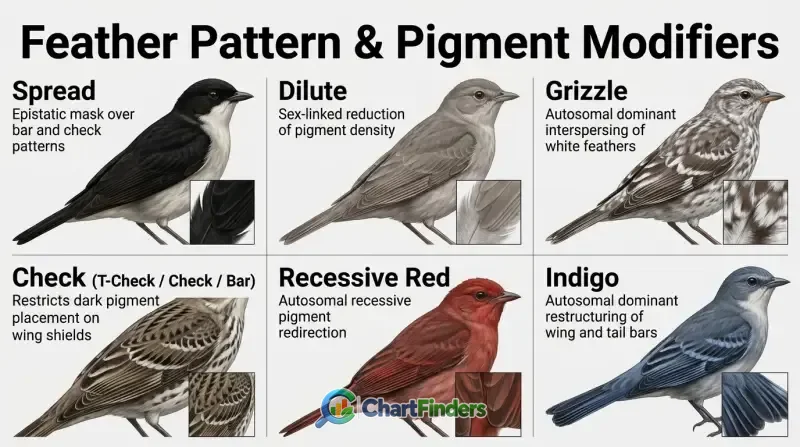
Pigeon Color Chart: Genetics, Inheritance Patterns, and Breeding Matrices
- Blue is established as the genetic wild type (ancestral baseline) for all domestic and feral pigeons.
- Pigeon color genes reside on the sex-linked Z chromosome, meaning cocks carry two alleles (ZZ) while hens carry one (ZW).
- Base colors follow a strict dominance hierarchy: Ash-Red dominates Blue, which in turn dominates Brown.
- Modifying factors like Spread, Dilute, Grizzle, and Recessive Red actively alter or mask underlying base pigments.
- Breeding charts allow fanciers to forecast precise phenotypic ratios for both male and female offspring based on parental genotypes.
At the core of avian coloration lies the interaction of two primary melanin pigments: eumelanin (which produces black, dark, and blue tones) and phaeomelanin (which produces red and brown tones). Unlike mammals, where many color traits are autosomal, pigeons rely heavily on sex-linked chromosomal inheritance. This unique biological framework dictates that a hen inherits her single Z chromosome exclusively from her sire, making sex-linked traits immediately visible in female offspring without the masking effects of hidden recessive alleles.
To master the application of a pigeon color chart, one must first categorize the foundational genetic building blocks, secondary modifiers, and pattern genes that interact to produce thousands of distinct color variations.
The Genetic Baseline: Wild Type Blue and the Base Color Hierarchy
In pigeon genetics, the ancestral wild-type color is Blue (often referred to as Blue Bar). Every domestic pigeon carries genetic material derived from this baseline. The three primary base colors form a clear dominance hierarchy:
- Ash-Red ($B^A$): The dominant allele in the series. It produces silver-ash body coloration with red bars and tail bands.
- Blue ($+$): The intermediate wild type. It produces grey-blue bodies with distinct black bars on the wing shields and a terminal tail band.
- Brown ($b$): The recessive allele at the locus. It replaces black pigment with a rich chocolate or cinnamon brown.
Because these alleles occupy the same locus on the Z chromosome, a cock (ZZ) can carry two different base colors (heterozygous) or two identical ones (homozygous), whereas a hen (ZW) only expresses whatever single base color is present on her lone paternal Z chromosome.
Modifier Genes and Pattern Alterations
Base colors rarely appear in isolation. They are constantly shaped, restricted, or intensified by modifier genes and pattern factors that dictate how melanin is distributed across the feather vane.
| Gene / Modifier | Symbol | Genetic Action | Phenotypic Effect on Blue Base |
|---|---|---|---|
| Spread | $C$ | Epistatic mask over bar and check patterns | Turns a patterned blue bird into a solid Black pigeon. |
| Dilute | $d$ | Sex-linked reduction of pigment density | Converts Black to Dun, Blue to Silver, and Ash-Red to Ash-Yellow. |
| Grizzle | $G$ | Autosomal dominant interspersing of white feathers | Adds a frosted or peppered white effect across the plumage. |
| Check (T-Check / Check / Bar) | $C^t / C / +$ | Restricts dark pigment placement on wing shields | Alters plain bars into heavily flecked checkered patterns. |
| Recessive Red | $e$ | Autosomal recessive pigment redirection | Overrides all base colors to produce a uniform deep red or yellow bird. |
| Indigo | $In$ | Autosomal dominant restructuring of wing and tail bars | Replaces standard black bars with a lustrous blue-violet sheen. |
The table above highlights how secondary genes interact with the primary pigment engine. For example, the Spread gene does not change the underlying color chemistry; rather, it forces melanin to distribute evenly across the entire wing shield, effectively hiding the underlying bar or check pattern from view.
Decoding the Pigeon Color Breeding Chart
Predicting the outcome of a mating requires tracking both the sex chromosomes (Z and W) and autosomal pairs. Because hens pass their W chromosome to female offspring without contributing to sex-linked color alleles, sons inherit color traits from both parents, while daughters receive sex-linked traits exclusively from their fathers.
Sex-Linked Inheritance Mechanics in Cocks and Hens
When analyzing a mating between a sex-linked mutation (such as Brown or Dilute) and a wild-type bird, the directional flow of chromosomes determines the sex of the resulting chicks that will display the trait.
- Hens as Carriers: A brown hen ($b/-$) mated to a pure blue-black cock ($+ / +$) will produce normal-looking daughters that carry the blue phenotype (since they receive their Z chromosome from the sire), while her sons will be split-to-brown, carrying the recessive brown gene hidden on their maternal Z chromosome.
- Cocks as Carriers: Conversely, a brown cock ($b / b$) mated to a blue hen ($+ / -$) will produce 100% brown-carrying daughters because every daughter receives her sole Z chromosome from the sire.
This asymmetrical inheritance pattern is the of auto-sexing breeds and precise loft management. Fanciers utilize these exact formulas to pre-select replacement stock for breeding programs or racing teams.
Comprehensive Breeding Outcome Matrix
The following matrix outlines expected offspring phenotypes resulting from common parental base color pairings, assuming standard homozygous or hemizygous wild-type backgrounds for simplicity.
| Sire (Male Parent) Phenotype | Dam (Female Parent) Phenotype | Expected Son (Cock) Phenotypes | Expected Daughter (Hen) Phenotypes |
|---|---|---|---|
| Blue ($+ / +$) | Blue ($+ / -$) | 100% Blue | 100% Blue |
| Ash-Red ($B^A / B^A$) | Blue ($+ / -$) | 100% Ash-Red (Carrier for Blue) | 100% Ash-Red |
| Blue ($+ / +$) | Ash-Red ($B^A / -$) | 100% Ash-Red (Carrier for Blue) | 100% Blue |
| Brown ($b / b$) | Blue ($+ / -$) | 100% Blue (Carrier for Brown) | 100% Brown |
| Blue ($+ / +$) | Brown ($b / -$) | 100% Blue (Carrier for Brown) | 100% Blue |
| Brown ($b / b$) | Brown ($b / -$) | 100% Brown | 100% Brown |
As demonstrated in the matrix, crossing a recessive sire with a dominant dam yields sexually dimorphic outcomes where daughters immediately express the paternal recessive trait, whereas sons act as heterozygous carriers.
Advanced Color Interactions and Rare Mutations
Beyond the standard base colors and simple modifiers, advanced pigeon genetics incorporates complex structural genes and pattern modifiers that create striking exhibition varieties. Understanding these rare phenotypes prevents confusion when unexpected color variations appear in the loft.
Recessive Opal and Dominant Opal
Opals alter the structural deposition of melanin in the feather barbs. Recessive Opal lightens the ground color and creates a striking contrast by turning dark wing bars into a pale, silvery-white frost. It also alters the under-down color from slate grey to a much lighter shade. Dominant Opal achieves a similar luminous effect on the wing shield, often producing a wide, triangular light patch that highlights the shoulders of the bird.
Pale and Factor Interactions
The Pale mutation acts as a milder dilution factor, lightening eumelanin without the extreme pastel effect produced by the true Dilute gene. When combined with check patterns and grizzle, pale mutations create delicate laced or frosted appearances highly prized in fancy breeds like Archangels and Oriental Frills.
Practical Application in Modern Lofts
Translating genetic theory into loft management requires systematic record-keeping. Modern pigeon racing and breeding operations integrate digital identification—such as RFID leg rings—with pedigree databases to track multi-generational color inheritance.
- Verify Parental Genotypes: Before pairing birds, examine pedigree records to identify hidden split (heterozygous) traits, such as a blue bird carrying hidden brown or dilute genes.
- Account for Sex Linkage: Remember that hens cannot carry recessive sex-linked traits in a hidden state; if a hen displays a dilute or brown phenotype, she definitely carries and expresses it.
- Isolate Test Pairs: When working with complex pattern modifiers like Spread or Grizzle, utilize test matings with wild-type blues to reveal whether a bird is homozygous or heterozygous for the dominant trait.
Common Mistakes and Genetic Misconceptions
Even experienced breeders occasionally misinterpret visual clues due to overlapping phenotypic expressions. Avoiding these common pitfalls ensures accurate breeding records:
- Confusing Phenotype with Genotype: A solid black pigeon may look uniform, but it is genetically a blue or ash-red bird modified by the Spread ($C$) gene. Removing the spread modifier reveals the underlying bar or check pattern.
- Assuming Hens Can Be Split for Sex-Linked Traits: Because hens possess only one Z chromosome, they are hemizygous. They either carry a sex-linked gene and express it, or they lack it entirely. They can never be “split” carriers for brown, dilute, or ash-red.
- Overlooking Environmental Pigment Bleaching: Sun exposure and nutritional deficiencies can cause melanin breakdown, making dark check patterns appear bronze or washed out. True genetic mutations must be verified through breeding outcomes rather than sun-bleached feathers.
Frequently Asked Questions
The wild-type color is Blue (specifically Blue Bar). This is the ancestral baseline from which all domestic and feral pigeon color variations evolved.
Because hens inherit their single Z chromosome exclusively from their father, sex-linked traits (such as brown or dilute) passed from a sire appear directly in all of his daughters. Sons, receiving a Z chromosome from both parents, will only display recessive sex-linked traits if they inherit them from both mother and father.
Yes. Because blue is dominant over brown, a cock can be heterozygous ($+ / b$), displaying normal blue plumage while carrying the recessive brown gene to pass on to his offspring. Hens cannot carry brown covertly.
The Spread gene is an epistatic modifier that forces melanin to distribute evenly across the wing shields, masking underlying bar and check patterns and turning the bird into a solid color (such as solid black or solid dun).
Juvenile pigeons possess soft baby down and first-feather plumage that frequently lacks the full intensity of adult pigmentation. As they undergo their first complete molt, permanent adult feather structures replace juvenile feathers, often revealing true base colors and pattern modifiers.
Mastering the pigeon color chart bridges the gap between art and science in avian husbandry. By understanding sex-linked inheritance, base hierarchies, and modifier interactions, fanciers can predict breeding outcomes with scientific precision and maintain healthy, vibrant loft populations.