
The decision to expand a single-cat household into a multi-cat environment is one that many feline enthusiasts contemplate with both excitement and anxiety. Watching a lonely cat sleep away the afternoon hours naturally prompts thoughts of bringing home a companion. However, felines are intensely territorial creatures with complex social structures that differ radically from pack animals like dogs. Understanding the nuanced balance between the enrichment a second cat provides and the logistical, financial, and behavioral challenges that accompany them is essential for creating a harmonious home.
When personalities align and proper management strategies are implemented, a second cat can drastically improve an indoor pet’s quality of life through mutual grooming, play, and security. Conversely, a poor match can lead to chronic stress, household marking behaviors, and physical altercations that require professional intervention or even rehoming. This guide explores the complete landscape of multi-cat ownership, weighing the advantages against the disadvantages, breaking down the financial and spatial realities, and outlining the exact steps needed to ensure success.
Evaluating the Pros And Cons Of 2 Cats in Modern Households
- Companionship: Compatible cats provide mutual play, grooming, and emotional comfort, particularly for indoor cats left alone during the day.
- Financial Impact: Veterinary, food, and supply costs scale directly with a second cat, often doubling routine expenses and increasing emergency vulnerability.
- Resource Management: Multi-cat households require strict adherence to the “N+1” rule for litter boxes, feeding stations, and resting heights to prevent resource guarding.
- Introduction Dynamics: Success is almost entirely dictated by the speed and methodology of the initial introduction; rushing this phase causes long-term territorial friction.
- Waste Maintenance: Litter box maintenance doubles in volume, necessitating dedicated cleaning systems to prevent odor buildup and behavioral litter box avoidance.
- Individual Attention: Owners must intentionally allocate one-on-one time for each cat to monitor health changes and maintain human-feline bonds.
| Dimension | One-Cat Household | Two-Cat Household |
|---|---|---|
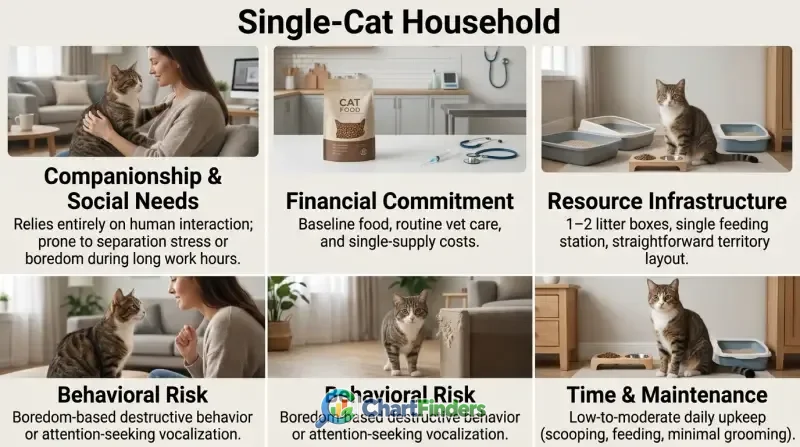
| Companionship & Social Needs | Relies entirely on human interaction; prone to separation stress or boredom during long work hours. | Provides natural feline interaction, chase play, and social grooming when personalities match. |
| Financial Commitment | Baseline food, routine vet care, and single-supply costs. | Double food/litter consumption, two routine wellness exams, and compounded emergency veterinary risk. |
| Resource Infrastructure | 1–2 litter boxes, single feeding station, straightforward territory layout. | Minimum 3 litter boxes in separated zones, multiple vertical territories, and separate feeding locations. |
| Behavioral Risk | Boredom-based destructive behavior or attention-seeking vocalization. | Territorial aggression, redirected aggression, resource guarding, and inappropriate elimination. |
| Time & Maintenance | Low-to-moderate daily upkeep (scooping, feeding, minimal grooming). | High daily upkeep (multiple boxes, complex cleaning rotations, monitoring dynamic shifts). |
The table above illustrates the foundational shift that occurs when moving from a single-cat environment to a multi-cat household. Every aspect of home management—from physical space allocation to financial budgeting—requires scaling up.
The Benefits of Owning Two Cats
When the social match is right, the advantages of a multi-cat home extend far beyond simply having double the affection. Cats are sentient beings that thrive on mental stimulation and species-specific social outlets.
Built-In Playmate and Natural Stimulation
Indoor cats frequently suffer from under-stimulation, leading to sedentary habits, obesity, and behavioral problems like furniture scratching or night waking. A compatible second cat provides a natural outlet for predatory play, wrestling, and chase games that humans cannot replicate. Watching two cats interact in mutual play offers deep psychological enrichment for the animals, keeping their minds sharp and bodies agile.
Social Support and Emotional Comfort
While cats have a reputation for independence, many form deep social bonds. Bonded pairs or well-matched companions engage in allogrooming (social grooming), sleep curled together, and provide a comforting presence when owners are away at work. This continuous companionship is especially beneficial for young, high-energy cats or social breeds that demand more interaction than a single human schedule allows.
The Challenges and Downsides of Owning Two Cats
Despite the appealing picture of two cats snuggling on a sofa, the reality of multi-cat ownership involves distinct friction points that catch many owners unprepared.
Escalating Financial Commitments
The cost of cat ownership does not simply add linearly; it multiplies across food, high-quality litter, preventative parasite treatments, and routine veterinary wellness exams. , if one cat develops a chronic condition such as diabetes, renal disease, or dental resorption, the financial strain on the household doubles relative to single-cat care.
Territorial Conflict and Behavioral Stress
Unlike dogs, who naturally form hierarchical packs, cats are solitary hunters that tolerate shared territory rather than crave it. Introducing a second cat often triggers baseline stress, manifesting as subtle bullying, blocking access to food or litter boxes, and spraying urine to mark territory. Resolving these behavioral issues often requires professional behaviorist intervention.
The Financial and Spatial Realities of Multi-Cat Homes
Before bringing a second feline into your living space, you must conduct an honest audit of your physical home and financial reserves. Cat ownership expenses go far beyond the initial adoption fee or purchase price.
Budgeting for Routine and Emergency Care
To maintain two cats in optimal health, owners must budget for double portions of premium food, treats, and veterinary preventatives. More importantly, emergency veterinary care—such as blockages, trauma, or unexpected illnesses—can easily reach thousands of dollars. Having a dedicated pet savings account or comprehensive pet insurance policy is exponentially more critical with two animals in the home.
Spatial Planning and the N+1 Rule
Space is currency in the feline world. A cramped apartment can easily become a stress chamber for two cats that cannot escape one another. Resource distribution must follow strict environmental management principles:
- Litter Boxes: The golden rule is $N+1$ boxes, where $N$ equals the number of cats. For two cats, you must provide a minimum of three litter boxes placed in separate, non-dead-end locations to prevent one cat from ambushing the other.
- Feeding Stations: Cats are vulnerable when eating. Feeding stations should be visually separated so that neither cat feels threatened or stalked while consuming their meals.
- Vertical Space: Multi-level cat trees, wall shelves, and window perches expand the usable territory of a home, allowing cats to navigate rooms without crossing paths on the floor.
Step-by-Step Introduction Methodology
The single greatest determinant of whether having two cats is a blessing or a curse is how the initial introduction is handled. Rushing the process by dropping a new cat directly into the living room is a recipe for lifelong animosity.
Phase 1: Complete Isolation and Scent Swapping
Upon arrival, the new cat must be confined to a separate “basecamp” room (such as a spare bedroom or bathroom) equipped with its own food, water, litter box, and resting spots. During the first several days, allow the cats to smell each other under closed doors without visual contact. Swap bedding between the rooms so they become accustomed to each other’s scent.
Phase 2: Visual Introduction and Controlled Exposure
Once baseline curiosity replaces overt aggression or fear at the door, introduce visual contact using a baby gate, a cracked door propped open with a doorstop, or a mesh screen. Feed both cats near the barrier simultaneously so they associate the presence of the other cat with positive experiences like delicious food.
Phase 3: Direct Supervised Interaction
Gradually allow short, supervised face-to-face sessions in neutral territory. Interrupt any mounting tension with a distractor toy before it escalates into a fight. Slowly increase the duration of these sessions over weeks—never days—until the cats can peacefully inhabit the same space.
Common Mistakes in Multi-Cat Households
Even well-intentioned owners often stumble into predictable traps that undermine household harmony. Avoiding these pitfalls saves months of behavioral rehabilitation.
- Failing to Provide Enough Resources: Providing only one large litter box or a single feeding bowl invites resource guarding and chronic anxiety.
- Punishing Aggression: Yelling at or punishing cats for hissing or swatting only increases their stress and associates the presence of the other cat with fear and human volatility.
- Ignoring Subtle Body Language: Many owners only intervene during loud fights, missing subtle signs of psychological bullying such as staring, blocking pathways, or tail flicking.
- Neglecting Individual Human Time: Assuming cats will entertain each other and reducing personal playtime leads to behavioral withdrawal and weakens the bond with the human caregiver.
Frequently Asked Questions
Yes. Kittens under six months old possess high social adaptability and lack deeply ingrained territorial instincts. They typically bond rapidly and tolerate each other with minimal friction compared to mature adult cats whose territories are firmly established.
While true lifelong hatred is rare with proper protocol, some cats will never become cuddling companions. In these cases, successful management involves “peaceful coexistence” through territory sharing, where owners use scheduled rotation or baby gates so both animals live stress-free lives without interacting.
Sex matters less than individual temperament, age, and energy levels. However, male-male pairs often engage in higher-energy wrestling, while female-female pairs can occasionally form more intense territorial rivalries if resource competition is mismanaged.
While some adaptable cats integrate within a week, most standard introductions take between two to four weeks. In cases involving fearful, traumatized, or previously abused rescues, the process can safely extend over several months.
Not necessarily. If a cat’s destructive behavior stems from lack of play, a companion can help. However, if the destruction is driven by environmental stress, anxiety, or medical issues, adding a second cat will likely exacerbate the problem rather than solve it.
Conclusion
Deciding to bring a second cat into your home is a major commitment that demands careful evaluation of your financial readiness, physical space, and personal time. When approached with patience, proper resource distribution, and a slow, methodical introduction process, two cats can enrich each other’s lives and bring immense joy to your household. However, if space is tight or resources are limited, a single, well-pampered cat remains a deeply fulfilling and responsible choice.