
Mastering raptor identification is one of the most rewarding yet challenging pursuits in birding. Unlike songbirds that can often be identified by a quick flash of color or a distinctive call, hawks and eagles demand a approach. A single species can show remarkable color morph variations, juvenile plumage looks vastly different from adult plumage, and distance or backlighting can turn a distinct field mark into a confusing silhouette. Yet, once you learn to look past the superficial colors and focus on structural geometry and biomechanics, hawk identification transforms from an intimidating guessing game into a systematic science.
This comprehensive guide provides an authoritative reference framework designed to help you decode raptors whether they are soaring high above a mountain ridge, perched silently on a roadside utility pole, or flashing through a dense woodland canopy. By understanding the core taxonomic groups, diagnostic field marks, seasonal movement patterns, and common look-alikes, you will develop the observational fluency required to identify hawks with confidence in any field condition.
Explore our detailed breakdown on Rabbit Breed Identification Chart [Full Reference Chart].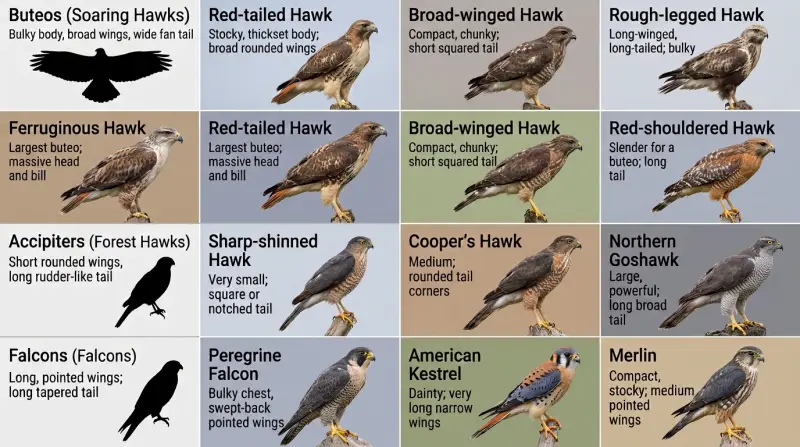
Hawk Identification Chart
- Silhouette is King: Always evaluate body shape, wing-to-body ratio, and tail length before checking plumage details.
- Buteos vs. Accipiters: Buteos are heavy-bodied soarers with wide wings and fan tails; accipiters are forest hunters with short, rounded wings and long steering tails.
- Plumage Varies: Juveniles frequently feature streaked underparts and barred tails, whereas adults often show barred underparts and solid or finely banded tails.
- Behavior Tells a Story: Soaring circles indicate buteos or vultures; rapid flap-flap-glide sequences point to accipiters or falcons; hovering usually signals American Kestrels or Rough-legged Hawks.
- Lighting Matters: Backlit birds appear as solid dark silhouettes; always reposition when possible to view underwing patterns and chest markings.
- Context is Essential: Habitat, season, and geographic flyway dramatically narrow down the statistical probability of a given species.
To establish a reliable baseline for identification, field observers must understand how North American raptors are categorized. The following master reference chart breaks down the primary groups, their physical dimensions, signature flight behaviors, and hallmark field marks.
| Group / Species | Average Size & Wingspan | Silhouette & Structure | Flight Style | Key Field Marks |
|---|---|---|---|---|
| Buteos (Soaring Hawks) | Medium to Large (34–56 in.) | Bulky body, broad wings, wide fan tail | Circles lazily on thermals; occasional flapping | Soaring posture with wings held in a shallow ‘V’ or flat plane |
| Red-tailed Hawk | 19–26 in. / 48–56 in. | Stocky, thickset body; broad rounded wings | Soars steadily; banks sharply in wind | Rusty-red tail (adults); pale chest with dark belly band |
| Broad-winged Hawk | 13–18 in. / 34–39 in. | Compact, chunky; short squared tail | Direct, purposeful flaps mixed with brief soaring | Bold black-and-white tail bands; pale underwings with dark borders |
| Rough-legged Hawk | 19–24 in. / 52–56 in. | Long-winged, long-tailed; bulky | Buoyant, slow soaring; frequently hovers | Dark wrist patches (“carpal patches”) below; feathered legs |
| Ferruginous Hawk | 22–27 in. / 53–56 in. | Largest buteo; massive head and bill | Soars with wings held in a distinct dihedral | White “V” on back formed by pale scapulars; feathered legs forming a dark “V” |
| Red-shouldered Hawk | 17–24 in. / 37–43 in. | Slender for a buteo; long tail | Soars with flat wings; circles woodlands | Reddish shoulder patches; translucent crescent “windows” near wingtips |
| Accipiters (Forest Hawks) | Small to Large (20–41 in.) | Short rounded wings, long rudder-like tail | Rapid flap-flap-glide sequence | Built for high-speed maneuverability through dense trees |
| Sharp-shinned Hawk | 10–14 in. / 20–27 in. | Very small; square or notched tail | Erratic, frantic flapping punctuated by quick glides | Square tail corners; tiny head doesn’t project past wrists |
| Cooper’s Hawk | 14–20 in. / 27–36 in. | Medium; rounded tail corners | Flap-glide; more deliberate than Sharp-shinned | Rounded tail; larger blocky head projects past wrists |
| Northern Goshawk | 20–26 in. / 40–45 in. | Large, powerful; long broad tail | Deep, powerful wingbeats; explosive speed | Blue-gray adult plumage; bold white supercilium (eyebrow stripe) |
| Falcons (Falcons) | Small to Medium (20–43 in.) | Long, pointed wings; long tapered tail | Rapid, stiff wingbeats; breathtaking stoops | Built for pure aerial speed and agility |
| Peregrine Falcon | 14–19 in. / 39–43 in. | Bulky chest, swept-back pointed wings | Very rapid, powerful wingbeats | Dark helmet pattern on face; slate-gray back |
| American Kestrel | 9–12 in. / 20–24 in. | Dainty; very long narrow wings | Hovers expertly in open country | Dual facial stripes; rusty back and tail |
| Merlin | 10–13 in. / 23–26 in. | Compact, stocky; medium pointed wings | Fast, aggressive, erratic flight | Dark-banded tail; streaked underparts; lacks kestrel’s rusty back |
The table above illustrates the foundational split in raptor morphology. As you analyze an unknown bird, always determine whether its proportions match the broad-winged soaring profile of a buteo, the compact, agile framework of an accipiter, or the streamlined, aerodynamic build of a falcon.
The Anatomy of Hawk Identification
Successful identification requires a disciplined, step-by-step observational routine. When a raptor crosses your field of view, your brain should automatically process four distinct categories of data: structure, flight mechanics, plumage details, and behavioral context.
1. Evaluating Silhouette and Structural Proportions
Structural geometry is your most reliable tool because it remains consistent regardless of lighting, age, or color morph. Consider the overall ratio between the head, body, wings, and tail.
- Buteos: Feature broad, paddle-shaped wings and a wide, relatively short fan-shaped tail. Their bodies look robust, thickset, and heavy.
- Accipiters: Exhibit short, rounded wings and a long, narrow tail that functions like a boat rudder. This cross-shaped silhouette provides maximum maneuverability in tight spaces.
- Falcons: Possess long, sharply pointed wings and a long, tapering tail. Their body build is streamlined and torpedo-like, engineered to minimize air resistance during high-speed pursuits.
2. Analyzing Flight Dynamics and Wingbeat Cadence
How a bird moves through the air reveals its ecological niche. Biomechanics dictate wing shape, and wing shape dictates flight style.
Buteos are thermal specialists. You will frequently see them lazily circling higher and higher in wide ascending spirals without flapping their wings, utilizing invisible columns of rising warm air. Conversely, accipiters rarely soar for long periods in open skies. Their signature flight pattern is a distinctive series of rapid, stiff wingbeats followed by a short, flat glide (flap-flap-glide). Falcons exhibit rapid, powerful wingbeats with pointed wingtips slicing the air, capable of explosive acceleration.
3. Decoding Plumage and Field Marks
Once you establish the structural group, zoom in on specific color patterns. Plumage features help confirm species-level identity, though you must account for age-related differences.
Many juvenile raptors feature heavily streaked chests and finely barred tails, while adults often display barred underparts, solid dark backs, or distinct tail colors (such as the rust-red of an adult Red-tailed Hawk). Look closely at key diagnostic zones: the wrist area on the underwing (carpal patches), the throat, the chest band, and the terminal band of the tail.
Detailed Breakdown of Major Raptor Groups
To deepen your field proficiency, let us examine the specific ecological behaviors and identification nuances of the three primary hawk families found across North America.
The Buteos: Masters of the Open Sky
Buteos are medium-to-large soaring hawks that dominate open country, agricultural fields, and forest edges. They feed primarily on small mammals like mice, voles, and rabbits.
The Red-tailed Hawk is North America’s most common and widespread buteo. Adults are easily recognized by their rusty-red tails, though juveniles lack this feature and instead show a finely barred brown tail and a distinct pale chest with a ragged dark belly band. The Rough-legged Hawk and Ferruginous Hawk represent the heavyweights of open western and northern wintering grounds. Both species possess feathered legs all the way down to the base of their toes—an evolutionary adaptation for extreme cold. The Rough-legged Hawk is famous for its habit of hovering over fields like a giant kestrel, while the Ferruginous Hawk boasts a massive head, heavy bill, and a striking rusty-white plumage.
The Accipiters: Stealth Hunters of the Woodlands
Accipiters are ambush predators built for navigating dense forests at high speeds. They prey primarily on small-to-medium-sized birds and tree squirrels.
Distinguishing between the Sharp-shinned Hawk and the Cooper’s Hawk is one of the classic challenges in field ornithology. Both species share identical blue-gray backs and rusty-barred underparts as adults. Identification rests on subtle structural and behavioral clues. The Sharp-shinned Hawk is roughly the size of a Blue Jay; it has a small, rounded head that does not project far past its wing wrists, a square or slightly notched tail tip, and an erratic, buoyant flight style. The Cooper’s Hawk is larger, closer to the size of a Crow; it features a larger, blocky head that projects noticeably forward during flight, a rounded tail with white corners, and a more deliberate, powerful flap-glide cadence. The Northern Goshawk is the largest accipiter—a fierce, powerful forest ghost characterized by slate-gray plumage, bold white eyebrow stripes (supercilia), and piercing red eyes in adults.
The Falcons: Precision Aerial Predators
While taxonomic classification places falcons in a separate evolutionary lineage from true hawks, birders study them alongside raptors due to overlapping ecological roles. Falcons rely on unmatched speed and aerial agility.
The Peregrine Falcon is renowned as the fastest animal on Earth, capable of exceeding 200 mph during its hunting stoop. It features dark, pointed wings, a barred tail, and a striking dark helmet or “malar stripe” contrasting against a white throat. The American Kestrel is North America’s smallest falcon, instantly recognizable by its rufous back and tail, slate-blue crown, and dual vertical black facial markings on a white cheek. The Merlin is a dark, compact, high-energy falcon that lacks the kestrel’s colorful rusty back, instead showing heavily streaked underparts and a finely banded tail.
Comparative Analysis: Key Look-Alike Dilemmas
Even experienced field researchers encounter tricky identification pairs. Resolving these challenges requires analyzing multiple micro-features simultaneously.
| Look-Alike Pair | Primary Confusion Point | Species A Diagnostic Clue | Species B Diagnostic Clue |
|---|---|---|---|
| Sharp-shinned vs. Cooper’s Hawk | Similar plumage (blue-gray back, barred breast); overlapping female/male sizes | Small head doesn’t project past wrists; tail tip squared; flight bouncy | Large blocky head projects past wrists; tail tip rounded; flight deliberate |
| Red-tailed vs. Swainson’s Hawk | Both are large soaring buteos found in open western landscapes | Stocky build; belly band; pale throat; broad rounded wings | Slender build; dark chest bib contrasting with pale belly; pointed wings |
| Merlin vs. American Kestrel | Small, compact falcons of open or edge country | Dark, streaked underparts; banded tail; lacks rufous back | Rusty-red back and tail; distinctive dual facial cheek stripes |
| Broad-winged vs. Red-shouldered Hawk | Medium-sized forest buteos with barred underparts | Stocky; short squared tail with bold black/white bands; pale underwings | Slender; long tail with narrow bands; translucent wingtip “windows” |
When reviewing the table above, note that size alone is a treacherous metric. A large female Sharp-shinned Hawk can equal the body mass of a small male Cooper’s Hawk. Therefore, structural proportions—such as head projection and tail shape—must take priority over absolute dimensions.
Step-by-Step Field Identification Framework
When you spot an unfamiliar raptor in the field, execute this four-step decision framework to narrow down your options systematically:
- Scan the Silhouette: Does the bird have broad, paddle-shaped wings (buteo), short rounded wings and a long tail (accipiter), or long pointed wings (falcon)? Eliminate two of the three major groups immediately.
- Observe the Flight Action: Is it soaring effortlessly in circles on a thermal, executing rapid flap-glide sequences through canopy gaps, or slicing the air with stiff, rapid wingbeats?
- Check the Lighting and Key Field Marks: Reposition to avoid heavy backlighting. Look for belly bands, wrist patches, tail banding patterns, and facial markings.
- Integrate Habitat and Geography: Consider your location. Are you watching a coastal migration bottleneck, an open western grassland, or an eastern deciduous forest? Match the bird to its expected ecological habitat.
Common Mistakes and Pitfalls in Raptor ID
Avoiding common observational errors will dramatically improve your identification accuracy over time.
- Relying Solely on Color: Many hawks exhibit multiple color morphs (light, dark, and intermediate). A dark-morph Red-tailed Hawk lacks the classic red tail and pale chest, often confusing novice observers who rely entirely on plumage coloration.
- Misjudging Size Without Scale: Distances in open skies distort size perception. A Cooper’s Hawk flying high overhead can easily be mistaken for a Red-tailed Hawk if structural cues are ignored. Always look for relative proportions rather than absolute size.
- Ignoring Juvenile Plumage Differences: Young raptors frequently look drastically different from their adult counterparts. Assuming all birds of a species share adult plumage leads to persistent misidentifications.
- Failing to Account for Molt: Damaged, missing, or growing flight feathers can alter tail shape and wing silhouette, making a square tail look rounded or a broad wing look pinched.
Frequently Asked Questions
The adult Red-tailed Hawk is generally considered the easiest raptor for beginners. Its bulky silhouette, soaring behavior, pale chest, and diagnostic rusty-red tail make it distinct and common across North America, providing a solid benchmark for comparison.
Examine the wingtips and tail proportions. Falcons possess long, sharply pointed wings swept back in an aerodynamic crescent with a long, tapering tail. Hawks (buteos and accipiters) feature broader, more rounded or paddle-shaped wings and wider tails designed for soaring or maneuverability rather than raw speed.
In most raptor species, males and females share nearly identical plumage, but females are noticeably larger—a phenomenon known as reverse sexual dimorphism. In species like the Cooper’s Hawk and Northern Goshawk, this size difference is so pronounced that a large female can easily be mistaken for a different species when viewed in isolation.
Soaring in circular thermal columns allows hawks to gain altitude with minimal energy expenditure. By riding invisible columns of warm, rising air, they can scan vast expanses of ground for prey or travel long distances during migration without active flapping.
Autumn (specifically September through November) is prime time for hawk watching. During this period, millions of raptors funnel along geographic bottlenecks such as mountain ridges, coastline edges, and lake shores during their southward migration, making mass counts possible at designated hawk-watch sites.
Conclusion
Hawk identification is an observational skill built upon patience, pattern recognition, and structural analysis. By moving beyond surface-level colors and anchoring your identifications in silhouette geometry, flight biomechanics, and environmental context, you open the door to a deeper appreciation of raptor biology. Whether you are tracking massive autumn migration flights along a mountain ridge or observing a solitary Kestrel hovering over a roadside pasture, applying this systematic chart framework will turn fleeting glimpses into confident, accurate identifications.