
The vast genus Ilex encompasses hundreds of species distributed worldwide, ranging from towering evergreen trees to low-growing deciduous shrubs. Because many hollies share a superficial resemblance—particularly glossy green foliage and brilliant red or yellow berries—accurate field identification can quickly become challenging for gardeners, botanists, and nature enthusiasts alike. Variations in leaf morphology, from the classic spiny-toothed Christmas holly to the smooth, spineless margins of certain Asian species and native American varieties, mean that a structured observational approach is essential.
This guide serves as an authoritative master reference for analyzing, classifying, and differentiating holly foliage. By breaking down complex botanical traits into clear diagnostic categories, examining cross-sectional structures, and highlighting subtle differences between native and cultivated look-alikes, you will gain the field expertise required to identify virtually any holly species with absolute confidence.
Explore our detailed breakdown on Sea Bean Identification Chart [Master Comparison Chart].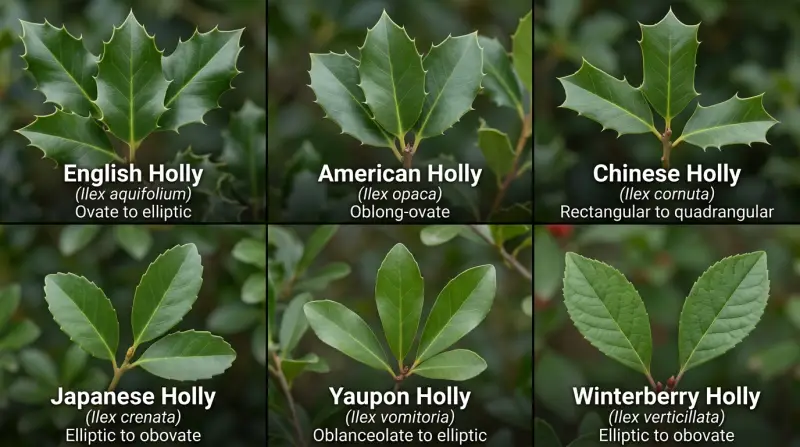
Holly Leaf Identification Chart
- Evergreen vs. Deciduous: While most commercial and iconic hollies retain leathery leaves year-round, certain species (such as Ilex verticillata) drop their non-spiny, thin leaves entirely in autumn.
- Phyllotaxy: All true hollies feature an alternate leaf arrangement along the stem, never opposite.
- Margin Diversity: Leaf edges vary dramatically from entire (smooth) and undulate to spinose (spiny) with precise numbers of teeth per side depending on the species and cultivar.
- Texture and Luster: Leaf blades are typically coriaceous (leathery), featuring a glabrous (hairless) dark-green upper surface and a paler, often matte lower surface.
- Apical Features: The leaf apex (tip) frequently terminates in a rigid terminal spine or an acuminate point crucial for taxonomic sorting.
To systematically identify a holly specimen in the field, observers must look beyond casual visual impressions and evaluate specific anatomical markers. The following comprehensive classification chart compares major holly species based on their defining foliar characteristics, growth habits, and geographic origins.
| Species / Cultivar | Leaf Shape | Margin Type & Spines | Length & Width | Texture & Luster | Key Diagnostic Features |
|---|---|---|---|---|---|
| English Holly (Ilex aquifolium) | Ovate to elliptic | Undulate, spinose (5 spines per side) | Up to 14 cm long, 8.3 cm wide | Coriaceous, dark green, glossy upper | Flat to slightly keeled cross-section; cuneate base; 2–3 mm tip spine. |
| American Holly (Ilex opaca) | Oblong-ovate | Spinose with 3–7 flat spines per side | 5–10 cm long, 2–4 cm wide | Dull to semi-glossy green, yellowish matte underside | Flat margins (not wavy); distinct thickened yellowish midrib and veins. |
| Chinese Holly (Ilex cornuta) | Rectangular to quadrangular | 3 strong spines (one terminal, two basal “horns”) | 4–9 cm long, 2–4 cm wide | Extremely thick, coriaceous, very glossy dark green | Distinctive horned appearance; very stiff, rigid blade structure. |
| Japanese Holly (Ilex crenata) | Elliptic to obovate | Crenate to serrulate (small rounded teeth) | 2–4 cm long, 1–2 cm wide | Finely textured, glossy green, glabrous | Resembles boxwood; lacks sharp spines entirely; small diminutive size. |
| Yaupon Holly (Ilex vomitoria) | Oblanceolate to elliptic | Crenate-serrate (bluntly toothed toward apex) | 1–5 cm long, 1–2.5 cm wide | Leathery, dull gray-green to medium green | Small, narrow leaves with rounded teeth; smooth lower half of blade. |
| Winterberry Holly (Ilex verticillata) | Elliptic to obovate | Serrate to doubly serrate (no spines) | 4–8 cm long, 2–4 cm wide | Thin, herbaceous (not leathery), pubescent veins below | Deciduous; leaves turn blackish upon drying in autumn. |
This reference chart illustrates the broad anatomical spectrum found within the Aquifoliaceae family. While evergreen structural models like English and American hollies dominate cultural perceptions, variations in margin architecture serve as reliable checkpoints during botanical keys.
Anatomical Foundations of Holly Foliage
Understanding the micro- and macro-anatomy of holly leaves requires examining how these plants have adapted to environmental pressures, herbivory, and seasonal shifts. Botanists rely on a precise vocabulary to describe the physical attributes of Ilex leaves.
Phyllotaxy and Stem Attachment
All members of the Aquifoliaceae family exhibit an alternate leaf arrangement. Leaves emerge individually at nodes along the stem in a spiral pattern rather than sitting opposite one another. The leaf petiole (stalk) connects the blade to the twig and can vary significantly in length—reaching up to 1.3 cm in some robust species like Ilex aquifolium. Petiole grooves and cross-sectional shapes (such as being flattened or channeled above) offer secondary clues when distinguishing closely related cultivars.
Blade Geometry and Dimensions
Holly leaf blades span several geometric categories:
- Ovate: Egg-shaped, widest below the middle.
- Elliptic: Oval, widest near the exact center, with tapering ends.
- Oblong: Longer than wide, with parallel sides for most of their length.
- Obovate: Inverted egg-shaped, widest above the middle.
Sizes range dramatically from the diminutive, boxwood-like leaves of Ilex crenata (often under 3 cm) to the expansive foliage of mature Ilex aquifolium specimens, which can measure up to 14 cm in length and over 8 cm in width.
Surface Texture, Luster, and Coloration
The upper leaf surface of evergreen hollies is almost universally coriaceous—meaning leathery, thick, and tough—and coated in a protective cuticular layer that imparts a high-gloss, reflective sheen. This adaptation minimizes moisture loss in winter winds. The underside (abaxial surface) is frequently lighter in color, appearing pale green, yellowish, or matte. Veins on the lower surface may be smooth or feature minute hairs (pubescence) depending on the species.
Margin Variations and Spinescence
The most striking visual feature of many holly leaves is their spiny margin. However, margin morphology is not uniform across the genus; it exists on a sliding scale from completely smooth to aggressively armored.
Spinose Margins
In species like Ilex opaca and Ilex aquifolium, the leaf margins are modified into sharp, prickle-like teeth known as spines. These are direct extensions of the leaf margin tissue rather than true modified stipules. In Ilex aquifolium, margins are typically undulate (wavy) in a side view, pushing spines into different planes, and feature approximately five spines per side, terminating in a prominent apical tip spine measuring 2 to 3 mm. Ilex cornuta takes spinescence to an extreme, often reducing the leaf blade to a rigid, rectangular shape dominated by three primary apical and basal spines that resemble horns.
Entire and Serrate Margins
Conversely, many valuable landscape and native hollies lack spines entirely. Entire margins are completely smooth and unbroken, as seen in certain cultivars of Dahoon holly (Ilex cassine). Crenate and serrate margins feature small, rounded or sharp teeth without the piercing needle-like quality of traditional holiday hollies. For instance, Japanese holly (Ilex crenata) features tiny, rounded teeth along its margins, earning it frequent misidentification as boxwood (Buxus species).
Deciduous vs. Evergreen Holly Foliage
A fundamental bifurcation in holly identification separates evergreen species from deciduous species. While the vast majority of hollies maintain their foliage year-round, several notable North American natives drop their leaves completely with the onset of winter dormancy.
Deciduous hollies—such as Winterberry (Ilex verticillata) and Possumhaw (Ilex decidua)—produce leaves that are notably thinner and more herbaceous than their leathery evergreen counterparts. These leaves lack the thick cuticular gloss, feature soft serrated edges, and turn a distinctive dark brown or blackish color as they dry out during autumn abscission. Identifying deciduous hollies in winter relies almost entirely on twig structure, bark texture, bud arrangement, and the persistent clusters of bright red berries left bare against the winter landscape.
Native vs. Invasive and Cultivated Species
Geographic context plays a in accurate leaf identification. Misidentifying native flora against non-native or invasive look-alikes helps preserve ecological balance and ensures appropriate landscape management.
- American Holly (Ilex opaca): Native to the eastern and south-central United States. Features flat, dull-to-semi-glossy leaves with 3 to 7 spiny teeth per side and a distinctly yellowish, prominent midrib.
- English Holly (Ilex aquifolium): Native to Europe, western Asia, and northwest Africa. Highly glossy, dark green leaves with deeply wavy (undulate) margins and robust, multi-planed spines. Widely naturalized in the Pacific Northwest of North America, where it can behave aggressively in native understories.
- Chinese Holly (Ilex cornuta): Introduced from eastern Asia. Readily identified by its quadrangular, deep-green, highly lustrous leaves that terminate in prominent horned spines with few or no lateral teeth.
Step-by-Step Field Identification Framework
When encountering an unfamiliar holly in the field or nursery, follow this sequential decision framework to determine its exact identity:
- Check Leaf Persistence: Is the plant holding green leaves through freezing winter weather? If yes, proceed to evergreen keys. If the branches are bare except for berries, examine the fallen or remaining thin leaves for serrated edges (likely a deciduous species like Winterberry).
- Examine Phyllotaxy: Confirm that the leaves attach to the stem in an alternate pattern, verifying the Aquifoliaceae family.
- Analyze Margin Structure:
- Are there sharp, piercing needle spines? (Points toward Ilex aquifolium, Ilex opaca, or Ilex cornuta).
- Are the edges smooth, rounded-toothed (crenate), or finely serrated without sharp points? (Points toward Ilex crenata, Ilex vomitoria, or Ilex glabra).
- Evaluate Leaf Surface and Cross-Section:
- Are the margins flat or wavy? Ilex opaca leaves are flat; Ilex aquifolium leaves are visibly undulate.
- Is the surface intensely glossy and dark green, or dull matte green?
- Measure Petiole and Apex: Check the length of the leaf stalk and inspect the terminal tip spine size to confirm species-level traits against standard botanical keys.
Common Identification Mistakes and Look-Alikes
Even experienced naturalists occasionally misidentify holly foliage due to convergent evolution in leaf shapes among unrelated plant families. Being aware of these pitfalls prevents common botanical errors.
Boxwood Confusion (Buxus species)
Japanese holly (Ilex crenata) is frequently mistaken for English boxwood or common boxwood due to its small, elliptic, dark green leaves and dense branching. To differentiate them, examine the leaf arrangement: hollies have alternate leaves, whereas boxwoods have strictly opposite leaves. Additionally, boxwood leaves often emit a distinctive, slightly pungent aroma when crushed.
Mahonia and Osmanthus Look-Alikes
Plants such as Oregon grape holly (Mahonia aquifolium) and false holly (Osmanthus heterophyllus) feature spiny, leathery leaves that strongly mimic true hollies.
- Mahonia: Features compound leaves (multiple leaflets arranged along a single stem axis) rather than the simple leaves characteristic of the genus Ilex, alongside bright yellow wood under the bark.
- False Holly (Osmanthus heterophyllus): Belongs to the olive family (Oleaceae) and possesses opposite leaves, instantly distinguishing it from true hollies despite its spiny, holly-like margins.
Frequently Asked Questions
No. While spiny leaves are a hallmark of iconic species like English and American holly, many species and cultivars feature entirely smooth (entire), wavy, or rounded-toothed (crenate) margins. Examples include Japanese holly (Ilex crenata), Yaupon holly (Ilex vomitoria), and inkberry holly (Ilex glabra), none of which possess sharp spines.
Native status depends strictly on your geographic location. In eastern North America, American Holly (Ilex opaca) is native, whereas English Holly (Ilex aquifolium) is an introduced European species that frequently escapes cultivation and becomes invasive in Pacific coastal forests. Always consult a regional extension office or botanical checklist for local classification.
Heterophylly—the occurrence of different leaf forms on a single plant—is common in hollies, particularly English holly. Lower branches or leaves growing in heavy shade often develop smooth, spineless margins because they face lower grazing pressure from herbivores, whereas upper, sun-exposed branches develop aggressive spines to deter browsing animals.
No. Holly plants are generally dioecious (having separate male and female plants), but foliar morphology shows no reliable sexual dimorphism. Flower inspection during the blooming season or observing fruit set in autumn remains the only accurate method for determining plant gender.
Foliar chlorosis and premature leaf drop in hollies are typically caused by environmental stress, poor soil drainage, root rot (such as Phytophthora), or high soil pH (hollies prefer acidic soils). Nutrient deficiencies, particularly in nitrogen or iron, also manifest as interveinal yellowing on otherwise glossy green leaves.
Conclusion
Mastering holly leaf identification requires moving past general impressions of “spiny green leaves and red berries” and focusing on specific anatomical markers. By systematically evaluating phyllotaxy, margin types, surface texture, cross-sectional geometry, and stem attachments, you can accurately differentiate between native varieties, cultivated hybrids, and deceptive look-alikes. Armed with this comprehensive understanding of Aquifoliaceae foliage, you can navigate complex field determinations with professional precision.