
Accurately identifying insect pests is the foundational step of effective environmental management and public health vector control. Among the myriad species of synanthropic flies that inhabit human dwellings, agricultural operations, and commercial food facilities, Musca domestica—the common house fly—remains the most ubiquitous. However, the domestic environment is rarely populated by a single fly species. Phorid flies, blow flies, flesh flies, fruit flies, and stable flies frequently co-occur indoors, sharing similar breeding substrates yet presenting vastly different biological risks, breeding sources, and structural remediation protocols. Mistaking a disease-carrying house fly for a drain-breeding phorid fly or a livestock-associated stable fly leads directly to failed control strategies.
This master guide provides a comprehensive, field-tested house fly identification chart and comparative framework. Designed for pest management professionals, public health sanitarians, facility managers, and meticulous homeowners, this resource examines the precise morphological characteristics, anatomical markers, life cycle milestones, and behavioral traits that separate the true house fly from its most common look-alikes. By moving past generalized guesswork and relying on structured morphological identification, readers can trace infestations back to their exact developmental origins and implement targeted, permanent solutions.
Explore our detailed breakdown on Rabbit Breed Identification Chart [Full Reference Chart].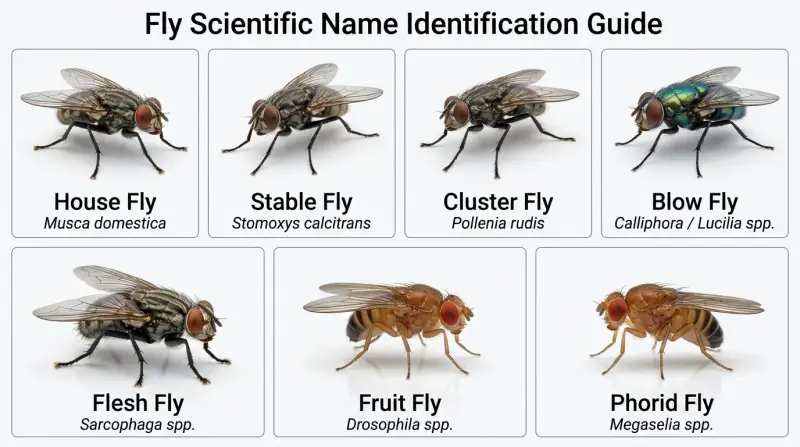
House Fly Identification Chart
- Thoracic Markings: The true house fly features exactly four dark, parallel longitudinal stripes running down the dorsal surface of its grey thorax.
- Wing Venation: The fourth longitudinal vein ($M_{1+2}$) exhibits a distinct, sharp upward bend toward the leading edge of the wing near the margin.
- Mouthparts: Adult house flies have fleshy, sponging-lapping labella designed exclusively for liquefying and consuming pre-dissolved organic matter, lacking piercing structures.
- Abdominal Coloration: The abdomen is typically yellowish-grey or buff laterally with a dark central median stripe and a checkered pattern, lacking metallic sheens.
- Crucial Look-Alikes: Stable flies look nearly identical at a glance but possess rigid, piercing-sucking mouthparts and bite painfully; cluster flies feature golden thoracic hairs and lack distinct stripes.
- Breeding Substrates: House flies require moist, fermenting organic matter such as animal manure, garbage, and decaying vegetative refuse to complete their larval development.
Systematic identification requires observing specific anatomical structures under adequate lighting or magnification. The following comprehensive reference chart delineates the key diagnostic features used by entomologists and pest management professionals to verify the identity of Musca domestica and distinguish it from its most frequent domestic competitors.
| Species (Common Name) | Scientific Name | Thoracic Characteristics | Wing Venation Clue | Abdomen Appearance | Mouthpart Type | Primary Breeding Source |
|---|---|---|---|---|---|---|
| House Fly | Musca domestica | Grey with 4 distinct, parallel black longitudinal stripes. | Fourth vein ($M_{1+2}$) bends sharply upward toward costa. | Greyish-yellow with dark median stripe and checkered pattern. | Sponging-lapping (non-biting). | Manure, garbage, decomposing organic waste. |
| Stable Fly | Stomoxys calcitrans | Grey with 4 stripes (shorter, broader) and pale spots on scutellum. | Fourth vein bends upward, but less sharply than house fly. | Greyish with dark rounded spots; checkered pattern. | Rigid, piercing-sucking proboscis (painful bite). | Wet straw, rotting hay, damp agricultural bedding. |
| Cluster Fly | Pollenia rudis | Dark olive-grey, no stripes, covered in golden-yellow crinkled hairs. | Fourth vein curves gently, not sharply angled. | Dark grey-black with irregular lighter patches (no stripes). | Sponging-lapping (non-biting). | Earthworms (parasitic larvae). |
| Blow Fly | Calliphora / Lucilia spp. | Uniform metallic blue, green, bronze, or copper; no stripes. | Fourth vein bends upward; upper calypter has hairs on upper surface. | Metallic sheen matching thorax; unpatterned. | Sponging-lapping (non-biting). | Carrion, animal carcasses, exposed meat waste. |
| Flesh Fly | Sarcophaga spp. | Grey with 3 distinct longitudinal stripes; bristly thorax. | Fourth vein bends sharply at nearly a 90-degree angle. | Checkerboard pattern of silver and black (silver checkerboard). | Sponging-lapping (non-biting). | Carrion, dung, decomposing animal matter, garbage. |
| Phorid Fly | Megaselia spp. | Small (1.5–3mm), brownish-yellow, distinctly humpbacked thorax. | Heavy veins near anterior margin; weak or absent posterior veins. | Tapered, unpatterned brown or yellowish. | Sponging (non-biting). | Drains, organic slime, sewer lines, overwatered soil. |
| Fruit Fly | Drosophila spp. | Small (2–4mm), tan to yellowish-brown, unstriped thorax, red eyes common. | Cross-vein absent; costal vein broken twice near base. | Light brown with dark transverse bands on posterior margins. | Sponging (non-biting). | Fermenting fruits, vinegars, beer, wet organic residues. |
When analyzing this chart, note that while overall body size can vary significantly due to larval nutrition and temperature fluctuations during development, structural morphology and venation remain constant. Relying on wing venation and thoracic striping patterns eliminates errors caused by size variation.
Visualizing Synanthropic Fly Prevalence
To understand the contextual distribution of indoor fly complaints, field surveys across urban and suburban residential structures indicate that while house flies represent the largest volume of outdoor nuisance complaints, interior structural invasions are frequently divided among several distinct families. The chart below illustrates the relative frequency of fly species encountered during indoor pest management service calls.
| Fly Family | Primary Representative | Estimated Indoor Encounter Rate (%) | Typical Nuisance Season |
|---|---|---|---|
| Muscidae | House Fly (Musca domestica) | 38% | Spring through Autumn (Peak Summer) |
| Calliphoridae | Blow Fly (Green/Blue Bottle) | 18% | Warm Weather / Year-round near structural entry points |
| Drosophilidae | Fruit Fly (Drosophila spp.) | 16% | Late Summer through Autumn (Year-round indoors) |
| Phoridae | Phorid / Humpbacked Fly | 14% | Year-round (Indoor breeding in plumbing) |
| Muscidae | Stable Fly (Stomoxys calcitrans) | 8% | Summer to Early Fall (Near livestock/farms) |
| Polleniidae | Cluster Fly (Pollenia rudis) | 6% | Autumn and Warm Winter Days (Overwintering) |
Anatomical Morphology of the True House Fly
Proper identification of Musca domestica requires a granular understanding of its anatomy. Divided into three distinct tagmata—head, thorax, and abdomen—the house fly exhibits highly specialized physical adaptations that enable its survival and role as a mechanical vector of human pathogens.
Head Structures and Sensory Systems
The head of the house fly is dominated by two large, reddish-brown compound eyes composed of approximately 4,000 individual ommatidia, granting a nearly 360-degree field of vision capable of detecting rapid movement. Sexual dimorphism is immediately apparent on the head:
- Males (Holoptic): The compound eyes closely approximate or touch each other at the dorsal crown of the head.
- Females (Dichoptic): The compound eyes are widely separated by a broad frons or forehead, providing space for egg-laying sensory organs.
Between the compound eyes sit three simple eyes, or ocelli, which detect light intensity changes. Projecting from the lower center of the head is the proboscis. Unlike biting flies, the house fly proboscis ends in two fleshy, spongy lobes known as the labella. These labella contain microscopic capillary grooves (pseudotracheae) that function like a sponge, secreting saliva to liquefy solid sugars, proteins, and organic residues before sucking them upward via capillary action.
Thoracic Identification Markers
The thorax is the locomotive center of the fly, bearing three pairs of jointed legs and a single pair of membranous wings. The dorsal mesonotum provides the single most reliable diagnostic marker for Musca domestica: exactly four dark, longitudinal, parallel stripes running from the anterior margin to the posterior margin against a dusty grey or yellowish background. The scutellum—the triangular plate at the rear of the thorax—features a slightly paler or yellowish margin at its tip.
The wings are clear and transparent, supported by a system of hardened veins. Entomologists place heavy diagnostic weight on the fourth longitudinal vein, designated as $M_{1+2}$ or the medial vein. In the house fly, this vein makes a distinct, sharp upward angle (nearly 45 to 60 degrees) toward the anterior margin (costa) before reaching the wing tip, nearly meeting the terminus of the third longitudinal vein. Behind the wings are two small, club-shaped balancing organs called halteres.
Abdominal Anatomy and Coloration
The abdomen is segmented, barrel-shaped, and consists of visible tergites. In typical house flies, the sides of the first, second, and sometimes third abdominal segments are yellowish or orange-buff, framing a prominent dark median longitudinal stripe that extends down the dorsal midline. The remaining posterior segments are dark grey or black with a variable checkered patterning. The abdomen of the female tapers into a telescopic, flexible ovipositor used to probe deep into organic substrates for egg deposition, while the male abdomen is broader and rounded at the terminal end.
The House Fly Life Cycle and Developmental Stages
Understanding the life cycle of Musca domestica is critical for effective management. House flies undergo complete metamorphosis (holometabolous development), progressing through four distinct biological stages: egg, larva (maggot), pupa, and adult. Under optimal summer temperatures (around 35°C or 95°F), this entire cycle can be compressed into a staggering 7 to 10 days.
1. Egg Stage
Female house flies mate shortly after emerging from the pupal case and seek out warm, moist, fermenting organic substrates rich in nitrogen for oviposition. A single female can deposit batches of 75 to 150 small, creamy-white, banana-shaped eggs measuring roughly 1 millimeter in length. Over her lifetime, one female can produce upwards of 500 to 900 eggs across 4 to 6 separate batches. Depending on ambient temperature and humidity, these eggs hatch into active larvae within 8 to 24 hours.
2. Larval Stage (Instars)
The newly hatched larva, commonly referred to as a maggot, is a cylindrical, legless, eyeless creature tapering toward the anterior head region, which features two small black mouth hooks used for feeding and tearing organic matter. The maggot passes through three distinct larval instars, growing rapidly:
- First Instar: Tiny (approx. 2mm), fragile, feeds on liquid components of the substrate.
- Second Instar: Molts, grows to roughly 5mm, possesses more heavily chitinized posterior spiracles (breathing pores).
- Third Instar: Reaches 10 to 12mm in length, creamy-white, highly active, and voracious. When ready to pupate, the third-instar larva ceases feeding and migrates away from the wet breeding medium toward a drier, cooler perimeter area.
The total larval stage lasts from 3 to 60 days depending heavily on ambient temperature, averaging 4 to 7 days in warm summer conditions.
3. Pupal Stage
Upon locating a suitable dry microenvironment (such as loose soil, beneath debris, or in dry edges of manure piles), the final larval skin hardens, darkens from yellow to deep reddish-brown or black, and contracts into a protective capsule known as the puparium. Inside this enclosed puparium, the larval tissues undergo histolysis, breaking down and reorganizing completely into adult anatomical structures. The pupal stage lasts between 3 and 6 days in warm weather, though development can pause or extend significantly during cooler ambient temperatures.
4. Adult Emergence and Maturation
When the adult transformation is complete, the fly utilizes an inflatable balloon-like sac on its head called the ptilinum. By swelling and pulsing the ptilinum with hemolymph, the adult exerts immense hydraulic pressure against the anterior cap of the puparium, forcing it open. The fly crawls upward through the soil or substrate, expands its wings, and allows its cuticle to sclerotize (harden) within a few hours. Adults live an average of 15 to 25 days under natural conditions, though availability of food, water, and shelter can extend adult longevity up to two months.
Distinguishing House Flies from Common Look-Alikes
Misidentification is the primary cause of failed fly control. Treating a home for house flies when the actual culprit is drain-breeding phorid flies or overwintering cluster flies wastes time and resources. Below is an in-depth breakdown of the most common insects mistaken for Musca domestica.
Stable Fly (Stomoxys calcitrans) vs. House Fly
Superficially, the stable fly is nearly indistinguishable from the house fly to an untrained observer. Both possess grey thoraxes with four dark longitudinal stripes. However, key differences separate them:
- Mouthparts: The stable fly features a rigid, slender, jet-black proboscis that projects horizontally forward from beneath the head like a tiny needle. Both males and females are blood-feeders and inflict a sharp, painful bite, whereas house flies possess soft, spongy mouthparts and cannot bite.
- Thoracic Markings: The four thoracic stripes on the stable fly are broader and shorter, and the central grey area often features distinct pale spots on the scutellum.
- Resting Posture: Stable flies rest with their bodies elevated at an angle relative to the surface and their wings held slightly apart (divergent), whereas house flies rest with their bodies flatter and wings overlapping parallel.
Cluster Fly (Pollenia rudis) vs. House Fly
Cluster flies are large, sluggish flies that invade homes in autumn to overwinter in wall voids and attics.
- Thoracic Features: Cluster flies possess a dark olive-grey thorax completely devoid of longitudinal stripes. Instead, the thorax is densely covered with short, crinkled, golden-yellow hairs that give it a woolly or golden sheen.
- Behavior: They do not breed in garbage, manure, or food waste; their larvae are obligate internal parasites of earthworms. Indoors, they gather in massive sluggish clusters near windows on warm winter days.
Blow Flies and Flesh Flies vs. House Fly
Large metallic or checkered flies are frequently encountered around household garbage and pet waste.
- Blow Flies (Calliphoridae): Easily recognized by their brilliant metallic coloration (shiny bottle green, blue, copper, or bronze). They lack thoracic stripes entirely and breed exclusively in carrion, dead rodents in walls, or exposed meat.
- Flesh Flies (Sarcophaga spp.): Large, robust grey flies featuring three distinct dark longitudinal stripes on the thorax (contrasting with the house fly’s four stripes) and a distinct silver-and-black checkerboard pattern on the abdomen. They deposit live larvae instead of eggs onto meat or garbage.
Phorid Flies and Fruit Flies vs. House Fly
Small flies are often misidentified as “baby house flies” (a biological impossibility, as adult flies do not grow larger after emerging from the pupal stage).
- Phorid Flies (Phoridae): Tiny (1.5–3mm), yellowish to dark brown, characterized by a noticeably humpbacked thorax and rapid, erratic running behavior across surfaces rather than flying. They breed in sewer slime, broken drain pipes, and damp organic sludge.
- Fruit Flies (Drosophilidae): Small (2–4mm) with tan bodies, prominent red eyes, and a preference for fermenting sugars, vinegars, overripe fruit, and beer residue.
Medical Importance and Pathogen Transmission
The house fly is far more than a simple nuisance; it is a significant mechanical vector capable of transmitting numerous human and animal pathogens. Because house flies feed indiscriminately on garbage, feces, sewage, and human foodstuffs, their bodies act as mobile transport vehicles for disease-causing microorganisms.
Pathogen Carriage Mechanisms
Pathogens are transmitted via three primary physical pathways:
- Exoskeletal Contamination: The body of a house fly—including its legs, feet (tarsi), wings, and body hairs—is covered in microscopic setae and adhesive pads that easily pick up bacteria, fungal spores, protozoan cysts, and viral particles from filth.
- Regurgitation (Vomiting): Because house flies can only ingest liquid food, they consume solid foods by regurgitating acidic digestive juices and crop contents onto the food source to liquefy it, then sucking the mixture back up. This leaves behind a pathogen-laden “fly speck.”
- Defecation: House flies defecate frequently, often depositing fecal droplets every few minutes while feeding or resting, contaminating surfaces with active pathogens.
Specific Diseases Associated with Musca domestica
Entomological and epidemiological studies have isolated over 100 distinct pathogenic organisms from house flies:
- Bacterial Infections: Salmonella enterica, Escherichia coli (pathogenic strains such as O157:H7), Shigella spp. (causing bacillary dysentery), Vibrio cholerae, and Campylobacter jejuni.
- Protozoan Parasites: Cysts of Giardia lamblia, Cryptosporidium parvum, and Entamoeba histolytica.
- Helminth Eggs: Eggs of parasitic nematodes and tapeworms (e.g., Ascaris lumbricoides, Trichuris trichiura, and hookworms) picked up from open latrefines or exposed manure.
- Viral Pathogens: Enteroviruses, poliomyelitis virus, and avian influenza strains.
Systematic Inspection and Identification Methodology
Eliminating a house fly infestation requires locating the exact breeding site. Adult flies seen indoors represent only a fraction of the total population; the majority of the population resides nearby as eggs, larvae, or pupae in an unseen organic breeding medium.
Step-by-Step Field Investigation Protocol
- Map Indoor Distribution: Note where adult flies congregate. High concentrations near windows indicate light attraction from resting areas, while congregations near specific appliances, garbage bins, or drain openings indicate localized feeding or breeding activity.
- Inspect Exterior Perimeters: Walk the perimeter of the structure within a 50-foot radius. Look for unsealed garbage dumpsters, pet waste accumulation zones, grass clippings mixed with soil, agricultural manure storage, or decomposing vegetative compost.
- Verify Species Morphology: Capture a representative specimen using a sticky card or vial. Examine the thorax under a hand lens (10x–20x magnification) to confirm the presence of four distinct longitudinal stripes, and check the wing for the sharp upward bend of vein $M_{1+2}$.
- Locate Larval Habitats: Probe suspect organic matter using a trowel or probe. Look for active, squirming, creamy-white third-instar maggots tunneling away from the wet core toward drier perimeter soil.
- Trace Flight Range: House flies routinely fly 1 to 2 miles from their breeding source, though they will remain within 300 feet if abundant food and shelter are immediately present. If no interior breeding source is located, expand the search radius outward.
Common Identification Mistakes and Edge Cases
Field identification is occasionally complicated by biological anomalies, environmental damage, or physical wear on older specimens. Recognizing these edge cases prevents misdiagnosis.
- Worn or Damaged Specimens: Older adult house flies that have battered themselves against walls or screens may lose thoracic bristles or have tattered wings, making the four stripes difficult to discern. Always inspect multiple specimens to ensure an accurate diagnosis.
- Nutritional Stunting: Larvae developing in overcrowded or nutrient-deficient substrates pupate prematurely, resulting in dwarf adult house flies half the normal size. Despite their small stature, their thoracic striping and wing venation remain proportioned identically to normal specimens.
- Genetic Color Variations: While rare, environmental temperature extremes during the pupal stage can occasionally produce minor variations in abdominal pigmentation, though the structural morphology of the head, antennae, and wing veins remains definitive.
Frequently Asked Questions
No. True house flies (Musca domestica) possess spongy, fleshy mouthparts (labella) designed exclusively for lapping up liquids. They lack the piercing-sucking stylets required to puncture skin. If you are experiencing painful bites from a fly indoors, the culprit is almost certainly the stable fly (Stomoxys calcitrans), which looks nearly identical to the house fly but possesses a rigid, forward-projecting proboscis.
Size, coloration, and morphology clearly separate them. House flies are robust, measure 6 to 9 millimeters in length, feature a grey thorax with four dark longitudinal stripes, and have grey-yellow abdomens. Fruit flies are tiny (2 to 4 millimeters), tan or yellowish-brown with uniform unstriped thoraxes, and frequently possess prominent bright red eyes. Fruit flies also breed strictly in fermenting liquids, whereas house flies breed in solid organic waste and manure.
No. Once an adult fly emerges from its pupal case, it never grows larger. The common misconception that tiny flies are “babies” that will grow into large house flies is biologically incorrect. Insects only grow during their larval (maggot) stage. A small adult fly is simply an adult that developed under crowded conditions or in nutrient-deficient media.
House flies are diurnal insects that rest during hours of darkness. At night, they cease active flight and congregate on ceilings, upper walls, hanging wires, light fixtures, porch structures, and outdoor vegetation close to food sources. They generally avoid cool, drafty areas and prefer warm, sheltered vertical surfaces.
Exclusion and sanitation represent the only permanent solutions. Sanitation involves eliminating all moist organic breeding media by sealing garbage in tight-fitting containers, cleaning outdoor waste receptacles weekly, removing pet waste promptly, and managing compost piles correctly. Exclusion requires maintaining intact 16-mesh window screens, installing self-closing exterior doors, and utilizing commercial air curtains over loading dock doors.
Conclusion
Accurate identification is the of sustainable structural pest management. The house fly (Musca domestica) occupies a critical intersection between structural sanitation, public health, and urban entomology. By relying on definitive morphological markers—specifically the four longitudinal thoracic stripes, the characteristic sharp upward bend of wing vein $M_{1+2}$, and sponging mouthparts—pest management professionals and property owners can decisively separate true house flies from look-alikes such as stable flies, cluster flies, blow flies, and phorid flies. Armed with this knowledge, control efforts can transition from temporary palliative treatments to permanent, root-cause structural remediation.