
Few discoveries in a garden bed or turfgrass matrix can startle a property owner quite like unearthing a massive, fleshy, C-shaped larva wriggling in the soil. While many lawn-dwelling grubs are relatively small, a subset of scarab beetle larvae grows exceptionally large, earning them the moniker of “huge white grubs.” These organisms are the subterranean juvenile stages of scarab beetles, encompassing destructive root-feeders that target everything from ornamental shrubbery and vegetable crops to pristine turfgrass systems.
Distinguishing these large larvae from one another is critical because their damage thresholds, life cycles, and management strategies vary wildly. Treating a minor population of non-pest or low-threshold grubs with heavy chemical interventions is both ecologically harmful and economically inefficient. Conversely, failing to recognize a severe infestation of multi-year root pests can result in devastating plant collapse. This master reference guide provides a definitive analytical framework, detailed morphological breakdowns, diagnostic keys, and data-backed thresholds to master the identification of huge white grubs.
Explore our detailed breakdown on Rabbit Breed Identification Chart [Full Reference Chart].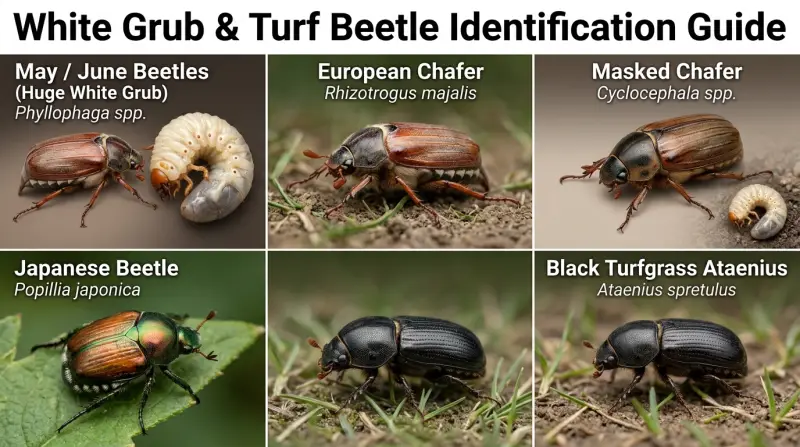
Huge White Grub Identification Chart
- Morphological Distinction: Huge white grubs (primarily May/June beetles) measure over 1 inch in length, whereas minor turf grubs (Japanese beetles, masked chafers) rarely exceed 0.5 to 0.75 inches at maturity.
- The Raster is King: Definitive species-level identification relies on examining the raster—the pattern of hairs, spines, and bare patches on the ventral side of the final abdominal segment using a hand lens.
- Life Cycle Variance: Unlike annual grubs that complete development in one year, huge white grubs often require two to three years underground, intensifying cumulative root damage.
- Damage Thresholds: True huge white grubs have low economic thresholds (3–5 per square foot) compared to smaller species like black turfgrass ataenius (30–50 per square foot).
- Ecosystem Context: Not all white grubs are destructive pests; some feed exclusively on decaying organic matter, making accurate morphological identification essential before treatment.
Identifying white grubs requires moving past general descriptions—such as “white, C-shaped, with a brown head”—and examining specific anatomical markers. The table below outlines the primary diagnostic differences between huge white grub complexes and standard turf-damaging species.
| Common Grub Group | Scientific Family / Genus | Mature Length | Life Cycle Duration | Raster Pattern (Key ID Feature) | Economic Threshold (per sq. ft.) |
|---|---|---|---|---|---|
| May / June Beetles (Huge White Grub) | Phyllophaga spp. | 1.0 – 1.5+ inches | 2 to 3 years | Two parallel rows of straight, short spines (palidia) pointing inward. | 3 – 5 grubs |
| European Chafer | Rhizotrogus majalis | 0.75 – 1.0 inch | 1 year | A “Y”-shaped anal slit with two distinct parallel rows of raster bristles converging at the base. | 5 – 8 grubs |
| Masked Chafer | Cyclocephala spp. | 0.75 – 1.0 inch | 1 year | Randomly scattered bristles with no distinct parallel rows (palidia) and a transverse anal slit. | 8 – 10 grubs |
| Japanese Beetle | Popillia japonica | 0.5 – 0.75 inch | 1 year | A “V”-shaped raster pattern formed by two rows of spines converging toward the anal slit. | 8 – 10 grubs |
| Black Turfgrass Ataenius | Ataenius spretulus | 0.25 inch (Tiny) | 1 to 2 generations/year | Extremely small; three pads surrounding the anal slit without distinct linear palidia. | 30 – 50 grubs |
This comparative baseline illustrates why size alone is insufficient for precise management. While May/June beetles clearly dominate the physical size category, distinguishing them from large European chafers requires looking closely at the posterior anatomy.
Anatomy of a White Grub: Deciphering the Key Diagnostic Zones
To use any professional white grub identification chart effectively, you must understand the insect’s gross anatomy. When examining a specimen pulled from soil or turf, field entomologists focus on three primary zones: the head capsule, the legs, and the raster.
1. Head Capsule Color and Mandibles
The head capsule provides an initial clue regarding age and family. Scarab larvae possess hard, chitinized head capsules equipped with powerful chewing mandibles.
- Coloration: Varies from light amber to dark mahogany-brown. Huge white grubs (Phyllophaga) often feature a deep, reddish-brown to dark chestnut head capsule.
- Width: The width of the head capsule increases predictably across instars (larval stages). First-instar grubs have disproportionately large heads relative to their tiny bodies, while third-instar (mature) grubs have heavy, robust head capsules capable of shearing tough woody roots.
2. Thoracic Legs
All scarab larvae possess three pairs of segmented thoracic legs located just behind the head. Leg characteristics help separate scarab pests from other soil-dwelling larvae, such as click beetle larvae (wireworms) or true crane fly larvae (leatherjackets, which lack legs entirely).
- Segmentation and Claws: True white grubs have distinct, well-developed jointed legs with tiny terminal claws.
- Raster Comparison: Some look-alikes, like dung beetle larvae, may possess reduced legs, whereas scarab pest larvae maintain strong, functional walking legs used to navigate soil pore spaces.
3. The Raster (The Ultimate Identification Tool)
The raster is located on the ventral surface of the last abdominal segment. It features a combination of bare spaces, an anal slit (transverse, longitudinal, or Y-shaped), and specialized hairs called teges and palidia.
- Anal Slit Shape: Look closely at the opening at the very tip of the abdomen. Is it a horizontal slit, a vertical line, or shaped like a letter? Masked chafers feature a transverse (horizontal) slit, while European chafers and Japanese beetles show distinct angular formations.
- Palidia: These are parallel rows of heavy, spine-like setae located anterior to the anus. In huge white grubs (Phyllophaga), the palidia are typically prominent, arranged in two distinct parallel or slightly divergent rows of short spines pointing inward toward each other. If the spines are completely random with no rows, you are likely looking at a masked chafer or a harmless dung beetle.
Major Species in the Huge White Grub Complex
The term “huge white grub” generally points to members of the genus Phyllophaga, though other large scarabs can occasionally match their physical dimensions. Understanding the biology of these specific organisms dictates how and when damage occurs.
May and June Beetles (Genus Phyllophaga)
May and June beetles represent one of the largest and most complex genera of scarab beetles, with over 200 species across North America.
- Size and Appearance: Mature larvae can reach lengths of 1.25 to 1.5 inches. They possess a prominent yellowish-white body, a dark amber-to-brown head, and a darkened posterior where soil contents show through the translucent cuticle.
- Life Cycle: Most species operate on a three-year life cycle. Adults emerge in spring (May or June) to mate and lay eggs in the soil. The eggs hatch into first-instar grubs that feed lightly on organic matter and roots. By the second year, they reach their massive second and third instars, causing severe damage to turf and plant roots. They overwinter deep in the soil profile, pupate in their third spring, and emerge as adult beetles.
- Damage Signature: Because they spend up to three years underground, populations accumulate mass and appetite. Turfgrass infested with Phyllophaga often dies in large, irregular patches that can be easily rolled back like a carpet due to complete root destruction.
The European Chafer (Rhizotrogus majalis)
While slightly smaller than the largest Phyllophaga species, mature European chafer grubs often cross into the “large grub” classification, measuring nearly a full inch in length.
- Aggressive Feeding Habit: European chafer grubs are notorious for continuing to feed late into autumn and even during mild winter thaws. This prolonged feeding schedule attracts predators like raccoons, skunks, and crows, which tear up lawns looking for a protein-rich meal.
- Raster Clue: The raster features a distinct “Y”-shaped anal opening with two parallel rows of stiff hairs (palidia) that converge at the base of the stem of the “Y”.
Masked Chafers (Genus Cyclocephala)
Often referred to as southern or northern masked chafers, these species produce annual grubs that reach approximately 0.75 to 1 inch long.
- Lack of Parallel Spines: Unlike May/June beetles or chafers, masked chafer rasters completely lack parallel rows of spines. The hairs on the raster are arranged in a random, scattered pattern with a bare rectangular patch just anterior to the transverse anal slit.
- Behavior: Adults do not feed on foliage (unlike Japanese beetles), but the larvae are aggressive turf root chewers from mid-summer through late autumn.
Distinguishing Pests from Beneficial Soil Dwellers
One of the most common and costly mistakes in turf and garden management is destroying beneficial or harmless organisms that happen to look like white grubs. Not every C-shaped white worm in the soil is a pest.
Green June Beetle Larvae (Cotinis nitida)
Green June beetle larvae are enormous—frequently reaching 1.5 to 2 inches in length—making them prime candidates for being misidentified as destructive huge white grubs. However, their habits and locomotive mechanics are entirely unique.
- Locomotion: If you place a Green June beetle grub on a flat surface, it will not crawl forward on its legs. Instead, it rolls onto its back and crawls upside down using friction from its dorsal bristles against the ground.
- Diet: Unlike root-chewing Phyllophaga, Green June beetle grubs are saprophytic; they feed primarily on decaying organic matter, compost, and thatch. While heavy populations can loosen turf roots by tunneling, they rarely cause direct root-shearing damage to healthy plants. Management is rarely required unless tunneling disrupts delicate turf seedlings.
Rhinoceros Beetles and Dung Beetles
Various other scarabaeid larvae inhabit rich garden soils, feeding on rotting wood, mulch piles, or animal dung. These beneficial decomposers recycle nutrients back into the ecosystem. Always check the raster and mouthparts: true root pests possess heavy mandibles and specific raster rows, whereas many organic-matter feeders inhabit mulch layers rather than the root zone of living turfgrass.
Data and Thresholds: When Does a Population Warrant Action?
Management decisions must never be based on finding a single grub. Healthy, established turfgrass systems naturally support a baseline population of soil insects without showing above-ground stress.
The following bar chart illustrates the stark contrast in economic damage thresholds across different white grub classifications. Higher threshold numbers mean the turf can support more grubs per square foot before showing visible damage.
| Grub Species / Group | Minimum Threshold (sq. ft.) | Maximum Threshold (sq. ft.) | Risk Level for Turf Collapse |
|---|---|---|---|
| May / June Beetles (Phyllophaga) | 3 | 5 | High (Due to large body mass & multi-year feeding) |
| European Chafer | 5 | 8 | Moderate-High |
| Japanese Beetle / Masked Chafer | 8 | 10 | Moderate |
| Black Turfgrass Ataenius | 30 | 50 | Low (Requires massive density to show damage) |
Interpretation: Because huge white grubs (May/June beetles) consume exponentially more root mass per individual due to their physical size, a threshold of just 3 to 5 grubs per square foot warrants immediate management intervention. In contrast, tiny turfgrass ataenius larvae require upwards of 30 to 50 individuals in the same area before economic damage manifests.
Step-by-Step Field Identification Procedure
When you unearth a suspicious white grub in your lawn or garden bed, execute the following diagnostic sequence to identify the specimen accurately:
- Measure the Specimen: If the larva is under 0.75 inches, it is unlikely to be a mature huge white grub (Phyllophaga). If it exceeds 1 inch, proceed to step two.
- Test Locomotion (Behavioral Check): Place the grub on a flat hard surface. Does it flip onto its back and crawl using its back? If yes, it is likely a harmless Green June beetle larva. If it crawls normally on its thoracic legs, proceed to step three.
- Inspect the Anal Slit: Use a hand lens (10x magnification) to examine the rear ventral segment. Note whether the anal slit is transverse (a horizontal bar), longitudinal, or shaped like a Y or V.
- Examine the Raster Pattern: Look for rows of bristles (palidia).
- Two parallel rows of short, inward-pointing spines with a clear gap? Likely May/June Beetle (Phyllophaga).
- Y-shaped anal slit with converging parallel rows? Likely European Chafer.
- Completely scattered bristles with no rows? Likely Masked Chafer.
- Assess Population Density: Cut a 1-foot by 1-foot square of turf to a depth of 2 to 3 inches in a yellowing area. Count all grubs found within that core. Compare your count against the economic threshold chart to determine if management is required.
Common Mistakes and Diagnostic Pitfalls
Even experienced landscapers occasionally misdiagnose subterranean pest pressures. Avoid these frequent errors:
- Confusing Grub Damage with Drought or Disease: Root loss caused by huge white grubs stops water and nutrient uptake, causing turf to wilt and turn straw-brown. However, drought stress, summer patch disease, and chinch bug damage present identical above-ground symptoms. Always inspect the soil before applying pesticides.
- Ignoring the Life Cycle Stage: Attempting to apply long-residual insecticides against mature, third-instar huge white grubs in late spring is largely ineffective because large grubs are entering their pupal stage and have stopped feeding. Timing treatments for when eggs hatch (typically mid-summer) is vital.
- Overlooking Multi-Year Overlap: Because Phyllophaga species have multi-year cycles, overlapping generations mean you may find small first-instar grubs and massive third-instar grubs in the exact same soil core simultaneously. Base your threshold calculations primarily on the larger, damaging instars.
- Failing to Use Magnification: Naked-eye identification of raster patterns is nearly impossible. Attempting to identify scarab species without at least a 10x hand lens leads to misclassification.
Frequently Asked Questions
Normal white grubs—such as Japanese beetles and masked chafers—complete their life cycle in one year and rarely exceed 0.75 inches in length. “Huge white grubs” typically refer to May and June beetle larvae (genus Phyllophaga), which grow up to 1.5 inches long, feature robust reddish-brown head capsules, and require two to three years to complete their subterranean development.
No. While huge white grubs possess strong mandibles designed for chewing tough plant roots and organic matter, they do not bite humans, livestock, or domestic pets. They are entirely subterranean and defenseless outside of curling into a defensive C-shape when exposed.
Wildlife possess an exceptional sense of smell and hearing, detecting grubs moving through the soil long before human inspection reveals them. , nocturnal predators often feed during dusk or dawn when grubs migrate closer to the thatch layer. If animals are actively rolling back your turf, a subsurface grub population is almost certainly present, even if your initial spot-check missed them.
No. While most pest scarabs damage roots, specific large larvae like Green June beetle grubs feed entirely on decaying organic matter and compost rather than living root systems. Identifying the raster pattern and checking locomotion behavior ensures you do not treat a beneficial decomposer.
The optimal window for soil sampling is late summer (August to September) when newly hatched larvae are small and actively feeding near the soil surface, or early spring before soil temperatures warm up and pests resume heavy feeding. Avoid sampling during freezing winter conditions or dry mid-summer droughts when grubs burrow deep out of reach.
Conclusion
Mastering the identification of huge white grubs transforms pest management from a guessing game into a precise, science-backed protocol. By looking past general appearances and examining diagnostic markers such as the raster pattern, anal slit geometry, physical dimensions, and locomotion habits, property managers can accurately separate destructive multi-year root pests from harmless organic decomposers. Always anchor your intervention decisions in quantitative soil sampling and economic thresholds, ensuring that your turfgrass and garden ecosystems remain resilient, balanced, and healthy.