
Quick Answer: Koi fish identification relies primarily on body conformation, skin quality, and specific color patterns (Hi, Shiro, and Sumi) distributed across recognized scale types (such as scaled, doitsu, and ginrin). Major varieties are classified into groups like Go Sanke (Kohaku, Taisho Sanshoku, Showa Sanshoku), metallic categories (Hariwake, Ogon), and patterned non-metallics (Bekko, Utsurimono, Asagi), with absolute precision requiring the trained eye of a breeder to evaluate pattern balance, color depth, and skin luster.
(Reference: Types of Koi Varieties, Classifications, and More!)Mastering the identification of Japanese Nishikigoi (colored carp) is a journey that bridges biology, art, and decades of breeding history. To the untrained observer, a pond of mixed koi may simply look like an array of colorful swimming fish. To the experienced hobbyist, breeder, or judge, every individual fish represents a precise genetic combination of pigment cells, skin layers, and structural conformation.
Explore our detailed breakdown on Rabbit Breed Identification Chart [Full Reference Chart].Identifying koi accurately requires moving beyond superficial color spotting. It demands an understanding of how colors interact, how scale variations alter light reflection, and how body shape indicates structural health and lineage. Whether you are evaluating a show-grade specimen, selecting juvenile tosai from a dealer, or simply trying to categorize the fish in your backyard pond, understanding the standardized taxonomy of koi is essential.
This comprehensive guide explores the structural elements, primary color groupings, scale variations, and advanced identification techniques used by experts. By breaking down the complex array of varieties into logical categories, you will gain the analytical framework necessary to identify virtually any koi variety with confidence.
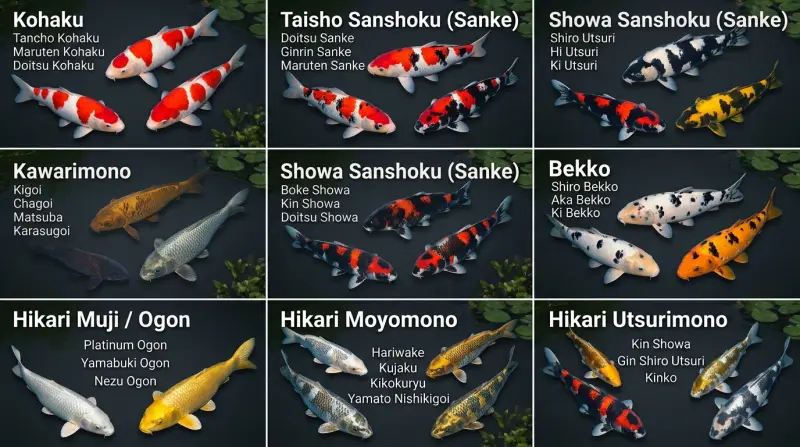
Koi Fish Identification Chart
- Koi identification is categorized primarily by color families, pattern distribution, scale type, and body conformation.
- The “Go Sanke” group—comprising Kohaku, Taisho Sanshoku, and Showa Sanshoku—represents the foundational pillars of Nishikigoi grading and identification.
- Scale variations, including traditional scalation, scaleless Doitsu, and sparkling Ginrin scales, fundamentally alter how a variety is classified.
- Juvenile koi (tosai) present unique identification challenges because patterns and skin luster shift significantly during their first few years of growth.
- Evaluating skin quality (ji) and color edge sharpness (kiwa and sashi) separates high-grade specimens from lower-tier variants within the same visual category.
The standard system of koi classification groups varieties into distinct classes based on shared genetic traits, color combinations, and breeding histories. To utilize a koi identification chart effectively, you must first understand the fundamental building blocks of koi genetics: the base colors, the scale structures, and the rules of pattern placement.
The Core Pigments and Terminology
Japanese koi nomenclature relies on precise terminology to describe colors and markings. Learning these terms is the first step toward accurate identification:
- Hi: Red or orange-red pigment. In top-grade koi, this should be deep, uniform, and saturated right down to the skin edge.
- Sumi: Black pigment. Sumi can be lacquer-like and deep or have a softer, grayish tone depending on whether it lies deep within the dermis or on the surface.
- Shiro: White pigment. High-grade Shiro should resemble clean snow without yellowish tints or muddy undertones.
- Ki / Cha / Ogon: Yellow, brown, and metallic gold/silver pigments respectively.
- Kiwa: The trailing edge of a red or black pattern patch where it meets the white skin. Crisp, clean kiwa indicates high quality.
- Sashi: The leading edge of a red pattern patch, where white scales slightly overlap the red pigment, creating a half-moon or hazy effect.
| Variety Group | Primary Colors | Defining Characteristics | Common Sub-Varieties |
|---|---|---|---|
| Kohaku | White, Red (Hi) | Pure white base skin with unbroken red markings distributed across the body. | Tancho Kohaku, Maruten Kohaku, Doitsu Kohaku |
| Taisho Sanshoku (Sanke) | White, Red, Black (Sumi) | White base with red patches and small, localized black accents. No black on the head. | Doitsu Sanke, Ginrin Sanke, Maruten Sanke |
| Showa Sanshoku (Showa) | Black (Sumi), Red, White | Black base skin with dynamic red and white pattern panels. Black wraps around the body and enters the head. | Boke Showa, Kin Showa, Doitsu Showa |
| Utsurimono | Black base with accent color | Solid black background overlaid with patches of white, red, or yellow. | Shiro Utsuri, Hi Utsuri, Ki Utsuri |
| Bekko | White, Red, or Yellow base with Black | Light base color featuring small, saddle-like black spots. No black on the head. | Shiro Bekko, Aka Bekko, Ki Bekko |
| Asagi / Shusui | Blue-grey, Red, White | Reticulated (net-like) blue-grey scales on the back with red belly and cheek accents. Shusui is the scaleless (Doitsu) version. | Asagi, Shusui, Hi Shusui |
| Kawarimono | Miscellaneous / Solid | A catch-all category for unique or newly stabilized varieties that do not fit standard color classes. | Kigoi, Chagoi, Matsuba, Karasugoi |
| Hikari Muji / Ogon | Solid Metallic (Gold, Silver, Platinum) | Monochromatic metallic sheen covering the entire body without secondary patterns. | Platinum Ogon, Yamabuki Ogon, Nezu Ogon |
| Hikari Moyomono | Multiple Metallic Colors | Metallic base skin overlaid with two or more non-black colors or patterns. | Hariwake, Kujaku, Kikokuryu, Yamato Nishikigoi |
| Hikari Utsurimono | Metallic Showa / Utsuri | A fusion of metallic sheen with Utsuri or Showa black-and-color pattern structures. | Kin Showa, Gin Shiro Utsuri, Kinko |
This reference matrix outlines the broad taxonomic structure established by the All Japan Airinkai (AJA) and the Zen Nippon Airinkai (ZNA). Within each of these major groups, individual variations and scale mutations create dozens of distinct sub-categories.
Anatomy of Identification: Scale Types and Body Conformation
Color is only the most obvious visual cue in koi identification. Beneath the surface, the physical architecture of the fish—specifically its scale mutation and body conformation—dictates its proper classification.
Scale Variations: Wagoi, Doitsu, and Ginrin
A single color pattern can appear entirely different depending on the scale type of the fish:
- Wagoi (Traditional Scales): Standard, full-scaled koi. Every scale features a defined perimeter, creating a traditional net-like or armored visual appearance across the body.
- Doitsu (German Scales): Scaleless or partially scaled koi developed by crossing German leather carp with Japanese koi. True Doitsu koi have completely smooth skin except for a neat row of large, mirror-like scales running along the dorsal fin base and lateral line.
- Ginrin (Sparkling Scales): Diamond-scaled koi. These scales feature a specialized reflective crystalline structure that catches sunlight, making the fish sparkle intensely. Ginrin scales can be bred onto almost any underlying color variety (e.g., Ginrin Kohaku or Ginrin Showa).
Body Conformation and Sexing
Conformation refers to the overall build of the koi. A high-value show koi exhibits a torpedo-like, powerful body shape with broad shoulders, a thick tail tube (peduncle), and symmetrical pectoral fins that resemble the wings of a plane. Female koi tend to develop a wider, more rounded body cavity as they mature, especially when carrying eggs, while males often maintain a sleeker, more streamlined profile with slightly larger, more pointed pectoral fins.
The Pillars of Classification: The Go Sanke Group
No koi identification chart is complete without a deep dive into the Go Sanke group. Comprising Kohaku, Taisho Sanke, and Showa Sanshoku, these three varieties dominate koi shows worldwide and represent the peak of selective breeding discipline.
Kohaku: The Red and White Standard
The Kohaku is universally recognized as the foundational variety of koi. A quality Kohaku features a pristine, porcelain-white skin base (ji) overlaid with rich red patterns (hi).
Key Identifiers: Absolutely no black pigment. The white must remain pure white without yellow tinting, and the red markings must have clean edges (kiwa*).
- Variations:
Tancho Kohaku:* A single, perfectly shaped round red spot centered on the head, with a completely white body.
Maruten Kohaku:* A red mark on the head accompanied by separate red body patterns, reminiscent of the Tancho.
Nidan / Sandan / Yondan:* Kohakus with two, three, or four distinct red pattern steps along the spine.
Taisho Sanshoku (Sanke)
Developed in the Taisho era (1912–1926), the Sanke adds small, deep black (sumi) markings to the classic Kohaku template.
- Key Identifiers: White base, red patches, and black accents. Crucially, a Sanke never has black pigment on its head. The sumi appears only as localized stepping stones on the body, often framed entirely by white skin rather than crossing over the red patches.
Showa Sanshoku (Showa)
Often confused with Sanke by beginners, the Showa is genetically distinct. While Sanke is a white fish with red and black added, Showa is a black fish with red and white markings layered over it.
Key Identifiers: A deep black (sumi*) base skin that wraps entirely around the body and extends into the pectoral fins (motoguro). Showa always feature black pigment on the head, frequently in a V-shape or sweeping mask pattern.
Metallic and Luster Varieties
The introduction of metallic sheen transformed koi breeding in the 20th century. These varieties contain guanine crystals in their skin layers, causing them to gleam under natural light.
Hikari Muji / Ogon (Solid Metallics)
Ogon are solid, monochromatic metallic koi. They serve as the backbone for many modern metallic hybrid crosses.
- Yamabuki Ogon: Bright, buttery metallic yellow.
- Platinum Ogon (Matsukawabake / Purachina): Flawless metallic silver-white.
- Nezu Ogon / Chagoi variants: Bronze, grey, or olive metallic tones.
Hikari Moyomono (Patterned Metallics)
These fish display multiple metallic colors, patterns, or net-like scalation effects.
- Hariwake: A metallic white base cleanly split by orange or yellow pattern panels.
- Kujaku: A platinum metallic base where each scale features a dark, pinecone-like center (reticulation), overlaid with orange or red patches.
Patterned Non-Metallic and Primitive Varieties
Beyond the Go Sanke and metallics lie fascinating historical varieties characterized by striking contrast, primitive scale patterns, or monochromatic earth tones.
Utsurimono and Bekko
Both groups feature black patterns, but their underlying structures differ fundamentally:
- Shiro Utsuri: A striking black-and-white fish where the black pattern is deep, glossy, and wraps around the body like a mosaic.
- Hi / Ki Utsuri: Black base with vibrant red or yellow pattern panels.
Bekko: Smaller, saddle-like black spots (sumi*) resting on a clean white, red, or yellow base. Unlike Utsuri, Bekko never have black on the head.
Asagi and Shusui
Asagi are among the oldest recognized koi varieties, featuring a distinct reticulated pattern that resembles woven netting.
Asagi: Scales on the back are pale blue-grey with dark edges, creating a net effect. The cheeks, belly, fins, and the lower edge of the body feature bright red (hi*) coloration.
- Shusui: The Doitsu (scaleless) counterpart to the Asagi. It features a clean, pale blue back with two distinct rows of large, deep blue mirror scales running alongside the dorsal fin.
Practical Identification Checklist for Pond Owners
When standing in front of a dealer’s tank or examining your own pond fish, answering these four sequential questions will allow you to correctly categorize almost any koi:
- Is the skin metallic or non-metallic? If it gleams like polished chrome, gold, or platinum, it belongs to the Hikari (metallic) groups. If it has a matte, porcelain, or satin finish, look to traditional categories.
- What is the dominant base color? Is the primary skin tone snow white, deep black, blue-grey, or solid yellow/brown? This instantly eliminates 70% of potential misclassifications.
- What scale type does the fish possess? Count the rows. Does it have full, traditional overlapping scales (Wagoi), diamond-sparkling scales (Ginrin), or smooth skin with only dorsal/lateral rows (Doitsu)?
- Where is the black (sumi) located? Check the head. If black is present on the head, consider Showa, Utsuri, or Kawarimono. If the head is completely clear of black, evaluate Sanke, Bekko, or Kohaku.
Common Identification Mistakes and Edge Cases
Even experienced hobbyists occasionally stumble over tricky identification hurdles. Understanding these edge cases prevents costly mislabeling:
- Sanke vs. Showa Confusion: The single most common mistake. Always look at the head. If there is black on the head, it is a Showa. If the head is strictly white and red, it is a Sanke. Additionally, check the pectoral fins: Showa frequently feature heavy black pigment at the joint (motoguro), while Sanke pectoral fins are typically clean white or feature very subtle, fine black stripes.
- Tosai Development Shifts: Identifying juvenile koi under six inches is notoriously difficult. A young Showa may look entirely black or muddy, while a young Kohaku may show transient yellowish hues that burn off into brilliant white as the fish matures over two to three years.
- Mud Pond Discoloration: Koi raised in natural mud ponds often develop temporary mineral staining or darkened skin tones to protect themselves from intense sunlight. A fish that looks dull or brownish in a mud pond will often clarify dramatically within a few weeks of being transferred to a clear, filtered clean-water holding tank.
Frequently Asked Questions
As koi mature (typically by age two or three), females develop a broader, heavier body profile, particularly around the abdomen when carrying eggs. Males tend to remain slender and streamlined. Additionally, mature males often develop small, rough white tubercles (breeding tubercles) on their gill covers and pectoral fins during the spring spawning season, and their pectoral fins are generally more pointed and rigid compared to the softer, more rounded fins of females.
Doitsu translates directly to “German.” Doitsu koi are scaleless or partially scaled varieties created by crossbreeding traditional Japanese scaled koi (Wagoi) with European leather carp and mirror carp imported from Germany in the late 19th century. A true Doitsu koi features completely smooth, skin-like flanks except for a neat, armored row of large mirror scales running directly along the base of the dorsal fin.
Juvenile koi undergo significant hormonal, pigmentary, and structural shifts during their first three years of life. Pigment cells (chromatophores) located deep within the dermis take time to migrate toward the surface or mature in density. Red (hi) pigments can thicken and sharpen, black (sumi) can emerge from beneath the skin or retract, and yellowish juvenile tints commonly fade into brilliant snow-white as the dermal layers thicken.
Both varieties feature black markings on a white base, but their underlying color genetics differ completely. A Shiro Utsuri is built upon a deep black base skin where white is overlaid as a secondary pattern; the black wraps extensively around the body and is prominent on the head. A Shiro Bekko is built on a clean white base with small, isolated black spots (resembling tortoise shell) resting on top like saddles, and a Shiro Bekko never has black pigment on its head.
No. Ginrin (diamond scales) is a scale mutation rather than an independent color variety. Ginrin can be bred onto almost any recognized koi category. For example, a Kohaku with sparkling diamond scales is classified as a Ginrin Kohaku, while a metallic silver-white fish with sparkling scales is a Ginrin Platinum Ogon. The term simply modifies the primary variety name to denote the reflective scale trait.
Conclusion
Accurate koi fish identification is both a structured science and a refined aesthetic discipline. By breaking down specimen characteristics into base skin colors, scale mutations, pattern distribution rules, and body conformations, you transform a confusing mix of swimming colors into an organized taxonomic system. Whether you are building a show-winning collection or simply deepening your appreciation for the inhabitants of your garden pond, observing the fine details of kiwa, sashi, and sumi unlocks the true beauty and heritage of Japanese Nishikigoi.