
Quick Answer: A Scat Identification Chart is a specialized field guide tool utilized by wildlife biologists, trackers, conservationists, and outdoor enthusiasts to identify animal species based on the physical, structural, and chemical characteristics of their droppings. Accurate identification requires synthesizing five core diagnostic pillars: shape and structure, internal contents (such as hair, bone fragments, chitin, or seeds), physical dimensions and scale, placement patterns in the immediate environment, and broader geographical and seasonal habitat context.
Interpreting wildlife sign is one of the oldest, most dependable skills in natural history and field ecology. While visual sightings of wild mammals, birds, and reptiles are often fleeting, nocturnal, or entirely absent due to cryptic behaviors, the clues they leave behind—specifically scat—remain static in the environment. These deposits record a literal biological history of an animal’s diet, digestive physiology, health status, home range, and social behavior. Whether you are managing private land, tracking regional biodiversity, conducting formal wildlife censuses, or simply trying to understand what creature has been visiting your rural property or national park campsite, learning to read animal droppings transforms an ordinary landscape into an open, highly legible book.
Modern wildlife observation has evolved far beyond traditional paper field guides. Alongside classic manuals, contemporary trackers now utilize digital identification frameworks, ecological databases, and machine-learning-assisted mobile applications to cross-reference visual data in real-time. However, technology is only as effective as the observer’s foundational knowledge. Misidentifying predator scat as herbivore sign—or confusing a domestic dog deposit with that of a native canid—can lead to flawed ecological assessments, misguided conservation management, and missed field safety precautions. This guide explores the anatomy of wildlife droppings, establishing a structured, highly rigorous framework for accurate, context-driven identification across North American and temperate ecosystems.
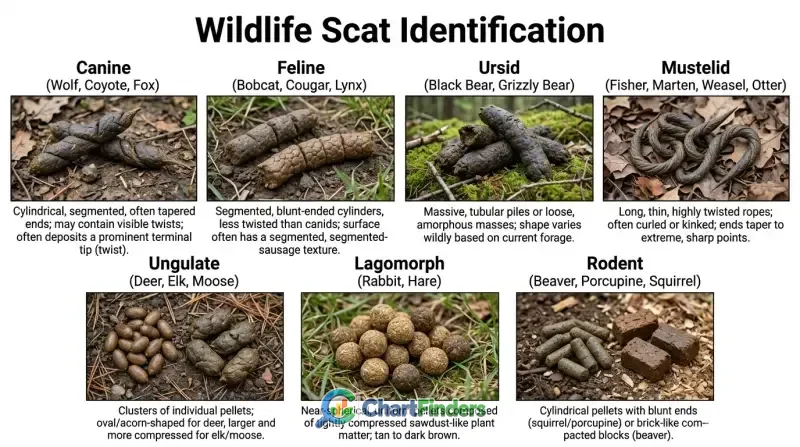
Scat Identification Chart and Field Guide Framework
- Diet Dictates Structure: Obligate carnivores produce segmented, tubular scat filled with fur and bone; herbivores produce pellet-like or fibrous masses; omnivores yield highly variable, amorphous droppings that shift dramatically with seasonal food availability.
- Context is Essential: Scat morphology can never be interpreted in isolation; elevation, geographical range, micro-habitat, and seasonal food sources must be factored into every identification to prevent false conclusions.
- Age Alters Appearance: Environmental exposure to moisture, solar UV radiation, wind, and insect activity rapidly alters the texture, color, and structural integrity of fresh droppings within days.
- Pathogen Awareness: Field safety mandates that scat should never be physically handled with bare hands due to dangerous zoonotic parasites, bacteria, and viral vectors.
- Digital Aids Supplement Experience: AI-powered applications serve as rapid triage tools in the field, but final confirmation requires cross-referencing physical dimensions, internal contents, and local ecological context.
To master wildlife tracking, one must approach scat analysis systematically. Every animal deposit is a biological snapshot dictated by digestive anatomy and metabolic requirements. Carnivores possess short, simple digestive tracts designed to process protein and fat quickly, resulting in dense, cylindrical scat that frequently twists at the ends and wraps tightly around underlying substrates like twigs or grass blades. Herbivores, possessing complex multi-chambered stomachs (ruminants) or specialized hindgut fermentation systems (such as cecal digesters), must extract nutrients from fibrous, cellulose-rich plant matter, yielding uniform pellets or compacted vegetable fiber. Omnivores inhabit the dietary middle ground, producing versatile shapes that reflect whether they are gorging on summer soft mast or scavenging winter carrion.
The following comprehensive reference matrix outlines the primary taxonomic groups, typical morphologies, diagnostic contents, deposition habits, and common look-alikes encountered in the field.
| Taxonomic Group | Primary Shape & Structure | Typical Contents | Placement & Environment | Common Look-Alikes |
|---|---|---|---|---|
| Canine (Wolf, Coyote, Fox) | Cylindrical, segmented, often tapered ends; may contain visible twists; often deposits a prominent terminal tip (twist). | Hair, bone fragments, teeth, insect exoskeleton parts, occasionally berry seeds. | Prominently displayed on trails, rocks, ridgelines, and trail junctions to mark territory. | Domestic dog scat (though dogs usually show irregular diets and lack targeted placement). |
| Feline (Bobcat, Cougar, Lynx) | Segmented, blunt-ended cylinders, less twisted than canids; surface often has a segmented, segmented-sausage texture. | Fine fur, compact bone shards; typically free of vegetable matter unless intentionally purged. | Often partially or fully buried in a shallow scrape under loose soil, pine needles, or leaf litter. | Large domestic cat deposits or chunky canine scat found on soft substrate. |
| Ursid (Black Bear, Grizzly Bear) | Massive, tubular piles or loose, amorphous masses; shape varies wildly based on current forage. | Seasonal mass: whole berries, mast (acorns), grass pulp, chewed insect parts, or hair/bone. | Found along forest trails, near feeding sites, berry patches, or at the base of large trees. | Feral hog wallows/piles or very large domestic dog waste. |
| Mustelid (Fisher, Marten, Weasel, Otter) | Long, thin, highly twisted ropes; often curled or kinked; ends taper to extreme, sharp points. | Matted fur, small mammalian skull fragments, feathers, chitin. | Elevated locations: flat rocks, fallen logs, mossy mounds, or river rocks (otter latrines). | Small feline or rodent accumulation, though mustelid scat has a distinct spiral kink. |
| Ungulate (Deer, Elk, Moose) | Clusters of individual pellets; oval/acorn-shaped for deer, larger and more compressed for elk/moose. | Finely ground vegetable fiber, woody fragments, digested leaves. | Randomly scattered or grouped on forest floors, meadows, and bedding areas. | Rabbit or hare scat (which is rounder and more fibrous-porous). |
| Lagomorph (Rabbit, Hare) | Near-spherical, uniform pellets composed of tightly compressed sawdust-like plant matter; tan to dark brown. | Woody pulp, dried grass, bark fibers. | Randomly distributed in feeding zones, beneath brush piles, or concentrated in forms. | Deer pellets (which are larger and distinctly indented/oval). |
| Rodent (Beaver, Porcupine, Squirrel) | Cylindrical pellets with blunt ends (squirrel/porcupine) or brick-like compacted blocks (beaver). | Inner bark, wood chips, seeds, green foliage. | Localized middens, tree bases, water edges, or specific toilet areas (porcupines). | Shrew or vole droppings (microscopic by comparison). |
Reading this table requires balancing visual inspection with ecological reasoning. For instance, finding a cylindrical dropping on an exposed rock trail immediately points toward a canid or a mustelid. Examining the scale—whether it measures two inches in diameter or a half-inch—narrows the candidate pool instantly from a massive gray wolf down to a diminutive red fox.
Anatomy of Scat: Deconstructing the Five Diagnostic Pillars
Accurate scat identification is rarely achieved through a single characteristic in isolation. Professional trackers and wildlife biologists use a multi-variable mental checklist to evaluate every discovery. Understanding how these five pillars interact prevents common misidentifications in the field.
1. Shape, Texture, and Consistency
The structural integrity of scat tells an immediate story about the animal’s digestive physiology and gut transit time. Predator scat is generally cohesive, segmented, and rubbery when fresh. Because meat and fat digest completely, carnivore droppings hold together in distinct tubes that often display a glossy sheen from intestinal mucus. Herbivore scat is fundamentally different; plant cell walls are composed of tough cellulose and lignin that require mechanical grinding and microbial fermentation. Because digestion of fibrous plant matter is less complete, waste emerges as discrete units (pellets) or loose, fibrous mounds. Omnivore scat shifts dramatically across seasons in response to food availability. A black bear eating lush spring grass produces cow-pie-like liquid masses, whereas the same bear feeding on autumn acorns produces dense, putty-like logs packed with intact nut hulls.
2. Internal Contents (Dietary Signatures)
Dissecting scat—safely, using a stick or specialized tool—reveals internal clues that settle taxonomic debates. Canid and feline scat frequently contain guard hairs wrapped tightly around bone fragments, acting as a natural binding agent that holds the segments together. Mustelid scat is often wrapped entirely in a felted sheath of rodent fur. Bird and reptile predators leave chalky white streaks of uric acid coating their waste due to their unique excretory systems, though mammalian carnivores lack this trait. Finding large quantities of unchewed seeds, pits, or insect carapaces points directly toward omnivores (bears, raccoons, coyotes) or specialized frugivores.
3. Dimensions and Scale
Size is a primary elimination tool, but it must be applied with extreme caution due to age, hydration status, and individual animal variation. A coyote scat can easily overlap in size with a small wolf scat or a large domestic German Shepherd deposit. Trackers must measure both total length and individual diameter. For example, bobcat scat rarely exceeds 0.75 inches in diameter, whereas a mature cougar scat routinely measures 1 inch or greater. Ungulate pellet sizes scale linearly with body mass: key deer pellets are tiny, white-tailed deer pellets are medium, elk pellets are large and cigar-shaped, and moose pellets are massive, bulbous cylinders.
4. Placement, Location, and Marking Behavior
Where an animal deposits its waste is an evolutionary strategy governed by territorial imperative, predator avoidance, and social communication. Canids deliberately select prominent landmarks—rock outcroppings, trail intersections, logs, and the exact center of dirt paths—to broadcast chemical signals via anal gland secretions deposited on or near the scat. Conversely, felines are meticulous burial artists, scratching together leaf litter and duff to hide their scent from both prey and apex competitors, leaving a visible “scrape” behind. Mustelids establish communal latrines on raised logs, boulders, or riverbanks near water sources, creating layered mounds accumulated over months or years. Understanding animal behavior instantly eliminates impossible candidates based on geography and micro-habitat.
5. Age, Weathering, and Environmental Alteration
Scat degrades rapidly upon exposure to environmental elements. A fresh dropping is moist, glossy, dark in color, and emits a potent olfactory signature. Within 24 to 48 hours, solar ultraviolet radiation turns outer layers gray or chalky white, while wind dries out the core, causing radial cracking and splitting. Rain washes away soluble compounds, and insect larvae (such as blowfly maggots, carrion beetles, and dung beetles) rapidly colonize protein-rich predator scat, hollowing it out from within. A tracker must mentally rewind the environmental clock: an old, flattened, bleached canine scat may easily be mistaken for an aged herbivore mass unless the internal bone matrix or residual hair is observed.
Detailed Profiles of Major Wildlife Families
Examining specific wildlife families reveals the subtle diagnostic markers that separate closely related species in the field.
Canids: Wolves, Coyotes, Foxes, and Domestic Dogs
Canid scat is characterized by its elongated, tubular form, twisted ends, and high concentration of hair and bone.
- Gray Wolf: Massive diameter (often exceeding 1.25 inches), long segments, heavily packed with large bone fragments and big game hair. Often found directly in the middle of active logging roads or game trails.
- Coyote: Highly adaptable in appearance, averaging 0.75 to 1 inch in diameter. Contents shift seasonally from small mammal fur and bones in winter to grasshoppers, juniper berries, and persimmons in summer. Tends to taper sharply at both ends.
- Red & Gray Fox: Significantly smaller (0.5 inches or less in diameter), highly twisted, and frequently containing insect parts, berry skins, and small rodent skulls. Foxes often deposit scat on top of small bumps, flat rocks, or tufts of grass to maximize scent dispersal.
- Domestic Dog: Highly variable due to commercial diets. Unlike wild canids, dog scat often lacks uniform tapering, appears bulky and misshapen without directional purpose, and is rarely deposited with territorial precision on prominent trail crowns.
Felines: Cougars, Bobcats, and Lynxes
Feline scat is distinguished by its segmented, blunt, cylindrical shape with minimal twisting.
- Cougar (Mountain Lion): Large (1 to 1.5 inches in diameter), segmented into distinct blocks, containing fine compacted fur and dense bone meal. Cougars almost invariably cover their scat with a scraped pile of dirt, pine needles, or duff, leaving a characteristic “scratch hill” behind.
- Bobcat & Lynx: Smaller versions of cougar scat (0.5 to 0.8 inches in diameter), segmented like links of sausage, blunt-ended, and frequently deposited near territorial boundaries or scent mounds. Like cougars, they frequently attempt burial, though winter snowpacks can occasionally prevent successful scraping.
Ursids: Black Bears and Grizzly Bears
Bear scat is defined by its sheer volume and variable consistency.
- Black Bear: Highly dependent on seasonal foraging. In spring, it appears as loose, green, fibrous piles of grass and clover. In summer, it transforms into massive, seed-and-berry-packed tubes. In autumn, it becomes pasty, sweet-smelling mast deposits rich in acorns and beechnuts.
- Grizzly Bear: Similar in composition to black bear scat but generally larger in volume. Grizzly bear scat frequently shows signs of vigorous digging activity nearby, as they utilize their powerful claws to excavate rodent middens (such as glacier lilies or ground squirrels), mixing earth directly into the waste.
Mustelids: Fishers, Martens, Otters, and Weasels
Mustelid scat is the most distinctively coiled and rope-like in the natural world.
- River Otter: Found almost exclusively in communal latrines near water bodies. Otter scat is unique because it is often composed almost entirely of compressed fish scales, fish bones, and crayfish carapaces, sometimes appearing as a dark, glistening, crushed mass rather than a clean cylinder.
- Fisher & Marten: Long, thin, highly convoluted ropes (0.25 to 0.5 inches thick) that twist into tight kinks and terminate in needle-sharp points. They are packed with porcupine quills, hair, and small mammal bones, and are preferentially deposited on elevated branches, fallen nurse logs, or flat boulders.
Practical Field Identification Methodology
When encountering an unknown dropping in the field, moving through a structured triage sequence prevents hasty misidentifications. Follow these sequential steps:
- Assess Placement and Substrate: Is it on an open trail crown, buried in a scrape, elevated on a log, or scattered randomly in a meadow? Eliminate impossible groups immediately (e.g., felines don’t poop on open trail crowns; canids don’t bury their waste).
- Measure Scale and Dimensions: Use a field ruler or a natural reference (like a coin or boot tread) to measure the diameter and segment length. Note whether it is a single continuous tube, segmented units, or a cluster of individual pellets.
- Inspect Exterior Surface and Texture: Look for twisting, tapering, glossiness, mucous coating, or fungal growth. Check if pellets are compressed together or completely spherical.
- Examine Contents Safely: Using a stick, gently probe the outer surface or break open a dried specimen. Identify whether hair, bone, chitin, seeds, or vegetable pulp dominates the matrix.
- Evaluate Regional and Seasonal Context: Factor in your geographical location, local elevation, seasonal food availability (e.g., are local berry bushes currently fruiting?), and known regional wildlife populations.
Common Mistakes, Look-Alikes, and Limitations
Even experienced trackers encounter ambiguous samples that defy easy categorization. Understanding common pitfalls prevents severe misinterpretations.
The Domestic Dog vs. Wild Canid Conundrum
The single most frequent error in wildlife tracking is misidentifying domestic dog waste as wolf or coyote scat. Commercial pet food alters the mineral and fiber content of dog feces, often giving it an irregular, nutrient-dense consistency that lacks the hair and bone matrix of wild predators. , dogs deposit waste haphazardly based on when their owners walk them, whereas wild canids exhibit deliberate territorial marking on prominent environmental features.
The Seasonality Trap
An animal’s diet shifts radically across the four seasons. A coyote feeding exclusively on grass and persimmons in late summer produces a soft, pulpy, bright orange dropping that resembles bear or raccoon sign. Relying solely on diet without evaluating structural morphology and track context leads to errors. Always cross-reference multiple identifying pillars.
Degradation and Weathering Artifacts
Rain, extreme heat, and freezing temperatures alter scat appearance within hours. A heavy downpour can dissolve the outer mucous layer of a carnivore dropping, washing away loose hair and making a canine sample look remarkably smooth and feline. Trackers must evaluate the local weather history over the preceding 72 hours before making a definitive species call.
Frequently Asked Questions
Yes. In most cases, visual inspection of placement, external shape, approximate scale, and surface texture provides enough diagnostic data for identification. When internal contents must be examined to differentiate look-alikes (such as distinguishing fox from coyote), a stick or wooden probe should be used to gently tease apart a dried specimen without direct skin contact.
Wildlife scat can harbor dangerous zoonotic pathogens, parasites, and bacteria. Notable risks include roundworms (such as Baylisascaris procyonis found in raccoons, which can cause severe neurological damage in humans), hantavirus from rodent droppings, and bacterial strains like Salmonella or E. coli from carnivore waste. Always practice strict hand hygiene and avoid disturbing dry, powdery rodent droppings in enclosed spaces without an N95 respirator.
Bear scat is notoriously variable. In spring, when bears emerge from hibernation to feed on fresh grasses, shoots, and sedges, their scat is loose, green, and cow-pie-like. In summer, heavy consumption of soft mast (berries, cherries) turns the scat dark, runny, and packed with seeds. In autumn, hard mast (acorns, beechnuts, pine nuts) produces dense, solid, putty-like logs that hold their shape and have a distinct nutty aroma.
AI-powered animal scat identification apps serve as excellent rapid triage tools for hikers and campers, offering instant suggestions based on visual machine learning. However, they are not infallible. Apps can struggle with weathered samples, unusual diets, or ambiguous sizes. They should be used to generate candidate species, which the user should then verify using physical dimensions, environmental context, and local wildlife distribution ranges.
While both produce pellet-style droppings, their structural composition and shape differ significantly. Deer pellets are slightly oval, often dimpled or pointed at one end, and composed of tightly compressed, finely ground vegetative matter. Rabbit and hare pellets are nearly spherical, slightly larger than mouse pellets, and composed of coarse, fibrous, sawdust-like plant fragments that crumble easily when dry because rabbits practice reingestion (coprophagy) to maximize nutrient extraction.
Conclusion
Mastering the art of scat identification requires patience, keen observation, and an appreciation for ecological context. By moving past the initial squeamishness associated with wildlife tracking, you unlock a profound layer of ecological literacy. Whether confirming the presence of a solitary bobcat patrolling a ridgeline, tracking seasonal bear movements through an alpine forest, or ensuring campsite safety in remote wilderness, the clues left beneath your feet tell an authentic, detailed story of the natural world.