
Accurately identifying Pacific salmon species is an essential skill for anglers, wildlife managers, commercial fishers, and conservation scientists. Because regulatory limits, conservation statuses, and commercial harvesting quotas often vary substantially by species, misidentification can lead to ecological mismanagement or legal infractions. However, telling one salmon apart from another can be genuinely challenging. As these fish transition from the pelagic ocean environment to freshwater spawning grounds, their bodies undergo dramatic morphological transformations, altering their coloration, body shape, scale retention, and even tooth structure.
(Reference: Chinook Salmon | NOAA Fisheries)This master guide provides a comprehensive framework for distinguishing salmon species across their life stages. By analyzing key morphological markers—such as spotting patterns on the back and caudal fin, the pigmentation of the mouth and gum line, scale size, and unique anatomical adaptations—you will develop a reliable methodology for field identification. Whether you are sorting catches in a commercial fishery, conducting escapement surveys, or practicing catch-and-release sportfishing, mastering these diagnostic indicators eliminates guesswork and ensures absolute certainty.
Explore our detailed breakdown on Spider Web Identification Chart: Field Data Breakdown.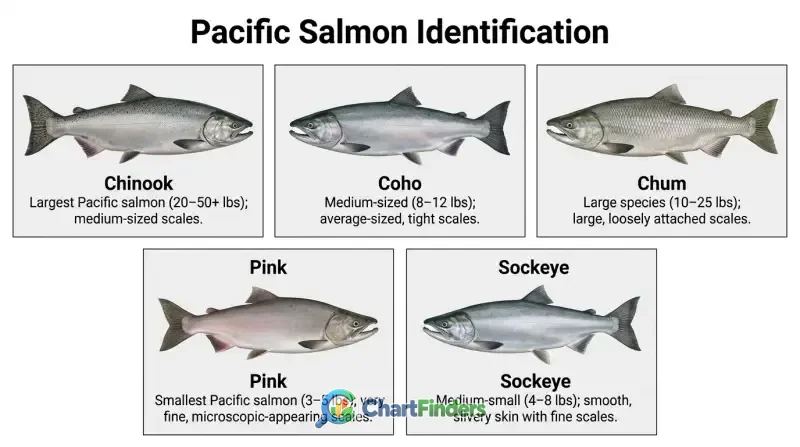
Salmon Identification Chart
- Mouth Pigmentation is Definitive: Chinook salmon possess black mouths with black gum lines, whereas Coho salmon feature white mouths and gum lines (with dark tongues).
- Tail Spotting Patterns Separate Species: Chinook have large black spots on both upper and lower lobes of the tail; Coho have spots restricted strictly to the upper lobe; Chum and Sockeye lack distinct tail spots.
- Scale Size Varies Widely: Pink salmon are characterized by exceptionally tiny, microscopic scales, while Chum and Chinook display medium-to-large scale structures.
- Spawning Transformations Alter Appearance: Ocean-phase fish are generally silvery with countershaded backs, while spawning-phase fish develop vibrant nuptial colors, hooked jaws (kypes), and humped backs.
- Ecological Context Aids ID: Knowing local run timing, river systems, typical habitat preferences, and weight ranges narrows down identification possibilities before physical examination begins.
To successfully navigate salmon identification, you must evaluate multiple characteristics simultaneously rather than relying on a single trait. Fish can exhibit natural variation within populations, making a multi-variable approach essential. The following comprehensive reference guide outlines the primary diagnostic features used by field biologists and regulatory agencies to differentiate the five major Pacific salmon species.
| Species | Common Name / Scientific Name | Gum Line & Mouth Color | Tail Spotting Pattern | Average Size & Scale Characteristics | Key Spawning Phase Traits |
|---|---|---|---|---|---|
| Chinook | King / Spring (Oncorhynchus tshawytscha) | Black mouth with a black gum line; large prominent teeth. | Large black spots on back, dorsal fin, and both upper and lower lobes of the tail. | Largest Pacific salmon (20–50+ lbs); medium-sized scales. | Dark olive to deep red-brown; heavy body, well-developed kype in males. |
| Coho | Silver (Oncorhynchus kisutch) | White mouth with a white gum line; dark tongue, medium teeth. | Black spots on the back with spots restricted only to the upper portion of the tail. | Medium-sized (8–12 lbs); average-sized, tight scales. | Bright red sides, dark backs, bright green head, pronounced hooked snout in males. |
| Chum | Dog / Keta (Oncorhynchus keta) | White mouth and gum line; fine teeth. | No distinct spots on back or tail (tail may show faint dark dusting). | Large species (10–25 lbs); large, loosely attached scales. | Striking vertical tiger-like barred stripes of purple, green, and pink; massive canine-like teeth. |
| Pink | Humpback (Oncorhynchus gorbuscha) | White mouth and gum line; dark tongue. | Large, oval-shaped black spots across the back and both lobes of the tail. | Smallest Pacific salmon (3–5 lbs); very fine, microscopic-appearing scales. | Males develop a prominent dorsal hump; pale bodies with brownish-green backs. |
| Sockeye | Red / Blueback (Oncorhynchus nerka) | White mouth and gum line; fine, small teeth. | No distinct spots on back or tail (fine speckling may rarely appear on back). | Medium-small (4–8 lbs); smooth, silvery skin with fine scales. | Brilliant fire-engine red body with a contrasting pale green-to-olive head. |
Understanding how to read this table involves assessing the specimen methodically from anterior to posterior. Begin by inspecting the interior of the mouth, then evaluate the spotting on the caudal peduncle and tail fin, and finally measure scale texture and body proportions. The following sections break down each species in exhaustive detail, contrasting their ocean-phase appearance with their spawning-phase transformations.
Detailed Species Profiles: Ocean Phase vs. Spawning Phase
Pacific salmon spend the majority of their adult lives in the open ocean or marine environments before returning to their natal freshwater streams to spawn. During their marine (ocean) phase, all species share a protective countershaded coloration: brilliant silver flanks designed to deflect predator vision, combined with a bluish-green or greenish-brown back. Once they enter freshwater, however, their physiology shifts dramatically. They stop feeding, reabsorb scales into thickened skin, develop secondary sexual characteristics, and undergo radical color shifts.
Chinook Salmon (Oncorhynchus tshawytscha)
Often referred to as King salmon, Chinook are the largest of all Pacific salmon, frequently exceeding 30 to 40 pounds, with record specimens topping 100 pounds. In the ocean, they are recognized by their robust, torpedo-shaped bodies, blue-green backs, and heavy black spotting on the back, dorsal fin, and both the upper and lower lobes of the tail. A critical diagnostic feature is the mouth: Chinook possess a black mouth cavity with a distinctly black gum line.
As Chinook enter freshwater and approach spawning grounds, their bright silver ocean coat darkens to a deep olive-brown, copper, or brick red. Spawning males develop a heavily hooked jaw, known as a kype, with large, exposed teeth, and their bodies deepen significantly at the shoulder.
Coho Salmon (Oncorhynchus kisutch)
Coho, or Silver salmon, are prized sportfish that typically range between 8 and 12 pounds. In the marine environment, they feature bright silver sides and a metallic blue-green back. They are easily confused with Chinook but can be definitively separated by two main features: their mouth has a white gum line (though the tongue may be dark), and their black spots are restricted exclusively to the upper half of the tail and back, leaving the lower tail lobe clear.
During the spawning migration, Coho transform dramatically. Their sides turn a brilliant, deep metallic red, their backs become dark blue-green, and their heads take on a dark green hue. Spawning males develop a strongly hooked snout and heavily hooked teeth, along with a distinct arched back.
Chum Salmon (Oncorhynchus keta)
Chum salmon, also known as Dog salmon or Keta, are large fish averaging 10 to 25 pounds. In the ocean phase, they have silvery sides with minimal spotting, often showing fine dark speckling along the back but no distinct spots on the tail fin. They feature relatively large, loose scales and a thick caudal peduncle.
The spawning phase of the Chum salmon is unmistakable. They develop striking, multi-colored vertical tiger stripes across their flanks in shades of purple, dark green, and maroon. , spawning males grow an intimidating set of large, canine-like teeth and hooked jaws that give them a dog-like appearance—hence their common moniker.
Pink Salmon (Oncorhynchus gorbuscha)
Pink salmon are the smallest and most abundant of the Pacific salmon, typically weighing between 3 and 5 pounds. In the ocean, they are distinguished by their bright silver flanks, lack of large scales (their scales are exceptionally fine and tiny), and large, oval-shaped black spots scattered across both lobes of the tail and the back.
Upon entering freshwater, Pink salmon undergo one of the most radical physical transformations in the animal kingdom. Spawning males develop an enormous, prominent dorsal hump just behind the head, earning them the nickname “humpies.” Their bodies turn pale grey to yellowish-white on the sides with brownish-green backs, and their jaws hook heavily.
Sockeye Salmon (Oncorhynchus nerka)
Sockeye salmon, or Red salmon, average 4 to 8 pounds and are renowned for their rich, deep red flesh. In the ocean phase, they are sleek, silvery fish with fine scales, a bluish-green back, and a complete absence of black spots on their back or tail (though very faint fine speckling may occasionally appear along the dorsal ridge).
In freshwater, Sockeye undergo a breathtaking nuptial transformation. Their entire body becomes a brilliant, uniform fire-engine red, while their head contrasts sharply by turning a pale olive-green. Spawning males develop a slight hump and a hooked jaw, making schooling groups of spawning Sockeye instantly recognizable in clear stream water.
Step-by-Step Field Identification Methodology
When you pull a salmon from the water or observe one in a shallow riffle, evaluating characteristics in a structured sequence prevents confusion and misidentification. Follow this five-step diagnostic framework:
- Inspect the Mouth and Gum Line: Open the fish’s mouth. If the gums are jet black, it is a Chinook. If the gums are white, proceed to step two.
- Examine Tail Spotting: Look closely at the caudal (tail) fin.
- Spots covering both upper and lower lobes? Check for small scales (Pink) or large size/black gums (Chinook).
- Spots restricted only to the upper lobe? It is a Coho.
- No spots on the tail at all? Proceed to step three.
- Assess Scale Size and Body Texture: Run your fingers along the flanks.
- If the scales are microscopic and nearly imperceptible, it is a Pink salmon.
- If scales are large, loose, and the fish lacks spawning colors, it is an ocean-phase Chum.
- If scales are medium-to-small and the fish is uniform silver with no spots, it is likely an ocean-phase Sockeye.
- Evaluate Spawning Coloration and Patterns: If the fish is in freshwater and showing nuptial colors:
- Vertical multi-colored tiger stripes and large canine teeth indicate a Chum.
- A massive dorsal hump and pale sides indicate a male Pink.
- A brilliant red body with a green head indicates a Sockeye.
- Deep red sides with dark backs and white gums indicate a Coho.
- Heavy, dark-reddish brown bodies with black gums indicate a Chinook.
- Check Contextual Clues: Consider the geographic location, river system, and run timing. For instance, Pink salmon run heavily in odd-numbered years in many Pacific Northwest river systems, while Sockeye are almost always associated with lake-drainage river basins.
Common Identification Mistakes and Edge Cases
Even experienced anglers and researchers occasionally encounter tricky specimens that defy quick categorization. Being aware of common pitfalls helps maintain high identification accuracy.
Mistake 1: Confusing Ocean-Phase Chinook and Coho
Both juvenile and adult ocean-phase Chinook and Coho feature silver bodies and black spots. An angler seeing spots on the back might assume they have a Chinook. However, failing to check the lower gum line or the tail spotting pattern leads to misidentification. Always check the lower gum line (black for Chinook, white for Coho) and whether spots extend below the lateral line onto the lower tail lobe.
Mistake 2: Assuming Spawning Colors are Uniform
As salmon progress through their freshwater spawning migration, their external appearance degrades. Fungus growth, skin thickening, and fading colors can obscure spotting patterns and gum pigmentation. In advanced stages of spawning decay, gum lines can become stained or discolored, and spotting can become masked by dark melanistic skin pigmentation. Whenever possible, rely on multiple secondary traits (such as body depth, tooth structure, and scale size) rather than relying on a single fading marker.
Mistake 3: Overlooking Jack Salmon Variations
“Jacks” are precocious male salmon that return to freshwater after spending only one year in the ocean. Because they are sexually mature at a fraction of the adult size (sometimes weighing only 1 to 3 pounds), they are frequently mistaken for smaller species like Pinks or Sockeye. A Chinook jack still possesses black gum lines, and a Coho jack still features upper-tail spotting and white gums. Always inspect anatomical markers regardless of the fish’s physical size.
Frequently Asked Questions
If the tail is damaged or obscured, rely on the mouth cavity and gum line. Chinook salmon have a black mouth with a jet-black gum line. Coho salmon have white gums and a white mouth cavity, though their tongue may have dark pigmentation. Additionally, Chinook generally have larger, more prominent teeth.
Generally, adult Sockeye and Chum salmon have no distinct black spots on their backs or tail fins. While a faint, fine speckling may occasionally appear along the dorsal ridge of a Sockeye, they lack the prominent, well-defined black spots found on Chinook, Coho, and Pink salmon.
When Pacific salmon migrate from marine environments into freshwater rivers to spawn, their endocrine system triggers massive hormonal changes. They stop feeding entirely and redirect their energy toward reproduction. The silvery guanine crystals in their skin are reabsorbed, revealing underlying pigments that create vibrant nuptial coloration designed to attract mates and signal dominance.
During the ocean phase, Pink salmon are best identified by their exceptionally fine, microscopic scales and large oval-shaped spots across both lobes of the tail. During the spawning phase, males are instantly recognizable by the massive, prominent dorsal hump on their back.
Yes. All five primary Pacific salmon species (Chinook, Coho, Chum, Pink, and Sockeye) are semelparous, meaning they spawn only once in their lifetime and die shortly thereafter. Their decomposing carcasses play a vital ecological role, returning marine-derived nutrients back into freshwater riparian ecosystems.
Mastering salmon identification requires patience, attention to detail, and a firm grasp of diagnostic anatomy. By methodically evaluating gum pigmentation, tail spotting, scale texture, and seasonal phase transformations, you can approach any salmon encounter with complete confidence and accuracy.