
Encountering a scorpion in and around a Southwestern home instantly triggers a mix of caution and curiosity. With more than forty species inhabiting the state of Arizona alone, homeowners and outdoor enthusiasts frequently face the challenge of determining whether a sighting represents a minor nuisance or a genuine medical emergency. Because most arachnids look menacing in dim light, relying on a structured scorpion identification chart is the most reliable way to cut through panic and evaluate real risk.
Accurate identification requires looking beyond mere size or color. Two scorpions of identical length can possess vastly different venom profiles depending on their evolutionary lineage. While the vast majority of scorpion stings result in localized pain, swelling, and temporary numbness comparable to a wasp sting, a small subset of species—most notably the bark scorpion—possesses neurotoxic venom capable of inducing systemic reactions, particularly in young children, pets, and elderly individuals. Mastering the diagnostic markers outlined in a field identification chart allows residents to implement targeted pest control, respond appropriately to stings, and eliminate unnecessary anxiety during seasonal encounters.
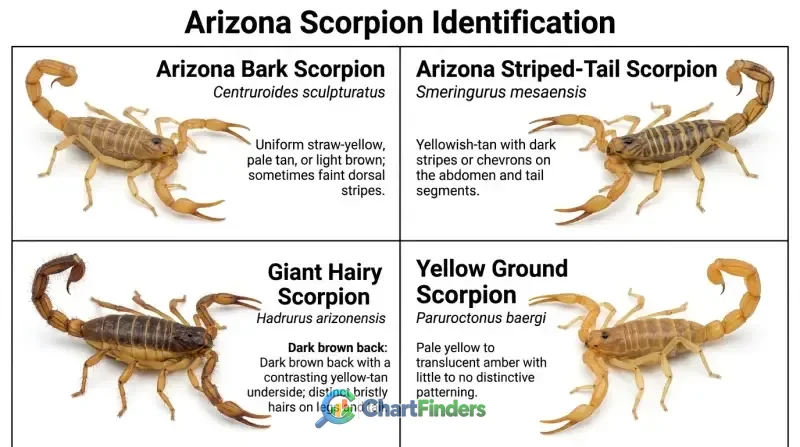
Scorpion Identification Chart
- Medical Significance vs. Harmlessness: Only a small fraction of scorpion species possess venom capable of causing severe systemic medical emergencies in humans.
- Pincer Proportions Matter: Slender, delicate pincers generally indicate neurotoxic bark scorpions, whereas thick, robust pincers point toward digging or generalist species with milder venom.
- The Sub-Aculeal Tubercle: The definitive morphological marker separating the Arizona bark scorpion from look-alikes is the small spine located directly beneath the stinger.
- Habitat and Posture Clues: Bark scorpions are exceptional climbers found on vertical surfaces, while giant hairy and striped-tail scorpions are typically ground-dwellers preferring burrows or debris.
- Ultraviolet Detection: All scorpions fluoresce a vibrant blue-green under UV (blacklight) illumination due to chemicals in their exoskeleton, making night inspections highly effective.
To use an identification chart effectively, observers must examine specific physical traits under proper lighting, ideally combining natural light with a UV inspection light. The following diagnostic matrix details the most common Southwest scorpion species encountered by residents, contrasting their size, coloration, morphological structures, and medical implications.
| Species Name | Average Adult Size | Pincer Morphology | Color & Markings | Key Diagnostic Feature | Medical Significance |
|---|---|---|---|---|---|
| Arizona Bark Scorpion (Centruroides sculpturatus) | 2.0 to 3.0 inches | Very thin, long, and slender | Uniform straw-yellow, pale tan, or light brown; sometimes faint dorsal stripes | Tiny spine (sub-aculeal tubercle) under the stinger; tail carried curled over the back | High (Medically Significant): Neurotoxic venom causes severe pain, numbness, and potential systemic symptoms. |
| Arizona Striped-Tail Scorpion (Smeringurus mesaensis) | 2.2 to 3.5 inches | Broad, stout, and moderately bulky | Yellowish-tan with dark stripes or chevrons on the abdomen and tail segments | Dense granular texture on tail segments; heavy build; prefers sandy soils | Low (Mild): Sting is painful and locally irritating, similar to a bee sting, but rarely dangerous. |
| Giant Hairy Scorpion (Hadrurus arizonensis) | 4.0 to 5.5 inches | Large, thick, and powerful | Dark brown back with a contrasting yellow-tan underside; distinct bristly hairs on legs and tail | Largest scorpion in North America; hairy appearance under magnification | Low (Mild): Painful due to sheer size and mechanical tissue damage, but venom toxicity is low. |
| Yellow Ground Scorpion (Paruroctonus baergi) | 1.5 to 2.2 inches | Average thickness, typical of ground dwellers | Pale yellow to translucent amber with little to no distinctive patterning | Smooth carapace; lacks dark banding; frequently mistaken for small bark scorpions | Low (Mild): Stings cause localized burning and redness that resolves quickly without medical intervention. |
When reviewing the table above, note that size alone is a deceptive metric. Immature bark scorpions can be quite small, while adult ground-dwelling species are considerably larger yet substantially less dangerous. Structural proportions—specifically the width of the chelae (pincers) relative to the metasoma (tail segments)—offer the most reliable anatomical separation points.
Anatomical Foundations of Scorpion Identification
Understanding scorpion morphology removes the guesswork from field identification. Every scorpion shares a uniform body plan divided into two main tagmata: the cephalothorax (prosoma) and the abdomen (opisthosoma), which further splits into a wide mesosoma and a narrow, five-segmented metasoma ending in the telson.
Cephalothorax and Eyes
The cephalothorax houses the central median eyes and a cluster of smaller lateral ocelli along the anterior corners. While scorpions possess poor visual acuity—relying instead on tactile hairs (setae) and slit sensilla to detect vibrations in the substrate—the arrangement of their eyes helps taxonomists verify family groups. The carapace surface may be smooth, granular, or tuberculate, providing friction and structural integrity.
Pincers (Pedipalps)
Pedipalps serve a dual purpose: capturing prey and defending against predators. The morphology of the pincer hand (chela) and fingers reflects the hunting strategy of the species:
- Slender Pincers: Species like the bark scorpion rely heavily on neurotoxic venom rather than crushing force to subdue agile prey (such as crickets and roaches). Their delicate pincers are optimized for lightning-fast grabs rather than holding heavy prey down.
- Robust Pincers: Burrowing and ground-dwelling scorpions feature heavy, muscular pincers capable of crushing hard-shelled beetles, spiders, and other desert invertebrates.
The Telson and Stinger
The telson consists of the bulbous vesicle (venom gland housing) and the aculeus (the hypodermic stinger). The presence or absence of a sub-aculeal tubercle—a tiny projection or spine located right at the base of the stinger—is the definitive diagnostic hallmark used by entomologists to identify members of the Centruroides genus.
Detailed Profiles of Common Southwest Species
To deepen identification skills, examining individual species profiles reveals how behavioral patterns complement physical markers.
1. Arizona Bark Scorpion (Centruroides sculpturatus)
The bark scorpion is the crown jewel of medical concern in the American Southwest. Unlike most ground-dwelling scorpions that wander aimlessly, bark scorpions are exceptionally agile climbers equipped with microscopic tarsal claws that allow them to scale vertical walls, stucco, drywall, and ceilings. When resting, they typically flatten their bodies against surfaces and curl their tails to one side rather than holding them flat. Their bodies are uniformly pale, lacking the bold dorsal striping seen in striped-tail species.
Behavioral Warning: Bark scorpions are social during winter months, occasionally aggregating in groups of twenty to thirty individuals beneath bark, rocks, or inside wall voids. This gregarious nature explains why homeowners who find one bark scorpion frequently discover several more nearby.
2. Arizona Striped-Tail Scorpion (Smeringurus mesaensis)
As the most frequently encountered large scorpion in desert residential developments, the striped-tail scorpion is built for excavation. It features robust pincers and a thick, granular tail marked by dark chevrons or longitudinal stripes. Unlike bark scorpions, striped-tails cannot climb smooth vertical surfaces well and are usually found wandering across floors, patios, or walking paths at night. Their venom is relatively mild, producing localized discomfort that subsides within a few hours.
3. Giant Hairy Scorpion (Hadrurus arizonensis)
Easily recognized by its impressive size—often exceeding four inches—the giant hairy scorpion is a majestic desert dweller. Its back is a rich, dark olive-brown, while its legs and underside are covered in dense, microscopic hairs that give it a frosted or velvety appearance. These hairs help detect air currents and humidity gradients in deep underground burrows. Though their size inspires fear, their sting is less potent than a honeybee sting, and they prefer to flee or display defensive postures rather than strike.
Diagnostic Checklist and Step-by-Step Identification Process
When an unexpected scorpion appears in the living room, garage, or patio, following a structured evaluation process ensures safety while identifying the animal accurately.
- Safety First: Never attempt to handle or pin a live scorpion with bare hands. Use long tongs, a jar, or a container if capturing it for inspection or removal.
- Examine Pincer Width: Look at the pedipalps. Are they thread-thin and delicate like a toothpick (suggesting a bark scorpion), or thick and robust like a crab claw (suggesting a striped-tail or hairy scorpion)?
- Inspect Tail Posture and Color: Observe how the tail rests. Does it curl tightly over the back or rest flat? Check for distinct dark stripes or a uniform straw-yellow hue.
- Check for the Sub-Aculeal Tubercle: Using a magnifying glass or macro camera lens, examine the base of the stinger. If a distinct small spine is visible beneath the curved tip, confirm it as a bark scorpion.
- Evaluate Climbing Ability and Location: Was the specimen found high up on a wall, ceiling, or upper doorframe? If yes, the probability of it being a bark scorpion increases significantly.
Common Identification Mistakes and Pitfalls
Even experienced homeowners fall prey to persistent myths and visual misinterpretations when attempting scorpion identification.
- Assuming All Small Scorpions Are Bark Scorpions: Immature scorpions of almost any species are small. Evaluating physical proportions (pincer thickness and tail shape) is more reliable than measuring length.
- Relying Solely on Color: Environmental humidity and temperature can cause slight color variations within the same species. A pale striped-tail scorpion can look deceptively like a bark scorpion to an untrained eye.
- Misinterpreting UV Fluorescence: All scorpions glow bright neon blue-green under UV light. Finding a glowing scorpion does not automatically identify its species; UV light simply confirms that an arachnid of some kind is present.
- Assuming Outdoor Scorpions Won’t Enter Homes: While desert species like giant hairy scorpions prefer deep burrows, shifting weather patterns, construction disturbance, and irrigation leaks frequently drive them across residential thresholds.
Frequently Asked Questions
Yes. The hyaline layer of the scorpion’s exoskeleton (the middle layer of cuticle) contains beta-carboline and other fluorescent compounds that react strongly to ultraviolet light, particularly in the 365nm to 395nm wavelength range. This adaptation helps scorpions detect ambient light levels in their environment, but it also makes night inspections with UV flashlights exceptionally effective for pest control.
Sexual dimorphism in bark scorpions is most evident in the proportions of the metasoma (tail segments). Male bark scorpions possess noticeably longer, more slender tail segments compared to females, allowing them to travel greater distances in search of mates. Females tend to have slightly bulkier abdomens, particularly when gravid (carrying developing embryos).
Stings from common North American scorpions—including the striped-tail and giant hairy scorpions—are extremely rarely fatal to healthy human adults, though they cause intense local pain. The Arizona bark scorpion is the sole exception in the United States capable of causing severe systemic neurotoxic reactions. While fatalities are rare due to the widespread availability of antivenom (such as Anascorp) and advanced supportive medical care, stings in small children, pets, and individuals with compromised health require immediate medical evaluation.
Wash the sting site thoroughly with soap and water to prevent secondary bacterial infection. Apply a cool compress to reduce local inflammation and pain. Elevate the affected limb if possible. Avoid traditional folk remedies such as cutting the wound, applying ice directly (which can cause tissue damage), or attempting to suction out venom. Monitor the victim for systemic symptoms like muscle twitching, abnormal eye movements, excessive drooling, or respiratory distress, and seek emergency medical attention if these occur.
Scorpions typically enter homes in search of three essentials: moisture, shelter, and prey (insects like crickets, roaches, and beetles). Extended drought conditions, heavy monsoon rains, or nearby land development disrupt natural habitats, forcing scorpions to seek refuge in cooler, damper indoor environments such as baseboards, bathrooms, laundry rooms, and garages.
Conclusion
Mastering scorpion identification moves homeowners from a state of anxious guesswork to confident environmental management. By understanding that physical traits—specifically pincer slenderness, tail structure, and the presence of a sub-aculeal tubercle—differentiate dangerous bark scorpions from harmless ground dwellers, residents can assess risk accurately. Combining visual identification charts with practical exclusion methods, sealing entry points, and conducting routine UV night inspections ensures a safe, scorpion-free living space.