
Quick Answer: A snake skin identification chart relies on scale morphology, patterning, and tail anatomy rather than the skin’s overall color or length. Shed skins stretch during the sloughing process, making physical length an unreliable metric. Instead, identifiers examine the anal plate (single in non-venomous species, divided in many venomous ones like pit vipers), subcaudal scale arrangements under the tail, head scale counts, and dorsal scale texture (keeled vs. smooth).
Discovering a discarded snake skin in a garden, garage, or along a hiking trail often triggers a mix of curiosity and caution. Because snakes shed their entire outer epidermis in one continuous piece—turning the skin inside out in the process—the physical remnants can look remarkably lifelike and intimidating. For homeowners, naturalists, and wildlife managers, analyzing this shed skin is frequently the fastest non-invasive method to determine what kind of serpent shares the local habitat.
However, snake skin identification is fraught with common misconceptions. Most people attempt to measure the skin’s length or judge its color pigments, failing to realize that a sloughed skin stretches significantly and loses its native melanin and carotenoid pigments. Accurate identification demands a structured approach, treating the shed like a forensic artifact. By evaluating scale architecture, subcaudal configurations, head plate arrangements, and geographic context, observers can systematically narrow down candidates and distinguish harmless native species from medically significant venomous ones.
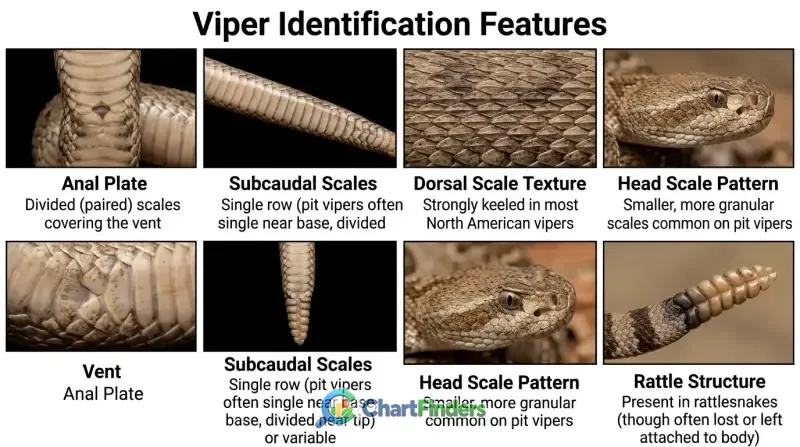
Mastering the Snake Skin Identification Chart
A comprehensive snake skin identification chart serves as a taxonomic key, guiding the observer from broad family traits down to specific structural markers. When examining a shed skin, you are looking at the exuviae—the translucent, inverted outer layer of keratinized scale tissue. Because the skin turns inside out as the snake crawls out of it, left becomes right, and dorsal features must be interpreted with this inversion in mind.
Field-experienced herpetologists rely on specific anatomical checkpoints when utilizing an identification chart. The process requires good lighting, a magnifying glass or jeweler’s loupe, and a methodical approach starting from the tail end and working toward the head. Understanding these morphological checkpoints eliminates guesswork and prevents unnecessary panic when dealing with unfamiliar wildlife remnants.
- Never trust length or color: Stretched shed skins can look 20% to 50% longer than the living snake, and true skin pigments are absent in the transparent exuviae.
- Examine the anal plate first: A single, undivided scale over the vent typically points to non-venomous colubrids, while a divided (paired) plate is standard for vipers and many elapids.
- Inspect subcaudal scales: Scales beneath the tail tip provide crucial clues; dual rows of subcaudals generally indicate non-venomous species, whereas single rows or mixed patterns require careful regional verification.
- Check for keels: Dorsal scales featuring a raised central ridge (keeled) indicate rough-scaled species like water snakes or vipers, while perfectly flat scales point to smooth racers or rat snakes.
- Geographic context is mandatory: A skin found in Texas, North Carolina, or the Pacific Northwest must be evaluated against the native species checklist of that specific region.
Anatomical Foundations of Snake Sheds
To successfully navigate any identification chart, one must master the basic vocabulary of snake scale anatomy. The skin is not a uniform sheet; it is composed of specialized rows of epidermal scales that protect the animal, retain moisture, and facilitate locomotion.
Dorsal scales run along the back and sides of the snake. On some species, each scale features a distinct longitudinal ridge called a keel, giving the snake a matte, rough texture. Other species possess completely smooth, glossy scales that reflect light. Counting the number of dorsal scale rows—measured across the widest part of the body—is one of the most reliable taxonomic identifiers used by researchers.
Moving toward the ventral (belly) side, the scales transition into broad, transverse plates designed to grip surfaces. These belly plates run in a single continuous line from the throat down to the cloaca (vent). Just past the vent lie the subcaudal scales, which cover the tail.
| Anatomical Feature | Non-Venomous Indicator (Typical) | Venomous Indicator (Typical) | Identification Significance |
|---|---|---|---|
| Anal Plate | Single (undivided) scale covering the vent | Divided (paired) scales covering the vent | Primary split for separating major families (e.g., Colubridae vs. Viperidae). |
| Subcaudal Scales | Paired (two rows) running down the tail | Single row (pit vipers often single near base, divided near tip) or variable | Critical for distinguishing pit vipers from harmless mimics. |
| Dorsal Scale Texture | Smooth or keeled depending on species | Strongly keeled in most North American vipers | Helps narrow down ecological habits (terrestrial, arboreal, aquatic). |
| Head Scale Pattern | Larger symmetrical shields on crown | Smaller, more granular scales common on pit vipers | Useful if the head region of the shed is intact. |
| Rattle Structure | Absent (tapered tail tip) | Present in rattlesnakes (though often lost or left attached to body) | Immediate confirmation of a venomous rattlesnake species. |
The table above outlines the primary morphological distinctions utilized in field identification. While these rules hold true for the vast majority of North American snakes, biological anomalies and regional variations mean that no single feature should be analyzed in total isolation.
Taxonomic Families and Scale Counting Methodology
To move past basic generalizations, field researchers rely on systematic scale counts. Understanding how different snake families organize their scales provides a rigorous framework for identification.
Dorsal Scale Rows
Dorsal scales are counted in diagonal rows across the body at its widest point (anterior to mid-body). Because snake bodies taper, counting near the head or tail will yield incorrect numbers. Most field guides provide dichotomous keys based on whether a species has an odd or even number of dorsal scale rows (e.g., 17, 19, 21, or 23 rows).
Ventral and Subcaudal Counts
Ventral scales include all broad belly plates from the neck down to the anal plate. Subcaudals include all scales from the anal plate to the terminal tail tip. Counting these requires a fine touch and a magnifying tool, but these counts remain constant throughout an individual’s life, making them invaluable for species-level verification.
| Taxonomic Family | Example Genera | Anal Plate | Subcaudals | Dorsal Texture |
|---|---|---|---|---|
| Colubridae (Harmless / Rear-fanged) | Pantherophis, Lampropeltis, Coluber | Single (mostly) | Paired (two rows) | Smooth or Keeled |
| Viperidae (Pit Vipers) | Crotalus, Agkistrodon, Sistrurus | Divided (paired) | Single (often paired near tip) | Strongly Keeled |
| Elapidae (Elapids) | Micrurus (Coral Snakes) | Divided | Paired (two rows) | Smooth |
| B | Charina, Nerodia | Single or Divided | Variable (Paired) | Smooth or Keeled |
Step-by-Step Snake Skin Identification Method
When you encounter a shed skin, following a disciplined, step-by-step examination protocol ensures the highest accuracy. Rushing to conclusions based on a quick glance often leads to misidentification.
Step 1: Determine the Orientation (Head vs. Tail)
Because snakes crawl out of their skin, the shed is completely inverted, turning inside out like a sock pulled off a foot. The first task is identifying which end is the head and which is the tail.
- The Head End: Usually wider, featuring clear impressions of eye caps (brilles)—transparent scales that cover the eyes—as well as mouth gape outlines and sometimes faint impressions of facial pits (in vipers).
- The Tail End: Tapers down to a fine point. Look closely at the very tip; if it ends in segmented, interlocking keratin rings, you are holding the skin of a rattlesnake. If it ends in a sharp, single-pointed scale, it belongs to a non-rattling species.
Step 2: Inspect the Anal Plate and Subcaudals
Once you locate the tail, trace upward to the cloacal opening (the vent). Examine the single large scale covering this opening:
- Undivided Anal Plate: A single shield spanning the width of the body. This is a hallmark of many harmless colubrid snakes (such as rat snakes, racers, and kingsnakes).
- Divided Anal Plate: Two separate scales meeting in a vertical seam over the vent. This configuration is standard for pit vipers (copperheads, cottonmouths, rattlesnakes) and elapids.
Next, examine the scales immediately following the vent toward the tail tip (subcaudals). Count whether they run in a double row (paired) or a single row (unpaired). While pit vipers typically feature single subcaudals near the base of the tail, exceptions exist, making regional snake checklists vital.
Step 3: Evaluate Dorsal Scale Texture (Keeled vs. Smooth)
Run your finger gently along the dorsal surface of the shed skin (remembering it is inside out).
- Smooth Scales: Feel completely flat and glassy. Common in snakes that favor burrowing or fast-moving open ground, such as racers, whip snakes, and smooth earth snakes.
- Keeled Scales: Feature a raised ridge running down the center of each individual scale, giving the skin a matte, textured, file-like feel. Water snakes, garter snakes, and most rattlesnakes possess keeled scales, which reduce glare and aid in aquatic or terrestrial traction.
Step 4: Analyze Pattern Traces and Proportions
While true skin pigments disappear in the transparent exuviae, melanin patterns often leave a dark shadow or ghostly impression on the shed skin. Examine the skin against a light source or place it on a white sheet of paper. Can you discern banding, blotches, or stripes? Combine these faint pattern impressions with your geographic location to match local species profiles.
Regional Considerations and Geographic Mapping
Snake distribution is strictly tied to geography, climate, and habitat. An identical scale count can belong to entirely different species depending on whether the skin was found in the arid deserts of Texas, the humid pine flatwoods of North Carolina, or the temperate forests of the Pacific Northwest.
For example, Texas boasts 76 distinct snake species, 11 of which are venomous. An urban homeowner in Austin discovering a shed skin is far more likely to encounter a harmless Texas Rat Snake (Pantherophis obsoletus) or a Brahminy Blindsnake than a Western Diamondback Rattlesnake (Crotalus atrox), despite all three sharing certain general reptilian characteristics.
When consulting a snake skin identification chart, always filter your findings through a localized species guide. Cross-reference the scale row count, habitat type, and geographic range to eliminate non-native or geographically impossible matches.
Common Mistakes and Limitations in Skin Identification
Even experienced naturalists encounter challenges when working with shed skins. Recognizing the limitations of exuviae analysis prevents costly mistakes in wildlife management and personal safety.
The Stretching Phenomenon
The single greatest pitfall in skin identification is relying on physical length. As a snake sloughs, the skin stretches axially. A 4-foot rat snake can easily leave behind a shed skin measuring over 5.5 feet in length. Never use length as a diagnostic metric to estimate the size of the living snake.
Damaged and Fragmented Sheds
Snakes rarely shed in pristine conditions if they crawl through dense brush, rocky outcrops, or damp soil. Fragmented, torn, or inverted skins often obscure critical diagnostic features like the anal plate or head shields. If the head and tail regions are missing or shredded, positive species identification becomes nearly impossible through visual charts alone.
The Danger of Relying Solely on “Venomous Rules”
Many amateur guides promote hard-and-fast rules, such as claiming all venomous snakes have vertical pupils and keeled scales, or that all harmless snakes have round pupils and smooth scales. These generalizations fail when confronted with exceptions. Coral snakes (elapids) possess round pupils and smooth scales, yet are highly venomous. Always rely on structural scale markers—such as anal plates and subcaudals—rather than behavioral myths or eye shapes.
Frequently Asked Questions
Yes, to a degree. While you cannot see venom glands or fangs clearly in a transparent shed, you can examine structural markers such as the anal plate and subcaudal scales. A divided anal plate combined with specific subcaudal arrangements often points toward venomous pit vipers, whereas single anal plates typically indicate harmless colubrids. However, fragmented or damaged skins can obscure these details, requiring expert verification.
During the sloughing process, the outer epidermal layer undergoes mechanical tension and stretching as the snake pushes its body through tight spaces or abrasive terrain. Consequently, a discarded skin can stretch up to 30% or more beyond the actual length of the living animal.
Look for the widest end of the skin and search for transparent, cup-like structures known as brilles or eye caps, which covered the snake’s eyes. You may also see the open gape of the mouth and impressions of facial pits between the nostrils and eyes if the specimen belongs to a pit viper.
Yes. Many non-venomous snakes—including garter snakes, water snakes, and hognose snakes—possess strongly keeled scales. Conversely, some venomous species (such as certain Asian pit vipers or specific geographic morphs) can have reduced keeling. Therefore, scale texture must be evaluated alongside anal plate configuration rather than in isolation.
Finding a shed skin confirms that a snake passed through the area, but it does not mean the animal is currently lingering nearby—snakes often move extensively after sloughing. Clear away tall grass, woodpiles, and debris near your foundation to eliminate shelter. If you spot the live snake and require removal, contact a local animal control professional or state wildlife agency.
Conclusion
Analyzing a discarded snake skin is a practical exercise in forensic biology. While the absence of color pigments and the tendency of skins to stretch can complicate the process, a systematic review of scale architecture cuts through the confusion. By prioritizing structural markers—specifically the anal plate, subcaudal scale arrangement, dorsal texture, and tail termination—observers can reliably differentiate between harmless garden visitors and medically significant venomous species. Combined with an understanding of local geographic distribution, a proper snake skin identification chart turns an intimidating mystery into an approachable scientific assessment.