
Navigating the grueling, punishing wilderness of SnowRunner requires more than just a powerful engine, a raised suspension, and a winch with plenty of cable. Beneath your truck’s heavy chassis, rubber meets dirt, mud, snow, and ice. Understanding how the game’s physics engine evaluates tread patterns can mean the difference between smoothly crossing a frozen marsh and spending three frustrating hours winching from tree to tree. Because the game does not explicitly reveal every underlying statistical value on its standard garage UI, mastering the SnowRunner tire chart is the ultimate equalizer for both veteran truckers and newcomers tackling difficult regions like Amur, Taymyr, and Kola Peninsula.
The tire system in SnowRunner operates on a sophisticated matrix of multipliers, friction ratings, and terrain resistance factors. While the game provides basic visual indicators—such as rating bars for asphalt, dirt, and mud—these indicators often mask critical behavioral nuances that emerge only when heavy cargo is loaded in deep snow or slick, black ice. This guide explores the anatomy of the SnowRunner tire chart, breaking down tire categories, hidden statistics, regional variations, vehicle-specific exceptions, and practical selection strategies to keep your fleet moving forward.
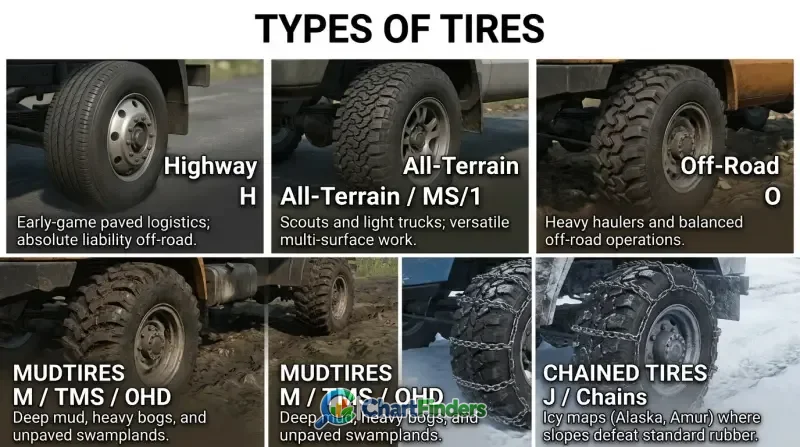
Understanding the SnowRunner Tire Chart
- Mudtires (M) feature the highest ratings for deep mud and snow, but many models suffer steep friction penalties on hard surfaces and packed ice.
- All-Terrain (MS/1) tires offer superior versatility, often outperforming dedicated mudtires on paved roads, shallow dirt, and light snow.
- Hidden multipliers dictate that specific truck weight classes and dual-wheel configurations alter how tire ratings translate into actual traction.
- Chained tires are virtually mandatory on icy inclines in regions like Alaska and Amur, despite having mediocre performance ratings in soft mud.
- Specialized mud tires, such as the OHD I, MHS II, and Tayga duals, possess unique performance profiles that break standard game rules.
- Always cross-reference a truck’s suspension height with available tire sizes; raised suspensions unlock larger footprints that alter ground pressure dynamics.
The SnowRunner tire chart is an analytical breakdown of every wheel option available across the game’s massive roster of scouts, off-road haulers, and heavy trucks. At its core, the chart classifies tires into distinct families based on their rubber compound, tread depth, lug spacing, and intended environmental application. Saber Interactive’s physics engine uses these classifications to determine how much grip a tire generates when contacting different terrain types.
Terrain in the game is categorized into layers. When a truck drives over ground, the tires interact with the surface layer and the underlying hardpan. If a tire lacks deep enough lugs or sufficient width, it sinks into the mud or snow until it hits a firmer base or loses momentum entirely. The tire chart maps out which models prevent sinking and which ones maximize forward thrust once submerged.
| Tire Category | Designation Code | Asphalt Grip | Dirt / Gravel Grip | Mud Performance | Snow / Ice Performance | Primary Use Case |
|---|---|---|---|---|---|---|
| Highway | H | Excellent (3.0+) | Poor (1.0) | Useless (0.0) | Terrible (0.0) | Early-game paved logistics; absolute liability off-road. |
| All-Terrain | All-Terrain / MS/1 | Good (2.0) | Good (2.0) | Low-Medium (1.5 – 1.8) | Fair (1.5) | Scouts and light trucks; versatile multi-surface work. |
| Off-Road | O | Fair (1.5) | Very Good (2.5) | Good (2.0 – 2.5) | Good (2.0) | Heavy haulers and balanced off-road operations. |
| Mudtires | M / TMS / OHD | Poor (1.0) | Good (2.0) | Superior (3.0+) | Variable (1.5 – 3.0) | Deep mud, heavy bogs, and unpaved swamplands. |
| Chained Tires | J / Chains | Fair (1.5) | Fair (1.5) | Low (1.2) | Maximum (3.0+ Ice) | Icy maps (Alaska, Amur) where slopes defeat standard rubber. |
Reading this table correctly requires understanding that higher numbers do not automatically mean an overall victory in every scenario. For example, a tire with a 3.0 mud rating may slip easily on wet asphalt if its rubber compound and tread pattern lack flat contact patch stability. Conversely, highway tires score exceptionally well on dry tarmac but become literal anchors the moment they touch wet grass.
Decoding Game Files vs. In-Game UI Bars
One of the most common points of confusion for players is the discrepancy between the garage user interface bars and the actual underlying XML game data. The visual bars in the garage rate tires from 1 to 3 stars or via color-coded blocks for Asphalt, Dirt, and Mud. However, these UI indicators are often generalized groupings.
In the game files, tires are assigned precise numerical friction coefficients for specific terrain tags (such as Mud, Dirt, Asphalt, and Ice). , tires feature a Float rating. A higher float rating means the tire acts like a snowshoe, distributing vehicle weight across a wider surface area to prevent sinking in soft terrain. Narrower, taller tires cut through soft top layers to reach solid ground beneath, a mechanic known as “trenching.” The tire chart helps players identify which philosophy a particular tread utilizes.
Detailed Breakdown of Tire Categories
Every vehicle class in SnowRunner has access to a specific subset of tire types. Understanding the strengths and weaknesses of each category prevents costly mistakes when purchasing upgrades for newly acquired trucks.
Figure 1: Comparative performance index of major SnowRunner tire categories across diverse terrain types. Values derived from internal game file coefficients.
Highway Tires (H)
Highway tires are default equipment on many commercial and highway trucks found early in the game. They offer exceptional grip on clean tarmac, allowing for high-speed transit on paved maps like Michigan. However, their shallow treads fill up instantly with dirt, mud, or snow, dropping their friction coefficient close to zero in off-road environments. Experienced players sell or replace highway tires immediately unless the truck is destined exclusively for paved road tanker duty.
All-Terrain Tires (AT / MS/1)
All-terrain tires represent the sweet spot for scout vehicles and select light trucks. They provide balanced friction across asphalt, dirt, and gravel while offering moderate capability in shallow mud and snow. Crucially, scout-specific all-terrain tires often perform remarkably well because scouts are lightweight enough not to sink deeply. On heavy trucks, standard AT tires quickly become outclassed once true off-road conditions appear.
Off-Road Tires (O)
Off-road tires are the workhorses of mid-to-late game fleet management. They strike a balance between mud performance and hard-surface drivability. Unlike specialized mud tires, off-road tires maintain respectable grip on asphalt and dirt roads, meaning your trucks won’t slide uncontrollably around corners during transit legs. Models like the OHD I or specialized dual off-road setups offer tremendous versatility across mixed-terrain maps.
Mudtires (M)
Mudtires feature aggressive, deep-lug patterns designed to paddle through viscous environments. In the deepest bogs of Taymyr or the snow-choked valleys of Amur, mudtires are essential. However, players must account for their poor asphalt performance: driving heavy trucks with pure mudtires on paved roads increases stopping distances and reduces lateral stability, making high-speed crashes common.
Chained Tires (J)
Chained tires are specialized gear designed strictly for winter maps. While their mud performance is noticeably inferior to standard mudtires, chains provide an unbreakable grip coefficient on solid ice and frozen inclines. In regions like Alaska and Amur, unchained trucks will slide backward down icy mountain passes even with the most powerful mudtires equipped. Installing chains transforms impassable winter death traps into manageable highways.
Specialized Tire Models and Outliers
Not all tires within the same category perform equally. Developers programmed specific tire models with unique internal modifiers that make them legendary within the community.
The Tayga Duals (TMS / Specialized MHS)
Vehicles like the Tayga 6436 and certain heavy Russian haulers gain access to specialized dual-wheel mudtires. These tires combine massive surface area with deep tread patterns, granting them unrivaled floating capability in deep mud. They allow heavy trucks to skim across bogs that swallow single-wheel alternatives.
OHD Series (Off-Road Heavy Duals)
Available on heavy American trucks like the Western Star 49X and TwinSteer, the OHD I and OHD II tires are celebrated for their stability. While pure mudtires might punch slightly deeper holes, OHD duals provide phenomenal side-slope stability and high resistance to tipping, which is vital when hauling tall cargo containers.
Scout Specifics: JAT HS/MS and Specialized Off-Road
Scout vehicles operate under entirely different physics calculations. Standard heavy truck rules do not apply. Lightweight scouts equipped with specialized off-road tires or modern DLC-added tire variants can traverse swamps that trap medium trucks. Always check if a scout can equip chained tires or specialized mud variants before embarking on deep snow expeditions.
Terrain Interaction and Physics Mechanics
To use the SnowRunner tire chart effectively, players must understand how the game’s terrain mechanics evaluate wheel behavior in real-time.
Trenching vs. Floating
When a truck enters mud or snow, the game calculates whether the tire will “trench” or “float.”
- Trenching occurs when narrow tires dig straight down through soft top layers to find hard ground at the bottom. This is effective in shallow mud over solid rock.
- Floating occurs when wide, large-diameter tires spread the vehicle’s weight across the top of the mud or snow, preventing the chassis from bottoming out on the terrain mesh.
Heavy trucks with dual rear wheels excel at floating, while lighter trucks with tall, skinny tires excel at trenching. Mismatching tire width with truck weight is the primary cause of getting bogged down.
The Ice Mechanic
Ice in SnowRunner is divided into two distinct types: normal ice and broken ice. Normal ice treats unchained tires as if they had zero friction, causing immediate sliding on slopes. Broken ice behaves like shallow water or mud, meaning mudtires and winch points become more valuable than chains.
Step-by-Step Tire Selection Framework
When approaching a new contract or exploring an unfamiliar region, use this practical decision-making framework to select your tires:
- Analyze the Region’s Primary Obstacle: Is the map paved with long transit stretches (Michigan), muddy swamps (Taymyr), or icy mountain switchbacks (Alaska/Amur)? Match your primary fleet category to this macro-environment.
- Check Suspension Compatibility: Visit the garage and check if raised suspensions unlock larger diameter tires. In SnowRunner, taller tires almost always outperform smaller tires of the exact same tread type because they increase differential clearance.
- Evaluate Transit vs. Off-Road Ratio: If a route requires 80% paved highway driving and only 20% mud pit crossing, choose Off-Road or All-Terrain tires instead of pure Mudtires to maintain safe transit speeds and control.
- Prioritize Chains for Winter Climbs: If an icy incline blocks access to a watchtower or garage, switch at least one dedicated rescue truck to Chained tires, even if it sacrifices mud speed elsewhere.
- Test Cargo Weight Impact: Heavy saddle trailers increase downward force, compressing tire contact patches. If your truck bogs down severely under load, upgrade to dual-wheel mud or heavy off-road variants.
Common Mistakes and Misconceptions
Even experienced players occasionally fall victim to misleading garage UI stats and common operational errors:
- Assuming Higher Star Ratings Equal Universal Success: A tire with three stars in mud might have terrible lateral stability on side-slopes, leading to frequent rollovers.
- Ignoring Tire Diameter: Upgrading from a 47-inch mud tire to a 55-inch mud tire provides a massive performance boost due to clearance alone, even if the base rating looks identical.
- Using Mudtires on Ice: Players often assume aggressive mudtires work well in winter. On packed snow and blue ice, mudtires offer virtually no grip compared to chained tires.
- Failing to Account for AWD/Diff Lock Interdependence: Tires cannot compensate for a truck lacking All-Wheel Drive or Differential Lock. Always ensure your drivetrain upgrades match your tire capabilities.
Frequently Asked Questions
No. While mudtires excel in deep bogs and thick snow, they suffer reduced friction on asphalt and hard dirt roads. Off-road tires offer a superior balance of handling and speed for mixed-terrain operations.
Both matter significantly, but tire diameter directly affects ground clearance. A larger tire prevents your differential and chassis from dragging on the ground, which is often the primary reason trucks get stuck.
Mudtires have poor traction coefficients on ice and packed snow. To climb icy inclines without sliding, you must equip Chained tires (J designation), which are specifically programmed with high ice friction values.
No. Scout physics use separate coefficients. Lightweight scouts with specialized off-road or JAT-series tires can float across mud pools that would trap medium trucks.
DLC tire packs, such as the JAT Tire Pack, introduce alternative tread options with adjusted friction values for various surfaces. While some DLC tires offer enhanced versatility, vanilla top-tier options like dual mudtires remain highly competitive.
Conclusion
Mastering the SnowRunner tire chart transforms the game from an exercise in frustrating winch recovery into a rewarding study in logistical planning. By looking past surface-level UI ratings and understanding how tire width, diameter, float, and friction coefficients interact with the game’s physics engine, you can outfit your fleet for maximum efficiency. Whether you are forging a path through the frozen wastes of Amur or hauling timber across Taymyr, choosing the right rubber ensures your cargo always reaches its destination.