
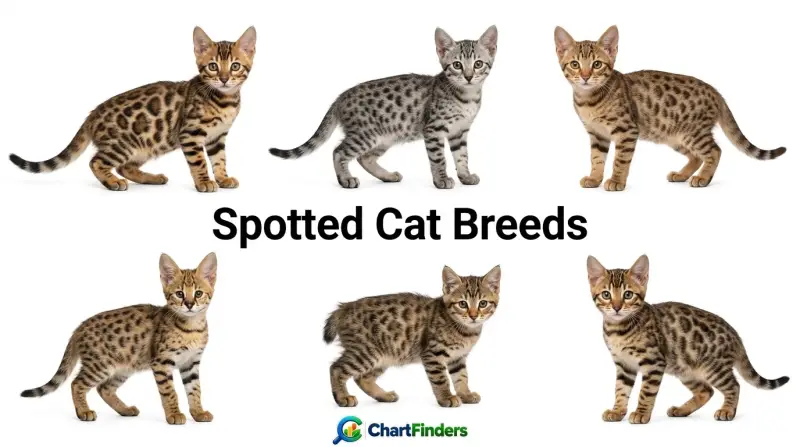
The allure of the wild has captivated cat enthusiasts for generations. The striking contrast of rosettes against a golden pelt, the intense, hooded gaze of a mini-panther, and the fluid movement of a predator evoke a sense of untamed wilderness inside the domestic living room. Yet, beneath these dramatic, spotted coats lie distinct temperaments, maintenance needs, and genetic histories that vary wildly from one breed to another.
Understanding spotted cat breeds requires looking past the surface glamour. While a Bengal or a Savannah might demand high-octane stimulation and vertical territory, a California Spangled or an Ocicat may offer a very different household dynamic. This comprehensive guide examines the spectrum of spotted domestic cat breeds, breaking down their genetic origins, coat patterning mechanics, temperament profiles, health considerations, comparative metrics, and the practical realities of living with a feline that looks like it belongs on the savanna.
Spotted Cat Breeds
- Genetic Diversity: Spotted coats arise from various genetic mechanisms, including agouti suppression, tabby mutations, and intentional wildcat hybridization (e.g., Asian Leopard Cat crosses in Bengals and Serval crosses in Savannahs).
- Temperament Varies Widely: Not all spotted cats are high-maintenance wild spirits; breeds like the Ocicat, Egyptian Mau, and California Spangled are purely domestic and form deeply affectionate, social bonds.
- Coat Pattern Terminology: True spots can manifest as solid spots, rosettes (doughnut-, arrowhead-, or paw-print-shaped markings with a lighter center), or broken mackerel stripes.
- Activity Levels: Most spotted breeds possess above-average energy, intelligence, and curiosity, requiring interactive play and substantial environmental enrichment.
- Grooming Simplicity: Despite their exotic appearance, most short-haired spotted breeds require minimal grooming due to their sleek, close-lying coats, though regular maintenance prevents skin oil buildup and minor shedding.
- Official Recognition & Regulation: Major registries like TICA and CFA maintain rigorous standards for recognized spotted breeds, evaluating conformation alongside spot clarity. Additionally, early-generation hybrids face strict municipal and state legal restrictions.
Feline coat patterns are governed by complex genetic interactions. The primary agouti gene determines whether individual hairs are banded with alternating light and dark pigments, creating the wild-type background. Superimposed upon this agouti background are modifier genes that disrupt traditional mackerel or classic tabby stripes into distinct spots, rosettes, or broken patterns. To truly understand spotted cat breeds, one must evaluate both their heritage and their physical conformation.
Major Spotted Cat Breeds Compared
The following table outlines the foundational characteristics, origin status, coat types, and general temperament profiles of the most prominent spotted cat breeds recognized globally and within the modern cat fancy.
| Breed Name | Origin Type | Coat Pattern Type | Activity Level | Typical Size | Temperament Profile |
|---|---|---|---|---|---|
| Bengal | Hybrid (Asian Leopard Cat x Domestic) | Rosettes / Spotted (High Contrast) | Very High | Medium – Large (8–15 lbs) | Energetic, vocal, highly inquisitive, water-loving, confident. |
| Ocicat | Pure Domestic (Abyssinian, Siamese, American Shorthair) | Thumbprint Spots (Agouti background) | High | Medium – Large (9–15 lbs) | Social, dog-like, highly trainable, people-oriented, adaptable. |
| Egyptian Mau | Natural Breed | Random Spacing Spots (Ticked roots, skin pigmented) | Moderately High | Medium (6–11 lbs) | Loyal, fast runners, sensitive, selective with strangers, vocal. |
| Serengeti | Pure Domestic (Bengal x Oriental Shorthair) | Round, Well-distributed Spots | High | Medium (8–12 lbs) | Athletic, talkative, confident, highly active, agile climbers. |
| Savannah | Hybrid (Serval x Domestic) | Bold Spots / Rosettes on Golden/Silver | Extremely High | Large (12–25+ lbs) | Intense jumper, highly intelligent, fiercely loyal to one handler. |
| Pixie-bob | Natural / Managed Mutation | Muted Brown Spotted Tabby (Polydactyl common) | Moderate | Medium – Large (8–18 lbs) | Relaxed, highly social, quiet chirper, dog-like loyalty, steady. |
| California Spangled | Pure Domestic (Multi-breed composite) | Dark Spots on Agouti/Silver/Bronze background | Moderately High | Medium (8–12 lbs) | Affectionate, athletic, playful, deeply attached to human families. |
The Genetics and Mechanics of Feline Spotting
The transformation of a striped tabby into a spotted feline involves precise biological engineering. All domestic cats inherit a baseline coat pattern from the agouti gene locus ($A$), which dictates whether hairs have banded pigments. When combined with the tabby gene complex—specifically the mackerel tabby allele ($T^m$)—cats display vertical stripes.
However, specific modifier genes interrupt these mackerel stripes. When these modifiers act upon the hair shafts, they fragment the continuous dark lines into discrete units. This genetic disruption creates three distinct spot configurations:
- Solid Spots: Round or oval patches of pigment where the hair shaft is dark from tip to base or uniformly tipped against a lighter background. Common in Egyptian Maus and Ocicats.
- Rosettes: Multi-toned markings featuring a lighter center surrounded by a darker ring, arrowhead, or paw-print crescent, mimicking the markings of leopards, jaguars, and ocelots. These are heavily selected for in modern Bengal breeding.
- Broken Mackerel: Dashed or interrupted vertical stripes that appear spot-like along the flanks but retain a more traditional tabby spine stripe, frequently seen in Pixie-bobs and domestic shorthair tabbies.
, background coloration plays a in aesthetic evaluation. High contrast is essential in premium spotted breeds. A clear, warm golden, copper, or silver background dramatically enhances the visual impact of dark brown, black, or charcoal spots, separating elite show-quality specimens from pet-quality variants.
In-Depth Profiles of Top Spotted Cat Breeds
Examining individual breeds reveals the diverse ways wild aesthetics manifest within domestic temperaments and body types.
1. The Bengal
Developed through the careful crossing of the Asian Leopard Cat (Prionailurus bengalensis) with domestic cats (such as the Egyptian Mau, Abyssinian, and Burmese), the Bengal is the definitive spotted icon of the modern cat fancy. Early generations (F1 through F3) retain wild tendencies and require specialized husbandry, but fully domestic generations (F4 and beyond) offer a balanced pet with an unmistakable appearance.
Bengals possess a sturdy, semi-foreign body type with thick, muscular frames and prominent whisker pads. Their coats often feature a “glitter” effect—a unique structural property of the hollow-tipped hair shaft that causes it to catch the light as if dusted with gold or pearl dust. They require extensive physical and mental stimulation, often mastering fetch, puzzle toys, and leash walking with ease.
2. The Ocicat
Despite its striking resemblance to an ocelot, the Ocicat contains no wild blood. Created entirely by accident in 1964 through an experimental breeding program crossing Abyssinians, Siamese, and American Shorthairs, this breed was named for its resemblance to the wild spotted cat.
Ocicats are large, athletic cats with powerful, balanced bodies and distinct “thumbprint” spots arranged in a pattern along the spine and flanks. Their temperament is famously social; they thrive in multi-pet households and often display dog-like attachment to their human families, greeting owners at the door and following them from room to room without demanding excessive high-altitude acrobatics.
3. The Egyptian Mau
Believed by many to be the direct descendant of the sacred cats of ancient Egypt, the Egyptian Mau is a natural breed with a history spanning millennia. It is distinguished not only by its naturally occurring spotted coat—where the spots are not merely on the fur, but visibly pigmented on the skin underneath—but also by its unique conformation.
The Mau possesses a lithe, graceful body with hind legs noticeably longer than its front legs, allowing for exceptional running speeds (up to 30 mph). They feature a characteristic “m” shape on the forehead (often called the scarab mark) and striking gooseberry-green eyes. Temperamentally, Maus are loyal and affectionate with their chosen circle, though they can be reserved around unfamiliar visitors.
4. The Serengeti
Created in 1994 by conservationist Karen Sausman through crossing Bengals and Oriental Shorthairs, the Serengeti aims to replicate the look of an African serval without introducing wild blood. The breed features exceptionally long legs, large, radar-like ears, and a graceful neck set upon a lean, muscular body.
Serengetis are exceptionally vocal, confident, and active cats. They enjoy high perches and interactive play, making them well-suited for owners who want an energetic, highly engaged feline companion.
5. The Savannah
Positioned at the boundary between wild and domestic, the Savannah is a hybrid cross between an African Serval (Leptailurus serval) and a domestic cat. Recognized by TICA, early generations (F1–F3) require specialized care, large outdoor enclosures, and experienced handlers. Later generations (F4 onward) integrate more smoothly into specialized domestic environments.
Savannahs are exceptionally tall, lean cats with elongated necks, oversized ears, and bold black spotting against golden or silver coats. Their intelligence and jumping ability—often clearing eight feet from a standing position—set them apart from standard domestic breeds.
6. The California Spangled
Developed in the 1980s by Paul Casey to resemble a mini-leopard, the California Spangled is an intentional composite breed derived from multiple domestic breeds including Abyssinian, American Shorthair, British Shorthair, Siamese, and various street cats. Though rarer today, they boast a remarkably wild appearance combined with a gentle, affectionate domestic temperament.
Physical Conformation and Coat Variation Trends
To evaluate the structural and aesthetic differences among leading spotted breeds, consider the following comparative metrics regarding ear placement, body type, and coat contrast.
| Breed | Body Conformation | Ear Set & Shape | Coat Contrast Level | Primary Recognized Colors |
|---|---|---|---|---|
| Bengal | Robust, muscular, semi-foreign | Medium-small, rounded tips, forward-facing | Very High | Brown (Black spots), Silver, Seal Lynx Point (Sepia/Mink) |
| Ocicat | Athletic, heavy, well-balanced | Moderately large, alert, corner-set | High | Tawny, Chocolate, Cinnamon, Blue, Lavender, Fawn |
| Egyptian Mau | Graceful, lithe, balanced athletic frame | Medium-large, moderately flared, alert | High (Spotted skin base) | Silver, Bronze, Smoke, Black |
| Serengeti | Long-legged, slender, elegant | Very large, upright, wide at base | Moderate to High | Brown Spotted Tabby, Silver, Black Smoke, Solid Black |
| Savannah | Tall, long-necked, slender hybrid frame | Very large, deep-cupped, upright | Very High | Brown Spotted, Silver, Black Smoke, Black |
Health, Care, and Dietary Considerations
Maintaining a spotted cat involves understanding both general feline care and breed-specific predispositions. Because many spotted breeds possess high energy reserves, their nutritional and environmental needs differ significantly from sedentary lap cats.
Nutritional Requirements
Active spotted breeds—particularly hybrids like Bengals and Savannahs—have higher metabolic rates and lean muscle mass requirements. They need high-protein diets rich in animal-based amino acids (such as taurine and arginine). Commercial diets formulated for active or working cats, or carefully balanced raw/wet food regimens, support their high-octane lifestyles.
Environmental Enrichment
Boredom in intelligent, high-energy spotted cats often translates into destructive behavior, excessive vocalization, or stress-induced over-grooming. Essential environmental components include:
- Vertical Space: Tall cat trees, wall-mounted climbing shelves, and secure window perches satisfy their natural desire for height, surveillance, and territorial dominance.
- Interactive Toys: Wand toys, motorized motion toys, and treat-dispensing puzzle balls challenge their problem-solving instincts.
- Water Play: Many Bengals, Savannahs, and Ocicats exhibit an innate fascination with moving water. Providing cat fountains or supervised water play helps fulfill this instinct.
Veterinary Screening and Genetic Health
Responsible breeding programs screen for genetic conditions prevalent in specific lineages. For instance, Bengals require screening for Hypertrophic Cardiomyopathy (HCM) and Progressive Retinal Atrophy (PRA-b). Pyruvate Kinase Deficiency (PK-def) genetic testing is also standard practice among reputable breeders to prevent hemolytic anemia. Hybrid breeds like early-generation Savannahs also require specialized veterinary care regarding nutritional absorption and parasite prevention.
Common Mistakes When Choosing a Spotted Cat
Prospective owners frequently encounter misconceptions when purchasing or adopting a spotted cat. Avoiding these common pitfalls ensures a harmonious match between pet and household:
- Assuming All Spotted Cats Are Hybrids: Buyers often believe every spotted cat possesses wild blood. Breeds like the Ocicat, Egyptian Mau, and Serengeti are 100% domestic and lack the intense behavioral quirks or management challenges of early-generation hybrids.
- Underestimating Exercise Needs: Selecting an active breed like a Bengal, Savannah, or Serengeti for a low-activity, sedentary household frequently leads to behavioral issues. These cats require dedicated daily interactive play and robust mental engagement.
- Ignoring Coat Maintenance Realities: While short coats are easy to brush, cats with dense pelts still shed seasonally. Regular weekly grooming prevents hairballs, distributes natural skin oils, and maintains coat sheen.
- Overlooking Legal Restrictions: Depending on local municipal or state laws, early-generation hybrid cats (F1–F3 Savannahs or Bengals) may be regulated, restricted, or outright prohibited. Always verify local exotic animal ordinances and zoning laws before adoption.
Frequently Asked Questions
Are all spotted domestic cats hybrids?
No. While the Bengal and Savannah involve wildcat hybridization in their ancestry, breeds like the Ocicat, Egyptian Mau, and Serengeti are entirely domestic creations produced through selective breeding of standard domestic cats.
Do spotted cats shed a lot?
Most popular spotted breeds (such as the Bengal, Ocicat, and Mau) have short, single coats with minimal undercoats, meaning they shed significantly less than long-haired breeds like Maine Coons or Persians. Weekly brushing is generally sufficient to manage loose fur.
What is the difference between a rosette and a spot?
A solid spot is a single filled-in patch of dark pigment. A rosette features a multi-toned appearance—often resembling a doughnut, arrowhead, or paw print—with a distinct lighter center enclosed by a darker border or crescent.
Are spotted cat breeds good with children?
Yes, many spotted breeds are exceptionally social, playful, and tolerant of children. Breeds like the Ocicat and Bengal match the high energy levels of kids and enjoy participating in games of fetch and interactive play, provided children are taught respectful interaction.
How much do purebred spotted kittens cost?
Prices vary widely based on lineage, generation (in hybrids), pet versus show quality, and breeder reputation. Pet-quality kittens from registered breeders typically range from $1,200 to $3,000+, while early-generation hybrids (F1–F3 Savannahs) can cost several thousand dollars more.
Conclusion
Spotted cat breeds bridge the gap between domestic companionship and wild aesthetics. Whether you are drawn to the golden, glittering rosettes of a Bengal, the balanced athleticism of an Ocicat, or the ancient grace of an Egyptian Mau, these felines offer unmatched visual appeal paired with high intelligence and engagement. By researching breed origins, matching activity levels to your lifestyle, and securing cats from responsible breeders, you can successfully welcome a piece of the wild into a loving home.