
Squash is one of the most remarkably diverse vegetable families available to gardeners, chefs, and botanists. Spanning hundreds of cultivars within the genus Cucurbita, these plants exhibit an astonishing array of shapes, sizes, colors, and culinary uses. However, this vast biological diversity often leads to significant confusion. Novice gardeners frequently struggle to distinguish between trailing winter vines and bush-type summer varieties, while cooks often misjudge whether a particular specimen’s skin is tender enough to eat raw or tough enough to require heavy processing.
Understanding how to properly identify squash goes beyond simple labeling; it unlocks the correct culinary application, storage requirements, and growing strategies for each specific type. Whether you are sorting through a late-summer harvest, selecting produce at a farmers’ market, or saving seeds in your backyard, having a reliable framework is essential. This guide provides a thorough, zero-fluff breakdown of squash classification, detailing the physical markers, physiological traits, and botanical characteristics that define every major variety.
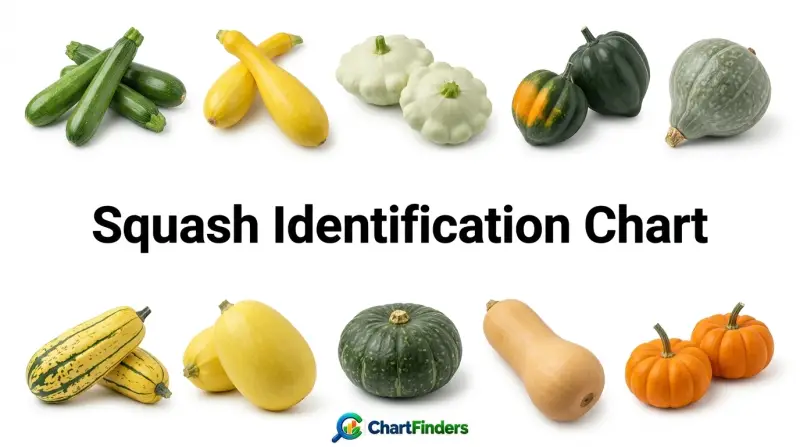
Squash Identification Chart
- Summer squash varieties feature thin, edible rinds, high water content, and short post-harvest shelf lives, requiring refrigeration within days.
- Winter squash varieties develop thick, lignified rinds and mature starches, allowing them to store for months at cool, room-temperature conditions.
- Stem characteristics serve as a primary taxonomic identifier; rigid, five-sided, prickly stems distinguish many Cucurbita pepo cultivars, while soft, rounded stems often indicate other species.
- Skin texture is the most reliable indicator of edibility; if a fingernail easily punctures the skin, it is almost always a summer squash type.
- Seed cavity size and flesh density vary predictably across cultivars, dictating whether a squash is best suited for roasting, pureeing, or raw culinary applications.
The following master identification chart details the core morphological traits of the most common summer and winter squash varieties. Use this reference to quickly cross-reference physical characteristics with botanical classifications.
| Common Name | Season | Primary Species | Shape & Color | Skin & Rind Texture | Stem Characteristics | Culinary Use / Storage |
|---|---|---|---|---|---|---|
| Zucchini | Summer | Cucurbita pepo | Cylindrical; dark green, light green, or yellow | Thin, smooth, completely edible | Angular, prickly, flared at the fruit attachment | Sautéeing, grilling, raw; short storage (1–2 weeks) |
| Yellow Crookneck | Summer | Cucurbita pepo | Bulbous bottom tapering to a curved neck; bright yellow | Bumpy or smooth; thin, edible | Fuzzy, rigid, deeply grooved | Steaming, frying, baking; short storage |
| Pattypan (Scallop) | Summer | Cucurbita pepo | Disk-shaped with scalloped edges; white, yellow, or green | Tender, thin, edible skin | Short, stiff, star-shaped cross-section | Stuffed, roasting whole, quick sautéing |
| Acorn Squash | Winter | Cucurbita pepo | Acorn-shaped with deep longitudinal ridges; dark green or golden | Moderately thin; softens when roasted | Deeply furrowed, woody, hard | Roasting halves, stuffing; stores 1–2 months |
| Butternut Squash | Winter | Cucurbita moschata | Bell-shaped or pear-shaped; beige/tan skin, deep orange flesh | Smooth, tough rind requiring peeling | Corky, deeply ridged, flared base | Soups, roasting, pureeing; stores 3–6 months |
| Delicata Squash | Winter | Cucurbita pepo | Cylindrical; pale yellow with green stripes | Thin rind, fully edible when cooked | Short, thin, woody | Roasting rings (unpeeled); stores 1 month |
| Spaghetti Squash | Winter | Cucurbita pepo or C. moschata | Oval to cylindrical; bright yellow to ivory | Hard, smooth, rigid rind | Stiff, thick, rounded or slightly angular | Baking and scraping flesh into noodle-like strands; stores 2–3 months |
| Kabocha Squash | Winter | Cucurbita maxima | Round, slightly flattened; dark mottled green with grey bumps | Tough rind, edible only after prolonged cooking | Thick, rounded, corky | Stir-frying, steaming, heavy roasting; stores 2–4 months |
| Hubbard Squash | Winter | Cucurbita maxima | Large, teardrop or oval; blue-gray, dark green, or orange | Extremely hard, bumpy, very tough rind | Thick, massive, deeply corky | Baking in wedges, pies; stores up to 6 months |
| Tromboncino | Both (Harvested Young or Old) | Cucurbita moschata | Elongated, serpentine body with a bulbous seed end | Thin when young, firm and tan when mature | Tan, corky, resistant to vine borers | Used as summer squash when green; winter squash when tan |
By analyzing the interplay between seasonal maturity, species genetics, and physical exterior markers outlined in the chart above, growers and cooks can eliminate guesswork when handling ambiguous cultivars.
Botanical Classification and the Genus Cucurbita
To truly master squash identification, one must look beyond the kitchen counter and into botanical taxonomy. All cultivated squash belong to the family Cucurbitaceae and, more specifically, the genus Cucurbita. Within this genus, domestic squashes fall into five primary domesticated species: Cucurbita pepo, Cucurbita moschata, Cucurbita maxima, Cucurbita argyrosperma (formerly C. mixta), and Cucurbita ficifolia.
Understanding these species boundaries is critical because members within the same species readily cross-pollinate, whereas species barriers prevent natural hybridization between separate groups. This genetic separation also governs physical characteristics such as vine architecture, seed shape, and cold tolerance.
Cucurbita pepo: The Most Variable Species
Cucurbita pepo is arguably the most diverse species in the garden. It encompasses the vast majority of summer squashes—including zucchini, yellow crookneck, and pattypan—as well as many popular winter squashes like acorn, delicata, and spaghetti squash. Botanically, plants in this species typically feature prickly, rigid, five-angled stems that flare noticeably where they attach to the fruit. Leaves are often deeply lobed and rough to the touch. The seeds are generally white to light tan with a distinct, slightly jagged margin.
Cucurbita moschata: The Resistant Achiever
Renowned for its natural resistance to pests like the squash vine borer, Cucurbita moschata includes butternut squash and the tromboncino cultivar. These plants thrive in warmer climates and are easily identified by their distinct stems, which are smooth, hard, and distinctly flared or bell-shaped at the point of fruit attachment, lacking the sharp five-sided angles of C. pepo. The leaves of C. moschata often feature subtle white mottling or spots, and the seeds are typically buff-colored with a wavy, darker margin.
Cucurbita maxima: The Giant Class
Representing some of the largest squashes in existence—including giant pumpkins, hubbard squash, and kabocha—Cucurbita maxima thrives in cooler conditions. The stems of this species are unmistakable: they are thick, spongy, rounded, and corky, completely lacking ridges or sharp angles. The leaves are kidney-shaped or rounded without sharp lobes, and the seeds are usually plump, white, and smooth-edged.
Additional Species: Cucurbita argyrosperma and Cucurbita ficifolia
While less common in standard suburban gardens, Cucurbita argyrosperma (silver-seed gourd or cushaw squash) features thick, angled, hairy stems and large white seeds with silver margins, prized for resilient growth in hot, humid climates. Cucurbita ficifolia (malabar gourd or figleaf gourd) is a perennial-like vine with black seeds and white flesh, uniquely resistant to fusarium wilt and frequently used as a rootstock for grafting other cucurbits.
Summer Squash Identification: Morphology and Traits
Summer squash varieties are harvested in an immature state while their rinds are still soft, their seeds are small and gelatinous, and their moisture content is exceptionally high. Because they are picked before physiological maturity, their storage life is short—typically lasting only one to two weeks under refrigeration.
Physical Markers of Summer Squash
- Rind Thickness: The skin is thin enough to be easily punctured by a fingernail. Peeling is never required.
- Seed Development: Inside the flesh, seeds are underdeveloped, soft, and completely edible without extraction.
- Growth Habit: The vast majority of summer squash cultivars grow in compact, self-supporting bush forms rather than sprawling vines, though semi-vining exceptions exist.
- Moisture Content: Cutting open a summer squash reveals dense, watery flesh that releases moisture rapidly when cooked.
Key Cultivars and Their Distinguishing Features
Zucchini (Cucurbita pepo) features a uniform cylindrical shape, tapering slightly toward the stem. Coloration ranges from deep forest green to bright golden-yellow, with occasional striped variants. Pattypan squash, easily recognized by its flying-saucer or disk-like silhouette with scalloped edges, provides a firmer texture that holds its shape well when hollowed out and stuffed. Yellow crookneck and straightneck varieties exhibit distinct textural differences on their skin; crooknecks feature pronounced, warty bumps and a curved neck, while straightnecks maintain a uniform taper.
Winter Squash Identification: Morphology and Traits
Winter squash varieties are left on the vine through the entire growing season until they reach complete physiological maturity. This extended maturation period triggers the conversion of sugars, the thickening of cell walls, and the development of a lignified, hard protective rind. This tough outer shell protects the interior flesh, enabling winter squash to cure and store for months without refrigeration.
Physical Markers of Winter Squash
- Rind Hardness: The outer skin is tough, woody, or leathery. If you cannot easily dent the skin with a fingernail, it is a winter squash.
- Seed Maturity: Mature seeds are hard, flat, fully formed, and surrounded by a fibrous pulp cavity that must be scooped out prior to cooking.
- Growth Habit: Most winter squashes produce aggressive, sprawling vines that can travel up to twenty feet across the garden floor or climb trellises.
- Density and Sugar Content: The flesh is dense, starchy, and relatively dry, concentrating sugars as the squash cures.
Key Cultivars and Their Distinguishing Features
Butternut squash (Cucurbita moschata) is instantly recognizable by its smooth, bell-like shape and pale tan skin concealing deep orange, sweet flesh. Acorn squash (Cucurbita pepo) is distinguished by its distinctive acorn profile and deep longitudinal ridges running from stem to blossom end. Kabocha squash (Cucurbita maxima) features a squat, heavily ribbed, round shape with a dark green, bumpy exterior that hides intensely sweet, dry, potato-like yellow flesh. Spaghetti squash (Cucurbita pepo) stands apart due to its internal flesh structure: when cooked, the cell walls break down into long, translucent strands that resemble pasta.
Comparative Analysis of Squash Categories
To summarize the fundamental differences that separate summer and winter classifications, review the comparative matrix below:
| Metric | Summer Squash | Winter Squash |
|---|---|---|
| Harvest Maturity Stage | Immature (soft seeds, high water) | Fully mature (hard seeds, dense starch) |
| Typical Skin / Rind | Thin, tender, easily punctured by fingernail | Thick, woody, lignified, impenetrable by nail |
| Post-Harvest Shelf Life | 1 to 2 weeks (requires refrigeration) | 1 to 6 months (cool, dry ambient storage) |
| Typical Growth Habit | Compact bush habit (rarely vining) | Sprawling vines (up to 20 feet in length) |
| Primary Culinary Prep | Raw, grilled, sautéed, steamed, or fried | Roasted, baked, pureed, or stuffed |
Step-by-Step Field Identification Protocol
When encountering an unfamiliar squash in a garden bed or marketplace without a label, field identification requires a systematic diagnostic approach. Follow this four-step sequence to determine the exact category and species.
- Examine the Rind Integrity: Press your thumbnail firmly into the skin of the fruit. If the skin gives way and punctures easily, classify the specimen as a summer squash. If the skin resists pressure entirely and feels like wood or hard plastic, it is a winter squash.
- Inspect the Stem and Attachment Point: Cut or inspect the stem remaining on the fruit. Check for geometric angles. A sharp, five-sided, prickly stem points directly to Cucurbita pepo. A smooth, corky, rounded stem indicates Cucurbita maxima or Cucurbita moschata.
- Evaluate Overall Shape and External Markings: Measure the silhouette. Does it feature deep ridges (acorn), a smooth bell profile (butternut), a scalloped disk (pattypan), or a uniform cylinder (zucchini)? Look for color patterns, such as longitudinal stripes, speckling, or solid blocks of color.
- Check Interior Seed Cavity (If Cut): Slice the fruit transversely. If the interior is filled with soft, immature seeds and watery pulp, it was harvested young. If the interior reveals a hollow cavity lined with fibrous strings and hard, flat, tan seeds, the fruit reached physiological maturity.
Common Identification Mistakes and Look-Alikes
Even experienced gardeners occasionally misidentify squash due to morphological overlap within the Cucurbita family. Recognizing these common pitfalls prevents horticultural errors.
Confusing Immature Winter Squash with Summer Squash
A frequent error occurs when gardeners harvest winter squash varieties—such as acorn or butternut—prematurely while they are still green and soft-skinned. Because they lack a hardened rind at this stage, they are often mistaken for summer zucchini. However, examining the stem provides the definitive clue: premature winter squash retains the woody, rigid, or furrowed stem characteristics of its mature form rather than the tender, flared stem attachment typical of true summer varieties.
Ornamental Gourds vs. Edible Winter Squash
Many small ornamental gourds belong to the genera Cucurbita, Lagenaria, or Cucumis. While some are technically edible when very young, mature ornamental gourds are bitter, woody, and entirely unpalatable due to high cucurbitacin content. To distinguish edible winter squash from bitter ornamental gourds, check the flesh density and scent; edible squash possesses a pleasant, starchy aroma when cut, whereas toxic gourds often emit a sharp, chemical scent and contain extremely bitter flesh.
Squash vs. Pumpkins and Gourds
Botanically speaking, pumpkins are not a separate taxonomic category; they are simply specific cultivars of winter squash, primarily belonging to Cucurbita pepo, Cucurbita maxima, and Cucurbita moschata. The distinction between a “pumpkin” and a “squash” is entirely cultural and culinary rather than botanical. Any round, orange winter squash with a sturdy handle-like stem is colloquially termed a pumpkin, yet it shares identical structural genetics with its elongated or uniquely colored squash relatives.
Frequently Asked Questions
How can I tell if a squash is safe to eat if it has a bitter taste?
If a squash tastes distinctly bitter, spit it out immediately and discard the entire fruit. Extreme bitterness indicates an abnormally high concentration of cucurbitacins, toxic compounds that can accumulate in cucurbits due to environmental stress, extreme heat, or accidental cross-pollination with wild gourds. Ingesting high levels of cucurbitacins causes severe gastrointestinal illness.
Can I save seeds from my squash for planting next year?
You can save seeds only if the parent plant was an open-pollinated or heirloom variety. Because squash species cross-pollinate readily via bees across distances of up to half a mile, seeds harvested from hybrid (F1) varieties will not grow true to type in the following generation, often resulting in erratic growth habits and unpalatable fruit.
What is the difference between bush and vine squash types?
Bush squash varieties grow in a compact, self-contained clump spanning roughly two to three feet in diameter, making them ideal for small gardens and container growing. Vine varieties produce aggressive, trailing runners that extend anywhere from six to twenty feet across the ground or up structural trellises, requiring significantly more space to mature.
Why is my summer squash turning yellow and rotting at the end before growing large?
This condition, known as blossom-end rot, is typically caused by inconsistent soil moisture or a calcium deficiency in the plant, which prevents proper cell wall development in the developing fruit. It is not an identification marker of a specific variety, but rather a physiological stress response.
How long can winter squash be stored after harvest?
Storage duration depends heavily on the specific species and curing process. Hard-rinded varieties like butternut and hubbard squash can store safely for three to six months when cured in a warm, dry area for ten days post-harvest and subsequently kept in a cool, dark, well-ventilated space (50°F to 55°F). Thin-rinded winter varieties like delicata and acorn generally last only one to two months.
Mastering squash identification requires looking past superficial color variations and examining the structural markers encoded in rinds, stems, and seed cavities. By applying the botanical criteria and classification standards detailed in this guide, you can confidently navigate every harvest, kitchen prep session, and garden bed.