
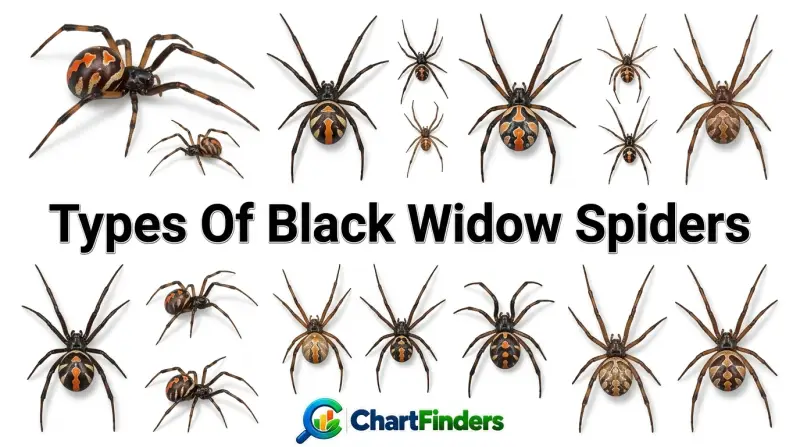
Few arachnids evoke as much immediate caution and scientific fascination as members of the genus Latrodectus. Widely recognized by their globular jet-black opisthosoma and characteristic warning coloration, these synanthropic web-spinners inhabit diverse ecological niches across North America. While popular culture often treats “the black widow” as a singular, monolithic entity, North American arachnology categorizes these medically significant spiders into distinct, geographically distributed species. Understanding the biological variations, morphological diagnostic markers, behavioral traits, and specific geographic ranges of these distinct populations is essential not only for pest management and public health safety, but also for appreciating the evolutionary adaptations of theridiid spiders.
This master reference examines the taxonomy, anatomical distinctions, behavioral ecology, and clinical management associated with the primary black widow species found within the United States. Through systematic breakdowns, comparative data, and detailed morphological analysis, we explore the precise criteria required to differentiate these medically important arachnids from benign look-alikes.
Taxonomic Classification and Distribution of Types Of Black Widow Spiders
- Three Main Species: The North American Latrodectus complex comprises L. mactans (Southern), L. hesperus (Western), and L. variolus (Northern).
- Sexual Dimorphism: Adult females are large, glossy black, and venomous, whereas males are diminutive, highly patterned, and functionally harmless to humans.
- Morphological Markers: Ventral and dorsal markings vary significantly by species, ranging from the classic solid hourglass to broken spots and lateral stripes.
- Venom Composition: Female venom contains latrotoxin, a potent presynaptic neurotoxin that triggers massive acetylcholine and norepinephrine release.
- Habitat Preference: These theridiids prefer dark, undisturbed, sheltered microhabitats such as woodpiles, crawlspaces, and outbuildings.
The genus Latrodectus belongs to the family Theridiidae, commonly known as cobweb spiders or comb-footed spiders, distinguished by a distinct row of serrated setae on the fourth tarsus used to pull silk from the spinnerets. Within the United States, three primary species dominate the geographic landscape, supplemented occasionally by introduced or closely related species such as the Brown Widow (Latrodectus geometricus) and the Red Widow (Latrodectus bishopi). Systematic identification relies heavily on a combination of geographic provenance, dorsal patterning, and ventral hourglass configuration.
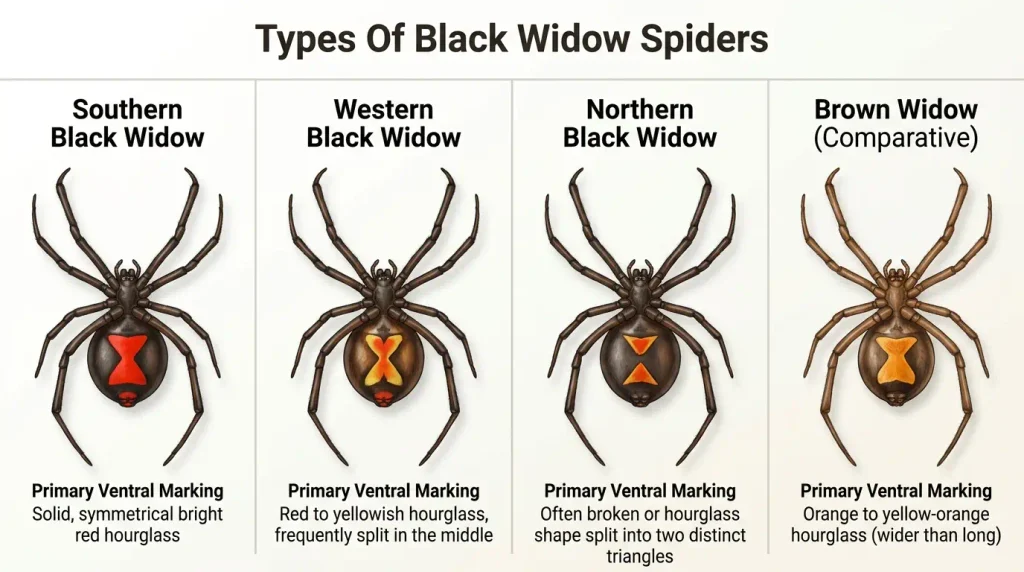
| Common Name | Scientific Name | Geographic Distribution | Primary Ventral Marking | Dorsal Patterning |
|---|---|---|---|---|
| Southern Black Widow | Latrodectus mactans | Southeastern U.S., extending north to New York and west to Texas | Solid, symmetrical bright red hourglass | Solid glossy black; juveniles may exhibit orange/white lateral dashes |
| Western Black Widow | Latrodectus hesperus | Western U.S., from the Pacific coast east to the Great Plains | Red to yellowish hourglass, frequently split in the middle | Glossy black; females occasionally show faint dorsal red spots |
| Northern Black Widow | Latrodectus variolus | Northeastern and Midwestern U.S., extending south into Florida | Often broken or hourglass shape split into two distinct triangles | Row of red or orange spots down the dorsal midline, sometimes with lateral white stripes |
| Brown Widow (Comparative) | Latrodectus geometricus | Gulf Coast, Southern California, spreading across the southern tier | Orange to yellow-orange hourglass (wider than long) | Mottled brown, tan, and black geometric patterns with dorsal spots |
The table above outlines the core taxonomic distinctions that separate the dominant North American widow lineages. While overlapping transition zones occur—particularly where Western and Northern ranges meet Central regions—molecular and morphological markers remain robust indicators of specific lineage.
1. Southern Black Widow (Latrodectus mactans)
The Southern Black Widow is the species most frequently referenced in historical literature and toxicology reports. Adult females exhibit a deep, highly reflective ebony coloration across the prosoma (cephalothorax), legs, and globose opisthosoma (abdomen). The definitive diagnostic feature is a vivid crimson-to-orange ventral marking shaped precisely like an hourglass, situated directly anterior to the spinnerets.
Dorsally, mature females are typically immaculate black without markings, though sub-adult instars and juveniles often display complex patterns of white, brown, and orange lateral stripes. Their webs are irregular, three-dimensional scaffolds spun in dark, low-traffic areas near ground level. Latrodectus mactans thrives in warm, humid climates, making agricultural outbuildings, stone walls, and dense brush prime micro-sites.
2. Western Black Widow (Latrodectus hesperus)
Geographically occupying the territory west of the 100th meridian, Latrodectus hesperus is the most commonly encountered widow spider across the western half of the United States. Morphologically similar to its southern counterpart, the Western Black Widow features a glossy black integument, but its ventral hourglass is frequently variable—often displaying a pinched center or a complete separation into two distinct triangular red spots.
Juvenile and immature female L. hesperus specimens routinely exhibit white or yellowish abdominal striping alongside dorsal red spots, which progressively darken into solid black as the spider reaches its final terminal molt. This species demonstrates remarkable physiological resilience, surviving in arid desert scrublands, urban residential garages, meter boxes, and suburban gardens.
3. Northern Black Widow (Latrodectus variolus)
Occupying the northeastern and midwestern sectors of the U.S., Latrodectus variolus exhibits the most divergent morphological profile of the three native species. While capable of delivering an identical neurotoxic payload, the adult female Northern Black Widow rarely displays a solid, classic hourglass. Instead, its ventral surface typically bears a wide, separated red spot or a pair of distinct red transverse bars.
Dorsally, L. variolus is easily distinguished by a longitudinal row of red or orange spots running down the midline of the abdomen, often flanked by diagonal white or yellow lateral stripes. This species is frequently found in arboreal habitats—nesting inside hollow tree stumps, brush piles, and elevated structural crevices rather than purely ground-level cavities.
4. Introduced and Regional Relatives: Brown and Red Widows
In addition to the three primary species, two other Latrodectus representatives inhabit parts of the United States. The Brown Widow (Latrodectus geometricus), introduced from Africa or South America, has established robust populations across the southern tier of states from Florida to California. It is easily identified by its mottled tan-and-brown coloration, geometric dorsal patterning, and a brilliant yellow-orange hourglass. Its egg sacs are uniquely spiky or echinoid in texture, covered in silk projections.
The Red Widow (Latrodectus bishopi), endemic almost exclusively to the sand pine scrub habitats of central and southern Florida, features a reddish-orange cephalothorax and legs, an abdomen with red spots surrounded by yellow rings, and a reduced or absent ventral hourglass.
Anatomical and Physiological Characteristics of the Genus Latrodectus
A rigorous examination of Latrodectus requires looking beyond external coloration to examine the internal and external functional morphology that dictates their predatory success and medical significance. Spider anatomy is divided into two primary tagmata: the cephalothorax (prosoma) and the abdomen (opisthosoma), joined by a narrow pedicel.
The prosoma houses the ambulatory appendages (eight walking legs arranged radially), the chelicerae, and the venom apparatus. The chelicerae are robust, vertically oriented appendages terminating in sharp, hollow fangs through which venom is injected via muscular contraction surrounding the venom glands located within the cephalothorax. The legs are exceptionally long and slender relative to body mass, lacking heavy spine armature but featuring specialized trichobothria (sensory hairs) tuned to detect minute air currents and low-frequency web vibrations.
Sexual dimorphism in Latrodectus is among the most extreme in the animal kingdom:
- Adult Females: Bulky, measuring 8 to 13 mm in body length (with a leg span up to 40 mm), possessing heavily sclerotized black cuticles, massive venom glands, and a globose abdomen designed for massive egg production.
- Adult Males: Gracile and diminutive, measuring only 3 to 5 mm in length. Males are sexually dimorphic in color, bearing elaborate white, red, and yellow banding, and possessing modified pedipalps designed for sperm transfer during reproduction. Males are non-venomous to humans due to insufficient cheliceral size and negligible venom yield.
Venom Biochemistry and Mechanism of Action
The medical notoriety of black widow spiders stems entirely from their specialized venom—a complex aqueous mixture containing enzymes, peptides, and high-molecular-weight neurotoxins known collectively as alpha-latrotoxin. Unlike many elapid snake venoms or myotoxic spider venoms that cause localized necrosis, alpha-latrotoxin acts systematically on the vertebrate nervous system.
Upon envenomation, alpha-latrotoxin binds irreversibly to specific receptors on presynaptic nerve terminals (such as latrophilin and neurexins). This binding event triggers massive, uncontrolled exocytosis of synaptic vesicles, flooding the synaptic cleft with neurotransmitters—primarily acetylcholine and norepinephrine. The resulting clinical syndrome, known as latrodectism, is characterized by intense muscular cramping, autonomic overactivity (diaphoresis, hypertension, tachycardia), and severe generalized pain originating near the bite site and radiating through the lymphatic and muscular systems.
Behavioral Ecology, Web Architecture, and Life Cycle
Black widow spiders are solitary, nocturnal ambush predators. Their ecological success depends heavily on their web construction and conservative metabolic rate. Understanding their behavioral patterns is critical for mitigating accidental human encounters.
Web Mechanics and Microhabitat Selection
Unlike orb-weavers that spin symmetrical, two-dimensional geometric wheels, or funnel-weavers that build dense sheets, Latrodectus species construct erratic, three-dimensional cobwebs composed of high-tensile-strength silk. The architecture consists of a dense, opaque retreat funnel where the spider spends daylight hours, connected to a complex, sticky scaffold of support lines extending downward to the substrate.
The lower suspension threads are coated with highly adhesive viscid droplets near the ground. When crawling arthropods—such as beetles, crickets, roaches, and ants—blunder into these guy-wires, the high-tension lines snap, dangling the insect in mid-air. The spider rapidly emerges from its retreat, descends via dragline, and uses its comb-footed hind legs (tarsal comb) to wrap the thrashing prey in thick bands of silk before delivering a paralyzing bite.
Preferred microhabitats share three consistent environmental parameters: darkness, structural protection from direct weather, and proximity to ground-level insect traffic. Common harborage zones include:
- Stacked firewood, lumber piles, and construction materials
- Underneath undisturbed pet bowls, planters, and garden stones
- Inside hollow fence posts, abandoned rodent burrows, and utility meter boxes
- Basements, crawlspaces, unsealed garage corners, and outhouses
Life Cycle, Mating, and Fecundity
The reproductive cycle of the black widow is marked by cautious courtship and behavioral adaptations designed to mitigate female cannibalism—though sexual cannibalism does occur, particularly in resource-scarce environments where males fail to perform complex vibratory courtship signaling.
Following successful mating, the female stores sperm in specialized spermathecae. Over the spring and summer months, she constructs multiple pear-shaped or spherical egg sacs, each containing between 200 and 900 eggs wrapped in tough, papery, multi-layered silk. A single female can produce up to 10 egg sacs in a lifetime.
Eggs incubate within the sac for 10 to 30 days. Upon hatching, the spiderlings undergo their first molt inside the protective casing before cutting their way out. To disperse, the spiderlings engage in ballooning—releasing long strands of gossamer silk into the air to catch thermal updrafts, carrying them across fields and neighborhoods. Development from spiderling to adult requires approximately two to four months across multiple molting instars, with females outliving males by several months to over a year.
Clinical Significance, Identification Mistakes, and Safety Protocols
While black widows possess potent neurotoxic venom, they are remarkably docile creatures. Bites almost exclusively occur defensively—most commonly when a spider is inadvertently pressed against human skin via clothing, trapped inside gardening gloves, or crushed while reaching blindly into dark structural voids.
Recognizing True Bites vs. Common Misdiagnoses
A primary challenge in clinical toxicology is the over-attribution of unexplained skin lesions to “spider bites.” True black widow envenomation displays a distinct clinical progression:
- Initial Contact: The bite itself may feel like a sharp pinprick or go completely unnoticed. Two faint red puncture marks are occasionally visible, though often obscured by localized swelling.
- Immediate Local Reaction: A small, blanched local erythema with a surrounding red halo often develops within 15 to 60 minutes. Unlike loxoscelism (brown recluse bites), black widow venom does not cause primary cutaneous necrosis or ulceration.
- Systemic Onset: Within 1 to 3 hours, pain migrates from the bite site into regional lymph nodes, progressing to severe, cramping spasms of the large muscle groups (abdomen, thighs, back). Abdominal rigidity can mimic acute surgical emergencies such as appendicitis.
- Autonomic Symptoms: Accompanying systemic indicators include profuse diaphoresis (sweating localized near the bite or hemithorax), hypertension, tachycardia, nausea, and anxiety.
Many localized skin conditions—including methicillin-resistant Staphylococcus aureus (MRSA) infections, tick-borne Lyme erythema migrans, contact dermatitis, and chemical burns—are frequently misidentified as widow bites by the public. True systemic latrodectism requires specialized medical evaluation, calcium gluconate administration (historically used for muscle spasms, though current protocols favor opioid analgesics and benzodiazepines), and, in severe cases, equine-derived Latrodectus mactans antivenom.
Prevention and Integrated Pest Management (IPM)
Controlling widow spider populations around residential structures relies on environmental modification and mechanical exclusion rather than indiscriminate chemical spraying:
- Habitat Reduction: Elevate firewood stacks at least 18 inches off the ground and move them away from exterior walls. Clear dense brush, tall weeds, and accumulated debris from around foundations.
- Exclusion: Seal gaps, cracks, and utility penetrations in foundation walls. Install fine-mesh screens on crawlspace vents and windows.
- Personal Protection: Wear heavy leather work gloves and long sleeves when reaching into dark, undisturbed storage areas, unboxing seasonal items, or handling stacked lumber.
- Inspection: Use a high-intensity flashlight to inspect dark corners of garages, basements, and patio furniture before handling.
Frequently Asked Questions
Are all black widow spiders equally venomous?
Biochemical analysis indicates that the neurotoxins (alpha-latrotoxin) produced by the Southern, Western, and Northern Black Widow species are virtually identical in potency. However, the quantity of venom injected can vary based on the spider’s size, age, and whether a previous defensive strike depleted its glandular reserves. Adult female Southern and Western widows generally deliver more severe systemic reactions due to their larger venom gland capacity.
Do male black widows bite humans?
Male black widows rarely bite, and when they do, their chelicerae (mouthparts) are typically too small or weak to successfully puncture human skin. , adult males possess significantly smaller venom glands yielding negligible toxin amounts. Bites resulting in latrodectism are exclusively inflicted by mature or sub-adult females.
How can you distinguish a black widow from a false widow spider?
False widow spiders belonging to the genus Steatoda (such as Steatoda grossa) are frequently mistaken for black widows due to their similar globose, shiny bodies. However, Steatoda species lack the bright red ventral hourglass marking entirely, often feature pale cream or yellowish crescent markings on the dorsal abdomen instead of solid black, and possess weaker neurotoxic venom that does not cause systemic latrodectism.
What should I do immediately if bitten by a black widow?
Remain calm and wash the bite area thoroughly with soap and water to prevent secondary bacterial infection. Apply a cool compress to reduce localized discomfort. Seek professional medical evaluation immediately, especially if systemic symptoms such as muscle cramping, severe pain, sweating, or chest tightness begin to develop. Do not apply tourniquets, attempt to cut or suction the wound, or apply heat.
Why do female black widows eat males after mating?
Sexual cannibalism is an evolutionary strategy observed in certain populations under specific ecological stress. Consuming the male provides the female with a vital influx of protein and nutrients directly supporting egg production and embryonic development. However, field studies show that males often successfully escape if they perform complex courtship vibrations or if the female is well-fed.
Conclusion
The three primary species of black widow spiders—Southern, Western, and Northern—represent a fascinating group of medically significant arthropods adapted to diverse ecological niches across the United States. While their neurotoxic venom commands respect and caution, understanding their distinct morphological markers, hidden microhabitats, and predictable behavioral patterns dispels unwarranted fear. By implementing proactive environmental sanitation, utilizing proper personal protective equipment during outdoor labor, and recognizing the true clinical markers of envenomation, human coexistence with these remarkable theridiid spiders remains safe and manageable.