
Few animals evoke as much ecological fascination—or terminological confusion—as the buffalo. Across popular culture, literature, and even everyday speech, the word “buffalo” is frequently used as a catch-all term for massive, horned bovines roaming open plains. However, true biological categorization reveals a starkly different reality governed by distinct evolutionary lineages, biogeographical isolation, and remarkable morphological adaptations.
Understanding the types of buffalo requires peering past common misnomers to examine the true wild species, their respective subspecies, and their critical domestic counterparts. From the formidable, boss-horned savanna dwellers of sub-Saharan Africa to the muscular, swimming-adapted water buffalo of Asia—and the distinct North American interloper often mistaken for them—each type represents a unique triumph of mammalian evolution. This comprehensive analysis explores the taxonomy, physical characteristics, ecological roles, behavioral ecologies, and practical management of every major buffalo type, establishing a definitive resource for wildlife enthusiasts, conservationists, and researchers alike.
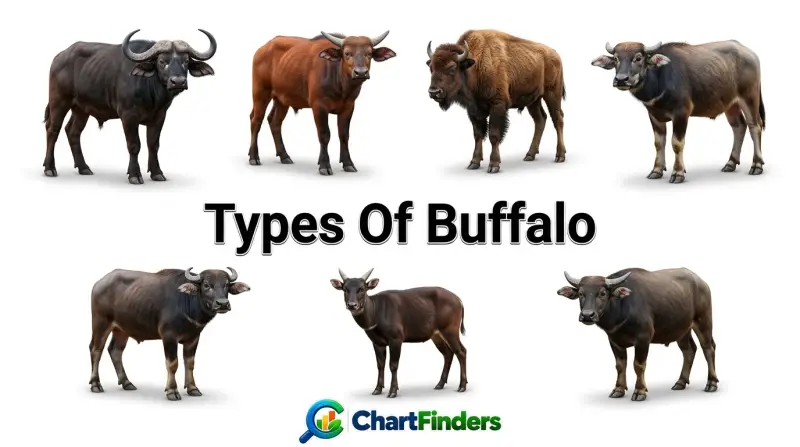
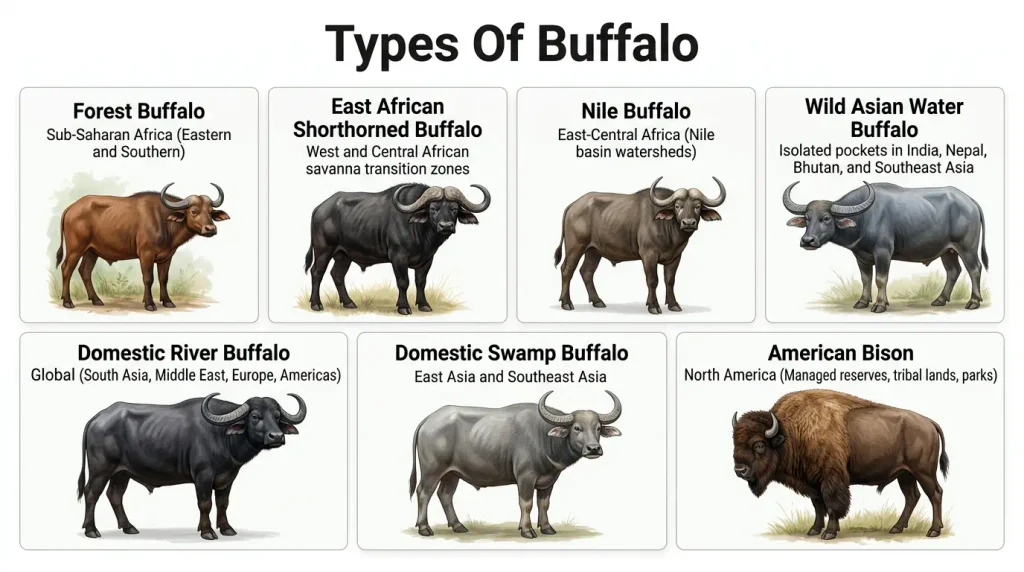
Types Of Buffalo – Buffalo Identification Chart
- Two True Species: Only the African buffalo and the Asian water buffalo belong to the biological tribe Bovini within the subfamily Bovinae as true buffalo.
- The American Bison Confusion: The North American bison is frequently called a buffalo, but it is a separate genus (Bison) native to North America and Europe, lacking the distinctive horns and evolutionary history of true buffalo.
- Subspecies Diversity: The African buffalo splits into distinct forms, notably the massive Cape buffalo of the savannas and the much smaller forest buffalo of Central African rainforests.
- Domestic vs. Wild Asian Buffalo: The wild Asian water buffalo is critically endangered, whereas millions of domestic river and swamp water buffalo inhabit agricultural landscapes worldwide.
- Conservation Realities: While domestic populations thrive, wild counterparts face severe threats from habitat loss, poaching, and genetic introgression through interbreeding with domestic stock.
To navigate the taxonomy of buffalo effectively, it is necessary to separate colloquial labels from rigorous biological classification. Below is an exhaustive breakdown of the genuine species, their recognized subspecies, and the major look-alikes that dominate global awareness.
| Common Name | Scientific Name | Primary Geographic Range | Key Identifying Feature | Conservation Status (IUCN) |
|---|---|---|---|---|
| Cape Buffalo | Syncerus caffer caffer | Sub-Saharan Africa (Eastern and Southern) | Massive fused horn bases (“bosses”), dark black coat, large size | Near Threatened |
| Forest Buffalo | Syncerus caffer nanus | Central and West African rainforests | Small stature, reddish-brown coat, slender backward-curving horns | Near Threatened |
| East African Shorthorned Buffalo | Syncerus caffer brachyceros | West and Central African savanna transition zones | Intermediate size, lighter horns compared to Cape variant | Near Threatened |
| Nile Buffalo | Syncerus caffer aequinoctialis | East-Central Africa (Nile basin watersheds) | Lighter coloration than Cape type, smaller body mass | Near Threatened |
| Wild Asian Water Buffalo | Bubalus arnee | Isolated pockets in India, Nepal, Bhutan, and Southeast Asia | Enormous crescent-shaped horns spanning up to 2 meters | Endangered |
| Domestic River Buffalo | Bubalus bubalis (River type) | Global (South Asia, Middle East, Europe, Americas) | Tightly curled, sickle-shaped horns, preference for clear water | Domesticated (Not Evaluated) |
| Domestic Swamp Buffalo | Bubalus bubalis (Swamp type) | East Asia and Southeast Asia | Wide-sweeping horizontal horns, wallowing habits in muddy swamps | Domesticated (Not Evaluated) |
| American Bison | Bison bison | North America (Managed reserves, tribal lands, parks) | Shaggy winter coat, prominent shoulder hump, short curved horns | Near Threatened (Wild populations) |
This comparative baseline establishes the fundamental divisions within the family Bovidae. Each group exhibits distinct behavioral ecologies, morphological specializations, and conservation statuses that warrant detailed examination.
The African Buffalo (Syncerus caffer)
The African buffalo, often referred to simply as the Cape buffalo, is widely recognized as one of the most formidable and unpredictable large mammals on the continent. Unlike its Asian counterpart, the African buffalo has never truly been domesticated. Its notoriously aggressive temperament, combined with unpredictable reactions when cornered or wounded, earned it a spot among Africa’s legendary “Big Five” game animals.
Taxonomists generally divide the African buffalo into several subspecies based on body size, horn morphology, and coat color, reflecting adaptation to vastly different ecosystems across sub-Saharan Africa.
1. Cape Buffalo (Syncerus caffer caffer)
The nominate subspecies and the largest of the African buffaloes, the Cape buffalo inhabits the southern and eastern savannas of Africa. Bulls can weigh up to 800 kilograms (1,760 lbs) and stand nearly 1.7 meters at the shoulder. Their most defining feature is the “boss”—a heavy, bone-like shield formed by the fusion of the horn bases across the forehead. This armor protects the skull from impacts during dominance clashes and makes mature bulls exceptionally difficult to bring down for predators like lions.
2. Forest Buffalo (Syncerus caffer nanus)
In stark contrast to its massive savanna cousin, the forest buffalo is a dwarf ecotype inhabiting the dense tropical rainforests of Central and West Africa. Standing less than 1.1 meters tall and weighing between 250 and 320 kilograms, the forest buffalo features a striking chestnut-red coat that darkens with age, particularly on the shoulders and head. Its horns are shorter, thinner, and sweep backward rather than curving down and up, allowing the animal to navigate dense undergrowth without getting entangled.
3. East African Shorthorned Buffalo (Syncerus caffer brachyceros)
Occupying the savanna-forest mosaic zones of West and Central Africa, the Shorthorned buffalo represents an intermediate morphological form. It is larger than the forest buffalo but smaller and lighter-colored than the Cape buffalo. Its horn structure displays characteristics of both extremes, reflecting its transitional geographic range.
4. Nile Buffalo (Syncerus caffer aequinoctialis)
Found primarily in the floodplains and grasslands of East-Central Africa, particularly around the Nile river basin, this subspecies resembles a smaller, lighter-colored variation of the Cape buffalo. They tend to form smaller herds and show high dependence on permanent water sources and marshy inundation zones.
The Asian Water Buffalo (Bubalus arnee)
The Asian water buffalo is the heavy-duty agricultural engine of the developing world, yet its wild ancestor remains one of the most endangered large mammals on Earth. Perfectly adapted to wetland habitats, river valleys, and tropical floodplains, the water buffalo possesses physical traits optimized for aquatic environments.
1. Wild Asian Water Buffalo (Bubalus arnee)
The wild water buffalo is massive—often exceeding the weight of the African Cape buffalo, with males reaching up to 1,200 kilograms. They boast the largest horns of any living animal, with a span that can stretch nearly two meters from tip to tip in a sweeping crescent shape. Today, pure wild populations are restricted to fragmented sanctuaries in Assam (India), Nepal, Bhutan, and parts of Southeast Asia. They face severe extinction risks due to habitat conversion, hunting, and genetic pollution from free-roaming domestic herds.
2. Domestic Water Buffalo (Bubalus bubalis)
Domesticated over 5,000 years ago in the Indus Valley and China, the domestic water buffalo numbers in the hundreds of millions. They are partitioned into two principal functional types:
- River Buffalo: Originating in South Asia and the Middle East (including breeds like the Murrah and Nili-Ravi), these animals prefer clean, running water and are primarily bred for high-volume milk production.
- Swamp Buffalo: Common throughout Southeast Asia and southern China, these stocky animals prefer muddy wallows and are traditionally utilized as draft animals for wet-rice cultivation, as well as for meat.
The American Bison (The Great Look-Alike)
No discussion of buffalo types is complete without addressing the American bison (Bison bison). In North America, the terms “buffalo” and “bison” are used interchangeably in colloquial speech, stemming from early European settlers who noted superficial similarities to the Old World beasts they knew.
Taxonomically, however, the American bison belongs to an entirely different genus within the tribe Bovini. Key anatomical differences separate bison from true buffalo:
- Humps and Heads: Bison possess a massive muscular shoulder hump and a heavy head carried low to the ground, adaptations designed for sweeping snow away during winters. True buffalo carry their heads higher and lack the pronounced shoulder hump.
- Coats: Bison grow a dense, shaggy winter coat that sheds in large patches during spring, whereas true buffalo have sparse, coarse hair covering dark skin.
- Horns: Bison horns are relatively short, sharp, and curved upward for goring predators, contrasting with the sweeping, helmet-like horns of African and Asian buffaloes.
Despite centuries of near-extinction driven by commercial slaughter in the 19th century, intensive conservation efforts—most notably by federal agencies, private ranchers, and indigenous nations such as the InterTribal Buffalo Council—have successfully restored over 3,000 bison to tribal lands, revitalizing both ecological integrity and cultural heritage.
Taxonomic Relationships And Evolutionary Divergence
To fully grasp why these animals differ so vastly in behavior, anatomy, and ecology, we must examine their evolutionary placement within the family Bovidae. True buffaloes belong to the subfamily Bovinae, which also includes cattle (Bos), yaks (Bos grunniens), and spiral-horned antelopes (Tragelaphini).
Within Bovinae, the tribe Bovini unites cattle, bison, and buffalo. However, genetic divergence occurred millions of years ago, resulting in profound chromosomal and physiological differences:
- African Buffalo (Syncerus): Possesses 52 chromosomes. It stands as an evolutionary outlier with no close living relatives among domestic cattle, having branched off early in the bovid lineage.
- Asian Water Buffalo (Bubalus): Possesses 48 to 50 chromosomes (depending on swamp or river variants). They are genetically distant from both cattle (Bos taurus) and African buffalo, meaning attempts to crossbreed water buffalo with domestic cattle invariably result in sterile offspring or embryonic failure.
- American Bison (Bison): Possesses 60 chromosomes—identical to domestic cattle. This genetic compatibility has allowed modern ranchers to create crossbreeds known as “beefalo,” further blurring the lines in agricultural settings.
| Taxon / Group | Scientific Genus | Chromosome Count (2n) | Domestication Status | Primary Native Region |
|---|---|---|---|---|
| African Buffalo | Syncerus | 52 | Wild (Never successfully domesticated) | Sub-Saharan Africa |
| Asian Water Buffalo | Bubalus | 48 – 50 | Both Wild and Domesticated | South & Southeast Asia |
| American Bison | Bison | 60 | Managed / Ranch-bred (Wild populations exist) | North America |
| Domestic Cattle | Bos | 60 | Fully Domesticated | Eurasia / Global |
Ecological Roles And Habitat Adaptations
Each buffalo type has sculpted its respective ecosystem through millennia of coevolution. Their physical presence alters landscapes in ways that benefit entire biological communities.
Savannah Engineering by African Buffalo
Cape buffalo herds act as quintessential ecosystem engineers in African savannas. As selective grazers, they consume tall, fibrous grasses that would otherwise crowd out shorter vegetation. This grazing behavior opens up the sward, allowing smaller antelopes and herbivores access to tender new shoots. , their heavy trampling creates micro-depressions that catch rainwater, aiding seed germination, while their nutrient-rich dung fertilizes depleted soils.
Wetland Management by Water Buffalo
Wild and feral water buffalo play a in wetland maintenance. By wallowing in mud holes and shallow marshes, they suppress invasive reed growth, create open water channels for fish and amphibians, and cycle nutrients trapped in aquatic sediments. Their heavy hooves break up compacted soil pans, enhancing hydrological connectivity across tropical floodplains.
Common Misconceptions And Identification Mistakes
Because vernacular naming conventions often override scientific accuracy, several persistent myths surround buffalo types. Recognizing these errors prevents confusion in conservation and ecological management.
- Mistake 1: Assuming American Bison are Buffalo. While the historical and cultural label “buffalo” is deeply entrenched in North American nomenclature, calling a bison a buffalo obscures its distinct evolutionary history and unique physiological adaptations to cold, snowy climates.
- Mistake 2: Believing African Buffalo Can Be Domesticated. Unlike the Asian water buffalo, attempts to domesticate the African buffalo have consistently failed throughout history. Their volatile temperament, acute spatial awareness, and resilience to stress make them unsuitable for intensive husbandry.
- Mistake 3: Treating Forest and Cape Buffalo as Separate Species. Morphologically, the tiny red forest buffalo looks nothing like the massive black Cape buffalo. However, genetic studies confirm they are subspecies of the same animal (Syncerus caffer), capable of interbreeding where their geographic ranges overlap in transitional ecotones.
Frequently Asked Questions
What is the difference between a true buffalo and a bison?
True buffaloes—the African buffalo and the Asian water buffalo—belong to the Old World tropics and feature prominent, sweeping horns without massive shoulder humps. The American bison is native to North America, possesses a distinct muscular shoulder hump, a heavy shaggy winter coat, and a different chromosomal count, though both belong to the broader bovid family.
Can African buffaloes be domesticated?
No. African buffaloes possess an unpredictable, highly aggressive temperament and have never been successfully domesticated. Their survival instincts and extreme defensive aggression make them dangerous to handle in captivity, separating them sharply from the docile domestic water buffalo.
Are water buffalo native to Australia?
No. Asian water buffalo were introduced to northern Australia in the 19th century as beasts of burden for early European settlements. When those settlements were abandoned, the buffalo escaped into the wild, establishing thriving feral populations across the tropical top end that now influence local wetland ecosystems.
Why do water buffalo love wallowing in mud?
Water buffalo possess relatively few sweat glands and have dark skin that absorbs intense solar radiation. Wallowing in mud and water provides vital thermoregulation by cooling their bodies. Additionally, the dried mud cake forms a protective physical barrier against biting insects, parasites, and harsh ultraviolet rays.
What is the conservation status of wild water buffalo?
The wild Asian water buffalo (Bubalus arnee) is classified as Endangered by the IUCN. Fewer than 4,000 mature individuals remain in scattered, fragmented populations across South and Southeast Asia. The primary threats include habitat loss due to agricultural expansion, hunting, and genetic dilution caused by interbreeding with free-ranging domestic water buffalo.
Conclusion
The term “buffalo” encompasses a fascinating spectrum of biological diversity. From the iron-willed, boss-horned lords of the African savanna and the swamp-loving heavyweights of Asian wetlands to the shaggy plains dwellers of North America mistakenly granted the name, these animals represent extraordinary adaptations to diverse environments. Recognizing the precise distinctions among types of buffalo enriches our understanding of wildlife taxonomy, informs modern conservation strategies, and ensures that these magnificent bovid lineages are accurately appreciated and protected for generations to come.